


Everyone tells you the Roth IRA is the best retirement account you can open, and then the moment you try to act on that advice the questions pile up. You cannot tell whether it actually beats a traditional IRA for your bracket, you suspect your income might be too high to even contribute, and you have no idea which dollars you could pull out tax-free if you needed them. So the account that is supposed to be simple ends up sitting on your to-do list for another year, and another year of tax-free compounding quietly slips away. When the IRS raised the 2026 limit to $7,500 last November, it handed you more room to fund a Roth IRA than ever, which only makes the cost of staying confused higher.
Here is how it works. I walk through exactly what makes a Roth IRA powerful, how the 2026 contribution and income limits apply to you, and when a Roth beats a traditional IRA for your situation. You will also see how high earners use the backdoor route to get in, and which withdrawals come out genuinely tax-free.
1. What a Roth IRA Actually Is (and Why It Is So Powerful)
Before any dollar amount or income limit means anything, you need the big picture. So let’s start where the confusion usually starts, with what a Roth IRA actually is and why so many people who are good with money treat it as the first dollar of retirement saving they want to lock in.
1.1 The one-sentence definition: after-tax in, tax-free out
A Roth IRA is an individual retirement account (IRA) created under Internal Revenue Code Section 408A, established by the Taxpayer Relief Act of 1997 and effective in 1998. The mechanics fit in one line: you fund it with money you have already paid income tax on, and qualified distributions, both your original contributions and every dollar of growth, come out free of federal income tax.
That word “after-tax” is doing real work. Roth contributions are never deductible, so you get no break on this year’s tax bill, and that is the part that trips people up. You hand the IRS its cut today, and in exchange you never hand it another cut on that money again.
Think of it as the mirror image of a traditional IRA, where you deduct the contribution now and pay ordinary income tax on every dollar you withdraw later. Stated plainly, the Roth bet is to pay a known tax bill today to wipe out an unknown one in retirement.
| Feature | Roth IRA | Traditional IRA |
|---|---|---|
| Contribution tax treatment | After-tax (never deductible) | Often deductible now |
| Growth | Tax-free | Tax-deferred |
| Qualified withdrawals | Tax-free | Taxed as ordinary income |
| Lifetime RMDs (original owner) | None | Yes, starting at age 73 |
Rules current as of the 2026 tax year.
The two accounts share almost everything else, so the real question is which side of that tax timing bet fits you. We get there in section 3, but first, why is the tax-free side worth so much over a working life?
1.2 Why tax-free compounding beats a tax-deferred account over decades
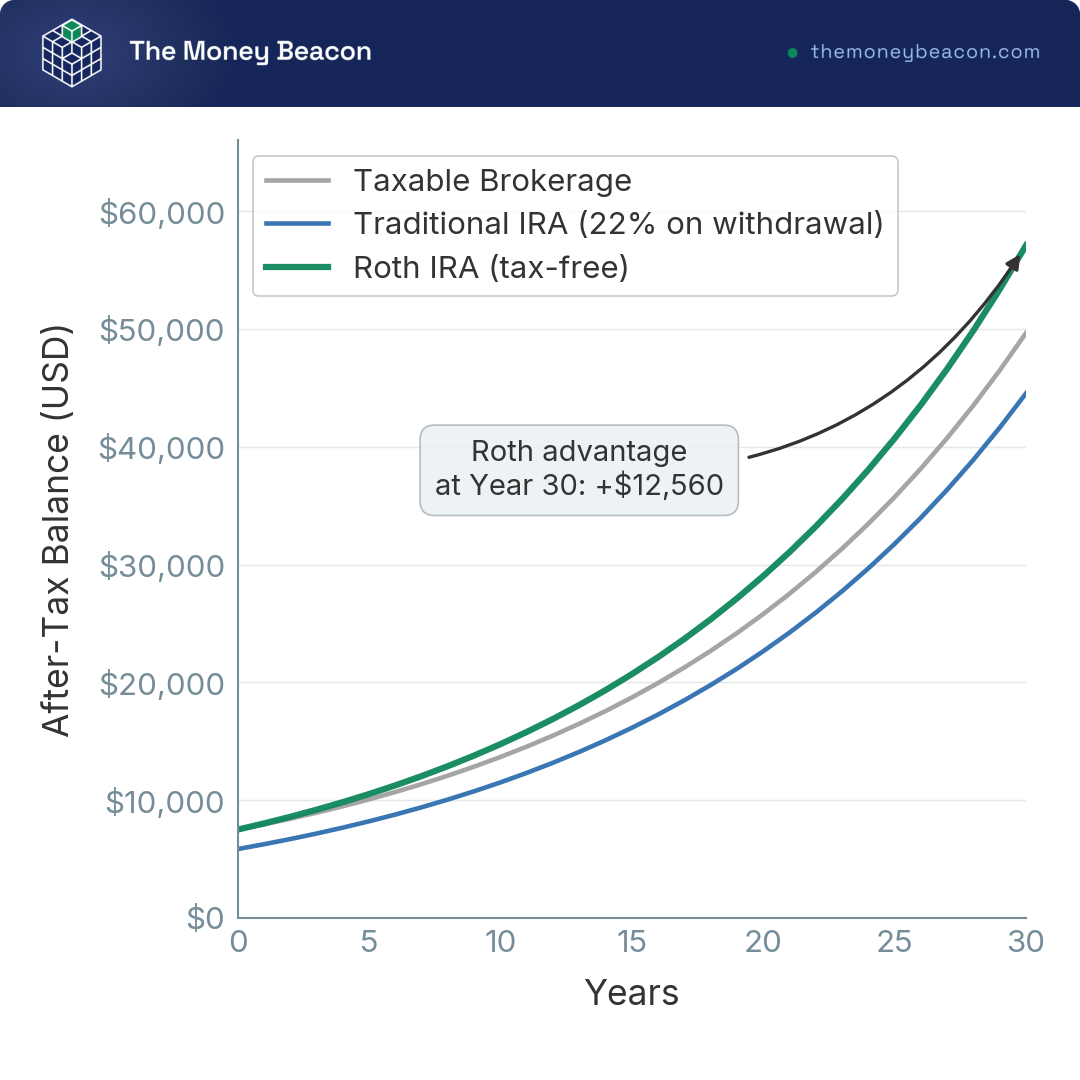
The power here is not magic, it is simply the absence of a future tax drag on a balance that has grown large. Take a single $7,500 contribution and let it grow at 7% nominal for 30 years.
It reaches roughly $57,300 before any tax. In a Roth IRA, the full $57,300 is yours, tax-free, as long as the distribution is qualified, and nothing is skimmed on the way out.
Now run the same dollars through a regular taxable brokerage account instead. The roughly $49,800 of gain faces long-term capital-gains tax of 0%, 15%, or 20% depending on your taxable income, so a 15%-bracket investor keeps about $42,300 of that gain after tax, plus the original contribution back. That is real money the Roth structure simply hands you.
There is one subtlety worth keeping in mind if you are a high earner: the net investment income tax adds 3.8% on top of the long-term capital-gains rate, not in place of it, which pushes the top combined federal rate on those gains to 23.8% once your MAGI clears $200,000 single or $250,000 married filing jointly. That drag hits the taxable comparison every year a gain is realized, yet it never touches growth inside the Roth IRA. Getting a handle on short and long-term capital-gains tax is exactly what makes the Roth wrapper look so good by contrast.
The reason the Roth advantage compounds rather than just adding up is that no tax is ever taken out of the growth along the way, so the entire balance keeps working for the full 30 years instead of a post-tax fraction of it.
1.3 Who can open one and what counts as earned income
The dollar case is clear, so the next thing to settle is whether you are even allowed to fund one. The gate is earned income, meaning taxable compensation: wages, salary, tips, self-employment net earnings, and commissions all qualify.
What does not count is where people get caught off guard. Investment income, rental income, Social Security, and pension income are not earned income, and your contribution can never exceed your earned income for the year. So a retiree living on dividends and Social Security has plenty of money but no room to contribute, while a teenager with a summer job does.
A non-working spouse is the useful exception here. Through a spousal Roth IRA, you can fund an account for a spouse with no paycheck on the working spouse’s income, provided you file jointly, which lets a household put away up to $15,000 combined in 2026 across two accounts, or $17,200 if both of you are 50 or older, as long as joint compensation covers it.
Age is no longer a barrier either. The SECURE Act of 2019 removed the old upper age cap, so a 70-year-old with a part-time job can still contribute every year they keep working.
| Counts as earned income | Does NOT count |
|---|---|
| W-2 wages, salary, tips | Interest, dividends, capital gains |
| Self-employment net earnings | Rental income |
| Commissions, bonuses | Social Security, pensions |
| Taxable alimony (pre-2019 decrees) | Unemployment compensation |
If your income lands in the left column, you have the raw eligibility to contribute. Whether you can do it directly, and for how much, depends on a second income test we get to in section 2.
1.4 The Roth IRA is an account, not an investment: where it sits among the buckets
Here is a distinction that quietly causes a lot of bad decisions: a Roth IRA is one container among several, not an investment in itself and not the only place your retirement money should go. The account is the tax wrapper; stocks, bonds, exchange-traded funds (ETFs), index funds, and target-date funds are the asset classes you hold inside it. You do not buy “a Roth IRA” the way you buy a fund, you open the wrapper and then choose what goes in.
Once you see where it sits next to the other wrappers, you can sequence them properly. Each one has its own limit, its own tax treatment on the way in and out, and its own rules on forced withdrawals.
| Account | 2026 limit (under 50) | Tax on contributions | Tax on qualified withdrawals | Lifetime RMDs? |
|---|---|---|---|---|
| Roth IRA | $7,500 | After-tax | Tax-free | No |
| Traditional IRA | $7,500 | Often deductible | Ordinary income | Yes (age 73) |
| Roth 401(k) | $24,500 | After-tax | Tax-free | No (since 2024) |
| Traditional 401(k) | $24,500 | Pre-tax | Ordinary income | Yes (age 73) |
| HSA (self-only) | $4,400 | Pre-tax | Tax-free (medical) | No |
| Taxable brokerage | None | After-tax | LTCG / ordinary | No |
Limits current for the 2026 tax year.
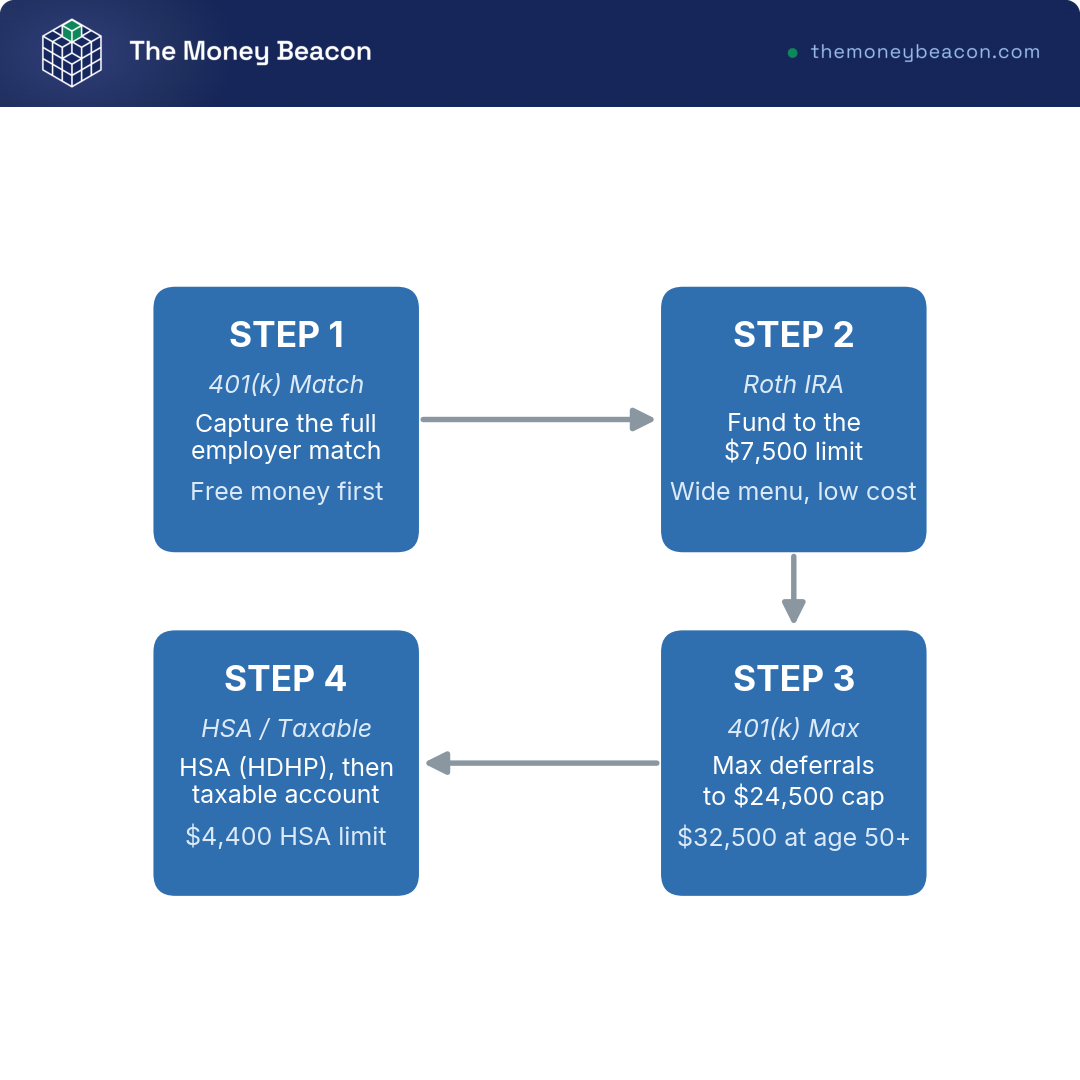
For most savers, a sensible order of operations falls right out of that table. Capture the full 401(k) employer match first, because that is free money no other account can match, then fund the Roth IRA up to the limit, then circle back to the 401(k) for more, and optionally use an HSA as a stealth retirement account if you are eligible. How much you need over a working life, and which buckets carry the load, is the larger project we lay out in our guide to how much you need to retire and where to save it.
1.5 Your next retirement dollar: a quick priority map
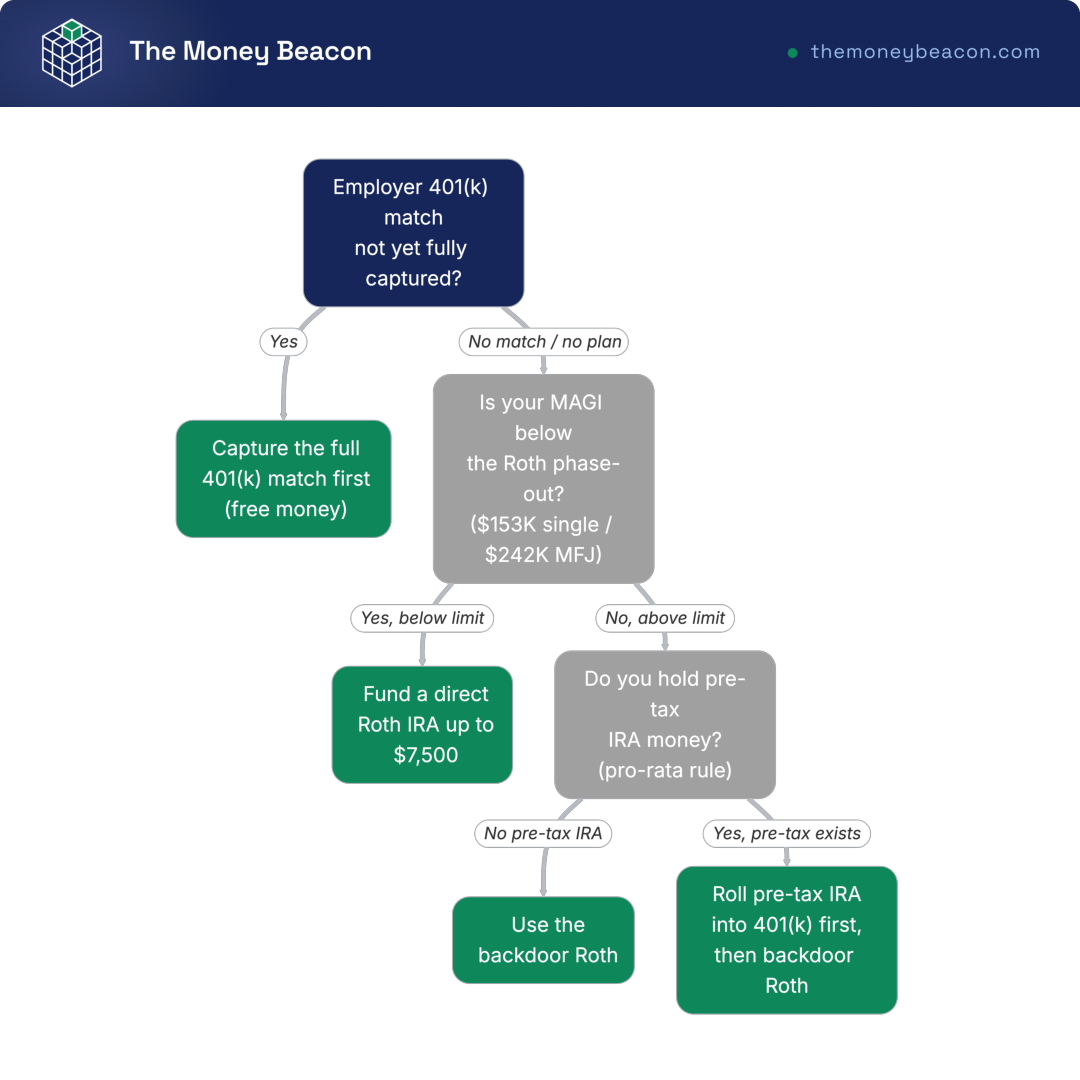
So you have a free $100, or $1,000, or $7,500 this month. Where should it actually go? The path is short. Take the 401(k) match first, then contribute directly to a Roth IRA if your income sits below the phase-out, and if it sits above, route the money through the backdoor Roth instead, rolling any pre-tax IRA into a 401(k) first so the conversion stays clean.
Those last two branches lean on rules we have not unpacked yet, the income phase-out in section 2 and the backdoor in section 5, so treat this as a map of the route, not the turn-by-turn directions. The point for now is simply that one decision, your income relative to the limit, sends your next dollar down one of two roads, and the tree below shows which.
2. 2026 Contribution Limits and Income Limits
You know what a Roth IRA is and why it earns the first slot after the match. The practical questions come next, and they are the two that decide everything else: how much can you put in this year, and does your income let you contribute directly at all?
2.1 The 2026 annual limit, the catch-up, and the MAGI phase-out ranges
For 2026, the IRA contribution limit is $7,500, up from $7,000 in 2025, and savers age 50 and older add a catch-up of $1,100 for $8,600 total. The IRS published these figures on November 13, 2025, so they are locked for the year.
One detail saves people from an expensive mistake. This is a combined cap across all your traditional and Roth IRAs, not a limit per account. You can split it, say $4,000 to a Roth and $3,500 to a traditional, but the two together cannot exceed the annual number.
Direct Roth contributions then run into a second test, your modified adjusted gross income, and above a certain point the IRS starts reducing what you can put in. The reduction happens across a band, not a cliff, which matters because a dollar of extra income does not wipe out your whole contribution, it just trims it.
| Filing status | Full contribution if MAGI below | Phase-out band | No direct contribution if MAGI at or above |
|---|---|---|---|
| Single / Head of household | $153,000 | $153,000 to $168,000 | $168,000 |
| Married filing jointly | $242,000 | $242,000 to $252,000 | $252,000 |
| Married filing separately (lived with spouse) | $0 | $0 to $10,000 | $10,000 |
2026 MAGI phase-out ranges.
The married-filing-separately row is unusually harsh. If you lived with your spouse at any point during the year, the band runs from $0 to $10,000, so you effectively lose direct Roth access almost immediately. The one escape is that an MFS filer who lived apart from their spouse for the entire year is treated as single for this test.
2.2 Can you contribute directly in 2026? An eligibility map
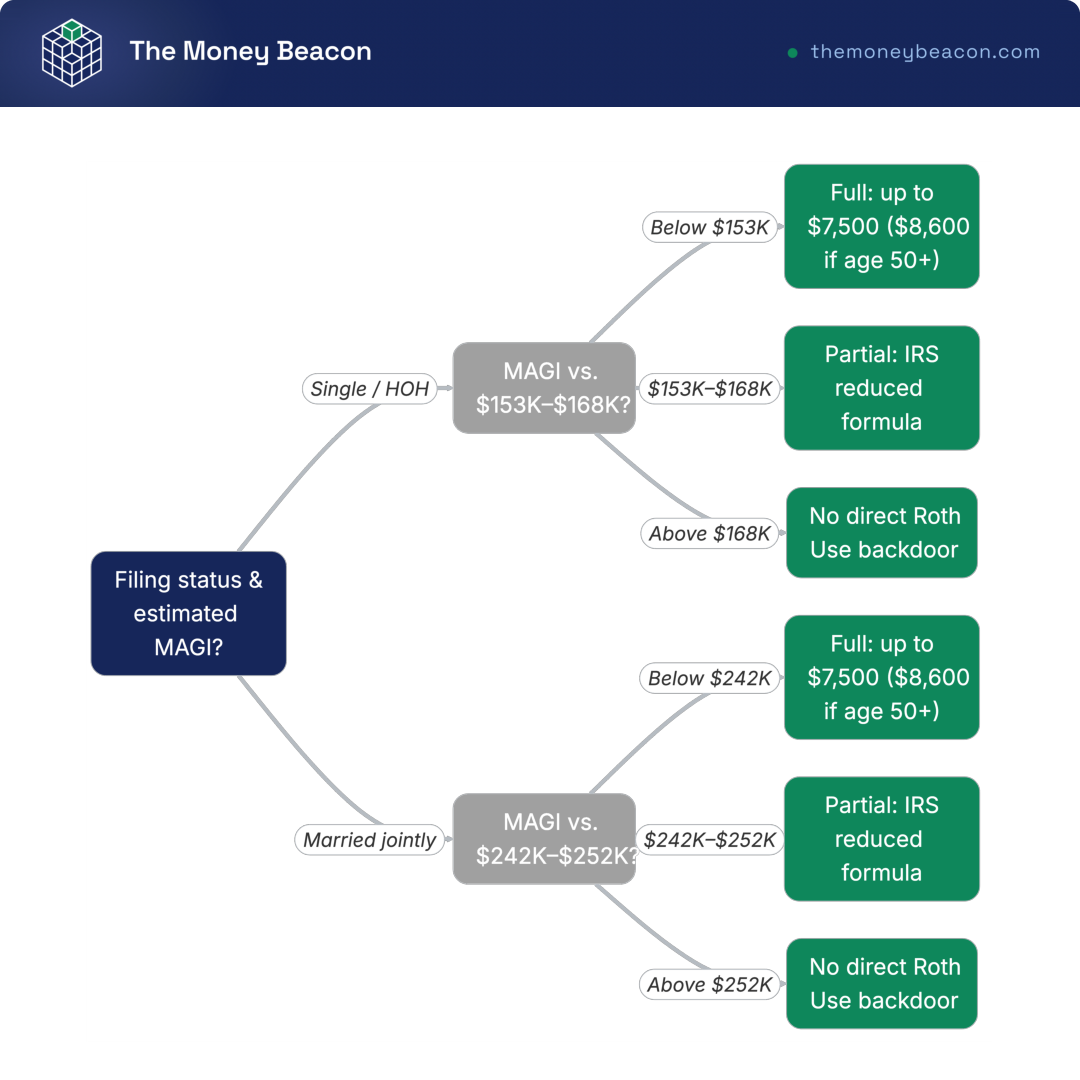
So where do you personally land? Two inputs decide it, your filing status and your estimated MAGI, and together they route you to one of three outcomes: a full contribution, a partial one you have to compute, or none at all.
If you land in “none,” that is not the end of the story. Above the top of the band the backdoor Roth stays open regardless of how much you earn, which is the workaround we walk through step by step in section 5. The tree below shows the branches; the arithmetic for the partial case is the subject of the next subsection.
2.3 What MAGI is, and how to calculate a reduced contribution
Modified adjusted gross income sounds like jargon, but for most people it sits close to their adjusted gross income. You start from AGI and add back a handful of items: the traditional IRA deduction, the student-loan interest deduction, the foreign earned income exclusion, and a few less common ones. For Roth eligibility specifically, you subtract any income from a Roth conversion in the year, so a conversion does not push you over your own contribution limit.
Here is the surprise that catches people every spring. A year-end bonus, a large capital gain, or a batch of vesting RSUs can lift your MAGI above the phase-out after you have already contributed, retroactively making an early-year contribution excessive. The fix exists, recharacterization or removal, but it is paperwork you would rather avoid, so if your income is anywhere near the band, estimate your MAGI before you contribute, not after.
When you do land inside the band, the IRS reduces your limit proportionally, and the method runs in four steps:
- Subtract the lower end of your band from your MAGI.
- Divide by the band width ($15,000 for single, $10,000 for MFJ).
- Multiply by the contribution limit.
- Subtract that result from the limit, round up to the nearest $10, with a $200 minimum if the result is positive.
Walk it through for a single filer, age 40, with a MAGI of $160,500. Start with $160,500 minus $153,000, which is $7,500 into the band. Divide by the $15,000 band width to get 0.50, multiply by the $7,500 limit to get $3,750, then subtract that from $7,500. The result is a $3,750 maximum Roth contribution, exactly half, which is what “band, not a cliff” means in dollars. If reducing your MAGI to stay lower in the band interests you, the broader playbook lives in our guide on how to lower your taxable income.
2.4 Deadlines, excess contributions, and the 6% excise tax
The clock is friendlier than most tax deadlines. You have until the tax-filing deadline of the following year, April 15, 2027 for the 2026 tax year, to make a 2026 contribution, which gives you over fifteen months to fund the account.
One mechanical trap lives in the funding screen itself. Between January 1 and the April deadline, brokerages default to the current calendar year, so you have to select the correct contribution year by hand or you will accidentally fund 2027 when you meant 2026.
Putting in more than allowed, or contributing with no earned income behind it, creates an excess contribution, and the penalty is not a one-time slap. It is a 6% excise tax for every year the excess sits in the account, which compounds quietly until you fix it. The cure is to remove the excess plus its attributable earnings, or recharacterize it, before the deadline.
| Step | To do | To avoid | Common mistake |
|---|---|---|---|
| Funding | Select the correct tax year | Letting the broker default to the wrong year | Funding “2027” in March when you meant 2026 |
| Eligibility | Estimate MAGI before contributing | Contributing early then exceeding the limit | Year-end bonus pushes MAGI over the cap |
| Excess | Remove or recharacterize before the deadline | Ignoring it and hoping | Paying the 6% excise tax annually |
The mechanics of getting money in are settled by now. The harder call is which IRA it should go into in the first place.
3. Roth IRA vs. Traditional IRA: Taxed Now or Taxed Later
You now know what a Roth IRA is and how much room you have. The decision that is left is the one this whole comparison turns on: should your money go into a Roth or a traditional IRA, and how do you decide for your own situation rather than someone else’s?
3.1 The fundamental tradeoff and a decision framework
Both accounts share the same $7,500 limit in 2026 and the same investment menu, so the single thing that separates them is when you pay tax. A traditional IRA lets you deduct the contribution now, if you are eligible, and taxes every withdrawal later as ordinary income. A Roth IRA gives you no deduction now and no tax on qualified withdrawals later.
The honest answer to “which is better” starts with a wrinkle most pitches skip: if your tax rate were identical today and in retirement, the two produce the exact same after-tax result, a mathematical wash. So the whole decision turns on which rate is higher, today’s marginal rate or the rate you expect when you withdraw.
| Your situation | Lean Roth | Lean Traditional |
|---|---|---|
| Early career, lower bracket now | Yes | No |
| Expect higher income later | Yes | No |
| Peak earning years, high bracket now | Sometimes | Often |
| Want tax-free income to manage Medicare/Social Security taxation later | Yes | No |
| Need the deduction to lower this year’s tax bill | No | Yes |
| Want to leave tax-free money to heirs | Yes | No |
That table sorts into three clean rules. If your current marginal rate is at or below the rate you expect in retirement, the Roth wins. If you are in a high bracket today and genuinely expect a lower one later, the traditional deduction often wins. And if you are honestly unsure, splitting your contribution across both buys tax diversification and hedges a future you cannot forecast. The same match-first logic applies to your workplace 401(k), where the Roth-or-traditional choice shows up again on the deferral side.
3.2 Putting the decision on one picture: rate, deduction, and RMDs
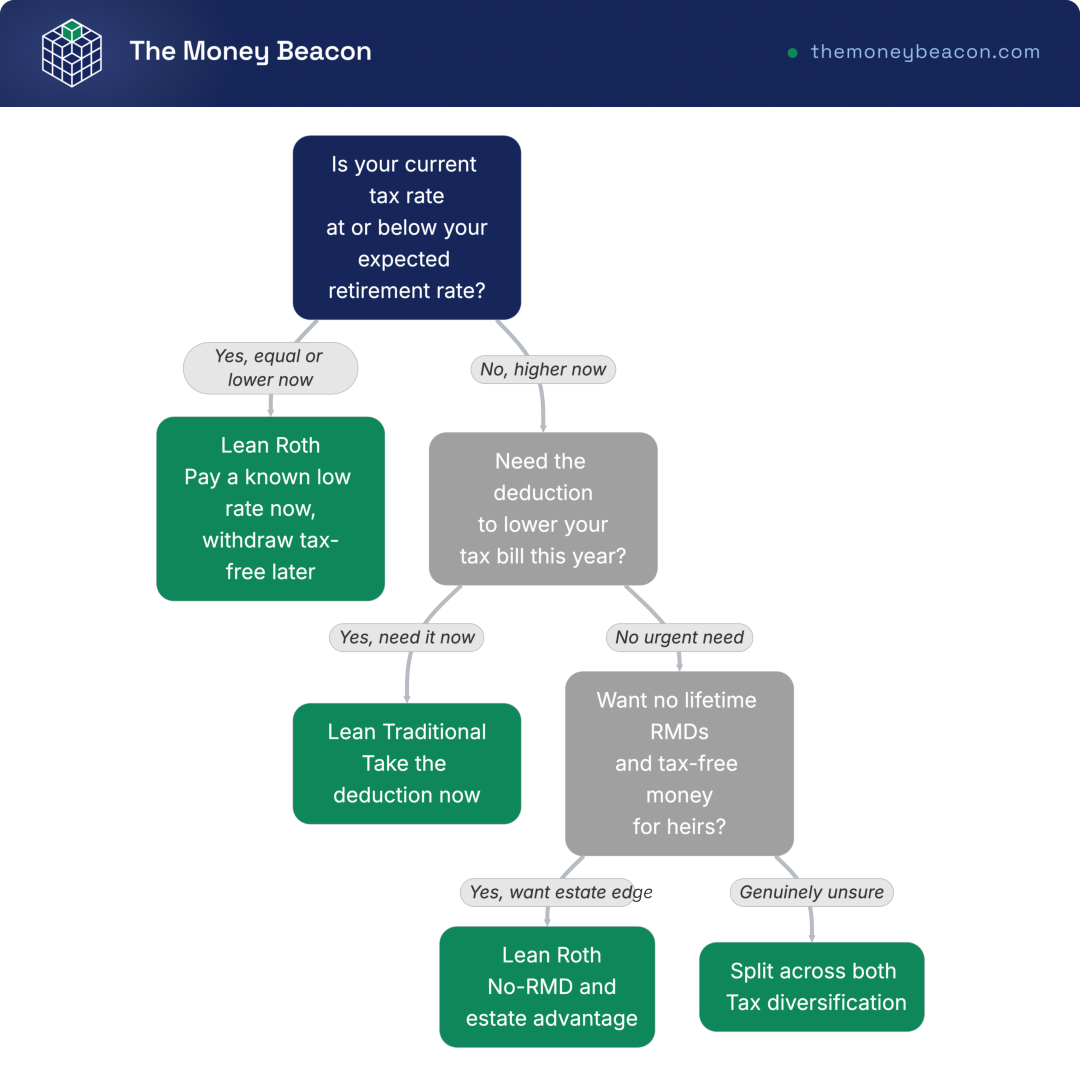
This decision is easier to follow as a picture than as a list of rules. The tree below walks the same logic in order: your tax rate now versus later, then whether you need a deduction this year, then whether avoiding required minimum distributions and leaving tax-free money to heirs matters to you, landing on Roth, traditional, or a split.
It is the framework table from the previous subsection turned into a path you can trace with your finger.
3.3 Traditional deduction limits, RMDs, and the estate difference
There is an asymmetry between the two accounts that catches people who assume the rules mirror each other. A Roth contribution’s eligibility depends on income alone. A traditional IRA’s deductibility depends on income and on whether you or your spouse are covered by a workplace plan. If neither of you is covered, the deduction is unlimited by income. If you are covered, it phases out across these bands.
| Filing status / coverage | 2026 deduction phase-out band |
|---|---|
| Single, covered by a workplace plan | $81,000 to $91,000 |
| MFJ, contributor covered | $129,000 to $149,000 |
| MFJ, spouse covered (you are not) | $242,000 to $252,000 |
| MFS, covered, lived with spouse | $0 to $10,000 |
2026 traditional IRA deduction phase-outs.
Above the band, a covered worker can still put money into a traditional IRA but gets no deduction at all, and that is not a dead end. It is precisely the nondeductible contribution that sets up the backdoor Roth, the maneuver we open up in section 5, so keep the term in mind for now.
The other quiet difference shows up decades later. A traditional IRA forces required minimum distributions starting at age 73, rising to 75 in 2033 under SECURE 2.0, taxed as ordinary income whether you need the money or not. A Roth IRA has no lifetime RMDs for the original owner, so the balance keeps compounding tax-free for as long as you live. Miss an RMD and the penalty is a 25% excise tax, cut to 10% if you correct it within the two-year window. The full no-RMD story comes back in section 6; here it is just one more reason the Roth side often wins the long game.
Hank’s take

the part most savers underestimate is policy risk over a 30-year horizon. Today’s brackets are historically low by the standards of the last century, and when you follow how tax law moves over decades, paying a known rate now on a Roth contribution starts to look less like a cost and more like locking in a price before it can rise.
4. Roth IRA vs. Roth 401(k): Two Different Roth Wrappers
By now the Roth-versus-traditional question is settled: you know the choice turns on whether your tax rate is higher today or in retirement, that a Roth IRA carries no lifetime RMDs, and that a high earner who gets no traditional deduction is staring at exactly the nondeductible contribution that sets up the backdoor. But there is a second Roth account most people first meet at work, and it makes the same tax-free promise. So if your employer also offers a Roth 401(k), is it the same thing as your Roth IRA, and how do the two fit together?
4.1 Limits, income eligibility, and the investment-menu tradeoff
Both wrappers hand you tax-free qualified withdrawals, so on the surface they look interchangeable. They are not. The contribution ceilings, the income rules, and the menu of what you can actually buy inside each one pull in different directions.
| Feature | Roth IRA | Roth 401(k) |
|---|---|---|
| 2026 employee limit | $7,500 ($8,600 at 50+) | $24,500 ($32,500 at 50+) |
| Income limit to contribute | Yes (MAGI phase-out) | None |
| Investment menu | Entire market | Employer’s plan menu |
| Employer match | Not applicable | Yes (now can be Roth) |
| Lifetime RMDs | None | None (since 2024) |
2026 figures.
The line that should jump out at you is the income one. The Roth 401(k) has no income limit at all, which is a direct answer to the MAGI phase-out that locked some readers out two sections ago. A high earner shut out of a direct Roth IRA can still pour up to $24,500 of after-tax dollars into a Roth 401(k), within a total defined-contribution additions limit of $72,000.
The catch is what you can buy once you are inside. A Roth IRA at Fidelity, Schwab, or Vanguard lets you buy nearly any stock, ETF, index fund, or target-date fund, often at 0.00% to 0.10% expense ratios. Fidelity, for instance, runs several zero-expense-ratio index funds and a cluster more in the 0.015% to 0.035% range. A Roth 401(k), by contrast, fences you into the plan’s menu, which may carry pricier funds plus an administrative or recordkeeping fee layered on top. That gap is the whole reason many savers max the freedom of the IRA for the dollars they fully control, and lean on the 401(k) mainly to grab the match. Want to see how the lowest-cost custodian stacks up? Our breakdown of opening a Roth IRA at Fidelity walks through the fund lineup.
4.2 The employer match, how it is taxed, and the order to fill both buckets
A Roth IRA has no employer behind it, so it can never hand you the one thing a 401(k) can: a match. That match is the closest thing to free money anywhere in personal finance, and it reorders the priorities.
For decades the match always landed in the pre-tax bucket no matter how you deferred. Under SECURE 2.0, employers now may offer the match as a Roth contribution, but they are not required to (IRS Notice 2024-02 confirmed it stays optional), so check your own plan rather than assume. The typical match formula is 50% of the first 6% of pay you defer, which roughly half of plans use, per Vanguard’s How America Saves 2025. Defer 6% of a $100,000 salary and the employer adds $3,000 you did nothing to earn beyond showing up.
One SECURE 2.0 wrinkle bites high earners in 2026. If your prior-year FICA wages topped $150,000 (indexed from a $145,000 statutory base), your catch-up contributions must now be made as Roth, not pre-tax. That is the high-earner Roth catch-up mandate, and it quietly removes the pre-tax catch-up option from the people who were most likely to want it.
So in what order do you actually fill these buckets? Four steps, with a dollar gate at each one:
- Fund the 401(k) up to the full employer match, because leaving it on the table is leaving free money behind.
- Move to the Roth IRA up to $7,500 ($8,600 at 50+), for the wider menu and lower fees.
- Circle back to the 401(k) and push toward the $24,500 cap.
- Still saving? Consider an HSA (self-only limit $4,400 in 2026), then a taxable brokerage.
That sequence is the backbone of where each dollar goes, and it folds straight into the larger question of how the accounts stack up over a career, which we map out in our guide to building a workable retirement plan.
5. The Backdoor and Mega Backdoor Roth for High Earners
The wrapper question is sorted and the funding order is set, but one group is still standing outside the Roth IRA looking in: anyone whose MAGI clears the top of the phase-out. If that is you, the direct door is shut, yet Roth money is still very much within reach. So how do you legally get it in, and what is the single trap that can turn the maneuver into a surprise tax bill?
5.1 How the backdoor Roth works, step by step
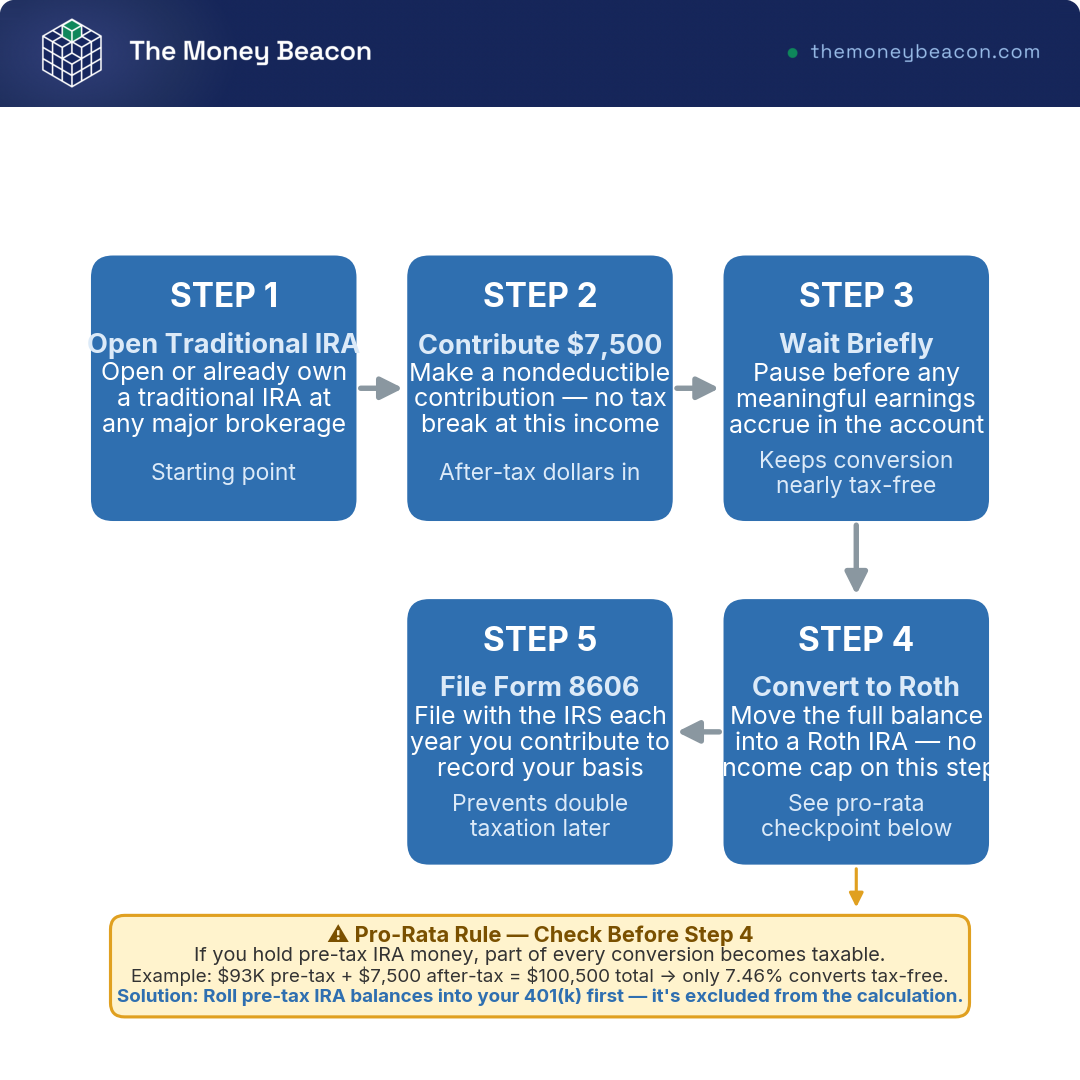
The backdoor Roth is a legal two-step maneuver, and it works because of a quirk in the rules: there is an income cap on direct contributions, but no income cap on conversions. You walk in through the conversion door instead of the front one.
Step one, you contribute up to $7,500 to a traditional IRA as a nondeductible contribution. You get no deduction, but that is fine, because your income was too high to deduct it anyway. Step two, you convert that traditional IRA to a Roth IRA, ideally soon after, before it has a chance to throw off meaningful earnings.
If the traditional IRA held only your after-tax contribution plus a few dollars of interest, the conversion is essentially tax-free, and you land $7,500 of fresh Roth money you were otherwise barred from. The whole thing takes a couple of clicks at most brokerages once you know the order, which the flowchart lays out box by box.
5.2 The pro-rata rule trap that can make it taxable
Here is the part that catches people who skip the fine print. The backdoor looks clean only if you have no other pre-tax IRA money sitting around, because of the pro-rata rule.
Under the pro-rata, or aggregation, rule in IRC Section 408(d)(2), the IRS treats all your traditional, SEP, and SIMPLE IRAs as one combined pool when it works out the tax on a conversion. It does not let you cherry-pick the after-tax dollars and convert only those. The taxable share gets calculated across the whole pool, so if you have pre-tax IRA money sitting anywhere, a chunk of your conversion is taxable even though the new contribution was after-tax.
Run the numbers and the trap is obvious. Say you have a $93,000 pre-tax rollover IRA and you add your $7,500 nondeductible contribution, for $100,500 in total IRA assets. Your after-tax dollars are just 7.46% of that pool. Convert $7,500 and the IRS treats only about $560 of it (the same 7.46%) as nontaxable, while the remaining $6,940 is taxable at your ordinary income rate. The move you made to avoid a tax bill just created one.
The fix is mechanical, and you do it before you convert: roll the pre-tax IRA money into your current 401(k), assuming the plan accepts roll-ins. A 401(k) is not an IRA, so it sits outside the pro-rata calculation entirely, which leaves only your clean after-tax contribution in the IRA pool to convert.
Tom’s take
I’ve run the four-dimension optimization on every account I hold, financial, tax, legal, and estate, and the pro-rata rule is exactly the kind of detail that quietly costs people thousands. The order of operations is the whole game here. Empty the pre-tax IRA into the 401(k) first, then convert; do it in the wrong sequence and you hand the IRS a bill you never had to pay.
5.3 Form 8606 and reporting the conversion correctly
A clean conversion still goes wrong if you skip the paperwork, and the paperwork is one form. Every nondeductible contribution and every conversion gets reported on Form 8606, which is what establishes your basis, the after-tax dollars you already paid tax on, so the IRS does not tax them a second time.
Forgetting it is the single most common backdoor error. Without Form 8606, the IRS has no record that you ever made an after-tax contribution, so it assumes the entire conversion is pre-tax and fully taxable, which means you pay tax on dollars you already paid tax on once. The rule of thumb is simple: file Form 8606 in the same year as any conversion, every year you do one.
| Step | To do | To avoid | Common mistake |
|---|---|---|---|
| Contribute | Mark it nondeductible | Deducting it | Double-counting basis |
| Pre-tax IRAs | Roll into 401(k) first | Converting with pre-tax IRAs open | Triggering pro-rata tax |
| Convert | Convert promptly | Letting earnings accrue | Small taxable earnings |
| Report | File Form 8606 each year | Forgetting it | Paying tax twice |
Get those four rows right and the backdoor turns into a routine annual move rather than a tax headache.
5.4 The mega backdoor Roth, including the self-employed route
If the standard backdoor moves $7,500 a year, the mega backdoor moves far more, sometimes tens of thousands. It is the ceiling of what a high earner can push into Roth, but it comes with a real gate: your 401(k) plan has to allow it, and most do not.
Two plan features are both required. The plan must permit after-tax (non-Roth) contributions, and it must offer either in-plan Roth conversions or in-service withdrawals and rollovers. Miss either one and the strategy is simply off the table for you, so the first step is always to read your plan documents or call the administrator.
Where the plan cooperates, the mechanics are straightforward. You contribute after-tax dollars above the $24,500 elective deferral limit, up to the total $72,000 additions cap (minus your own deferrals and any employer match), then convert those after-tax dollars to Roth. That can route well into five figures of extra Roth money in a single year, dwarfing the IRA backdoor’s $7,500.
The self-employed have their own version. A Solo 401(k) can be set up to permit both Roth and after-tax contributions, which opens the mega backdoor to a one-person business, whereas a SEP IRA does not offer Roth contributions at all, so it cannot run this play. And if you are self-employed, your earned income for all of this is your self-employment net earnings rather than W-2 wages, which is the figure your contribution limits get measured against. With the funding routes settled, direct, backdoor, or mega backdoor, the question shifts to what you can take back out.
6. Withdrawal Rules: What Comes Out Tax-Free and When
You have money in the account now, in through the front door, the backdoor, or the mega backdoor. So which of those dollars can you actually pull back out, and when does the IRS get a say?
6.1 Contributions vs. earnings, the two 5-year clocks, and age 59 1/2
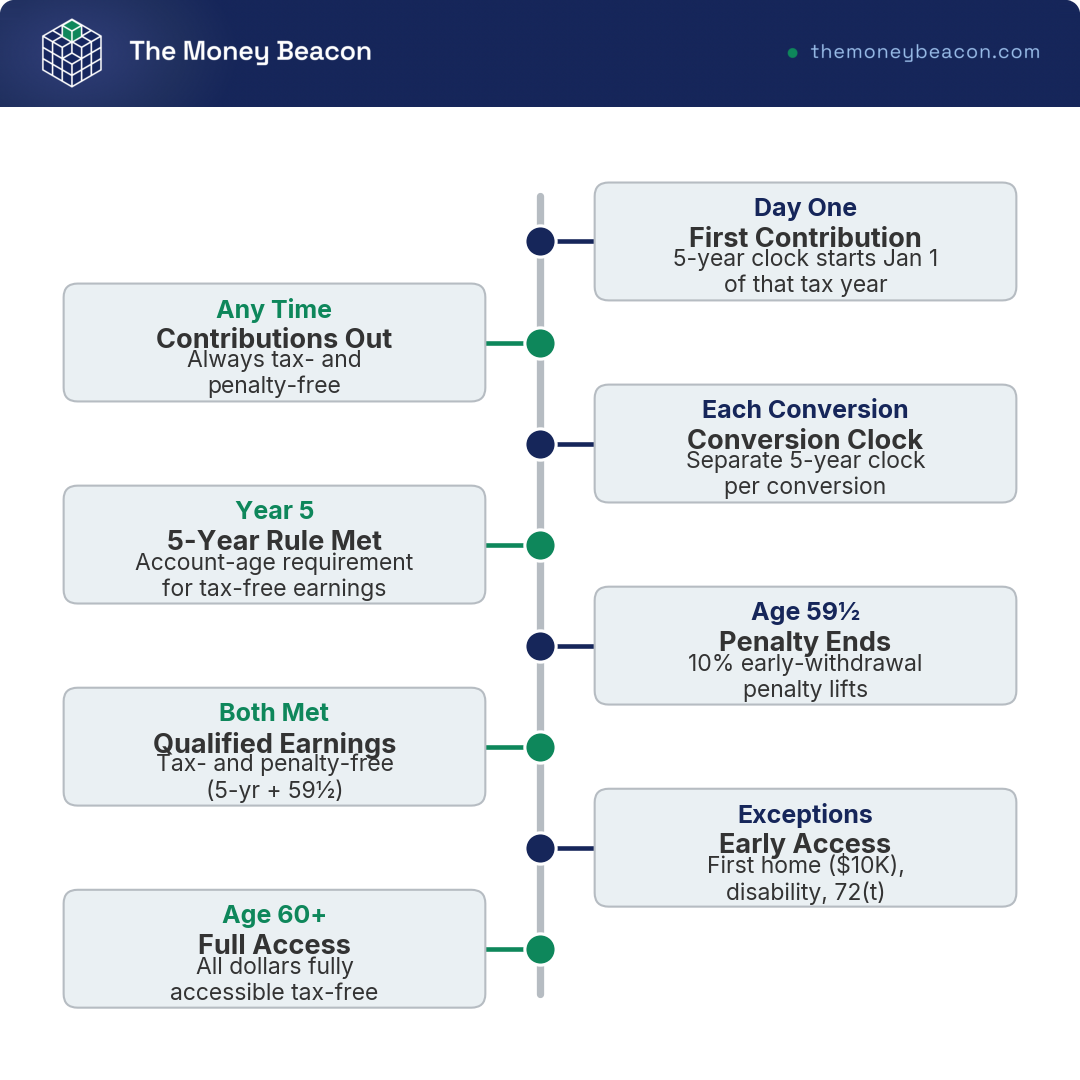
Start with the rule that should put you at ease. Your own contributions can come out at any time, at any age, free of tax and penalty, because you already paid income tax on them on the way in. The IRS has no second claim on money it already taxed. Put $7,500 in this year and you can take that $7,500 back next month if life demands it: no forms, no penalty, no waiting.
That works because Roth distributions follow a fixed ordering rule: contributions come out first, then any converted amounts, then earnings last. You only reach the restricted layer, the earnings, after you have withdrawn every dollar you ever put in. So for a saver with a short horizon to a known expense, the contributions (never the earnings) are the dollars you can safely tap. The catch is that the space you empty is gone for good; a Roth IRA gives you a fixed amount of tax-free room each year, and a dollar you pull out is a dollar of tax-free compounding you can never buy back.
Earnings are the layer with conditions. They come out tax- and penalty-free only when the distribution is qualified, which means two boxes are checked at once: the account has been open at least five years, and you are at least age 59 1/2 (or you meet one of the exceptions covered below). The five-year clock starts on January 1 of the tax year of your first contribution, so a contribution made in April 2026 for the 2026 tax year starts the clock retroactively on January 1, 2026.
Here is the subtlety that even careful savers often miss: there are two distinct five-year clocks, and they answer different questions. The contribution clock is one per person, set by your first-ever Roth contribution, and it governs whether your earnings come out tax-free. The conversion clock runs separately for each conversion you make, and it governs whether converted principal can be withdrawn penalty-free before you turn 59 1/2. Mix them up and you can think you are clear when you are not. Pull earnings before both conditions on the contribution clock are met, and the taxable portion gets hit with ordinary income tax plus the 10% early-withdrawal penalty.
6.2 Penalty exceptions and the no-RMD edge
The age 59 1/2 gate is not airtight. Even before a distribution is fully qualified, several exceptions waive the 10% penalty on earnings, though income tax can still apply on those earnings if the five-year rule has not been met.
| Exception | What it covers | Limit / condition |
|---|---|---|
| First-time homebuyer | Earnings for a first home | $10,000 lifetime |
| Disability | Total and permanent disability | Penalty waived |
| Qualified education | Tuition and related expenses | Penalty waived; tax may apply on earnings |
| Death | Beneficiary distributions | Penalty waived |
| 72(t) / SEPP | Substantially equal periodic payments | Strict schedule; penalty waived |
The first-time-homebuyer line carries a wrinkle worth catching. The exception waives the 10% penalty on up to $10,000 of distributions, but since your contributions were already withdrawable with no penalty at all, that $10,000 cap only starts to matter once you have spent every contributed dollar and are dipping into earnings. For most first-time buyers, the contributions alone cover far more than the cap ever reaches, which is one reason a Roth can quietly double as part of the down-payment math we walk through in our guide to buying your first home.
Now the feature that makes the Roth the one account you are never forced to drain. We flagged in section 3 that a traditional IRA forces required minimum distributions starting at age 73, taxed as ordinary income whether you need the cash or not, while a Roth IRA has no lifetime RMDs for the original owner. That contrast looks like a footnote until you reach retirement, where it turns into three real levers.
First, the balance keeps compounding tax-free for as long as you live, with no annual withdrawal the IRS demands. Second, because you decide when (or whether) to draw from it, you control your taxable income in retirement, which matters more than it sounds: that control is how retirees manage Medicare IRMAA surcharges and the tax on Social Security benefits, where up to 85% of your benefit can be federally taxable once other income climbs. Pulling from a Roth instead of a taxable source can keep you under a threshold you would otherwise trip. Third, your heirs inherit tax-free dollars; most non-spouse beneficiaries still have to empty the account within ten years under the inherited-account rule, but every dollar that comes out lands tax-free, which is not true of an inherited traditional IRA.
So the rules that govern what comes out are knowable, not a trap, and they reward the saver who understands them. That leaves the most practical question of all: if you do not yet have a Roth IRA open, how do you actually start one and put the money to work?
7. How to Open a Roth IRA and Invest Inside It
Everything up to here has been the why and the which. This is the how. The mechanics are genuinely simple, simpler than most people brace for, but there is one step where beginners reliably stumble, and it costs them years of growth. So let’s go from zero to invested, in the right order.
7.1 Opening and funding an account online
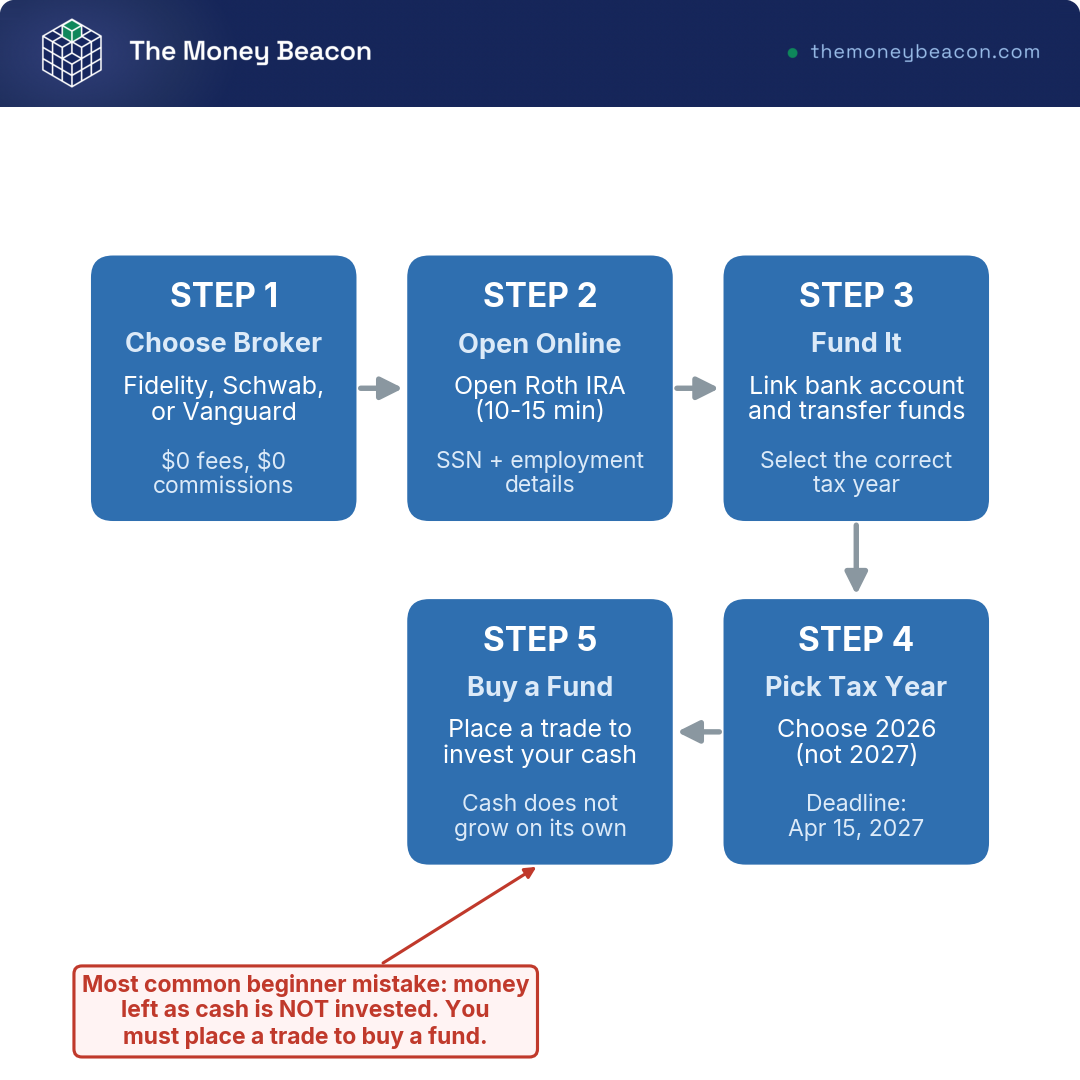
Opening a Roth IRA at a major brokerage, meaning Fidelity, Charles Schwab, or Vanguard, takes roughly 10 to 15 minutes online. All three lead the market on low-cost index funds and charge $0 in account maintenance fees and $0 commissions on online US stock and ETF trades, so the account itself costs you nothing to hold.
The sequence is short. You provide identity details (your Social Security number and employment information), link a bank account, transfer the funds, and select the correct contribution tax year, the same calendar-year trap from section 2.
Then comes the step that separates a funded account from an invested one. Money sitting in the account as cash is not invested, and cash earns next to nothing while it waits. You have to place a trade to actually buy a fund, and forgetting that is the single most common first-year failure: people transfer their $7,500, feel finished, and discover years later that it never grew because it sat in cash the whole time. If you want to see how the three big custodians compare on fees and fund lineups before you pick one, our comparison of the major brokerage accounts lays them out side by side.
7.2 What to actually invest in: index and target-date funds
So you are at the buy-a-fund step. What should you actually buy? The Roth IRA is the wrapper, and you still pick the asset classes that ride inside it. For most beginners, two routes cover the field.
The first is a total-market or S&P 500 index fund or ETF: broad US equity exposure at rock-bottom cost, with you handling any bond allocation separately. The second is a target-date retirement fund, a single fund that holds a diversified stock and bond mix and automatically shifts toward bonds as your target year approaches. The target-date route is one decision and done; you pick the fund closest to the year you plan to retire and it rebalances itself for the rest of your career. If you want the simplest possible start, buy one low-cost target-date fund, then double-check that the cash actually got invested.
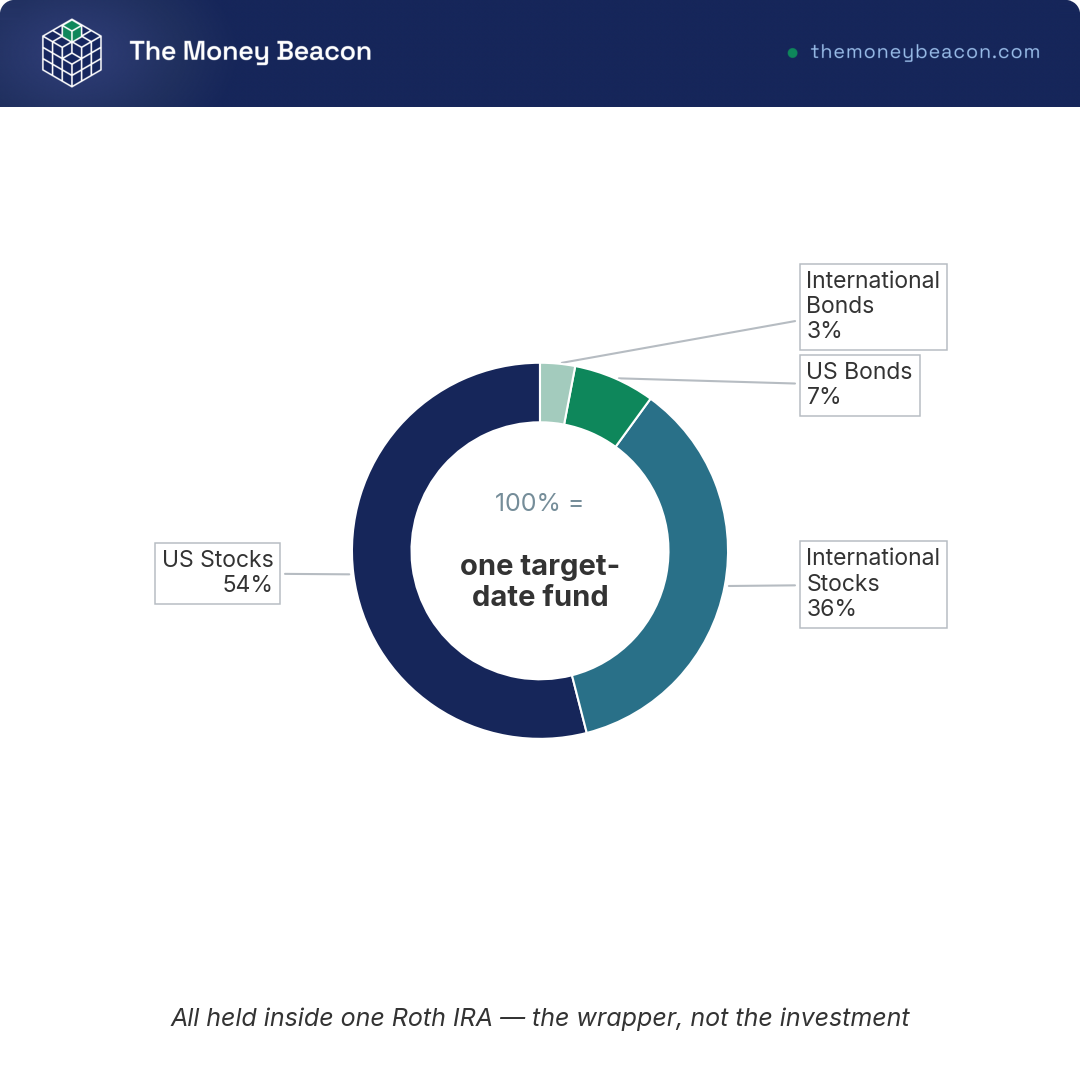
One distinction is worth keeping in mind. A target-date fund is not a rival to the Roth IRA; it is one of the asset bundles you hold inside the wrapper. The donut below shows what a single target-date 2055 fund is really made of, which is itself a diversified spread rather than one holding. If you would rather build the equity piece yourself, our look at choosing a total-market index fund or ETF covers the trade-offs.
7.3 Where each holding sits on risk, return, and cost
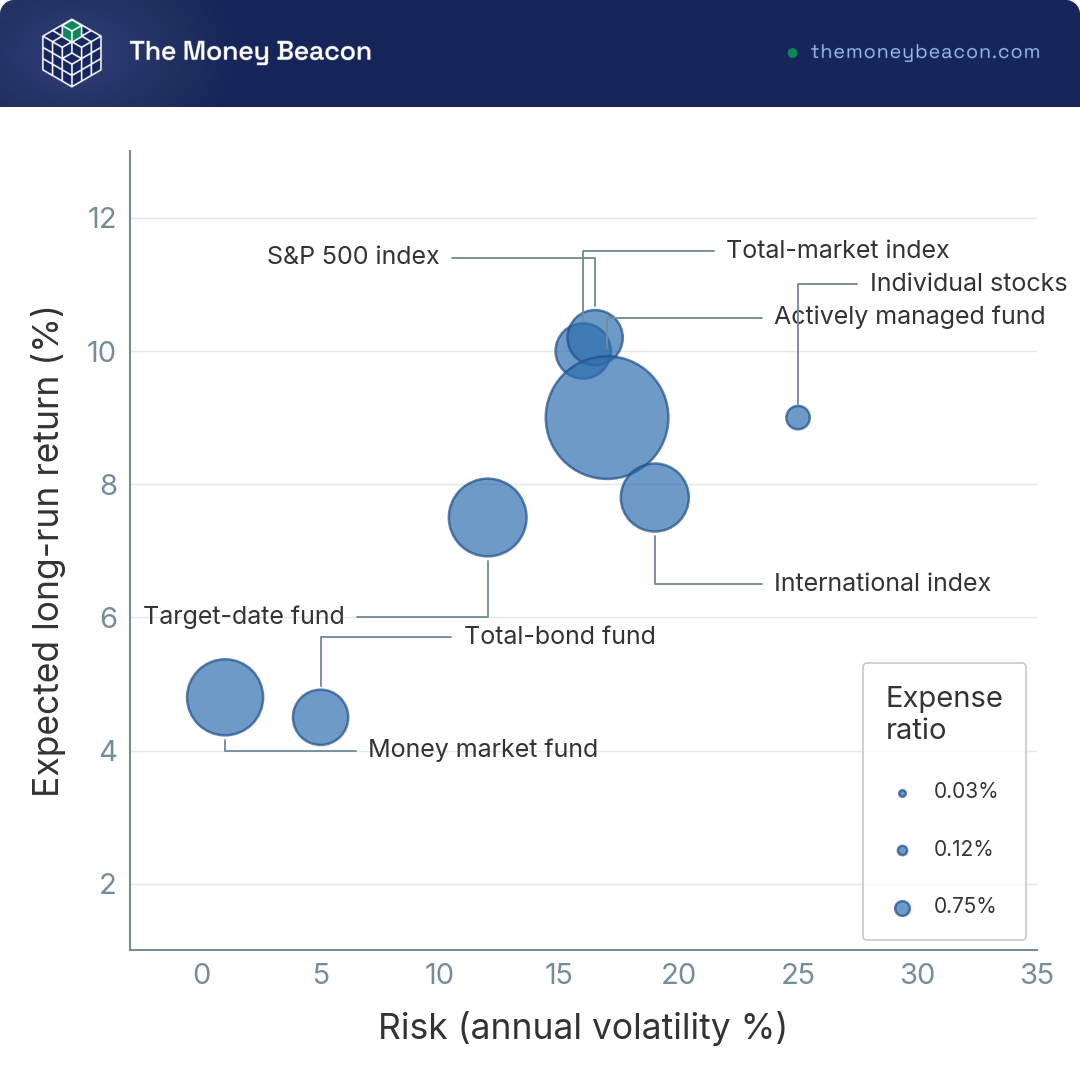
Index versus target-date is the headline choice, but it helps to see where the common Roth IRA holdings actually land relative to each other. Three things move together here: risk, expected long-run return, and cost, all on asset classes held inside the same Roth wrapper.
A total-bond fund sits at the low end of both risk and expected return. Equity index funds, whether total-market or S&P 500, sit at the high end of both, and they carry the lowest fees of the bunch, often right down at the floor. A target-date fund lands in between, since it blends the two and slides toward bonds over time. Individual stocks are the outlier: they carry no fund fee, but they are concentrated, which puts them at the highest risk with the widest range of possible outcomes. What the chart drives home is that the low-cost, broadly diversified funds give you most of the return without the concentration risk, and they do it for almost nothing.
7.4 Expense ratios and why fees quietly matter
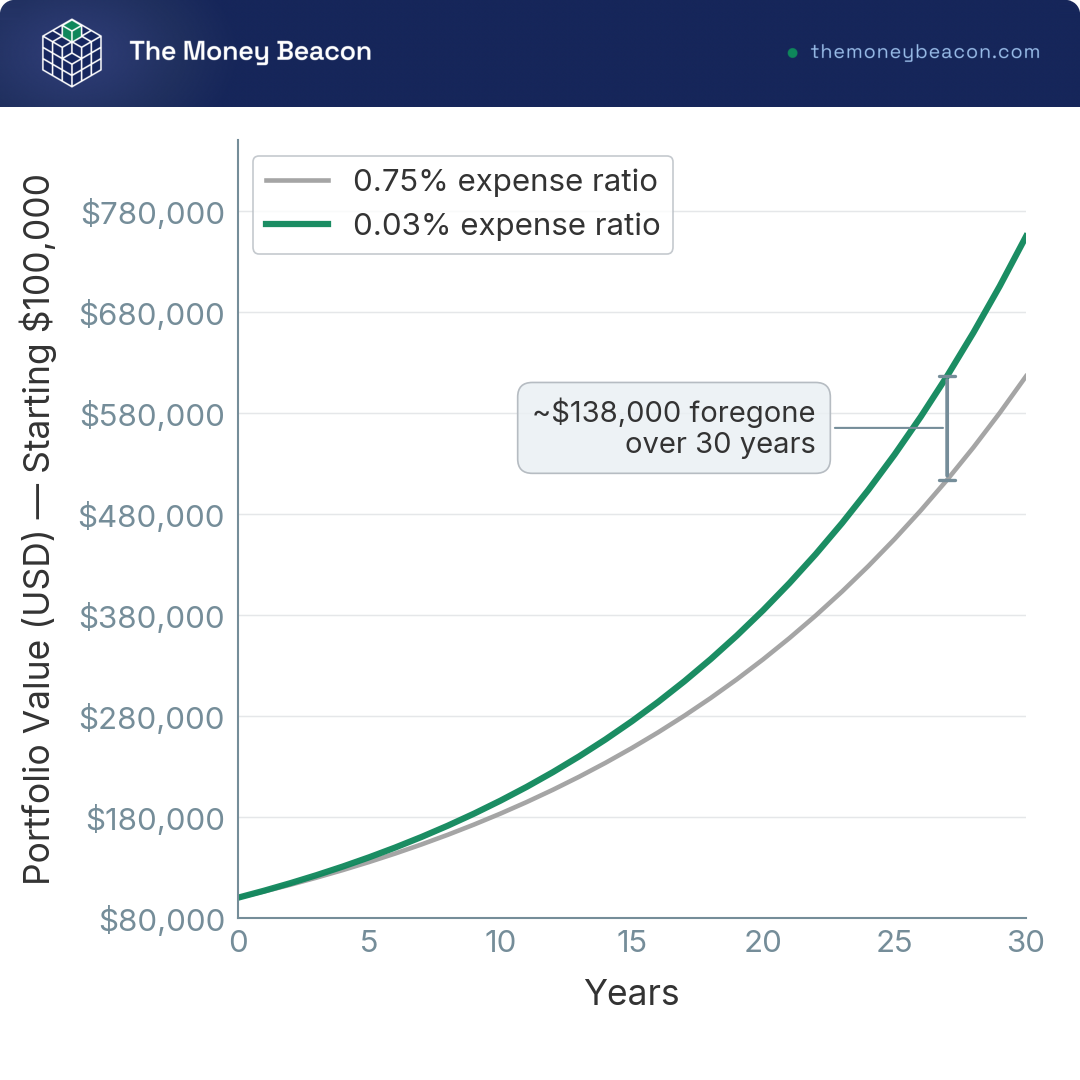
That phrase “almost nothing” deserves a hard number, because the gap between cheap and expensive funds does not look like much until you let it run. An expense ratio is just the annual percentage a fund charges you to hold it. The difference between a 0.03% index fund and a 0.75% actively managed fund reads like a rounding error, well under one percent either way. Over a few years, it nearly is. Over a career, it is anything but.
Let’s run through the maths. Take a $100,000 balance growing at 7% a year for 30 years. Pay the 0.75% fee instead of the 0.03% one and the higher fee costs you roughly $130,000 in foregone growth across that stretch. You read that right: a fee gap of less than three-quarters of a percent quietly eats a six-figure hole in the ending balance, all of it inside a tax-free account where you would most want every dollar to compound untouched. Past returns are no guarantee of future ones, and 7% is an assumption, not a promise, but the fee math holds regardless of the return: a higher expense ratio takes its cut no matter what the market does.
Robo-advisors such as Betterment and Wealthfront sit one layer up from this. They charge a management fee of about 0.25% per year on top of the underlying fund fees, in exchange for automated allocation and rebalancing. Whether that is worth paying depends on how much you value the hands-off automation, a trade-off we weigh in our comparison of the leading robo-advisors. For a saver willing to buy and hold one target-date fund, you are paying for a service you can do yourself for free.
Tom’s take
across my own ETF holdings, the one thing I refuse to overpay for is plain index exposure, because that is exactly where fees do the most damage over time. I push my private banks hard on every cost they quote, and the same discipline applies to a $7,500 Roth: a fund charging 0.75% to do what a 0.03% fund does is a quiet tax on your future self. Pick the cheap one and keep the $130,000.
7.5 Common first-year mistakes and the decisive answers at a glance
Before the recap, here are the errors that catch people in year one. None of them are complicated, and every one of them is avoidable once you know it is coming.
| To do | To avoid | Common mistake |
|---|---|---|
| Buy a fund after funding | Leaving cash uninvested | “I contributed but my money didn’t grow” |
| Pick the right tax year | Mislabeling the contribution year | Funding the wrong year near the deadline |
| Estimate MAGI first | Over-contributing | 6% excise tax on excess |
| File Form 8606 for backdoor | Forgetting it | Paying tax twice on a conversion |
| Use low-cost index/target-date funds | Chasing high-fee active funds | Decades of fee drag |
Read top to bottom, that table is the whole article in miniature: fund it, invest it, watch your income limits, paper the backdoor correctly, and keep your fees on the floor. Do those five things and you have sidestepped nearly every way a first-year Roth saver goes wrong.
And here is the entire guide condensed to one screen, every decision point you have worked through, with the rule and what it means for you in 2026.
| Decision point | The rule | What it means for you (2026) |
|---|---|---|
| Tax structure | After-tax in, tax-free out | Pay tax now; qualified growth and withdrawals are tax-free for life |
| Contribution limit | $7,500 (under 50); $8,600 (50+) | Combined across all your IRAs |
| Income limit (single) | Phase-out $153,000 to $168,000 | Above $168,000 MAGI, use the backdoor |
| Income limit (MFJ) | Phase-out $242,000 to $252,000 | Above $252,000 MAGI, use the backdoor |
| Roth vs. traditional | Compare today’s vs. future rate | Lower rate now leans Roth; higher rate now leans traditional |
| Backdoor Roth | Nondeductible contribution then convert | Watch the pro-rata rule; file Form 8606 |
| Mega backdoor | After-tax 401(k) then convert | Only if your plan allows it; up to $72,000 total additions |
| Contributions out | Always tax/penalty-free | Your contributions are accessible anytime |
| Earnings out | 5-year rule + age 59 1/2 | Otherwise tax + 10% penalty, unless an exception applies |
| RMDs | None for original owner | Compounds for life; estate and tax-diversification edge |
All figures current for the 2026 tax year.
Conclusion
The Roth IRA earns its reputation for one key reason: you pay a known tax bill today so that decades of growth and every qualified withdrawal come out federally tax-free for life. That single trade is what makes the 2026 limit of $7,500 worth funding, and it is why the whole Roth-versus-traditional question really comes down to one comparison, your tax rate now against the rate you expect in retirement.
Two points are worth considering as you make your decision. First, your contributions stay accessible at any age without tax or penalty, so a funded Roth quietly doubles as a backstop you can reach in a pinch. Second, if your income tops the phase-out, the backdoor route keeps the door open, as long as you respect the pro-rata rule and file Form 8606.
So if you are ready to open and fund one, the time to start the tax-free clock is now, not next April. To place the Roth correctly in your wider plan, our guide to the 401(k) shows how to sequence the employer match against your IRA, and our guide to building a retirement plan sets a target for how much you actually need. And once you start drawing the money down, our guide to investment taxes explains how a tax-free account fits beside the taxable dollars most people also hold. Past returns never guarantee future ones, but the rules in this guide hold no matter what the market does, which is exactly why understanding them pays off.
FAQ
What is the Roth IRA contribution limit for 2026?
For 2026, you can contribute up to $7,500 to a Roth IRA if you are under 50, or $8,600 if you are 50 or older, thanks to a $1,100 catch-up provision. That limit is a combined cap across all your traditional and Roth IRAs combined, not a per-account ceiling, so if you split contributions between a traditional and a Roth, the total of both still cannot exceed $7,500. There is also a floor: your contribution cannot exceed your earned income for the year, which matters if you work part time or take a low-income year. One more thing worth knowing about the 2026 figures, the IRS published them on November 13, 2025 as part of the annual inflation adjustment, so $7,500 is the confirmed number, not an estimate.
What are the 2026 Roth IRA income limits for single and married filers?
The income limit is actually a phase-out band, not a hard cutoff, so losing direct eligibility happens gradually as your modified adjusted gross income (MAGI) climbs. Single and head-of-household filers can contribute the full amount if MAGI stays below $153,000; the contribution shrinks proportionally inside the $153,000 to $168,000 band and disappears entirely at $168,000 or above. Married filing jointly follows the same shape with higher numbers, phasing out between $242,000 and $252,000. The harshest treatment goes to married filing separately if you lived with your spouse at any point during the year: the band runs from $0 to $10,000, which effectively closes off direct contributions for most MFS filers. None of this bars you from a backdoor Roth conversion, which carries no income limit regardless of how high your income climbs.
Should I choose a Roth IRA or a traditional IRA?
The decision comes down to one question: is your marginal tax rate higher today or will it be higher in retirement? If your rate now is the same as or lower than your expected retirement rate, the Roth wins because you pay the tax bill while it is cheap and every dollar of growth comes out federally tax-free. If you are in a peak-earning year and expect a meaningfully lower bracket once you stop working, the traditional deduction often wins because you shelter income at a high rate today and pay tax on withdrawals later at the lower rate. There is also a structural edge worth factoring in for the Roth: it carries no required minimum distributions for the original owner, so the balance can keep compounding without forced withdrawals starting at 73. When you genuinely cannot call which bracket wins, splitting contributions across both accounts buys tax diversification, a reasonable hedge against an uncertain future rate environment. You can pair the two within the same $7,500 annual limit, for example $4,000 Roth and $3,500 traditional, as long as the total stays at or below the cap.
Can I withdraw my Roth IRA contributions before retirement without a penalty?
Yes, and this is one of the features that sets the Roth apart from most retirement accounts. Because you funded the account with money you already paid income tax on, you can pull your contributions back out at any time, at any age, without owing a dollar of tax or penalty. The key word is contributions: the money you personally put in, not the investment growth those dollars may have generated. Roth distributions follow a specific ordering rule that puts contributions first in line, so you draw down everything you deposited before you touch a single dollar of earnings. The earnings layer is where the 5-year rule and the age 59 1/2 requirement come into play. If you only need access to what you contributed, none of those rules matter, which makes the Roth a quiet emergency backstop for disciplined savers, though tapping it does sacrifice irreplaceable tax-free compounding space you cannot get back.
How does a backdoor Roth IRA work, and is it legal?
The backdoor Roth is a completely legal two-step maneuver designed for savers whose income is too high for a direct Roth contribution. In the first step, you make a nondeductible contribution of up to $7,500 to a traditional IRA, a move that is open to anyone with earned income regardless of how much they make. In the second step, you convert that traditional IRA to a Roth IRA; conversions have no income limit, which is the legal opening the strategy uses. If your traditional IRA held only that after-tax contribution and minimal earnings, the conversion is essentially tax-free because you are moving money that was already taxed. The one trap to plan around is the pro-rata rule: if you hold any pre-tax IRA money elsewhere (in a rollover IRA, a SEP IRA, or a SIMPLE IRA), the IRS aggregates all of it when calculating the taxable share of your conversion, which can make a significant portion of the conversion taxable. The standard fix is to roll any pre-tax IRA money into your current 401(k) before converting, since 401(k) balances are excluded from the pro-rata calculation. Whatever path you take, file Form 8606 the same year to establish your after-tax basis and ensure the IRS does not treat the converted dollars as fully taxable. If the backdoor and its tax angles feel complex, our guide to investment taxes covers the underlying mechanics of how conversions and capital gains interact across account types.



Comments
Questions and corrections welcome. We read everything.