


You tap buy on $500 of Bitcoin, the app quotes you a price, and you accept it. What you can’t see is what that trade just cost you. On the simple buy screen, Coinbase builds a spread into the quoted price and charges a separate Coinbase Fee on top of it. Both show up once, in the order preview, and then they’re gone.
I went looking for the fee schedule, and there isn’t one anymore. The flat fee bands on small orders and the debit card percentage have come off the site, replaced by a line saying your fee is calculated when you place the order. Coinbase’s own pricing page returns a page-not-found, and the Coinbase Advanced Trade fees grid opens only after you sign in. What survives is a ceiling, published in a state disclosure block inside the US user agreement. The Coinbase Fee won’t exceed $10 on a transaction under $200, and won’t exceed 6% of the value above that.
That’s a ceiling, not a price. On a $25 buy it allows $10, which is 40% of the order, and small frequent purchases are where that ceiling does the damage. Put $500 a month through that screen for a year and the ceiling alone allows $360 of Coinbase fees on $6,000 of buying, with nothing published to tell you how close you’ll actually come.
So I priced this account from the outside, which is the only way left. This review ends on a verdict, and it isn’t the same verdict for everyone.
1. What you are actually opening when you open a Coinbase account
One login, and behind it four companies and two pricing screens. So who are you actually dealing with?
1.1 One app, four legal entities, and which one holds your money
Only one of those four is your counterparty.
Coinbase Global, Inc. is the listed parent and files the annual Form 10-K with the Securities and Exchange Commission (SEC). You contract with Coinbase, Inc., which holds your crypto and runs your USD Wallet under a money transmitter license and a New York State Department of Financial Services (NYDFS) license. Cold storage belongs to Coinbase Custody Trust Company, LLC. Your dollars are pooled elsewhere again, at partner banks including JPMorgan Chase and Cross River Bank, on a page stamped May 2025.
The scale is real: 9.2 million monthly transacting users on average in FY2025, and 84% of revenue from the US.
Coinbase prints no total on its Licenses page, so I counted: 46 jurisdictions, 44 states plus the District of Columbia and Puerto Rico. Six are missing, California and Massachusetts among them, which doesn’t mean the account is unavailable there: California is absent from that table and still carries a full disclosure block further down.
You need to be 18 and a US resident. Read your own state’s block first: California is the only one where Coinbase commits to at least 14 days’ notice before changing its fee information.
1.2 Two screens, two prices, and the order type that costs the most
The most expensive decision here isn’t which coin you buy. It’s which screen you buy it on.
On the simple buy and sell flow, Coinbase “includes a spread in the quoted price” and “may retain any excess spread from a transaction.” A separate Coinbase Fee is calculated at order time from your payment method, order size, market conditions, jurisdiction and asset.
Coinbase Advanced opens from that login and carries no spread, because “you’re interacting directly with the order book.” You pay a maker or taker fee instead, with “zero subscription fees and no minimum portfolio sizes.” Coinbase Advanced Trade fees are tiered by trailing 30-day volume or by “total Asset balance (in USD),” so a five-figure balance buys a better tier without trading, the same trick another platform that waives its fee once your balance clears a threshold uses.
Now the trap. The limit order on the simple screen looks disciplined and is the most expensive order type in the product: 1% execution on every limit buy and every limit sell, plus a Coinbase fee of up to 1.875%, so up to 2.875% before the spread. A $500 limit buy costs $5 plus as much as $9.38, or $14.38, against an Advanced maker floor published as “as low as 0.0%.” If limit orders are new to you, how order types like limit orders actually work comes first.
Switching screens costs nothing, and it’s the largest single saving available in this product.
1.3 208 tradable assets, and why that number should not decide anything
Three counts get quoted as Coinbase’s asset lineup, and they measure three different things. The disclosures page carries 208 rows under “US (incl. NY) Trading Assets” and 383 under “Coinbase Custody Trust Company,” institutional custody rather than anything you can buy. Coinbase Advanced lists 552 spot pairs, 237 against USDC, the dollar stablecoin, and a pair isn’t an asset. So I tallied each one myself.
Does breadth change your decision? Coinbase’s own customer balances say no. At December 31, 2025, Bitcoin was $252.8 billion of the $376.1 billion on the platform, and Bitcoin plus Ethereum $309.0 billion, 82% of the total in two assets Kraken, Gemini and Robinhood all list too.
Credit where it’s due on that same page: every row carries a “Coinbase Holding” and a “Commercial Engagement” column. If one small-cap ticker is why you’re here, look it up in the US trading table instead of comparing headline counts.
2. What a trade really costs, now that the price is no longer published
You have the mechanism by now, but not a number. So what can you know before you fund the account?
2.1 The prices Coinbase withdrew, and the ceiling five states make it keep
Four retail prices are gone from Coinbase’s site: the spread percentage on the simple flow, the flat fee bands on small orders, the debit-card percentage, and any dollar figure for an automated clearing house (ACH) transfer or a wire. That’s a proven absence, not a failed search: help.coinbase.com carries 2,792 links and exactly one US retail fee article. The payment methods table gives availability and a clearing speed, and no fee column.
In their place is a rule: your fee is “calculated at the time you place your order.” Any Coinbase fees calculator hits the same wall, because the deciding input isn’t published.
One number survived, because five state disclosure blocks make Coinbase keep repeating it.
Table: Published Coinbase Fee ceiling worked by order size
| Order size | Applicable published ceiling | Ceiling in dollars | Ceiling as a percentage of the order |
|---|---|---|---|
| $25 | $10 flat | $10.00 | 40.0% |
| $50 | $10 flat | $10.00 | 20.0% |
| $100 | $10 flat | $10.00 | 10.0% |
| $166.67 | $10 flat | $10.00 | 6.0% (the crossover point) |
| $199 | $10 flat | $10.00 | 5.03% |
| $200 | 6% of value | $12.00 | 6.0% |
| $500 | 6% of value | $30.00 | 6.0% |
| $1,000 | 6% of value | $60.00 | 6.0% |
| $10,000 | 6% of value | $600.00 | 6.0% |
Data current as of August 2026.
A flat $10 cap is mild at $1,000 and brutal at $25, and it drops back under 6% only at $166.67. Coinbase blocks the other reading itself: the fee you pay “is calculated and displayed to you at the time you place your order.” Every figure there is a ceiling, not a price, and 6% is not what Coinbase charges.
The Advanced tier grid is a different case. It exists, and Coinbase tells you to “sign in to your Coinbase.com account” to read it. Without an account that page is a sign-in screen: an access barrier, not a withdrawn price.
ACH takes one to five business days and can’t be used to sell. The clearest published evidence that a wire costs anything is the Coinbase One grid, where free wires are withheld from the cheapest tier.
2.2 The one price signal left, and it comes from an SEC filing
Coinbase does disclose its retail pricing once a year, just not to its customers. Two lines in the FY2025 10-K give you a number: consumer transaction revenue of $3.32 billion on $239 billion of consumer trading volume, an implied blended take rate of 1.39% of trade value. Coinbase doesn’t publish that ratio; it’s arithmetic on two filed figures.
Two caveats come with it. The revenue includes retained spread as well as the fee, so 1.39% is all-in, and it’s an average: a $100 buyer on the simple screen pays more, an Advanced trader less. The filing says as much: “Advanced traders incur lower fees per transaction than Simple traders.”
Let’s set it against a year of buying, $500 a month out of a linked bank account.
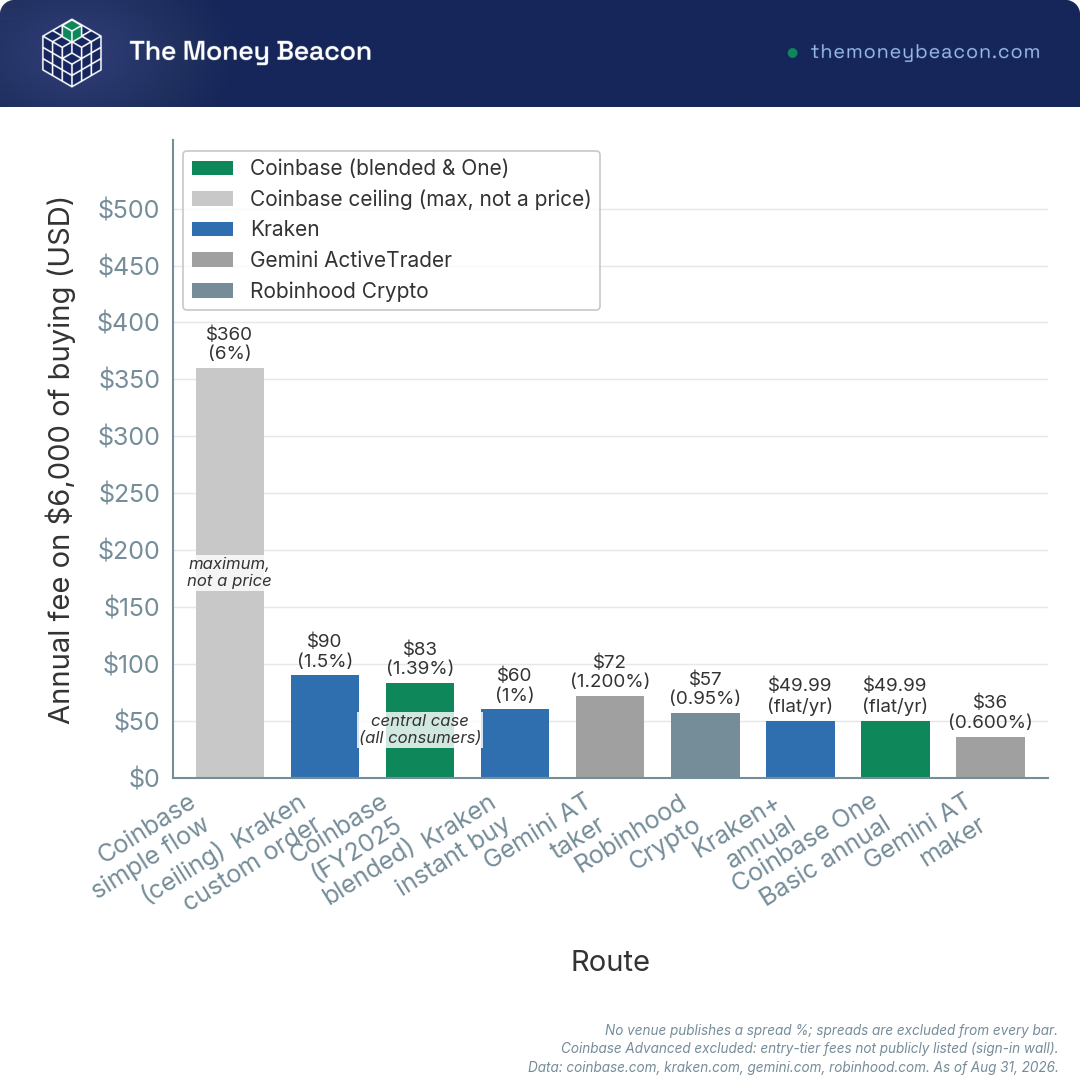
The $360 bar is a ceiling, not a forecast; the 1.39% central case is $83.40. Coinbase One Basic on the annual plan is $49.99 plus the spread. Kraken+ is $49.99 with the whole $6,000 inside its allowance.
The bar that isn’t there is the finding. Coinbase Advanced is the cheapest route in the product and the one row nobody outside the account can price, unlike a traditional brokerage that publishes its trading costs upfront. Gemini has withdrawn its own retail schedule in near-identical language, so this is a category problem, with Kraken as the exception. And every bar excludes the spread.
3. Does Coinbase One pay for itself?
Coinbase sells a fix at $4.99 a month, one of the few prices here you can read before you commit.
3.1 What each tier includes, and what zero trading fees does not cover
Three tiers, one grid, and the line that decides the value isn’t in it. Prices range from $4.99 to $299.99 a month, all three paying a 3.50% annual percentage yield (APY) on USDC.
Table: Coinbase One: what each tier includes
| Benefit | Basic | Preferred | Premium |
|---|---|---|---|
| Monthly price | $4.99 | $29.99 | $299.99 |
| Annual price | $49.99/year | $299.99/year | $2,999.99/year |
| Zero trading fees | Up to $500/month | Up to $10,000/month | Unlimited |
| Account protection | $1,000 coverage | $10,000 coverage | $250,000 coverage |
| USDC rewards | 3.50% APY, unlimited | 3.50% APY, unlimited | 3.50% APY, unlimited |
| Staking rewards boost | +5% boost | +10% boost | +15% boost |
| Advanced trade fee rebates | Not included | 25% off spot trading fees up to 100 USDC/mo | 25% off spot trading fees, unlimited |
| Free wires | Not included | Available | Available |
| 24/7 priority support | Not included | Available | Concierge |
| Coinbase One Card | Annual plan required to qualify | Available | Available |
| Mortgage closing cost rebate | Up to $10,000 | Up to $10,000 | Up to $10,000 |
Data current as of August 2026.
The advertised Coinbase One benefits are in that grid; the exclusions are printed underneath. “Zero trading fees: Crypto trading only. Coinbase Advanced, DEX fees, and derivatives excluded. Coinbase includes a spread in the price when you buy, sell, or convert cryptocurrencies.” A decentralized exchange (DEX) trade is outside the waiver, and the fee page adds that “the zero trading fee benefit does not apply to the 1% limit order execution fee.”
What you’re buying is a waiver of the Coinbase Fee on simple-screen market orders, capped at a monthly volume. A subscriber who moves to Advanced for cheaper trading has stepped outside the benefit they’re paying for, apart from the rebate on the two upper tiers.
Two rows hide conditions the grid doesn’t show. The Coinbase One Card also needs separate creditworthiness criteria, and the mortgage closing cost rebate has no published terms for earning it.
3.2 The break-even volume, and the twentyfold gap at the identical $4.99
So is Coinbase One worth it at the Basic tier? Take a 1% notional fee, matching Kraken’s published instant-buy price. Basic annual repays itself at $417 of monthly buying, Basic monthly at $499, Preferred annual at $2,500, Premium annual at $25,000. At the 1.39% blended rate those fall to $300, $1,799 and $17,986, though that version flatters the subscription: the blended rate includes retained spread and the subscription doesn’t waive it.
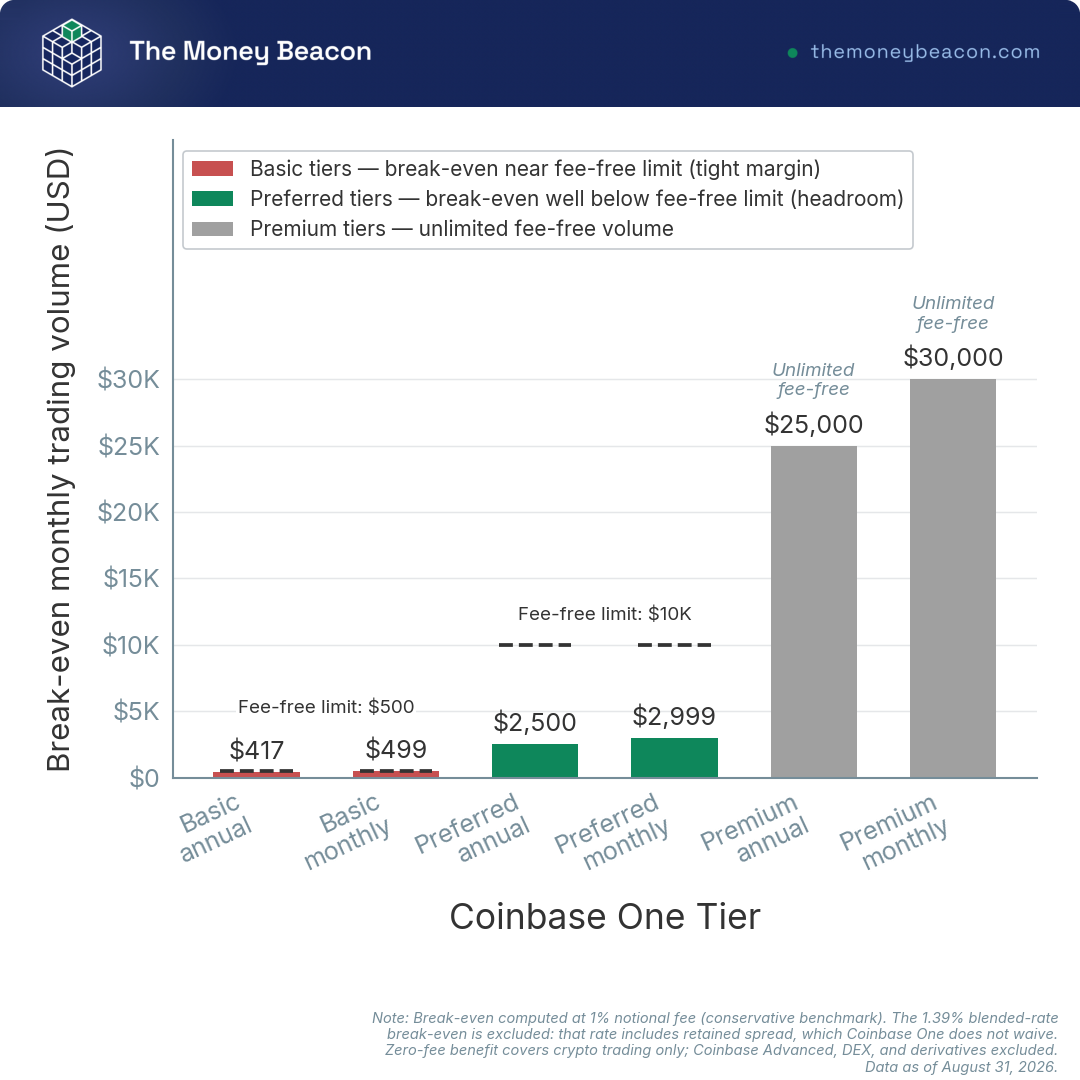
On Basic the break-even and the allowance marker nearly touch, so the tier is priced against its own cap. Preferred has real headroom: a fully used $10,000 allowance for $299.99 a year is a maximum effective fee of about 0.25%, and $500 a month never gets near it.
Then the comparison that’s hardest to explain away. Kraken+ costs the same $4.99 a month and the same $49.99 a year, and waives trading fees on up to $10,000 of monthly volume against Basic’s $500. And both still charge the spread.
Tom’s take

I’ve shopped most of the big private banks and made them bid against each other, and that lesson scales all the way down to a $4.99 subscription. When two products at the same price cover twenty times different amounts, the one you’re already using hasn’t had to compete for you.
Cancellation only takes effect at the end of the billing period, refunds are generally unavailable, and an unused allowance doesn’t roll over. The monthly plan costs $9.89 more a year, the price of being able to stop.
3.3 The yield benefits, after Coinbase takes its cut
Two benefits carry the value for a buy-and-hold reader, and only one can repay a subscription on its own. USDC rewards pay 3.50% APY from a $1 balance and are “exclusively available to Coinbase One members.” A balance of $1,428 earns $49.99 a year, exactly the Basic annual price; $1,711 covers the monthly plan. Hold more and the membership is paid for before you place a trade.
Two things stop it from being a savings rate. Your USDC balance “is not insured by the Federal Deposit Insurance Corporation (FDIC) or the Securities Investor Protection Corporation (SIPC),” so 3.50% here and 3.50% at a bank aren’t the same number, and an FDIC-insured account paying a comparable rate is the fair comparison. On plain dollars the user agreement doesn’t hedge: “Coinbase owns the interest or other earnings on these investments.”
Staking costs a commission, not a fee. There’s nothing to pay to stake or unstake, and 35% of the network rewards goes to Coinbase, against Gemini’s published up to 30% and Kraken’s published 20% on on-chain flexible staking. Even Premium’s 25.25%, bought for $2,999.99 a year, doesn’t reach Kraken’s standard rate.
The boost advertised on top of Coinbase staking rewards is a percentage of a percentage. Preferred lifts your share from 65.00% to 71.50%, so a $10,000 stake earning an illustrative 2.0% net goes from $200 to $220 a year, and $20 doesn’t repay a $299.99 tier.
The other cost is time, published asset by asset.
Table: Staking eligibility, minimums, payout frequency, and unstaking waits by asset
| Asset | Minimum balance to earn | Rewards payout frequency | Estimated unstaking wait | Earning during unstaking |
|---|---|---|---|---|
| Cosmos (ATOM) | 0.0001 ATOM | Every 7 days | ~25 days | Yes |
| Ethereum (ETH) | No minimum balance | Every 3 days | ~10 days | Yes |
| Tezos (XTZ) | 0.0001 XTZ | Every 3 days | ~2 days | Yes |
| Cardano (ADA) | $1 worth of ADA | Every 5 days | ~2 days | Yes |
| Solana (SOL) | $1 worth of SOL | Every 5 days | ~5 days | Yes |
| Polkadot (DOT) | No minimum balance | Every 1 day | ~4 days | Yes |
| MATIC (POL) | No minimum balance | Every 5 days | ~8 days | Yes |
| Avalanche (AVAX) | No minimum balance | Every 4 days | ~9 days | Yes |
| Sui (SUI), excluding New York | No minimum balance | Every 5 days | ~24 hours | Yes |
Data current as of August 2026.
Read the unstaking column first. Staked assets “can not be traded or transferred until unstaking completes,” from about 24 hours on Sui to about 25 days on Cosmos, so never stake money you might need inside a month.
4. Does the safety story survive its own documents?
Fees are arithmetic. Whose coins these are if Coinbase fails tomorrow is not.
4.1 Who legally holds your coins, and what the 10-K says happens if Coinbase fails
I read the custody section expecting boilerplate. The US user agreement is stronger than that.
Table: Custody terms in the US User Agreement
| Term in the US User Agreement (2026-07-22) | Published wording |
|---|---|
| Custodial character | “All Supported Digital Assets held in your Digital Asset Wallet are custodial assets held by Coinbase for your benefit” |
| Legal characterization | “Coinbase is a ‘securities intermediary’ as used in Division 8 with respect to Supported Digital Assets, and your Digital Asset Wallet is a ‘securities account’ as used in Division 8” |
| Title | “Title to Supported Digital Assets shall at all times remain with you and shall not transfer to Coinbase” |
| Creditor protection | “All interests in Digital Assets we hold for Digital Asset Wallets are held for customers, are not property of Coinbase, and are not subject to claims of Coinbase’s creditors” |
| No rehypothecation | “Coinbase may not grant a security interest in the Supported Digital Assets held in your Digital Asset Wallet” |
| Segregation | “Coinbase shall have no obligation to create a segregated blockchain address for your Supported Digital Assets” |
User Agreement wording current as of July 2026.
Five of those six rows protect you. Title never moves, the coins are ring-fenced from Coinbase’s creditors, and neither can be lent or pledged. That is Uniform Commercial Code (UCC) Division 8 at work.
The sixth row surprises people. Coinbase owes you no segregated blockchain address, and the FY2025 Form 10-K confirms retail crypto is “held in an omnibus manner.” Your Bitcoin is a book entry against a pooled address.
Then the same 10-K takes much of it back. Custodied crypto “could be subject to bankruptcy proceedings and such customers could be treated as our general unsecured creditors.” Coinbase offers the June 2022 Article 8 update as mitigation, then adds the line that decides it: “courts have not yet considered this type of treatment for custodied crypto assets.”
A brokerage account has decades of case law behind customer property. This has a contract clause and an untested theory. Anything you would be materially hurt to lose belongs off the platform, a call that a capped position size and a hardware wallet can help settle. Test the route with one small Coinbase withdrawal while nothing is wrong.
4.2 What is insured here, and the large region that is not
So what covers the balance while it sits here? Three schemes answer that, and the gaps between them are wide.
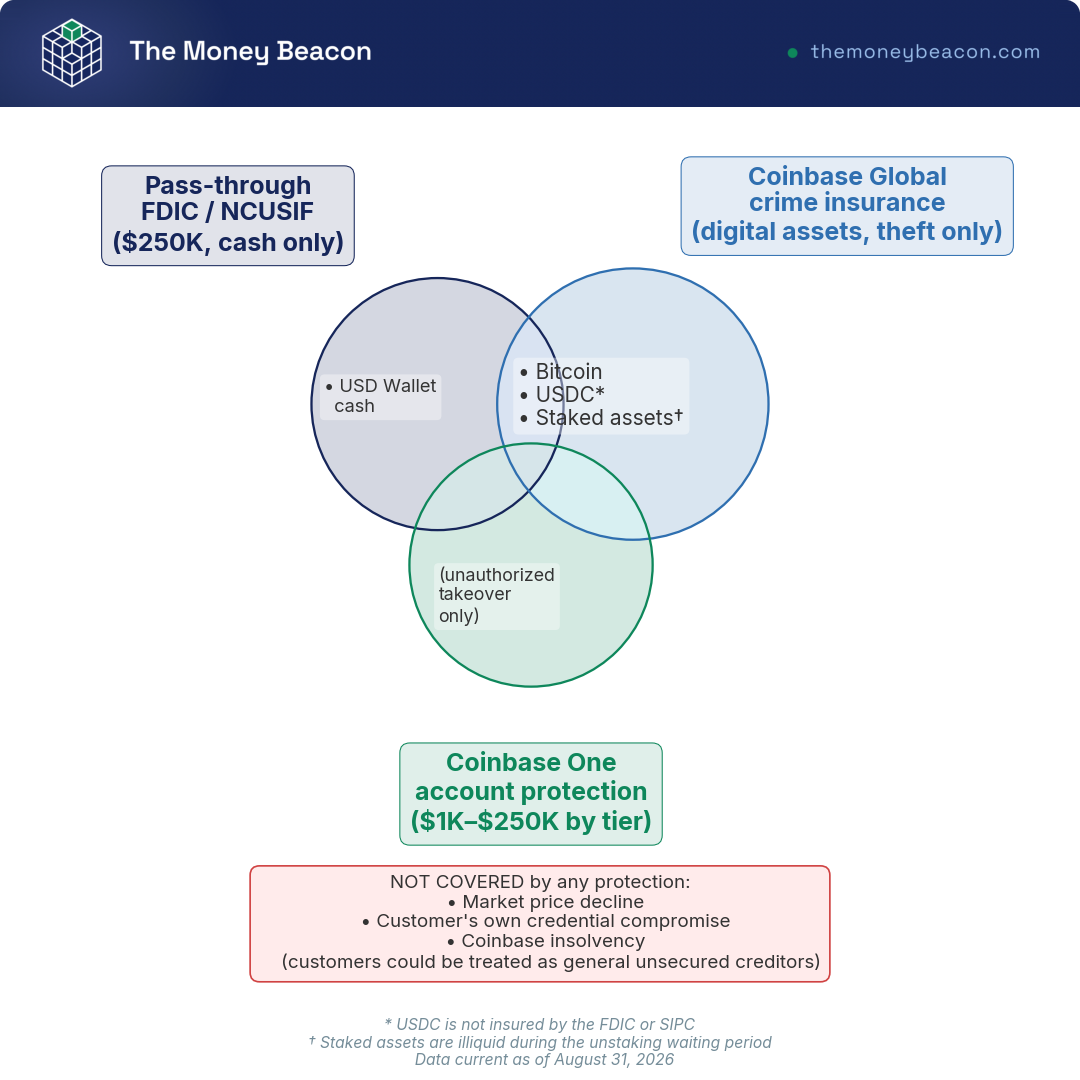
Cash in the USD Wallet carries pass-through FDIC or National Credit Union Share Insurance Fund (NCUSIF) coverage up to $250,000 per individual, conditional on Coinbase keeping correct information about you and accurate records. That insures a partner bank failing, not Coinbase failing.
Crypto gets none of it. Coinbase states cryptocurrency “is not insured or guaranteed by or subject to the protections of” the FDIC, the NCUSIF or SIPC. USDC is not insured either, and “SIPC does not apply to digital assets or cash held in your USD Wallet,” a long way from what SIPC coverage actually protects in a real brokerage account.
That leaves the crime policy, thinner than its reputation. Coinbase Global carries it, it covers a portion of custodied assets against theft only, and it “has a one-year term without automatic renewals.” I couldn’t find a dollar figure anywhere Coinbase publishes, and the 10-K shows why one wouldn’t settle much: customer assets are “substantially more than our corporate assets and available insurance.” Two points in Coinbase’s favor are filed rather than advertised, though: hot wallets never hold more than 2% of custodied assets, and corporate assets exceed everything in those wallets.
Both the crime policy and the paid Coinbase One account protection exclude “losses resulting from unauthorized access to your personal Coinbase account(s) due to a breach or loss of your credentials.” The Form 8-K of May 15, 2025 disclosed that exact vector: “no passwords or private keys” compromised, the stolen data used for social engineering. A Coinbase scam built on social engineering falls outside the free protection and the paid one alike.
Hank’s take
the arrangements that worry me are never the ones that look fragile. They are the ones no failure has ever tested, and an untested legal theory is exactly that.
5. The verdict: is Coinbase worth using, and who should go elsewhere?
Cost and protection are on the record. What is left is comparative.
5.1 Where Coinbase sits against Kraken, Gemini and Robinhood on the published record
I priced the four venues from the outside. Only Coinbase hides its maker and taker schedule behind an account.
Table: Published retail pricing side by side: Coinbase, Kraken, Gemini, Robinhood
| Data point | Coinbase | Kraken | Gemini | Robinhood |
|---|---|---|---|---|
| Simple or instant buy fee | Not published; ceiling of $10 under $200, otherwise 6% | 1% on instant and recurring trades; 1.5% on custom orders | Not published; calculated at order time and shown in the trade review screen | 0.00% to 0.95% on exchange routing; no published fee tier on the default market maker routing |
| Spread on the retail flow | Yes, percentage not published, excess retained by Coinbase | Yes, stated: “the price you see includes a spread” | Yes, on Instant, Recurring and Convert orders | Not published |
| Pro or advanced maker at the entry tier | Published only behind a sign-in wall | 0.40% | 0.600% | n/a |
| Pro or advanced taker at the entry tier | Published only behind a sign-in wall | 0.80% | 1.200% | n/a |
| Pro or advanced maker at the top published tier | Floor stated as “as low as 0.0%” | 0.0% (Tier 12) | 0.000% (at $250M volume) | n/a |
| Pro or advanced taker at the top published tier | No taker figure published | 0.10% (Tier 12) | 0.020% (at $250M volume) | n/a |
| Full tier grid published on an open page | No | Yes | Yes | Partially |
| Crypto deposit or withdrawal fee | Network fee, plus processing fees on USDT and Lightning | Not collected for this review | Not collected for this review | “you’ll never be charged deposit or withdrawal fees” |
| Small-balance conversion fee | Not published | 3% fixed | Not published | Not published |
Data current as of August 2026.
Kraken crypto fees are all on one open page, and Gemini publishes its ActiveTrader ladder the same way. Robinhood publishes least on routing, though its own $0 commissions and Gold-gated cash sweep get the same first-party treatment here.
What works in Coinbase’s favor appears on no fee grid. Coinbase Global files a 10-K and states it has “no payment for order flow (PFOF) relationships with market makers.” It issues Form 1099-DA and Form 1099-MISC. And it names a state regulator behind a Formal Complaint Process that closes when Coinbase answers, or 45 business days after you file. Support is the thin part: the security page advertises 24/7 live support, promises a live agent only “depending on the hours,” and publishes no response time for any tier.
On tax, the 1099-MISC threshold reads $600 for tax year 2025 on one Coinbase page and $2,000 on another, and Form 8949 has left the retail tax center. DEX trades appear on no Coinbase form, and transferred-in assets arrive with no cost basis, which makes how capital gains and cost basis actually get taxed your record-keeping job.
5.2 Who Coinbase fits, and who should price a rival first
Profile by profile, here is where this Coinbase review lands.
The small-ticket buyer putting $50 to $200 in on the simple screen does not fit. The ceiling alone is 10% to 20% of an order that size, and the real price can’t be checked before you fund an account.
The recurring buyer at $200 to $500 a month fits only after changing something: move to Advanced, which costs nothing extra, or take Basic annual once volume clears the $417 break-even inside the $500 allowance.
The buy-and-hold accumulator with $10,000 to $100,000 across two or three coins fits, on Advanced, for the portion they can afford to leave custodied.
The yield seeker splits. Stablecoin yield fits with a subscription, since $1,428 of USDC at 3.50% repays Basic annual, with no FDIC or SIPC behind it. Staking does not fit, because 35% against Kraken’s 20% is a permanent premium on the yield itself.
The cost-focused active trader does not fit on the published record, because Coinbase can’t be priced before the account is open. Neutral does not mean undecided here, and three of those rulings are a flat no.
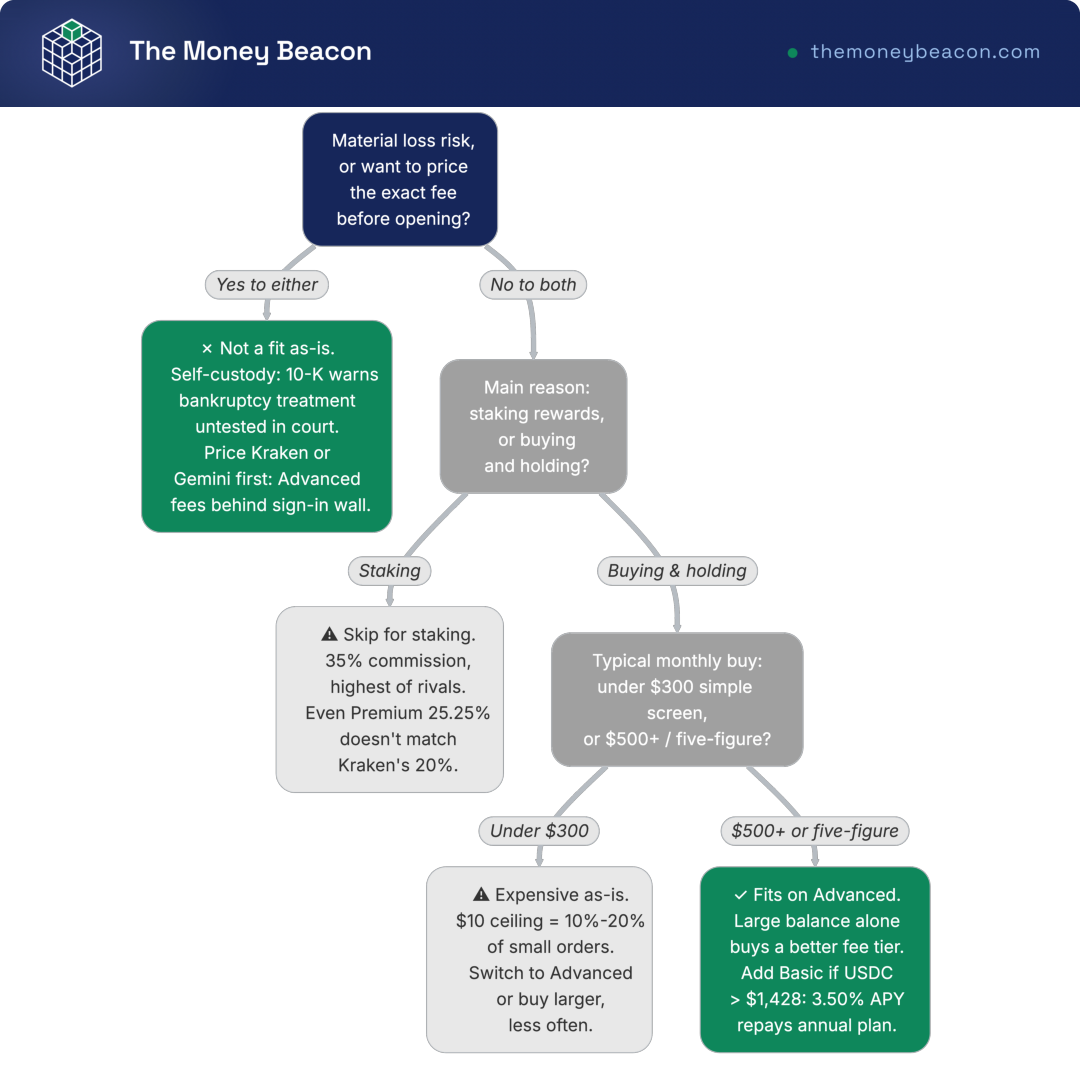
If none of those five profiles is you, the tree above walks you through custody risk, staking and buy size to an answer.
Conclusion
I came to this review looking for a price and found a ceiling instead. Coinbase has pulled its retail fees off its own site, kept only the ceiling that state disclosure blocks force it to repeat, and put its cheapest screen behind a sign-in wall. The one honest price signal in the whole product sits in a filing written for shareholders rather than customers.
Coinbase earns its place on Advanced Trade, and only for the portion of a position you can afford to leave custodied. The rest of the record argues the other way, and I’m not going to soften it. Buying $50 at a time on the simple screen runs into a cap that allows $10 on a $25 order. Staking here surrenders 35% of the network rewards where Kraken surrenders 20%. And anyone who needs the real number before funding an account still can’t get one.
The two decisions that matter here are made once, cost nothing, and nobody prompts you on either. One is which screen you buy on. The other is how much of the position stays with a custodian whose bankruptcy treatment no court has yet tested. The app is built so the default carries you.
So before your next buy, open Coinbase Advanced from the same login and place that order there rather than on the simple screen.
Further reading, if this account is one piece of a bigger plan: why a low-cost index core belongs underneath any crypto slice, what an insured account pays against that 3.50% USDC rate, and how to match each pot of money to when you will actually need it.
FAQ: Coinbase fees, insurance, and taxes
Does Coinbase charge a monthly fee?
No, not by default. I didn’t pay a cent to open my account or to hold cash and crypto in it, and Coinbase spells that out directly: a standard balance is free to hold. A monthly charge on your statement almost always means you signed up for Coinbase One, the optional subscription priced at $4.99, $29.99, or $299.99 a month depending on the tier. Closing the account doesn’t cost anything either, and I didn’t find an inactivity fee anywhere in the US User Agreement. The one thing worth knowing: leave a balance sitting untouched long enough and the state can eventually claim it as unclaimed property, so don’t just walk away from a small leftover amount.
How much does Coinbase actually charge on a $100 or $1,000 buy?
Coinbase won’t tell you upfront, and that’s the honest answer I can give you. The fee gets calculated the moment you place the order and only shows up on the preview screen right before you confirm. What Coinbase does publish is a ceiling: no more than $10 on any purchase under $200, and no more than 6% above that. So a $100 buy could run you up to $10, and a $1,000 buy up to $60. Treat those as worst-case numbers, not what you’ll actually pay. Coinbase’s own 2025 annual filing implies its average consumer take rate lands closer to 1.39% of the trade, which on $1,000 works out to roughly $14 once the spread is included.
Is Coinbase One worth paying for?
It depends on how much you trade and whether you hold USDC. I ran the numbers on the $49.99-a-year Basic tier: it pays for itself somewhere between $300 and $417 of monthly buying, and its zero-fee allowance tops out at $500 a month, so if you’re only putting in $150 a month, skip it. Where it gets more interesting is USDC. Hold at least $1,428 of it and the 3.50% rewards rate alone covers the annual fee, before you’ve traded a single dollar. Two catches to remember: the fee waiver doesn’t touch the spread, and it doesn’t apply to Coinbase Advanced or to the 1% limit-order execution fee.
Is my crypto FDIC insured on Coinbase?
No, and Coinbase says so plainly in its own help center: your crypto “is not insured or guaranteed by or subject to the protections of” the FDIC, the NCUSIF, or SIPC. The only thing that carries pass-through FDIC or NCUSIF coverage is the US dollar cash sitting in your account, up to $250,000 per person, and only because that cash sits pooled at partner banks, similar to how an FDIC-insured checking account gets covered. That protection only kicks in if a partner bank fails and only if Coinbase’s own recordkeeping checks out. It does nothing if the price of your crypto, or your USDC balance, drops.
Is staking on Coinbase worth it, and how much does Coinbase take?
Coinbase keeps 35% of your staking rewards as its standard commission, dropping to 31.75%, 28.5%, or 25.25% once you’re on a Coinbase One tier, on assets like ETH, SOL, ADA, DOT, ATOM, and XTZ. There’s no fee to stake or unstake as long as you wait out the network’s normal unbonding period, which ranges from about a day on SUI to roughly 25 days on ATOM. Coinbase only publishes a ceiling, “up to 13% APY,” and the real per-asset rate only shows up once you’re logged in, already net of that commission. For comparison, Kraken keeps 20% of staking rewards and Gemini up to 30%, so Coinbase’s cut is at the high end. And rewards count as ordinary income the moment you receive them, whether you cash out or not.
Does Coinbase send me a tax form?
Yes, though not a complete one. You get a Form 1099-DA for gross proceeds from sales or exchanges, and a 1099-MISC if your reward income clears the threshold, and Coinbase actually publishes two different numbers for that threshold: $600 for tax year 2025 on one page and $2,000 with no year attached on another, so check which one applies before you file. There’s no 1099-K, and starting with tax year 2025 Coinbase dropped Form 8949 from its retail tax center too. Coinbase also withholds 24% on certain reportable transactions when it doesn’t have a valid taxpayer ID on file for you. Reward income is taxable whether or not a form ever shows up, and if you moved crypto in from another platform, Coinbase has no record of your cost basis, so that bookkeeping lands on you, the same discipline that makes harvesting a capital loss elsewhere in your portfolio worth doing carefully.




Comments
Questions and corrections welcome. We read everything.