


Most people set their 401(k) once, on their first day at work, and never look at it again. You picked a contribution percentage during onboarding, accepted whatever fund the plan dropped you into, and moved on. The trouble is that a 401(k) holds most of your retirement, and the autopilot version of it quietly leaks money: you leave employer match dollars unclaimed, you pay fund fees you never see, you get caught off guard by vesting when you switch jobs, and you risk a 10% early-withdrawal penalty on top of tax if you ever cash it out. For 2026, the IRS raised the amount you can defer from your own pay to $24,500, so the gap between running the account well and running it on autopilot is now wider than ever.
So how do you take the wheel? This guide treats the 401(k) as a tool you can actually control. You’ll see how it works and how money flows in, where the 2026 contribution limits and the employer match really land, how traditional stacks up against Roth, and how to pick low-fee funds without guessing. And when you change jobs, what do you do with the old account, and which penalty, loan, and required-distribution rules decide what you actually keep?
1. What a 401(k) Actually Is and Why It Carries US Retirement Saving
To take control of a 401(k), we must first understand the account’s underlying mechanisms. What is the thing you signed up for on your first day, how does money actually land in it, and why does it hold more of the average American’s retirement than anything else? We start with the plain-English definition, then look at why this account replaced the pension and who now carries the risk.
1.1 The plain-English definition: a payroll-funded account with a tax break
A 401(k) is a tax-advantaged, employer-sponsored retirement account, and it gets its odd name from the spot in the tax code that created it, Internal Revenue Code section 401(k). The mechanism is simple: you agree to route a slice of each paycheck into the account before it ever reaches your bank, a move the rules call an elective deferral, and in exchange the government gives that money a tax break it would never get in a regular account.
Here is the distinction that trips people up most, so it is worth getting right at the start. A 401(k) is a container, not an investment. The account is the wrapper that holds your money; the funds you pick inside it are what you actually own and what grows. That means a 401(k) is never the right thing to compare against an exchange-traded fund (ETF) or an index fund, because they answer different questions. The account decides how your money is taxed; the funds decide what it is invested in.
So how large a piece of the system is this one account? The donut below puts the 401(k) next to the other places Americans keep retirement money.
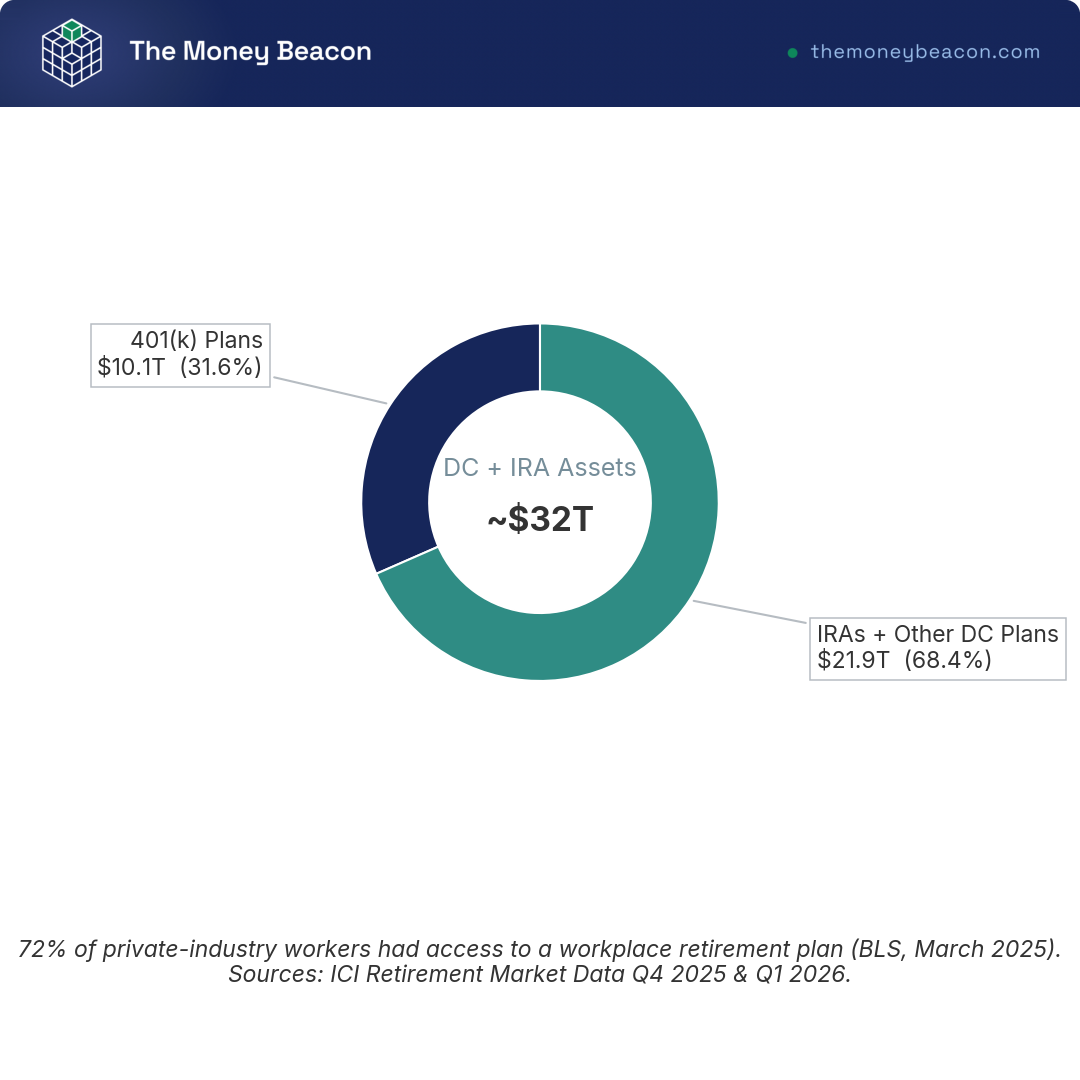
US 401(k) plans hold roughly $10.1 trillion, and once you add individual retirement accounts (IRAs) and the other defined-contribution plans, the combined pool sits near $32 trillion. The 401(k) is the workhorse here, and the next question is why it ended up carrying so much of the load.
1.2 Why the 401(k) replaced the pension, and who runs the plan
For most of the twentieth century, a career employer promised you a monthly check for life, a defined-benefit pension, and the company carried the whole burden: it funded the plan, invested the money, and absorbed the risk that you might live to 100. The 401(k) flipped that arrangement. The feature dates to the Revenue Act of 1978, the tax-law provision that first authorized salary deferrals, and over the following decades the defined-contribution model quietly took over. The difference is not cosmetic. In a pension the employer shoulders the risk; in a 401(k), you do.
The table lays out exactly who carries what once the pension becomes a 401(k).
| Feature | Defined-benefit pension | 401(k) (defined contribution) |
|---|---|---|
| Who funds it | Mostly employer | Employee + employer match |
| Who bears investment risk | Employer | Employee |
| Who bears longevity risk | Employer (lifetime check) | Employee |
| Portability on job change | Usually low | High (rollover) |
| Payout | Monthly annuity | Lump sum / withdrawals |
The 401(k) hands you portability and control, but it also hands you every risk the old pension used to absorb, which is precisely why running it well matters so much.
You are not entirely on your own, though. Three layers govern the plan in the background. The IRS writes the tax rules and sets the annual limits, the Department of Labor (through its Employee Benefits Security Administration) enforces ERISA, the law that protects your money and polices the people managing it, and a recordkeeper such as Fidelity, Vanguard, Schwab, or Empower runs the day-to-day administration. One ERISA rule worth knowing by name now is the 404(a)(5) fee disclosure, the document your plan must hand you that lists what every fund costs. You will put it to work later when we hunt for fees. For now, the takeaway is simple: in a 401(k), the outcome rests on your own decisions, so the rest of this guide is about making those decisions well.
1.3 How money goes in and grows: deferral, auto-enrollment, and tax-free compounding
So how does the money actually get in? Every contribution starts as an elective deferral, a percentage of your pay (or a set dollar amount) pulled out before the paycheck hits your account. You choose whether those dollars go in pre-tax, which lowers your taxable income now, or as Roth, which is taxed now but pulls out tax-free later. The full traditional-versus-Roth decision is a judgment call we work through in section 4; here, the only point is that the same payroll pipe feeds both.
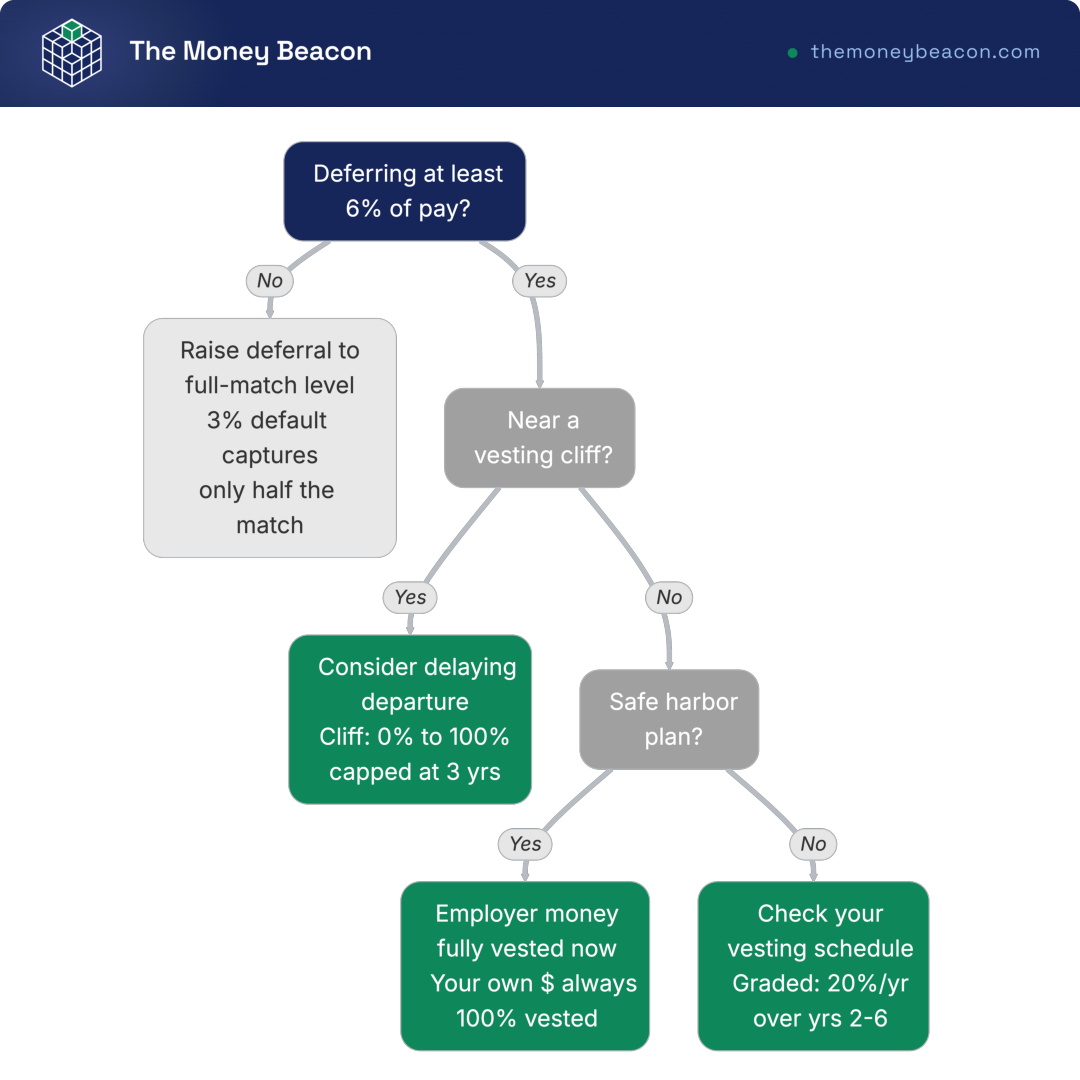
Many workers never pick a number at all, because the plan picks one for them. Under SECURE 2.0, most new 401(k) plans must automatically enroll eligible employees, starting the deferral somewhere between 3% and 10% of pay and nudging it up by about 1% a year until it reaches the 10%-to-15% range. Auto-enrollment is a genuine improvement, since it gets people saving who otherwise never would. The catch is that the default rate is rarely enough. If your plan starts you at 3% but the employer matches up to 6%, that comfortable-looking default is quietly capturing only half the free money on offer. You can change the rate or opt out whenever you want, and most people should change it.
The real payoff shows up once the money is inside the wrapper. In a regular brokerage account, the IRS taxes your dividends, interest, and realized gains year after year, and every dollar paid in tax is a dollar that stops compounding. Inside a 401(k), none of that happens along the way. Your money compounds uninterrupted, tax-deferred in a traditional account and tax-free in a Roth, and that shelter is the core edge a 401(k) holds over an ordinary taxable account. A handful of dates and deadlines shape how you use it in 2026, and the calendar below maps them out.
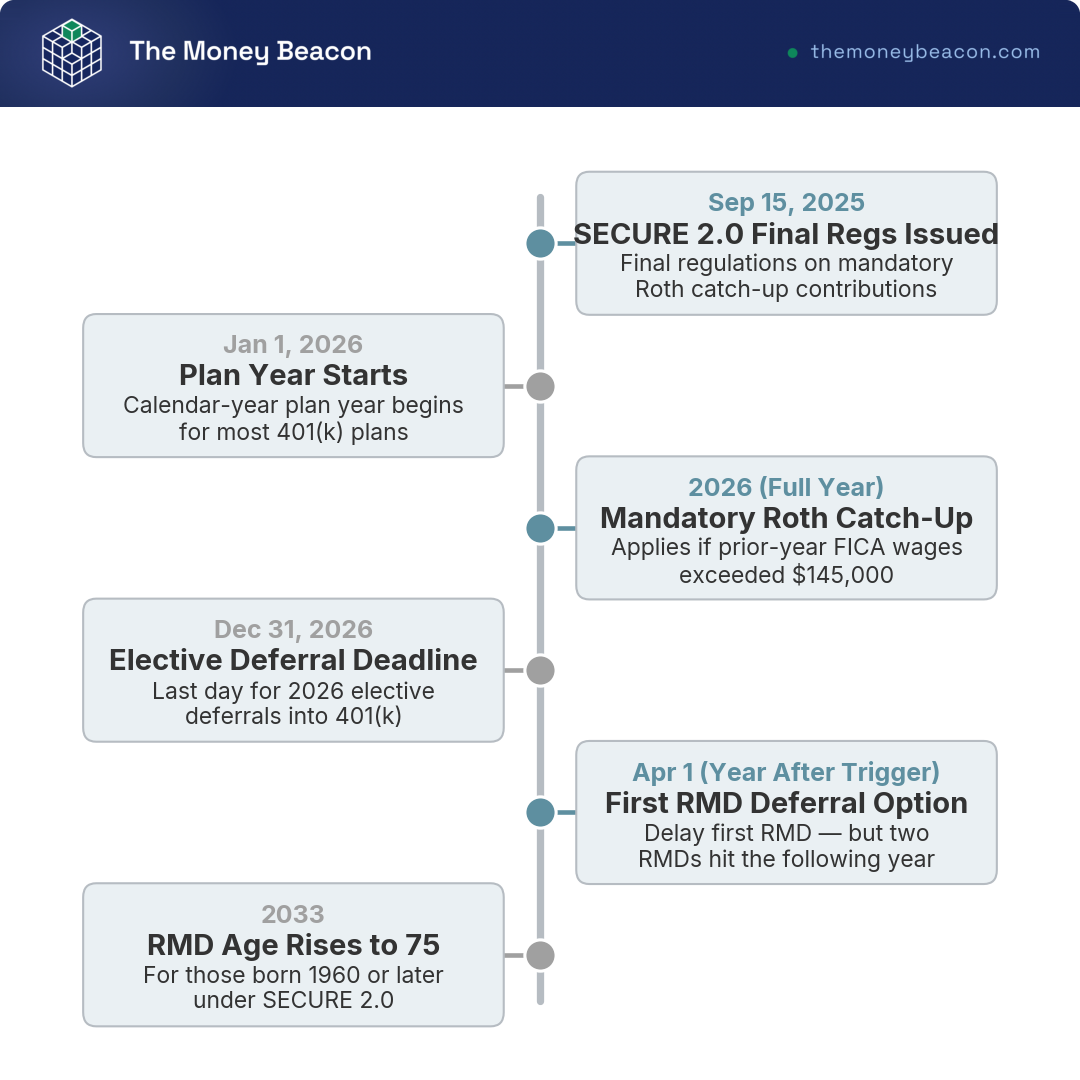
You now know what a 401(k) is, who runs it, and how money flows in and compounds. The obvious next question is how much of your own pay you are even allowed to send through that pipe.
2. The 2026 Contribution Limits: How Much You Can Really Put In
You know the money goes in by deferral, so the question becomes: how much can the IRS let you defer in 2026, and which ceiling actually applies to you? There are three different caps, and they do not mean the same thing. We start with the single number that governs your own paycheck, then zoom out to the much larger combined cap, and finish with the wrinkle that catches high earners.
2.1 The 2026 employee deferral limit and the age-based catch-ups
The headline figure for 2026 is $24,500. That is the most you can defer from your own pay into a 401(k), combining traditional and Roth in the same plan, and it is the number the IRS raised for this year. Spread across 26 biweekly paychecks, hitting it means setting aside about $942 per pay period. One detail saves people from an expensive mistake: this limit is per person, not per plan, so if you work two jobs with two separate 401(k)s, you still share one $24,500 ceiling across both.
Older workers get more room. Once you reach age 50, you can add a catch-up of $8,000, which lifts your personal ceiling to $32,500. SECURE 2.0 then layers on a richer “super catch-up” of $11,250 for the narrow band of ages 60, 61, 62, and 63, pushing the maximum to $35,750 in those four years. Read that last part carefully, because it is a common source of confusion: at age 64 the catch-up drops back to the standard $8,000. The super catch-up is a temporary four-year window, not a permanent higher limit, so the worker who plans around it as if it lasts forever is setting up a nasty surprise at 64.
The bar chart shows how the ceiling steps up and then steps back down across the age bands.
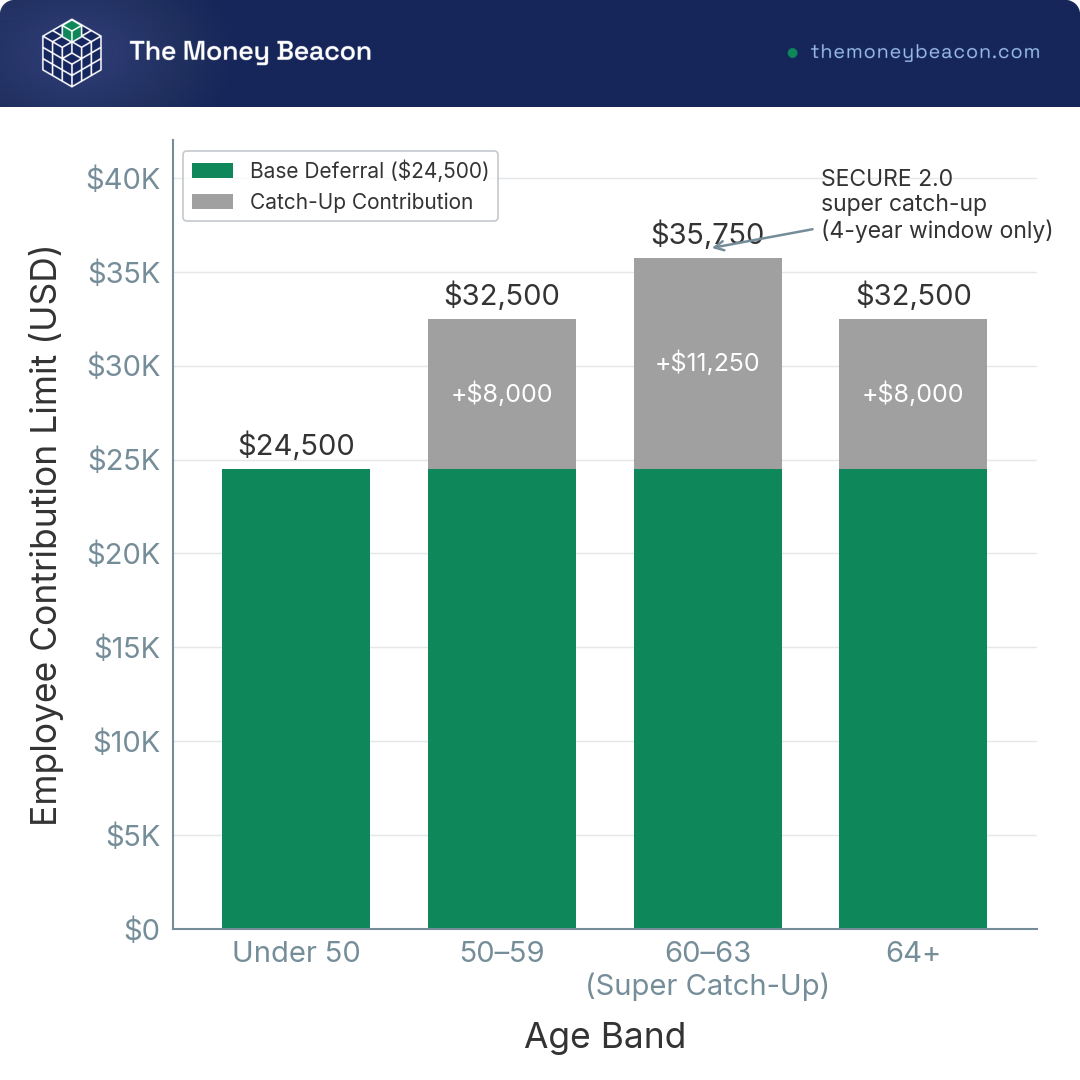
Those numbers cover what you can put in from your own paycheck. They are not, however, the largest cap on the account.
2.2 The combined employer-plus-employee limit (total annual additions cap)
Sitting above your personal deferral is a second, much bigger ceiling under IRC Section 415(c), and it counts everything that lands in the account in a year: your deferrals, the employer match, any non-elective employer money, and any after-tax contributions. For 2026 that total annual additions cap is $72,000, plus any catch-up you are entitled to on top. The plan can only count your pay up to a compensation limit of $360,000 when it runs these numbers. The three caps line up like this.
| Cap | 2026 amount | What it limits | Set by |
|---|---|---|---|
| Employee deferral | $24,500 | Your own salary deferrals | IRS COLA |
| Catch-up (50+/60-63) | $8,000 / $11,250 | Extra deferral for older workers | SECURE 2.0 |
| Total annual additions | $72,000 (+catch-up) | Employee + employer + after-tax | IRC 415(c) |
Data current as of June 2026.
The detail that matters here is which bucket the match falls into. Your employer’s match counts toward the $72,000 cap, not against your $24,500 deferral limit, so the free money your company adds never eats into how much of your own pay you can contribute. Most workers never come anywhere near $72,000; the gap between the two ceilings mainly exists for high earners running after-tax strategies. For the typical saver, the $24,500 number is the one that governs the decision.
2.3 The Roth catch-up wage rule and other 2026 wrinkles
One 2026 change reshuffles the deck specifically for higher earners. Starting this year, if your prior-year FICA wages topped $145,000, any catch-up contribution you make has to go in as Roth, after final regulations were issued on September 15, 2025. In plain terms, an affected worker can no longer take the pre-tax deduction on those catch-up dollars; they go in after-tax instead. Two points keep this from being misread. The threshold is FICA wages, not your total income, and the $145,000 figure indexes upward over time, so it will not stay fixed.
A related number worth knowing alongside it is the highly compensated employee (HCE) threshold, which is $160,000 for 2026 and governs the nondiscrimination testing that can cap or refund a top earner’s deferrals. Whether Roth treatment helps or hurts you is the larger traditional-versus-Roth question, and we settle that in section 4 rather than here. If you want to see where the parallel income limits on a Roth IRA actually start to bite, that is a separate account with its own rules. With the ceilings clear, the next move is the one with the highest guaranteed payoff in the whole guide.
3. The Employer Match and Vesting: Free Money and the Strings Attached
You know how much you can put in. Now comes the part of the 401(k) with the best return you will ever be offered, and a string or two attached to it. How do you capture every dollar of the employer match, and how much of it do you actually get to keep if you leave? We start with how match formulas work, make the case for grabbing the full match before anything else, then get into the vesting rules that decide what stays yours.
3.1 How the employer match works and the common formulas
An employer match is extra money your company adds on top of what you contribute, and the amount keys off your own deferral. The formula you will run into most often is 50% of the first 6% of pay: defer a full 6% and the employer kicks in another 3% of your salary. Vanguard’s plan data shows that roughly 72% of plans use a single-tier formula, and this 50%-of-6% structure is the most common one. Other plans run dollar-for-dollar up to some cap, or use a tiered formula such as 100% of your first 3% plus 50% of the next 2%. The table below lines up the common formulas with the deferral each one needs.
| Match formula | Employee deferral to max it | Max employer match (% of pay) |
|---|---|---|
| 50% of first 6% | 6% | 3.0% |
| 100% of first 3% + 50% of next 2% | 5% | 4.0% |
| 100% (dollar-for-dollar) up to 4% | 4% | 4.0% |
| 100% up to 6% (generous) | 6% | 6.0% |
Data current as of June 2026.
Look at what that first row really means. A 50%-of-6% match hands you a guaranteed 50% return on those dollars the instant they go in, before the market does anything at all. No fund, no stock, no strategy can promise you a reliable 50% return, which is why the match is the closest thing to free money in personal finance, and why not contributing enough to earn it is simply leaving guaranteed pay unclaimed.
3.2 Always capture the full match first, then build from there
If you take one action from this entire guide, make it this one: defer at least enough to capture the full employer match before you put a dollar anywhere else. The match is unconditional pay that no investment reliably beats, so it sits ahead of paying down low-rate debt, ahead of an IRA, ahead of everything.
Capturing the match is the floor, not the goal. A common planning benchmark, drawn from Vanguard’s data, is to work your total savings rate up toward 12% to 15% of pay over time, and the painless way there is to raise your deferral by about 1% each year, often timed to a raise so you never feel the cut. That next dollar fits inside a broader retirement saving plan that decides where each additional dollar should go once the free money is secured. The decision tree below walks the match-and-vesting check in order.
Hank’s take

the behavioral-finance research is blunt about defaults: people stick with whatever number the plan sets on day one, and that inertia is one of the most expensive habits a regular saver carries. The fix costs nothing but ten minutes in the payroll portal.
Grabbing the match is half the battle. The other half is making sure the employer’s share actually becomes yours.
3.3 Vesting schedules: cliff versus graded, and what is always yours
There is a string attached to that free money, and it is called vesting: the schedule that decides when the employer’s contributions become permanently yours rather than the company’s. Plans use two main shapes. Cliff vesting gives you nothing for a while, then flips you to 100% all at once, and ERISA caps that cliff at 3 years for most 401(k) employer money. Graded vesting hands it over in slices instead, commonly 20% a year over years 2 through 6, with ERISA capping the schedule at 6 years. The table tracks both year by year.
| Years of service | Cliff (3-yr) | Graded (2-6 yr) |
|---|---|---|
| 1 | 0% | 0% |
| 2 | 0% | 20% |
| 3 | 100% | 40% |
| 4 | 100% | 60% |
| 5 | 100% | 80% |
| 6 | 100% | 100% |
Data current as of June 2026.
The vital line here is what vesting does not touch. Your own deferrals, your rollover money, and every dollar of growth on what you contributed are 100% yours from the start, always, no waiting. Only the employer’s money can sit behind a schedule, and even that is immediate in safe-harbor plans, which trade instant vesting for a pass on nondiscrimination testing. So the risk is narrow but real: leave before you vest and you forfeit the unvested employer portion, nothing more.
That narrowness is exactly what makes one tip pay off. If you are eyeing the exit and you are close to a vesting cliff, calculate the forfeitable employer amount before you give notice, because a few extra weeks of service can flip thousands of dollars from the company’s column into yours. You now know how much goes in and how to lock down every dollar of the match. What you have not yet settled is how all of it gets taxed, whether this paycheck should be taxed now or taxed in retirement, and that is the choice we turn to next.
4. Traditional vs Roth 401(k): Taxed Now or Taxed Later
You now know how much you can put in and how to lock down every dollar of the match. What you have not settled is the tax question hanging over each contribution. Should this paycheck go in pre-tax, where it lowers your tax bill today, or as Roth, where you pay tax now and pull it out tax-free in retirement? This is a genuine judgment call, so we start with how each one is actually taxed, then work through who should lean which way, the case for splitting, and the one piece almost everyone gets wrong about the match.
4.1 How traditional and Roth 401(k) contributions are taxed
The whole choice turns on a single timing question: do you want your tax break now, or later? A traditional contribution is pre-tax, which means it comes out of your pay before the IRS takes its cut and lowers your taxable income this year. Put $10,000 into a traditional 401(k) in the 22% bracket and you trim your current federal tax bill by about $2,200. The catch comes decades later, because every dollar you eventually withdraw is taxed as ordinary income, at whatever rate applies to you in retirement, not at the lower long-term capital-gains rate. Traditional balances also carry required minimum distributions starting at age 73, a forced-withdrawal rule we get into in section 7.
A Roth contribution flips the timing. You get no deduction today, so the same $10,000 costs you the full $10,000 in after-tax pay right now. In exchange, a qualified Roth withdrawal is completely tax-free, growth included. Qualified means two boxes are checked: you are at least 59 1/2, and at least five years have passed since your first contribution to the Roth account. Clear both and decades of compounding come out without the IRS touching a cent. Since 2024, a designated Roth 401(k) also drops lifetime required distributions for the original owner, the same treatment a Roth IRA has always enjoyed, which matters because a forced annual required minimum distribution can otherwise push taxable income higher than you want late in retirement.
One advantage of the Roth 401(k) deserves a flag, because it catches high earners off guard in a good way. Unlike a Roth IRA, the Roth 401(k) has no income limit at all. A Roth IRA phases out for 2026 between $153,000 and $168,000 of modified adjusted gross income if you are single, and between $242,000 and $252,000 if you are married filing jointly, so above those figures the direct Roth IRA door closes. The workplace Roth has no such gate, which is exactly where the Roth income limits actually bite for top earners shut out of the IRA version. Worth knowing too: states tax retirement distributions differently, so the federal picture here is not the whole story. The decision tree below maps the core call.
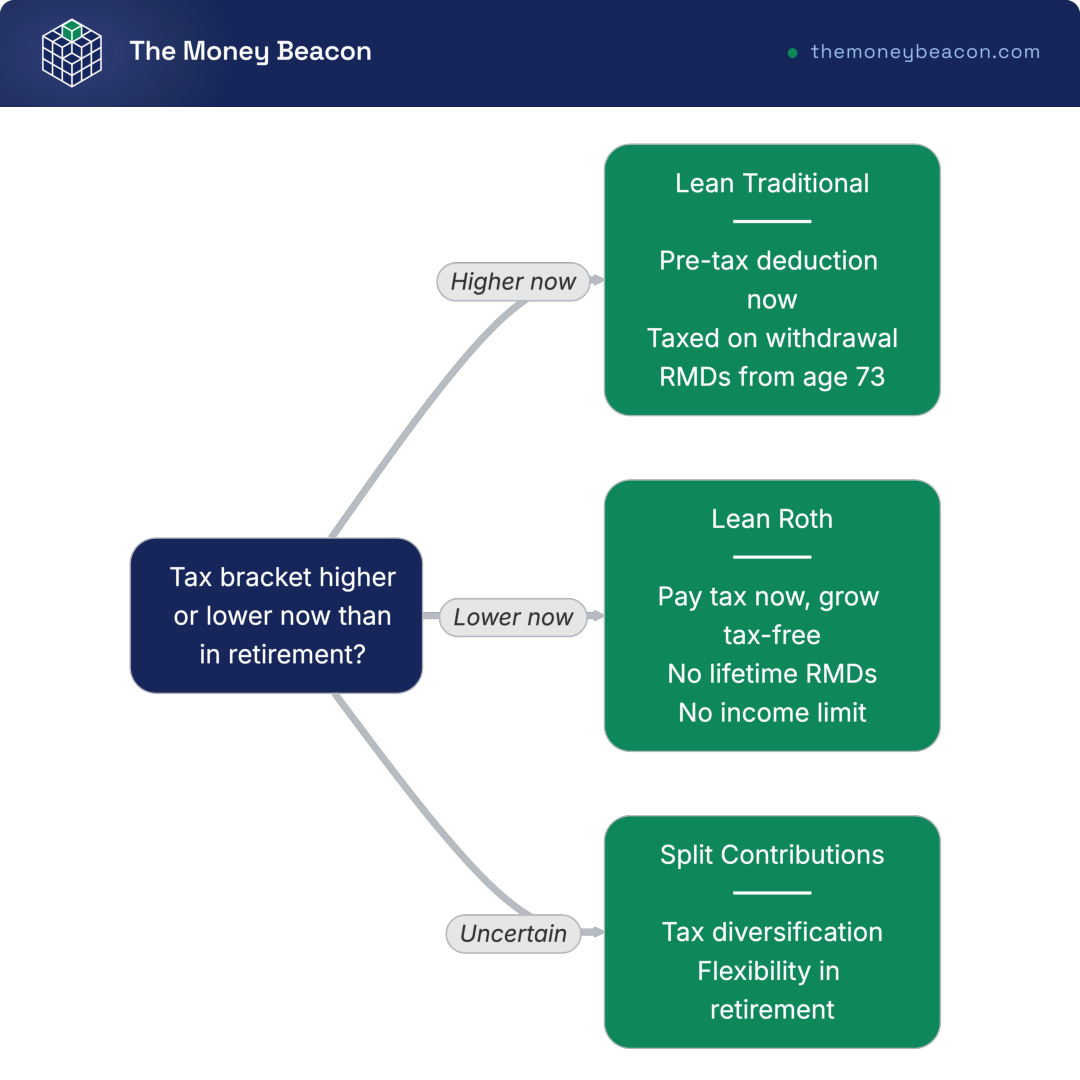
Knowing how each one is taxed is the easy part. The harder question is which one fits your own situation.
4.2 Who should choose which, the case for splitting, and how the match is taxed
So how do you actually decide? The whole choice reduces to one comparison: is your tax rate higher now than you expect it to be in retirement, or lower? If your current bracket is lower than the one you expect later, favor Roth and pay the tax cheaply now, while it is on sale. If you are at a peak-earning bracket today and expect a lower-income retirement, the traditional deduction is worth more to you now than the tax-free withdrawal will be later, because a pre-tax contribution is one of the simplest ways to cut your taxable income this year while your bracket is high. The table lines up the two side by side.
| Feature | Traditional (pre-tax) | Roth (after-tax) |
|---|---|---|
| Tax on contribution | Deducted now | Taxed now |
| Tax on qualified withdrawal | Ordinary income | $0 (tax-free) |
| Lifetime RMDs (original owner) | Yes, from age 73 | No (since 2024) |
| Best when | Higher tax now than later | Lower tax now than later |
| Income limit to contribute | None | None (unlike Roth IRA) |
Data current as of June 2026.
Reading down the table, the honest answer for most people is that you do not actually know your future bracket, and pretending otherwise is where the mistake creeps in. That uncertainty is the case for splitting. Send some of each paycheck to traditional and some to Roth, and you build two different tax buckets to draw from in retirement, pulling from whichever one is cheaper in a given year. Younger and early-career workers, whose income still has room to climb, often lean Roth, because today’s low bracket is unlikely to repeat once their earnings peak. There is no universal right answer, only the bracket math applied to your own path.
Tom’s take
once you start optimizing across tax, legal, and estate at the same time, you stop seeing this as one-or-the-other. I deliberately keep money in more than one tax bucket so that in any given year I can decide where the next dollar of income comes from rather than letting a single account dictate it. The flexibility is the whole point.
There is one detail here that quietly trips up nearly everyone who contributes Roth, and it is worth getting right. Even if every dollar of your own contribution goes in as Roth, the employer match is almost always deposited pre-tax, into a traditional bucket of its own. So the match and all its growth will be taxed as ordinary income when you withdraw it, regardless of how you fund your side. SECURE 2.0 did add an optional feature letting plans deposit the match as Roth (IRS Notice 2024-02), but sponsors are not required to offer it, and where they do, you owe tax on that Roth match in the year it is made. The common assumption that “all my money is Roth” is usually wrong. With the tax wrapper settled, the account still sits empty until you choose what to actually buy inside it, and that is where fees start to matter.
5. How to Invest the Balance: Funds, Fees, and Costly Mistakes
The tax choice is made, but a 401(k) is still just an empty container until you pick what goes inside. This is the step where people either set themselves up with a cheap, sensible portfolio or quietly hand a slice of their retirement to fund fees. What should you buy, and how do you keep costs from eating the returns? We start with the simplest hands-off option, then show in real dollars what a small fee does over a career, and how to read your own menu well enough to dodge the expensive traps.
5.1 Target-date and index funds: a simple low-cost portfolio
The good news is that the simplest option is also a perfectly good one. A target-date fund is a single all-in-one fund labeled with a retirement year, say “Target 2055,” that holds a diversified mix of stocks and bonds and automatically grows more conservative as that year approaches. It is the default investment in most auto-enrolled plans for a reason: one fund, no rebalancing, no decisions. The only thing to check is the price tag, because costs on target-date funds vary by a factor of five or more. Index-based versions run about 0.08% at Vanguard and 0.12% at Fidelity, while actively managed ones commonly charge 0.50% to 0.65%, against an industry average near 0.41%.
If you would rather build it yourself, an index fund tracks a whole market segment at rock-bottom cost, and three of them cover most of what a target-date fund does. The classic mix pairs a total US stock fund, a total international stock fund, and a total US bond fund, weighted heavily toward stocks when you are young and shifting toward bonds as you near retirement. The table lays out the common building blocks you are likely to find on your plan’s menu.
| Fund type | Asset class | Typical role | Typical expense ratio |
|---|---|---|---|
| Total US stock index | US equities | Core growth | ~0.02%-0.05% |
| S&P 500 index | US large-cap equities | Core growth | ~0.02%-0.05% |
| Total international index | Non-US equities | Diversification | ~0.05%-0.11% |
| Total US bond index | Bonds | Stability/income | ~0.03%-0.05% |
| Stable value / money market | Cash-like | Capital preservation | ~0.25%-0.50% |
| Target-date (index) | Mixed (one fund) | All-in-one | ~0.08%-0.12% |
Data current as of June 2026.
Every row in that table is an asset class held inside the 401(k), not a competing account. For the do-it-yourself saver, these are the same kind of cheap, broadly diversified funds you would reach for in any account. Whichever route you take, the number to watch on every line is that expense ratio, because it does more damage than it looks.
5.2 Expense ratios: the fee that compounds against you
An expense ratio is the annual percentage a fund skims off the top, deducted so quietly you never see it leave. The figure looks trivial, often a fraction of one percent, which is exactly why it does so much harm: nobody flinches at a rounding error, and the rounding error compounds for 35 years. Here is what that looks like in dollars. Invest $10,000 a year for 35 years at a 7% gross return, and at a 0.05% fee you finish near $1,360,000. Bump the fee to 0.50% and you give up roughly $120,000. Take it to 1.00% and you surrender about $245,000, nearly a fifth of the cheap-fund result, handed over for nothing.
Put another way, a 1%-fee active fund has to beat a cheap index fund by a full percentage point every single year just to break even with it, and the long-run record shows that most active managers do not clear that bar. This is the practical case behind the finding that low-cost index funds outperform most active managers over long horizons. The chart below traces how the three fee levels pull apart over a career.
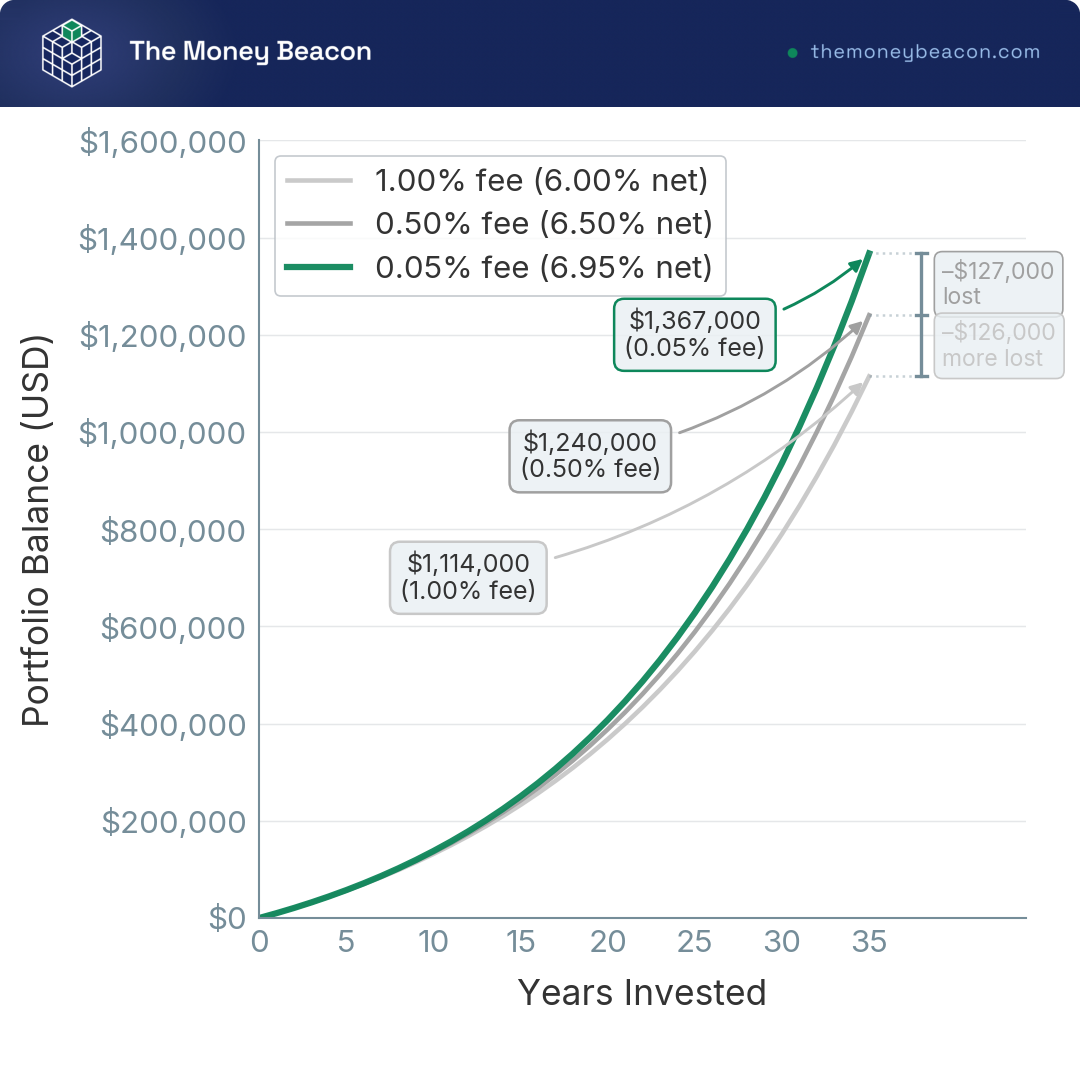
A six-figure cost is worth ten minutes of reading, so the next move is learning to spot those fees on your own plan’s paperwork.
5.3 Reading your fund menu and spotting the high-fee options
Where do those numbers actually live? Your plan has to hand you a 404(a)(5) fee disclosure, the document mentioned earlier when we covered who runs the plan, and it lists every fund’s expense ratio next to any administrative or recordkeeping charges. Read it with one rule of thumb in hand: if your plan offers an index target-date fund near 0.10%, use it over an active fund above 0.50% that shows no consistent edge. The cheap option is almost never the wrong call.
A few red flags are worth knowing by sight. Treat any actively managed fund above 0.75% as a flag to investigate, since you are paying a premium that the long-run data rarely justifies. Watch too for annuity or insurance products tucked inside the menu, which can carry surrender charges if you move your money, and for managed-account add-on fees layered on top of the fund costs. Choosing the low-cost index options on your menu and skipping the expensive layers is most of the battle. The chart contrasts typical index and active costs against that 0.75% threshold.
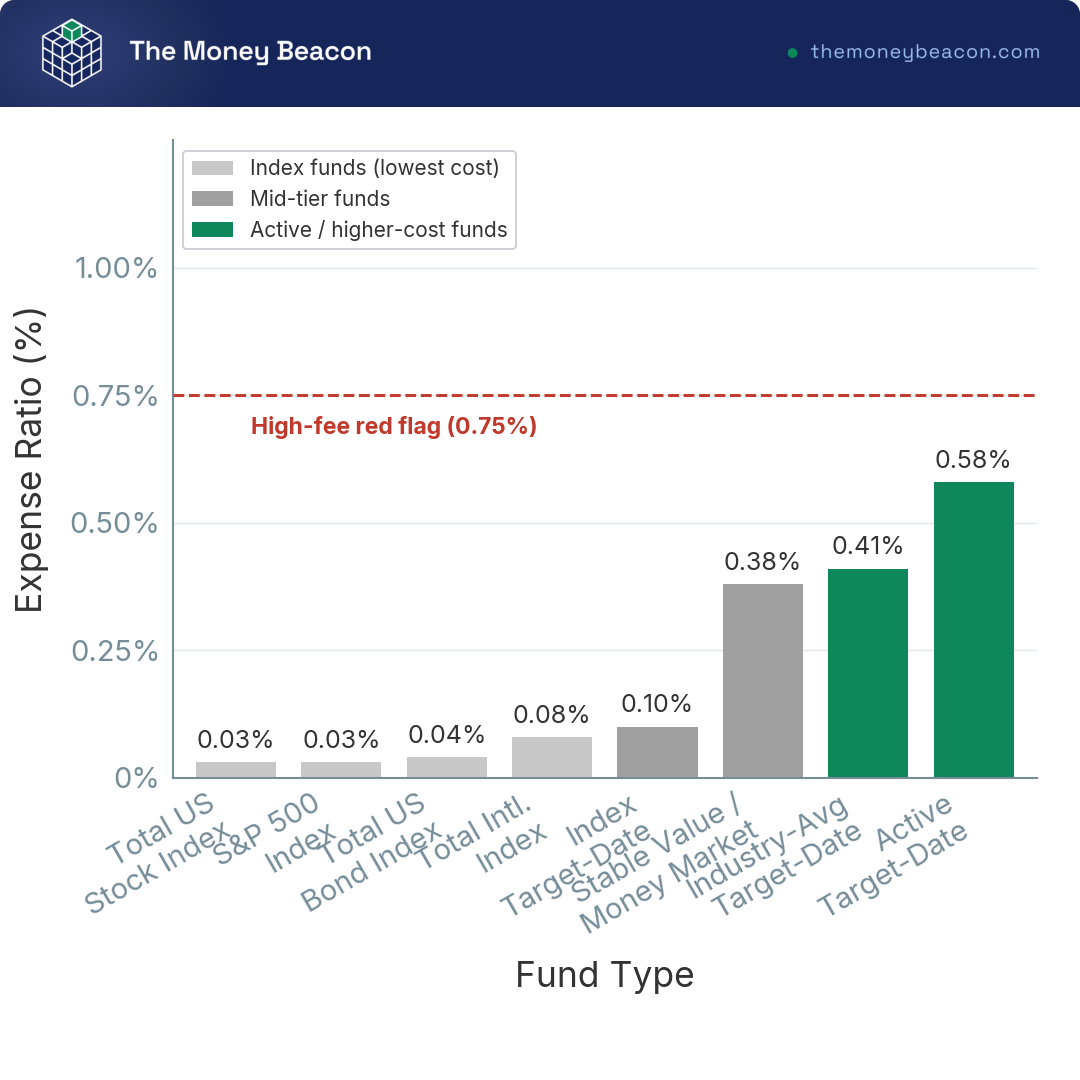
One last confusion is worth clearing up, because it quietly distorts how people think about all of this.
5.4 Account vs asset class: do not confuse the wrapper with what is inside
Here is the subtlety that trips up beginners quite a lot: an account is not an asset class, and the two are not rival choices. People ask whether they should buy “a 401(k) or an index fund,” or pit “a Roth IRA against an ETF,” as if those sat on the same shelf. They do not. There are three separate levels, and keeping them straight makes the whole subject click. The account (a 401(k), a Roth IRA, an HSA, a taxable brokerage) is a tax wrapper, and it answers one question: how is this money taxed and what are the rules? The asset class (US stocks, international stocks, bonds, cash) answers a different one: what is the risk and return of the thing you own? And the fund (an index fund, an ETF, a target-date fund) answers a third: how do you own that asset class cheaply?
Choosing the account decides how it is taxed; choosing the funds decides what it owns. A 401(k) does not compete with an index fund, it holds one. Get this backward and you make category errors that cost money, like fixating on the wrapper while ignoring the fee on the fund inside it, which, as the last subsection showed, is where a six-figure leak actually opens up. The diagram below separates the two circles cleanly.
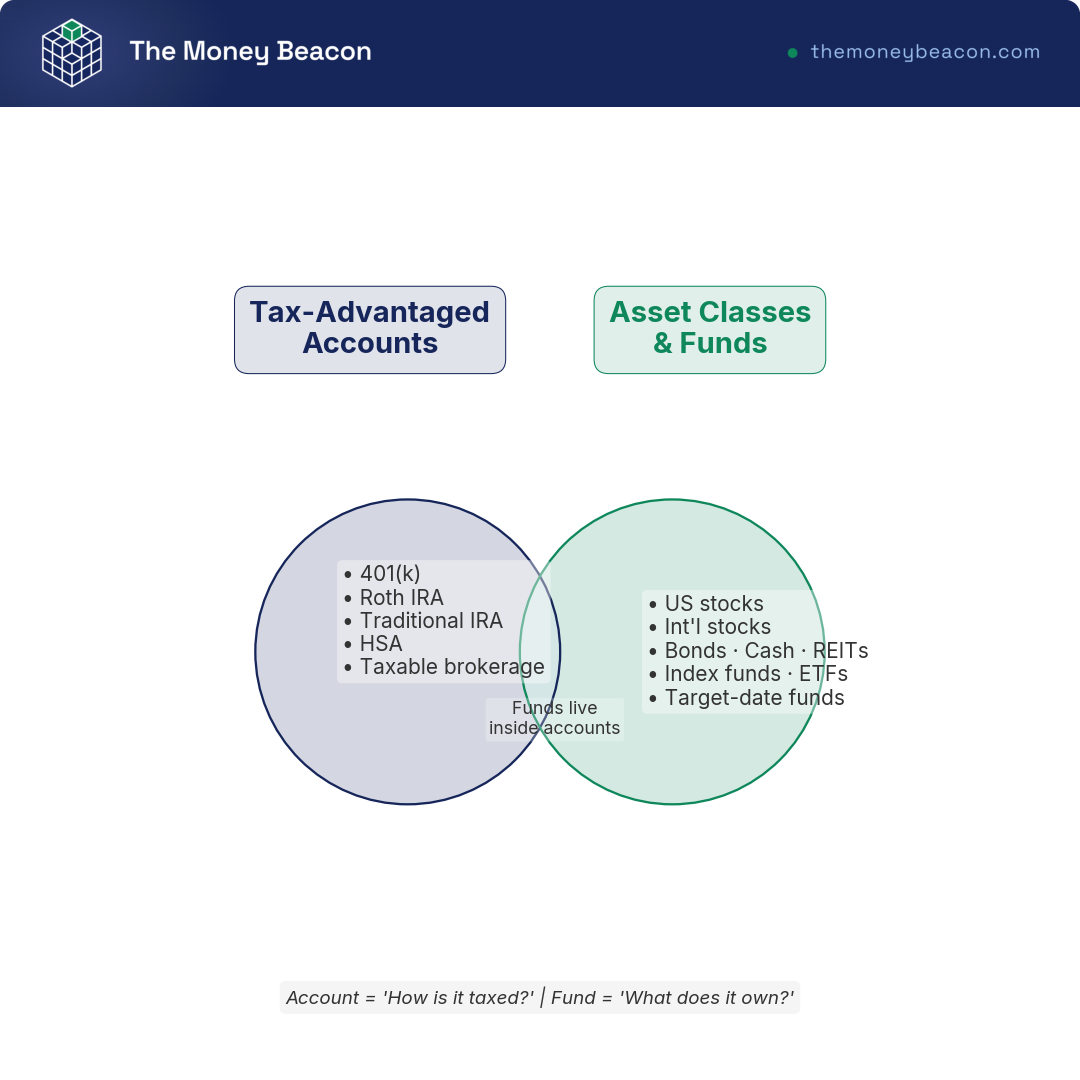
You have the account funded, the tax type chosen, and cheap funds inside it. The next thing that can undo all of that careful work is not the market, it is the day you change jobs.
6. Changing Jobs: Leave It, Roll It, or Cash Out
Sooner or later you leave the employer, and the 401(k) you built does not vanish, it just needs a decision. Your vested balance is yours to move, but where it goes can mean the difference between uninterrupted compounding and a tax bill that costs you thousands. So what do you do with an old 401(k)? We lay out the four options side by side, weigh the three sensible ones against the one costly mistake, walk the exact rollover steps, and finish with the parallel setup for the self-employed.
6.1 The four options for an old 401(k), side by side
When you walk out the door, four paths open up for the account you leave behind, and only your vested balance, the part that is fully yours after the vesting rules covered earlier, makes the trip. You can leave the money in the old plan, roll it into an IRA, roll it into your new employer’s 401(k), or cash it out. The table sets them next to each other on the criteria that decide between them.
| Option | Tax hit now | Investment menu | Keeps Rule of 55? | Best for |
|---|---|---|---|---|
| Leave in old plan | None | Old plan only | Old plan only | Good cheap legacy funds |
| Roll to IRA | None (direct) | Entire market | No | Want widest, cheapest choice |
| Roll to new 401(k) | None (direct) | New plan only | Yes (new plan) | Consolidation + creditor protection |
| Cash out | Income tax + 10% penalty if <59 1/2 | N/A | N/A | Almost never |
Data current as of June 2026.
Three of those four keep your money working and trigger no tax; the fourth, as the next subsections show, is the one to avoid. One mechanical point shapes whether the choice is even yours: small balances can be forced out when you leave. A vested balance over $1,000 and up to $7,000 can be automatically rolled into an IRA by the plan (the threshold was raised from $5,000 by SECURE 2.0), and a balance under $1,000 may simply be cashed out and mailed to you. Above $7,000, you decide. The required withdrawal rules that govern the account later do not apply to this move at all; this is purely about where the balance lives next.
6.2 Leave it, roll to an IRA, or roll to the new 401(k)
Start with the do-nothing option, because it is not always wrong. Leaving the money in the old plan makes sense when that plan holds genuinely cheap institutional funds you cannot easily replicate elsewhere. The real risk is human: orphaned accounts get forgotten, and a balance you stop logging into is one you stop managing.
Rolling to an IRA opens the widest and usually cheapest door. A direct rollover into a traditional IRA preserves the tax deferral and gives you the entire market to invest in, any ETF, index fund, or individual security, often at lower cost than a plan menu. The trade-off is a wrinkle most people never hear about: a sizable traditional-IRA balance can taint a future backdoor Roth through the pro-rata rule, which taxes any conversion proportionally across all your traditional IRA money (you track the nondeductible basis on Form 8606). An IRA also does not keep the Rule of 55, the early-access provision we get to in section 7. If you go this route, the destination is one of the low-cost brokerages built for US investors that charge nothing to hold the account.
Rolling into your new employer’s 401(k) is the option that keeps the 401(k)-specific perks intact. It preserves your Rule of 55 eligibility in the new plan, keeps the strong ERISA creditor protection that shields a 401(k), and keeps the balance out of that IRA pro-rata math entirely. The cost is choice, since you are limited to the new plan’s menu. Whichever way you go, one rule never bends: match traditional-to-traditional and Roth-to-Roth, or you manufacture a tax bill out of thin air. The decision tree below walks the branches in order.
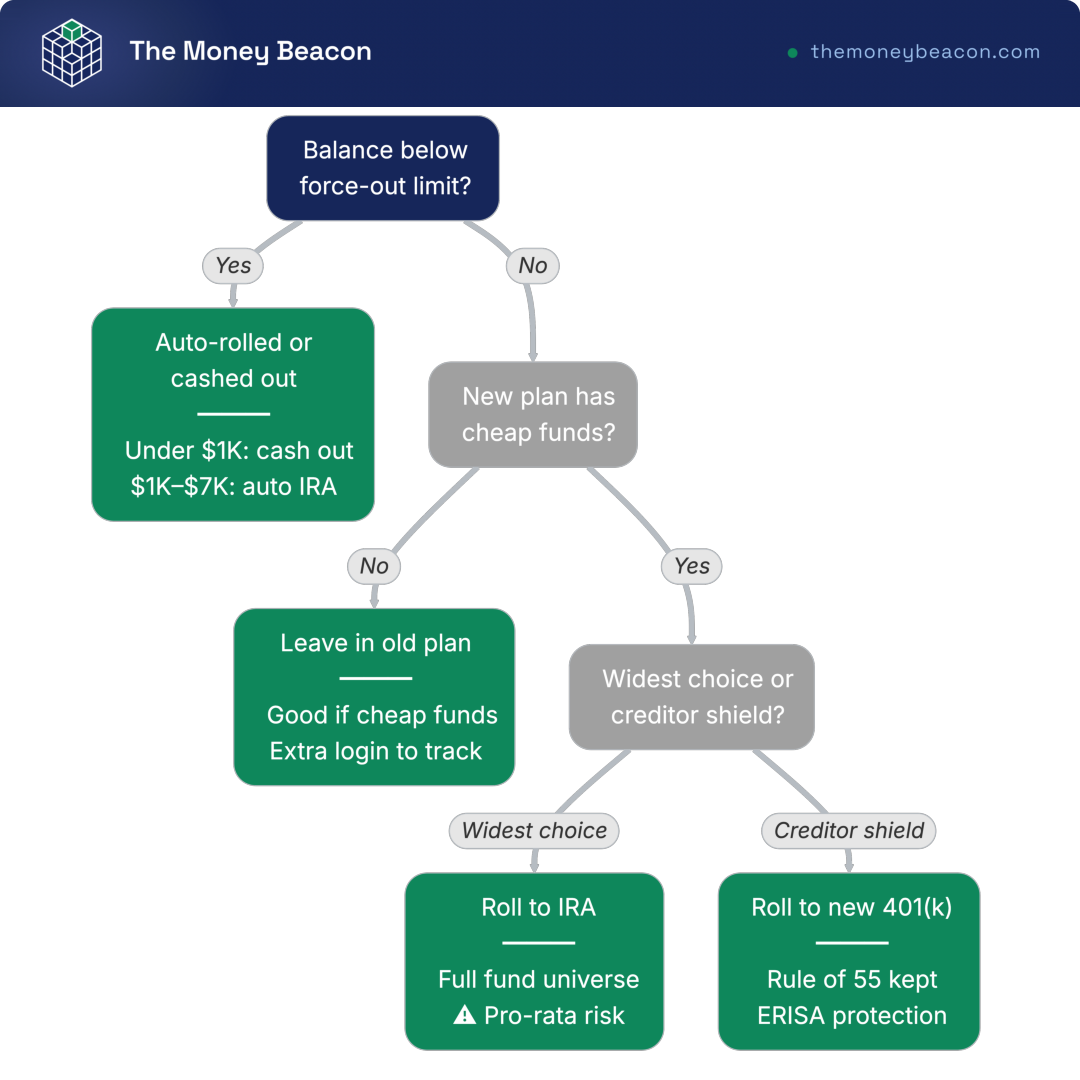
That covers the three options that keep your money invested. The fourth deserves its own warning, along with the exact steps to do a rollover right.
6.3 Cashing out, and the step-by-step direct rollover
Cashing out feels like the simple choice, and it is the single most expensive mistake people make on a job change. Take the balance in cash before age 59 1/2 and it is taxed as ordinary income and hit with the 10% early-withdrawal penalty on top. For a 24%-bracket worker, a $30,000 cash-out can lose roughly $10,000 to tax and penalty before any state tax, and that ignores the decades of compounding that money will now never do. The plan also withholds 20% up front, so you do not even receive the full amount you are torching. Cashing out a small old balance, the one that looks too modest to bother rolling, is the costliest common move there is.
The right move is a direct rollover, and the procedure is five plain steps. First, open the destination account, the IRA or new 401(k) where the money will land. Second, request a direct, trustee-to-trustee rollover from the old plan, so the funds move institution to institution and never pass through your hands. Third, match the tax type, traditional-to-traditional or Roth-to-Roth. Fourth, confirm there is no withholding. Fifth, invest the cash once it arrives, because a rollover that lands in a settlement fund and sits in cash is not doing its job. The flowchart below lays the sequence out.
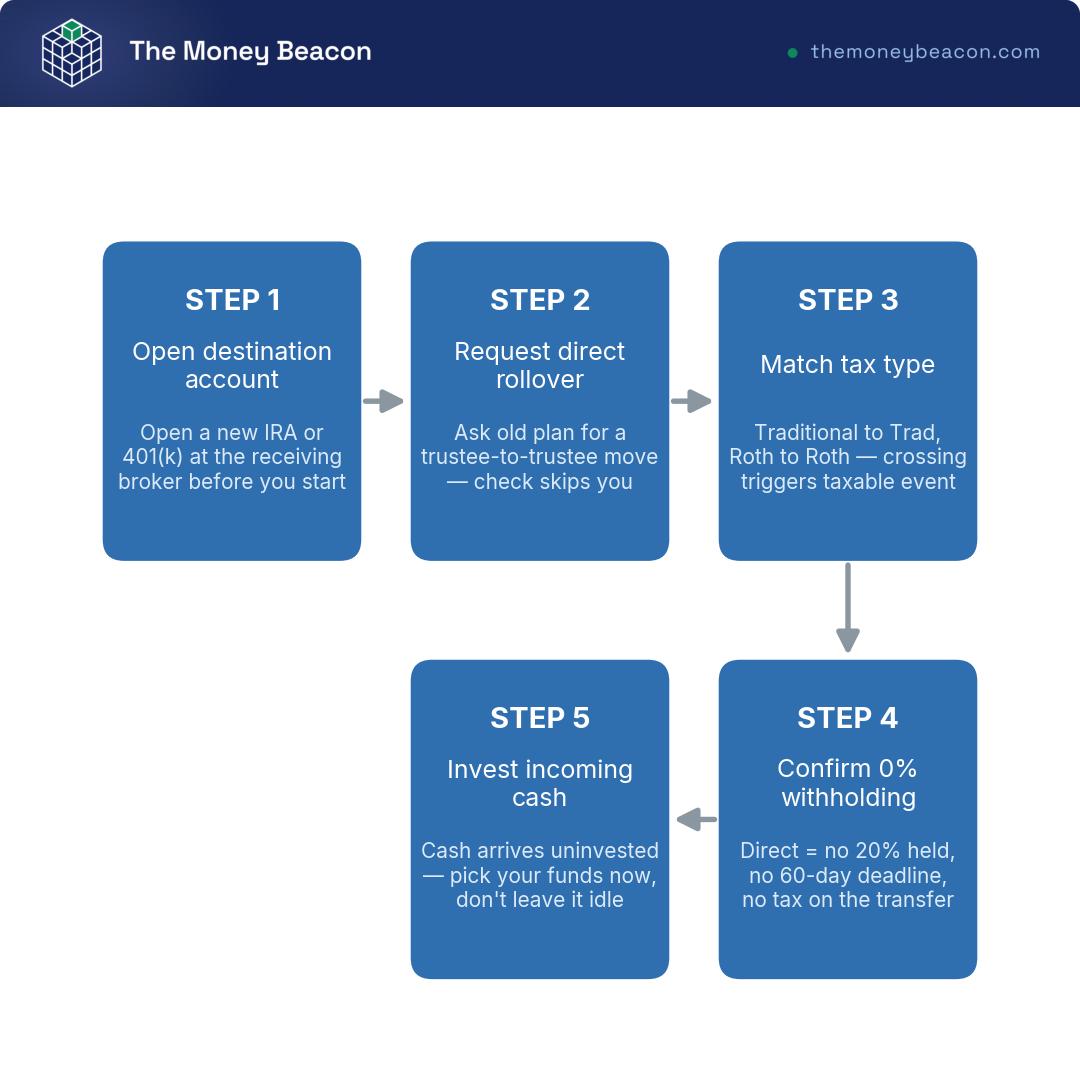
One trap is worth calling out, because it is easy to stumble into. An indirect rollover, where the plan cuts the check to you, forces a 20% withholding and starts a 60-day clock to redeposit the full amount elsewhere, including the withheld 20% you have to make up from your own pocket. Always choose the direct rollover and you sidestep the whole mess.
6.4 If you are self-employed: Solo 401(k), SEP, and SIMPLE
We have run this whole guide through the eyes of a W-2 employee, but if you work for yourself the same logic applies through different containers. The defining twist is that you wear both hats: you contribute as the “employee” up to the $24,500 deferral limit and again as the “employer,” together up to the $72,000 combined annual cap. There is no match to chase and no vesting schedule to clear here, because you are the employer. The table compares the parallel accounts.
| Account | Who it is for | 2026 employee limit | Roth option | Employer money |
|---|---|---|---|---|
| Employer 401(k) | W-2 employees | $24,500 | Usually | Match/non-elective |
| Solo 401(k) | Self-employed, no employees | $24,500 | Yes | Self as employer |
| SEP IRA | Self-employed/small biz | N/A (employer) | No | Up to $72,000 |
| SIMPLE IRA | Small employers | ~$17,000 | Yes (since SECURE 2.0) | Required match |
| Traditional/Roth IRA | Anyone with earned income | $7,500 | Yes (Roth) | None |
Data current as of June 2026.
Two differences stand out when you read across the rows. A Solo 401(k) accepts Roth contributions, while a standard SEP IRA does not offer a Roth option or the mega-backdoor feature, so a saver who wants tax diversification has a real reason to prefer the Solo plan. And setting one up no longer means an expensive third-party administrator: fintechs like Guideline, Human Interest, and Betterment now run low-cost small-business plans built on index-fund lineups. If your situation gets complicated enough that the tax and plan choices start interacting, a fee-only fiduciary advisor can price the trade-offs without selling you a product. You now know how to move and house the account through a job change. What remains is the set of rules that govern getting money out, the penalties, the loans, and the distributions the IRS eventually forces, which is where we head next.
7. The Rules That Bite: Penalties, Loans, and Required Distributions
You now know how to move and house the account through a job change, and you saw that cashing out is the costly version of that move. Generalize that one mistake and you have the theme of this section: pulling money out of a 401(k) early is expensive by design, and at the far end of life the IRS eventually forces some of it out whether you want it or not. So what does early access actually cost, when can you skip the penalty, and what are you required to take out later? We start with the plain 10% penalty, work through the exceptions that waive it, weigh a loan against a withdrawal, and finish with the distributions you cannot avoid in retirement.
7.1 The 10% early-withdrawal penalty before age 59 1/2
The cash-out math you just saw is one instance of a standing rule. Pull money out of a traditional 401(k) before age 59 1/2 and it is taxed as ordinary income plus a 10% early-withdrawal penalty layered on top, not instead of the tax. Run the numbers on a $10,000 withdrawal in the 22% bracket: about $2,200 goes to income tax, another $1,000 to the penalty, and you keep roughly $6,800 before any state tax takes its own bite.
That 32% haircut is not a flaw in the account, it is the lock that keeps your retirement money pointed at retirement. The practical lesson follows directly: your 401(k) is a poor emergency fund, because reaching it early forfeits roughly a third of every dollar plus all the future growth that dollar would have earned. Build the cash cushion somewhere you can actually touch, and let the 401(k) do the one job the penalty is protecting. Not every early withdrawal triggers the 10%, though, and the decision tree below maps the off-ramps.
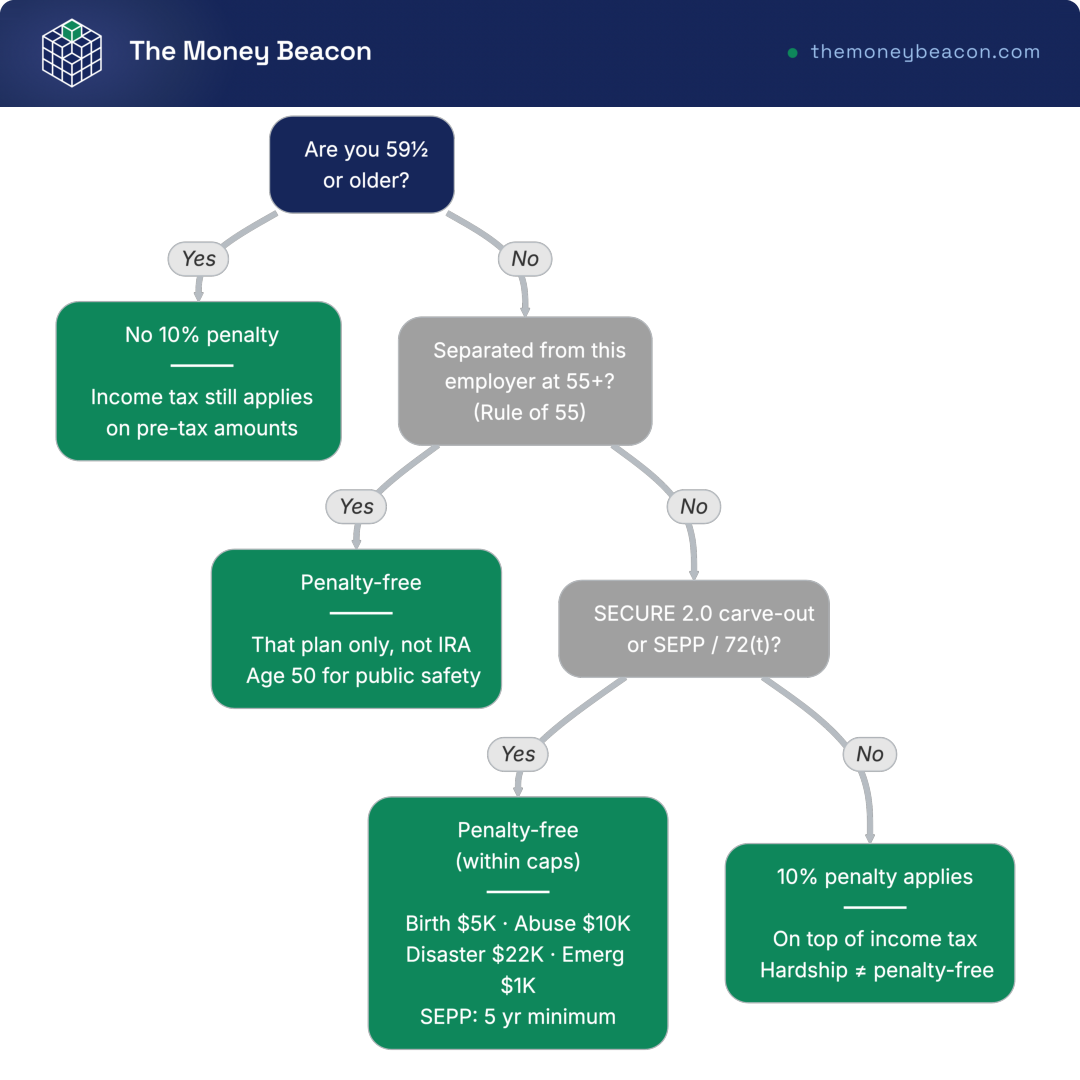
7.2 Exceptions: hardship, Rule of 55, SEPP/72(t), and SECURE 2.0 carve-outs
So when does the 10% actually disappear? A handful of specific exceptions waive the penalty, though the income tax on pre-tax dollars usually still applies. The one near-retirees ask about most is the Rule of 55: if you separate from your job in or after the year you turn 55, you can take penalty-free withdrawals, but only from that employer’s plan, and 50 is the age for qualified public-safety workers. Here is the trap that catches people who tidy up their accounts too soon: rolling that 401(k) into an IRA forfeits the Rule of 55 entirely, which is exactly why a roll-to-IRA can cost an early retiree the early-access door, as we flagged back in section 6.
A few other exceptions round out the list. SEPP, or 72(t), lets you take substantially equal periodic payments calculated by an IRS-approved method, held for the longer of five years or until age 59 1/2, and breaking the schedule early claws the penalties back retroactively. Permanent disability, death, an IRS levy, a divorce-related QDRO, and unreimbursed medical costs above 7.5% of your adjusted gross income all qualify too. SECURE 2.0 then added newer carve-outs within dollar caps: birth or adoption (up to $5,000), terminal illness, a federally declared disaster (up to $22,000), domestic abuse (the lesser of $10,000 or half the account), and a once-yearly emergency personal expense of up to $1,000. The table sorts the main triggers by what they waive.
| Trigger | 10% penalty waived? | Income tax still due? | Source plan |
|---|---|---|---|
| Age 59 1/2+ | Yes (no penalty) | Yes (traditional) | Any |
| Rule of 55 | Yes | Yes | That employer’s 401(k) only |
| SEPP / 72(t) | Yes | Yes | 401(k) or IRA |
| Disability / death | Yes | Yes | Any |
| Birth/adoption, disaster, abuse, $1,000 emergency | Yes (within caps) | Yes | 401(k)/IRA |
| Hardship (generic) | No (unless other exception) | Yes | 401(k) |
Data current as of June 2026.
The last row is the one that costs people money, so read it twice. A generic hardship withdrawal is not penalty-free. A hardship distribution lets you reach the money for an immediate, heavy need (medical bills, an eviction or foreclosure, tuition, a funeral, certain home repairs), but unless one of the exceptions above happens to cover your case, it is still taxed and still hit with the 10%. The word “hardship” feels like it should buy you a pass; it does not. One edge case runs the other way: a governmental 457(b) plan generally escapes the 10% on post-separation distributions, except on amounts rolled in from other plans. If you would rather not trigger any of this, there is an alternative that does not touch the penalty at all.
7.3 Borrowing against your 401(k): how loans work and the risks
What if you need the money but want to keep the account intact? If your plan allows it, you can borrow from your own 401(k) instead of withdrawing from it. The limit is the lesser of 50% of your vested balance or $50,000, and you repay it over about five years (longer for a loan to buy a primary residence) through payroll deduction, with the interest going back into your own account rather than to a bank. Repay on schedule and a loan is not a taxable distribution at all, which is its whole appeal over an early withdrawal. The table sets the two side by side.
| Feature | 401(k) loan | Early withdrawal (<59 1/2) |
|---|---|---|
| Taxed now | No (if repaid) | Yes (ordinary income) |
| 10% penalty | No (if repaid) | Yes (unless exception) |
| Must repay | Yes (~5 years) | No |
| Risk on job loss | Becomes taxable if unpaid | N/A |
| Growth lost | While borrowed | Permanently |
Data current as of June 2026.
Reading down those columns, a loan looks strictly better than a withdrawal, and on paper it often is, but the fourth row hides the real risk. Leave your job with an outstanding loan balance and it generally turns into a taxable, possibly penalized distribution, due by the deadline (including extensions) for filing that year’s tax return. A borrowing decision you made while employed can detonate the moment you are laid off, which is the worst possible time to owe tax. One myth deserves correcting while we are here: the idea that loan interest is “double-taxed.” You repay with after-tax dollars and pay tax again at withdrawal, true, but that is the same treatment as any after-tax money in a traditional account, not a special penalty on borrowing. The bigger cost is quieter: every dollar you borrow stops compounding for as long as it is out of the market. Borrowing is about getting money out early on your own terms; the last rule is about the money you are eventually forced to take.
7.4 Required minimum distributions (RMDs) in retirement
The account cannot defer tax forever, and this is where the bill finally comes due. A traditional 401(k) carries required minimum distributions, the withdrawals the IRS forces you to start taking at age 73 (rising to 75 in 2033 for anyone born in 1960 or later). Each year’s amount is your prior-year-end balance divided by an IRS life-expectancy factor, which is 26.5 at age 73. On a $500,000 balance, that first RMD is $500,000 / 26.5, or $18,867.92; on $100,000 it is $3,773.58. The chart below scales the first-year RMD across a range of balances.
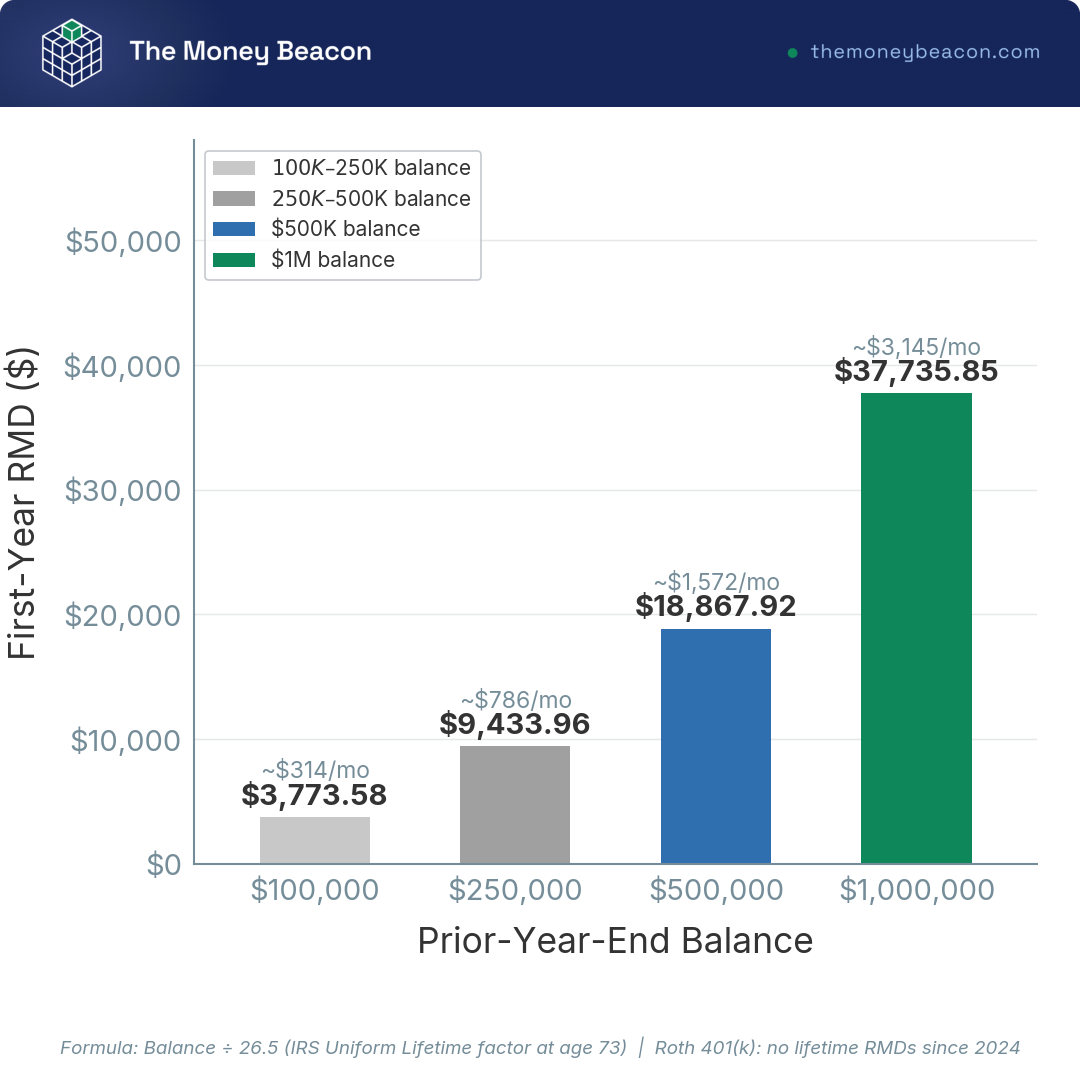
Two rules around the RMD are worth getting right, because both carry real money. The first is timing: take your first RMD by December 31 of the year you turn 73, or defer it to April 1 of the following year and accept that you will then take two RMDs in a single year, stacking the taxable income. Miss an RMD and the excise tax is 25% of the shortfall, reduced to 10% if you correct it promptly, a steep price for a calendar slip. The second is the Roth angle that quietly reshapes drawdown planning. Since 2024, a designated Roth 401(k) has no lifetime RMDs for the original owner, so that bucket can keep compounding untouched while you spend down the traditional balance first, and the order you draw across buckets is itself a tax question worth running across your whole portfolio.
Hank’s take
follow the data on retirement drawdowns and the same pattern shows up: people treat RMDs as a surprise rather than a date they have known for decades. The ones who plan the sequence, drawing taxable accounts and traditional balances on a schedule and letting Roth money ride, keep their bracket under control late in life. The forced withdrawal is not the problem; getting caught flat-footed by it is.
You now have every lever in the 401(k): how money goes in, how it is taxed, how it is invested, how it moves between jobs, and what it costs to take it out early or is forced out late. What is missing is the single page that puts them in order.
8. Your 401(k) Action Plan: The Decision Map at a Glance
Everything to this point has been one machine examined part by part. Now we bolt the parts together. If you stripped the guide down to the few decisions that actually move the outcome, what would you do at each one, and what is the mistake most likely to trip you there? The next two tables answer exactly that, first as a decision map across the six levers, then as a step-by-step checklist you can run from your first day of enrollment to your first RMD.
8.1 The 401(k) decision map: what matters most and what to do
Pulled into one view, the whole guide reduces to six levers, each with the one fact that decides it, the move to make, and the error to dodge.
| Lever | The decisive fact (2026) | What to do | Common mistake to avoid |
|---|---|---|---|
| Contribute | Employee limit $24,500; +$8,000 (50+) or +$11,250 (60-63) | Set deferral high enough to at least capture the full match | Staying at the 3% auto-enroll default |
| Match | Most common: 50% of first 6% | Defer at least the match threshold first | Leaving free money / forfeiting unvested funds |
| Tax choice | Traditional deducts now; Roth is tax-free later | Pick by current vs future bracket; split if unsure | Assuming the match is Roth (it is usually pre-tax) |
| Invest | Index funds ~0.05%; some active funds >1% | Use a low-cost index TDF or 3-fund mix | Paying 1% in fees for no edge |
| Job change | Direct rollover = no tax/withholding | Roll to IRA or new 401(k); never cash out | Cashing out and owing tax + 10% penalty |
| Withdraw | 10% penalty before 59 1/2; RMDs at 73 | Use exceptions (Rule of 55, SEPP) deliberately | Treating a hardship withdrawal as penalty-free |
Data current as of June 2026.
Read top to bottom, the map sorts itself by payoff: the match is the highest-return move and sits near the top, while fees and withdrawal rules are where careful savers quietly lose ground. The single thread running through every row is that the 401(k) rewards a few deliberate choices and punishes drift, the 3% default left untouched, the high-fee fund left unexamined, the old balance cashed out on the way to a new job. Reading the decisions is one thing; running them in order is another, which is what the checklist does.
8.2 Step-by-step checklist: to do, to avoid, and the common mistake at each step
The decision map tells you what matters; this last table tells you when. It walks the account’s whole life in sequence, from the day you enroll to the year your first RMD lands, pairing each step with the move to make and the mistake that most often derails it.
| Step | To do | To avoid | Common mistake |
|---|---|---|---|
| Enroll | Set deferral to at least the full-match level | Accepting the low default | 3% default misses half the match |
| Choose tax type | Decide traditional vs Roth deliberately | Defaulting without thinking | Ignoring future bracket |
| Invest | Pick a low-cost index option | High-fee active funds / annuities | Chasing past performance |
| Increase | Auto-escalate yearly toward the limit | Leaving the rate flat for years | Forgetting raises don’t raise savings automatically |
| Job change | Direct rollover (trustee-to-trustee) | Indirect rollover / cash-out | Triggering 20% withholding or the 10% penalty |
| Retirement | Plan RMDs by age 73 | Missing the RMD deadline | 25% excise tax on a missed RMD |
Data current as of June 2026.
The middle of that list is where the real compounding happens, and it closes the loop we opened back when we made the case for capturing the match. Grabbing the full match is the floor, not the ceiling: once it is secured, raise your deferral by about 1% a year, ideally timed to a raise so the cut never stings, and let auto-escalation carry the rate toward the limit while you barely notice. Do that, keep your funds cheap, and never cash out on a job change, and you have done the handful of things that decide whether this account funds the retirement it was built for. That is the whole operating manual in one ordered list.
Conclusion
Run well, the 401(k) rewards a few deliberate decisions and quietly punishes drift, and that is the whole story in one line. Capture the full employer match before anything else, because nothing else in personal finance pays you an instant 50% on the way in. From there the moves are unglamorous and they compound: pick a low-cost index fund near 0.10% rather than an active one over 0.50%, decide traditional versus Roth on purpose instead of by default, and never cash out an old balance on your way to a new job. The real shift is going from setting the account once on your first day to running it on a schedule, and that is what separates an account that funds retirement from one that leaks money to fees, taxes, and avoidable penalties.
A couple of details we covered are the ones people find out too late. The 60-63 super catch-up of $11,250 is a four-year window, not a permanent higher ceiling, so it reverts to $8,000 at 64. And the Rule of 55 lets you reach the money penalty-free from that employer’s plan, but rolling the balance into an IRA forfeits that door entirely, a mistake that comes up regularly among people who tidy up their accounts a year too soon.
Where you go next depends on the gap you most want to close. If your current tax bracket is lower than you expect it to be in retirement, the after-tax side of the math is worth a closer look in our guide to the Roth IRA, which also covers the income limits and the backdoor route the 401(k) sidesteps. And once the account is running on its own, the bigger question is how much you actually need and in what order to fund everything, the ground we cover in our retirement planning guide.
FAQ: Your 401(k) Questions, Answered
How much should I contribute to my 401(k) in 2026?
Start by deferring at least enough to capture your full employer match, because that money is guaranteed pay that no investment reliably matches. From there, a common planning benchmark is saving 12% to 15% of your salary, counting the employer contribution. The 2026 employee ceiling is $24,500, with an extra $8,000 if you are 50 or older and $11,250 if you are between ages 60 and 63. If 15% is out of reach right now, lock in the full match first, then nudge your contribution rate up about 1% a year until you get there.
What is the difference between a traditional 401(k) and a Roth 401(k)?
A traditional 401(k) is funded with pre-tax dollars, so you get a deduction now and pay ordinary income tax on every dollar you withdraw in retirement. A Roth 401(k) flips that: you contribute after-tax money with no deduction today, but qualified withdrawals taken after age 59 1/2 and a five-year holding period come out completely tax-free, growth included. Since 2024, the Roth 401(k) also carries no lifetime required minimum distributions for the original owner. Favor traditional when your tax rate is higher now than you expect it to be later, Roth when it is lower now, or split your contributions to hedge against future rates. Unlike a Roth IRA, the Roth 401(k) has no income limit, and our guide to the Roth IRA walks through how the two fit together.
What happens to my 401(k) when I change jobs?
Your vested balance belongs to you, and you have four choices for it. You can leave it in the old plan, roll it directly into an IRA, roll it into your new employer’s 401(k), or cash it out. A direct, trustee-to-trustee rollover moves the money with no tax and no withholding, which is why it is almost always the right call. Cashing out before age 59 1/2 means ordinary income tax plus a 10% early-withdrawal penalty, the costliest path by a wide margin. One detail to know: small vested balances up to $7,000 can be automatically rolled into an IRA by the plan when you leave.
Can I withdraw money from my 401(k) before age 59 1/2 without a penalty?
Sometimes, if your situation fits a specific exception. The Rule of 55 lets you take penalty-free withdrawals from that employer’s plan if you leave the job in or after the year you turn 55. SEPP, also called 72(t), allows substantially equal periodic payments penalty-free for the longer of five years or until you reach 59 1/2. SECURE 2.0 added penalty-free carve-outs for birth or adoption, a federally declared disaster, domestic abuse, terminal illness, and a once-a-year $1,000 emergency. Income tax still applies to any pre-tax amounts, and a generic hardship withdrawal usually still owes the 10% penalty, so do not assume hardship alone waives it.
What is a 401(k) employer match, and how does vesting work?
A match is employer money added to your account when you contribute. If your plan offers 50% of the first 6% of pay, contributing 6% earns you an extra 3% of pay in free money, an instant 50% return on those dollars. Defer at least enough to capture the full match before any other goal, since anything less leaves guaranteed pay on the table. Vesting decides how much of that employer money you keep if you leave early: a cliff schedule can take up to three years to vest you 100%, a graded schedule up to six years. Your own contributions, by contrast, are always 100% yours from day one.
Should I roll my old 401(k) into an IRA or my new employer’s plan?
It depends on what you value most. Rolling into an IRA opens the widest, cheapest investment universe, but it does not preserve Rule of 55 eligibility, and a traditional-IRA balance can taint a future backdoor Roth through the pro-rata rule. Rolling into your new 401(k) keeps Rule of 55 eligibility and ERISA creditor protection, and it keeps you out of that IRA pro-rata math. Either way, request a direct rollover and match traditional money to traditional and Roth to Roth. If you are weighing the broader picture of where each account fits, our retirement planning guide lays out how these pieces work together.
What are the 2026 401(k) contribution and catch-up limits?
The employee elective-deferral limit for 2026 is $24,500. The age-50 catch-up adds $8,000, the ages 60 to 63 super catch-up adds $11,250, and at age 64 the catch-up reverts to $8,000. The combined employer-plus-employee total annual additions limit is $72,000, plus any catch-up. One rule catches high earners off guard: if your prior-year FICA wages topped $145,000, you must make any catch-up contribution on a Roth basis starting in 2026, which means you lose the pre-tax catch-up deduction.
When do required minimum distributions from a 401(k) start?
Required minimum distributions from a traditional 401(k) begin at age 73, rising to 75 in 2033 for anyone born in 1960 or later. The first-year RMD uses the IRS Uniform Lifetime Table divisor of 26.5 at age 73, so a $500,000 balance produces a first RMD of $18,867.92. The costliest mistake is missing the deadline: the excise tax is 25% of the shortfall, reduced to 10% if you correct it promptly. Roth 401(k) balances no longer carry lifetime RMDs for the original owner, a change in effect since 2024 that reshapes how you sequence withdrawals. Because these distributions land as taxable income, our guide to investment taxes is worth pairing with this if you are planning a tax-efficient drawdown.



Comments
Questions and corrections welcome. We read everything.