


You’ve got a few thousand dollars (or a fat windfall) in your checking account, and you want to earn interest on it safely before you need it. So, you look online, and every online bank advertises a certificate of deposit (CD) rate to you. One boasts the highest 12-month annual percentage yield (APY); another offers a no-penalty CD; and a third provides a bump-up feature that allows you to increase your rate later. You’re left guessing which one actually fits your needs. The wrong choice can either lock up cash you need or cost you an early withdrawal penalty larger than the interest you earned.
So why does this matter right now? In June 2026, the Fed held its rate at 3.50% to 3.75% for the fourth consecutive meeting and reversed its earlier plan to cut. Therefore, today’s online bank 1-year CDs, which range from 3.8% to 4.0%, appear to be a temporary opportunity rather than a long-term trend. Put $10,000 in one for a year, and you’ll earn about $390 in interest. Leave the same amount in a typical bank that pays the Federal Deposit Insurance Corporation (FDIC) national average of about 1.65%, and you’d collect closer to $165. Same money, same safety, more than $200 a year apart.
Before I rank any CD offers, I’ll show you the exact method I use to compare them by rate, minimum, penalty, and FDIC coverage. Then, I will walk you through all six offers, one at a time, and conclude with my recommendation for your situation, whether you’re looking for the highest yield, want easy access to your cash, or are building a ladder.
1. How we compared these CDs: criteria, rate backdrop, and the 2026 lineup
The 2026 rate landscape at a glance
I’ll start by ranking six online banks in this comparison by their 12-month APY. As you can see in the chart below, they cluster near the top rate of 4.00%. A couple are right around 4.00% for one year, the rest fan out down to about 3.25%. All of them are higher than the FDIC’s national 12-month average of roughly 1.65%, by more than two full percentage points. The spread among them is narrow, so think of the chart below as a starting point: the real decision depends on the next set of criteria, not on who is a few hundredths of a point higher this week.
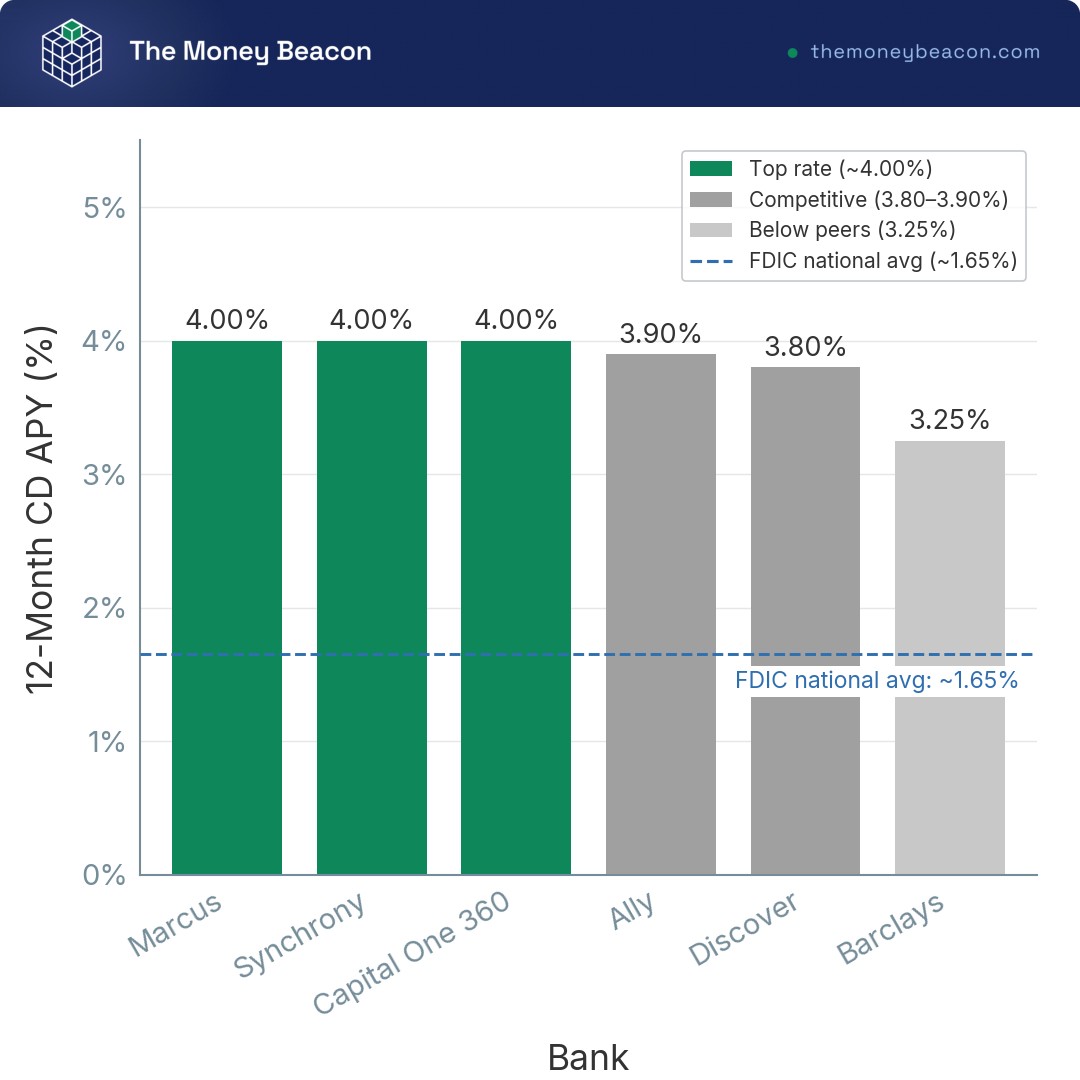
These are high yield cd rates by any reasonable standard.
The five criteria that actually decide a CD
A CD involves five separate decisions, and the APY is only one of them. The other four factors are the minimum deposit (whether you even qualify), the early-withdrawal penalty (what it costs to break the CD before it matures, quoted in days or months of forfeited interest), the special CD types on offer (a no-penalty CD lets you withdraw after a short waiting period without losing interest; a bump-up CD lets you raise your rate during the term), and FDIC coverage (the safety floor). Here’s what each one actually controls:
| Criterion | What it controls | Why it matters to a saver |
|---|---|---|
| APY by term | Yield earned, compounded annually | The headline number, but only one of five inputs |
| Minimum deposit | Whether you qualify | $0 minimums widen access; jumbo tiers may pay more |
| Early-withdrawal penalty | Cost if you need cash early | Can erase a rate advantage; short terms can dip into principal |
| Special CD types | Flexibility (no-penalty, bump-up) | Trades a lower APY for an exit or a rate-raise option |
| FDIC coverage | Safety of principal | Non-negotiable floor; covers up to limits |
Data current as of June 2026.
Here’s the rule I’d hold onto: when two CDs show the same 12-month APY, take the one with the milder penalty and the lower minimum, because those are the things that protect you when your plans change. It helps to match each dollar to a time horizon before you ever look at a rate sheet.
Why the headline rate matters less than you think
Let me express the rate difference in dollars because the abstraction obscures how small it is. For a $10,000, 12-month CD, 0.25% APY is worth approximately $25 per year. Across these six banks, the entire spread from the best to the worst headline rate is about $25 to $75 a year for $10,000. Now, weigh that against the cost of misjudging liquidity. Breaking a standard CD early will cost you around $74 to $111 in forfeited interest. In the short term, the penalty can dip into your principal, meaning you will walk away with less than you put in.
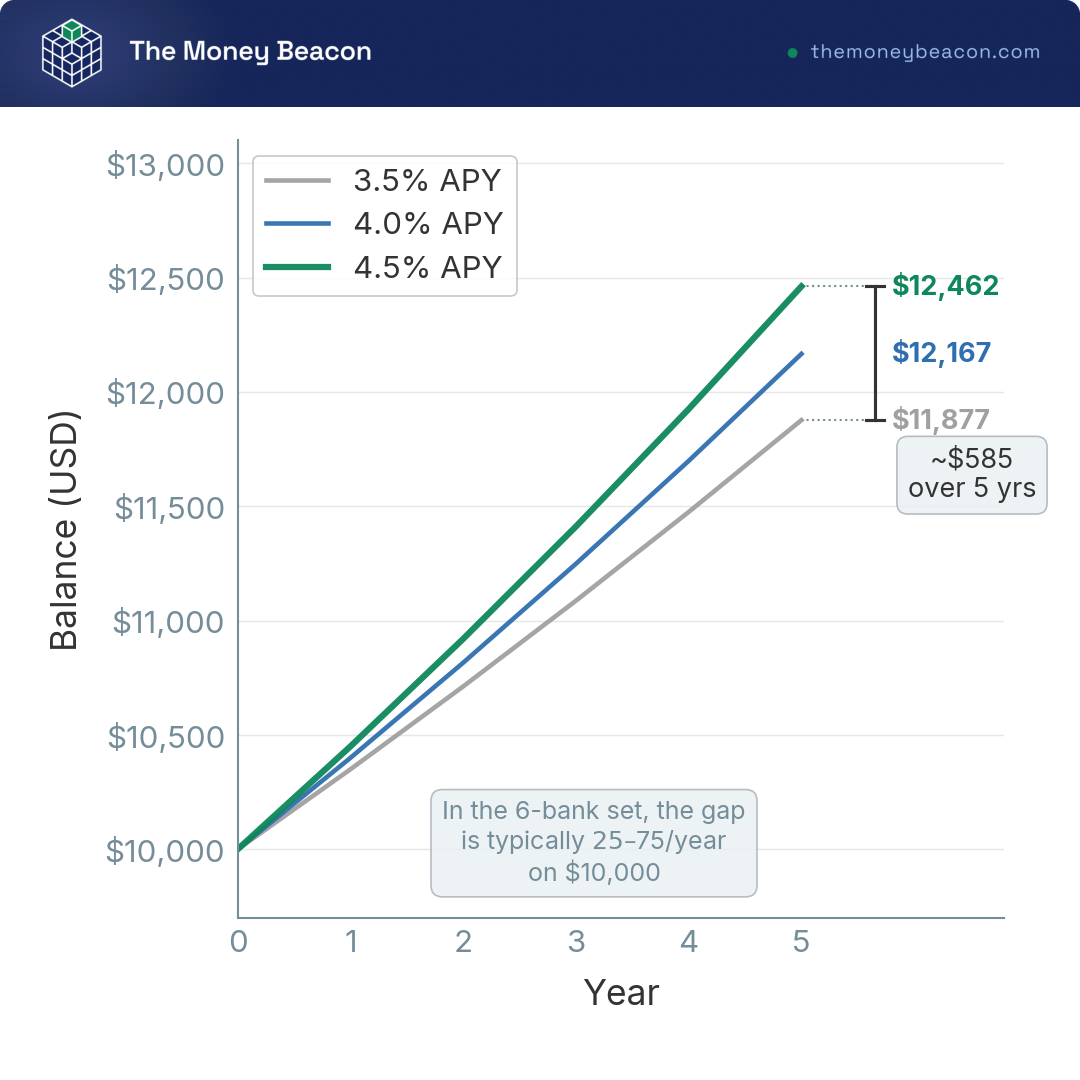
The chart below shows how $10,000 would grow over five years at three different interest rates. The difference between a 3.5% and a 4.5% CD is about $585 over five years. That’s real money, but far less than the cost of one mistimed exit. Term-fit and mild penalties beat chasing the top rate almost every time.
The 2026 rate backdrop: hold, maybe up
CD rates aren’t free floating; they track what the Federal Reserve does with short-term rates. Therefore, the macro picture sets the stage for everything below. Here are the current benchmarks that matter:
| Benchmark | Value (as of June 2026) | Source type |
|---|---|---|
| Federal funds target range | 3.50% to 3.75% | Federal Reserve (FOMC, June 17, 2026) |
| Federal funds effective rate | ~3.63% | Federal Reserve H.15 |
| FDIC national average, 12-month CD | ~1.65% | FDIC / FRED |
| FDIC national average savings | ~0.38% | FDIC / FRED |
Data current as of June 2026.
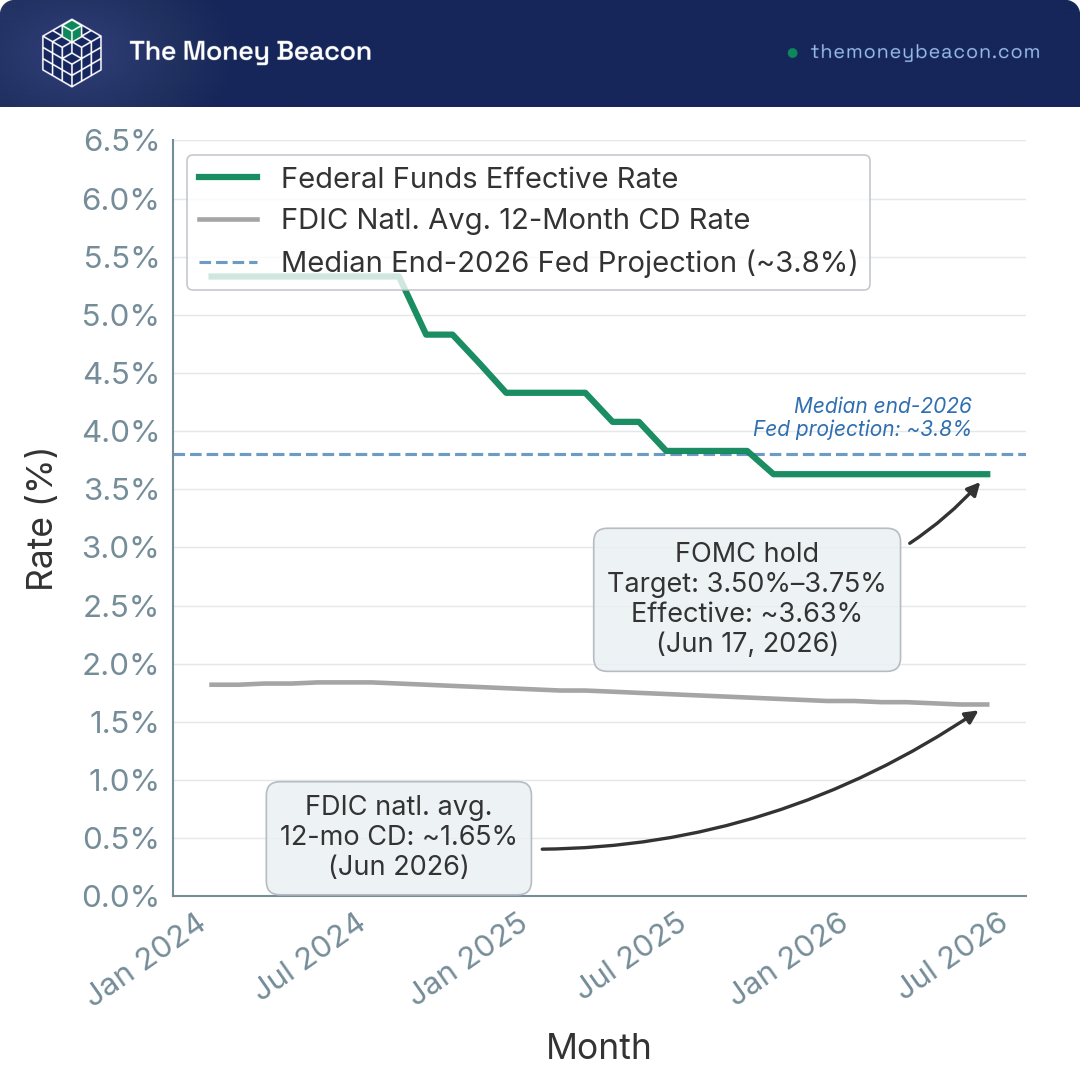
At its June 17, 2026 meeting the FOMC held the range at 3.50% to 3.75% for the fourth consecutive time. Its projections quietly removed the earlier 2026 cut path. The median member now estimates the end-of-2026 rate to be around 3.8%. Compared to the national average of 1.65% for CDs online banks look generous. So what does that mean for you? In this uncertain context, it may be smart to maintain flexibility with a shorter or no-penalty CD rather than locking in the longest term on a bet that rates are about to fall.
What the Fed signal means for locking a rate
The chart below shows the federal funds effective rate against the national 12-month CD average since January 2024. Note the recent flattening, where the June 2026 hold meets a hawkish tilt.
Hank’s take

follow the Fed closely and you realize a hold that walks back its own cut path isn’t routine, and by extension neither is the rate banks bother to offer right now; I’d treat today’s high-3s and low-4s as a window worth using, but not one worth over-committing to.
The FDIC floor and the 2026 lineup at a glance
Before chasing a rate, confirm its safety. The Federal Deposit Insurance Corporation (FDIC) insures deposits at member banks up to $250,000 per depositor, per insured bank, and per account ownership category. All six of the banks here are FDIC members, including Barclays Bank Delaware (FDIC certificate #57203).
| Bank (issuing entity) | 12-mo CD APY | Min. deposit | No-penalty CD? | Bump-up CD? |
|---|---|---|---|---|
| Marcus (Goldman Sachs Bank USA) | ~4.00% | $500 | Yes | Yes (Rate Bump) |
| Ally Bank | ~3.90% | $0 | Yes | Yes (Raise Your Rate) |
| Synchrony Bank | ~4.00% | $0 | Yes | Yes (Bump-Up) |
| Capital One 360 | ~4.00% | $0 | No | No |
| Discover Bank | ~3.80% | $0 | No | No |
| Barclays Bank Delaware | ~3.25% | $0 | No | No |
Data current as of June 2026; every APY and minimum must be re-verified on each bank’s own rate page.
These are online bank CD rates, , so they reset without notice. The rest of this guide reviews each bank individually. If you’re looking for a fully liquid alternative to a CD, comparison of the best HYSAs and APYs has you covered. Now, on to the first review.
2. Marcus by Goldman Sachs: a rate leader with both flexibility options
Marcus overview
Marcus is the consumer-deposit brand of Goldman Sachs Bank USA, an online-only operation with no branches and a deliberately short menu: a high-yield savings account and a full lineup of CDs, nothing more. As of June 2026, Marcus was among the rate leaders, with its 1-year CD paying about 4.00%. The pitch is simple: no checking account to manage and no sprawling product set. It’s just a clean, no-fee place to lock in a rate. If you want a high-interest certificate of deposit without the clutter of a full-service bank, Marcus is the bank for you.
Marcus strengths
Marcus offers competitive APYs across its entire term menu, with rates of approximately 4.00% for 6- and 12-month terms and around 3.90% for 3- and 5-year terms. Marcus is also one of the few banks that offers two types of flexibility: a No-Penalty CD on 7-, 11-, and 13-month terms, which allows you to withdraw funds without a penalty after the first seven days, and a Rate Bump CD on a 20-month term, which is ideal for savers who expect rates to climb. You also get a 10-day rate-guarantee window after opening (if the rate rises in those first days, you get the higher one) and a $0 monthly maintenance fee. Among the best 1 year cd rates you’ll find, few pair the yield with this much built-in flexibility.
Marcus weaknesses
The catch is the entry ticket: a $500 opening minimum, for all three CD types, the only non-zero minimum in this comparison. The early withdrawal penalty for short-term CDs is 90 days of interest, which is not the mildest. Penalties for longer terms climb to 180 to 270 days. The Rate Bump CD is only offered on a single 20-month term, and not for other terms. Because Marcus only offers deposit and savings accounts, there is no checking account and no way to bundle your CDs and spending in one app.
Marcus pricing & fees
| Item | Marcus |
|---|---|
| Monthly maintenance fee | $0 |
| Minimum opening deposit | $500 |
| Early-withdrawal penalty (terms ≤ 12 mo) | 90 days of simple interest |
| Early-withdrawal penalty (longer terms) | 180 to 270 days of interest (180 days for terms of about 1 to under 4 years) |
Data current as of June 2026.
Who Marcus is for
Marcus is ideal for a saver who wants a top-of-field rate plus the option of a no-penalty or bump-up CD, and who can comfortably meet the $500 minimum. It is not the right choice if you have less than $500 to deposit, or if you want a single app that bundles checking and CDs together. If you fit the first description, the next step is simple: confirm today’s 1-year APY on the Marcus rate page, then decide whether you want the standard, no-penalty, or Rate Bump version for your horizon.
3. Ally Bank: the mildest penalty and the broadest flexibility menu
Ally overview
Ally Bank is a full-service online bank and the direct banking subsidiary of Ally Financial. It offers checking and savings accounts, a money market account, and CDs. Its CDs paid about 3.90% on the 1-year in June 2026, and the whole lineup is built around flexibility rather than the single highest headline number. The benefit here is that you can manage your spending, your savings, and your locked-rate money in Ally Bank’s app, and that there are no minimum balances across the board.
Ally strengths
The standout feature is the penalty. Ally charges just 60 days of interest to break a short-term CD, the mildest schedule in this comparison, which (about $74 on a $10,000 12-month CD). Pair that with a $0 minimum and three CD types, including a No Penalty CD (penalty-free after the first 6 days) and a Raise Your Rate CD (one rate bump on the 2-year term, two on the 4-year), and you get the broadest flexibility menu in the set. There’s also a Ten Day Best Rate Guarantee, a 0.05% loyalty boost when you renew, and the convenience of full-service banking in a single app. For a saver scanning 6-month cd rates who also wants an easy exit, that combination is hard to beat.
Ally weaknesses
For all that flexibility, you give up a little of the top rate. The standard 1-year APY of about 3.90% may fall slightly short of the week’s top rate. If you break a longer CD, the penalty rises to 90, 120, or 150 days of interest, depending on the term. There are no physical branches, so in-person help is unavailable. The special CD APYs, including the No Penalty and Raise Your Rate versions, start a notch below the standard CD rate, which is the price you pay for the built-in options.
Ally pricing & fees
| Item | Ally |
|---|---|
| Monthly maintenance fee | $0 |
| Minimum opening deposit | $0 |
| EWP, terms ≤ 24 mo | 60 days of interest |
| EWP, terms 25 to 36 / 37 to 48 / 49+ mo | 90 / 120 / 150 days of interest |
| No Penalty CD | no EWP after first 6 days |
Data current as of June 2026.
Who Ally is for
Ally is the best choice for a saver who is concerned about liquidity or seeking flexibility and wants the lowest exit cost and the widest selection of special CDs with a $0 minimum. However, it is not the best option for someone looking to maximize their rate, since the standard rate is slightly below the top rate in the field. If you’re looking for flexibility, the next step is to decide between the standard CD and the No Penalty CD based on how likely you are to need the cash. Then, open an account with a $0 minimum and take advantage of the Ten Day Best Rate Guarantee.
4. Synchrony Bank: top-of-field rates with no-penalty and bump-up options
Synchrony overview
Synchrony Bank is an online deposits bank with no checking account, built around savings products: standard and special CDs, a high-yield savings account, and a money market account. In June 2026, Synchrony Bank consistently ranked among the top performers in this comparison. Its 1-year CD pays about 4.00%, with a $0 minimum. The appeal is straightforward: you get a top rate with some flexibility rather than a bare-bones product. If you’re looking for a high yield cd banks that offers a competitive APY and real exit options, Synchrony Bank is exactly what you’re looking for.
Synchrony strengths
The headline is the rate. In this comparison, standard terms were near the top at roughly 4.00% for the one-year term ending in June 2026, with no minimum to clear. The flexibility is the other half of the pitch. Synchrony offers two special CD types: a No-Penalty CD with an 11-month term and a Bump-Up CD with a 2-year term. This allows you to either maintain the option of an early exit or take advantage of a rate increase during the term. There’s also a 15-day rate-guarantee window after funding: if the posted rate rises in those first two weeks, you get the higher one. And there’s no monthly maintenance fee on any of it.
Synchrony weaknesses
The real cost shows up if you ever break a long CD. The early-withdrawal penalty climbs to 180 days of interest on 13- to 48-month terms and a full 365 days on anything 49 months or longer, the harshest in this set. The short-term penalty of 90 days is standard, but not the gentlest you’ll find. There’s no checking account either, so this can’t be your one-stop bank. And keep in mind that the Bump-Up CD allows only a single rate increase, locked to the 2-year term, so the rate-raise option is narrower than it first sounds.
Synchrony pricing & fees
| Item | Synchrony |
|---|---|
| Monthly maintenance fee | $0 |
| Minimum opening deposit | $0 |
| EWP, terms 12 mo or less | 90 days of simple interest |
| EWP, 13 to 48 mo / 49+ mo | 180 days / 365 days of interest |
Data current as of June 2026.
Who Synchrony is for
Synchrony is ideal for a rate maximizer who still wants a no-penalty or bump-up option and a $0 minimum to get in. It is not the right choice for anyone who might break a long-term CD, because that 365-day penalty on the longest terms can swallow a large slice of your interest. If that first description sounds like you, the next step is to confirm today’s 1-year APY on the Synchrony rate page, then decide between the standard CD and the 11-month No-Penalty CD based on how firmly you can keep your money locked in.
5. Capital One 360: one full-service online bank for everything
Capital One 360 overview
Capital One 360 is the online banking division of Capital One Bank (USA), N.A., a full-service bank that, unlike most in this category, maintains physical branches and cafés. It pairs 360 CDs with 360 Performance Savings and 360 Checking, so your spending, savings, and locked-rate money can all live under one login. The 1-year CD paid about 4.00% in June 2026 at a $0 minimum. Capital One also owns Discover, having closed that acquisition in May 2025, though the two brands run separate deposit products.
Capital One 360 strengths
The draw here isn’t a chart-topping rate, but rather the convenience of having everything in one place. You get competitive APYs of about 3.90% on the one-year term, a $0 minimum balance requirement, no monthly maintenance fee, and a single bank that handles checking, savings, CDs, and credit cards. The mobile app ranks near the top in both app stores. Unlike a pure online bank, you can visit a branch or café if you prefer to speak with someone in person. For savers who value having all their financial accounts in one place more than getting a few extra basis points, this bundle is ideal.
Capital One 360 weaknesses
The limitation is rigidity. Capital One 360 only offers standard CDs, with no no-penalty CD and no bump-up CD, so there’s no built-in exit and no way to raise your rate mid-term. If you need to break your CD early, the penalty is 90 days of interest on terms up to 12 months, rising to about 180 days on anything longer. At about 4.00%, the 1-year APY is competitive with other top rates, so the trade-off for full-service convenience is flexibility, not yield.
Capital One 360 pricing & fees
Here’s the info on a 360 CD.
| Item | Capital One 360 |
|---|---|
| Monthly maintenance fee | $0 |
| Minimum opening deposit | $0 |
| EWP, terms 12 mo or less | 3 months (about 90 days) of interest |
| EWP, terms over 12 mo | 6 months (about 180 days) of interest |
Data current as of June 2026.
Who Capital One 360 is for
Capital One 360 is the best choice for savers who want a full-service bank for all their needs, including access to branches and cafés, with no minimum balance requirement. However, it is not the right choice if you need the flexibility of a no-penalty or bump-up CD because it only offers standard CDs. If you want the convenience of having all your accounts in one place, first open a 360 Checking or Performance Savings account, then add a 360 CD with a term that matches your time horizon once your money is in one place.
6. Discover: the widest term range for ladder builders
Discover overview
Discover Bank is an online bank with the broadest term menu in this comparison, offering CDs from 3 months all the way out to 10 years, alongside savings, a money market account, and a cashback checking account. As of June 2026 it operates as a branded subsidiary of Capital One, with its deposit products continuing under the Discover name and its own rate sheet. The 1-year CD paid about 3.80% with a $0 minimum, having dropped its former $2,500 entry requirement.
Discover strengths
The standout feature is reach. With CD terms ranging from 3 months to 10 years, this is the widest span available, which is ideal if you’re building a multi-rung ladder and need a CD at every step. The minimum deposit has dropped from $2,500 to $0, opening the door to any deposit size. US-based phone support is available 24/7, which is a significant advantage if you bank at odd hours, and there’s no monthly maintenance fee. APYs remain competitive throughout the entire term range, ensuring that the long rungs of your ladder don’t suddenly become uncompetitive.
Discover weaknesses
At Discover, the flexibility trade-off cuts the other way. There are no special CD types, only standard CDs, so there is no early-exit or rate-raise option. The long-dated penalties are the harshest in this set, climbing to 9 months of interest on 4- to under-5-year terms, 18 months on 5- to 7-year terms, and a full 24 months on the 7- to 10-year band. The 1-year APY of about 3.80% is average, slightly below the top rates, so you’re choosing term breadth over the highest number.
Discover pricing & fees
| Item | Discover |
|---|---|
| Monthly maintenance fee | $0 |
| Minimum opening deposit | $0 |
| EWP, under 1 yr / 1 to under 4 yr | 3 months / 6 months of interest |
| EWP, 4 to under 5 yr / 5 to 7 yr / 7 to 10 yr | 9 months / 18 months / 24 months of interest |
Data current as of June 2026.
Who Discover is for
Discover is ideal for someone building a CD ladder who wants the widest choice of terms and a $0 minimum, with 24/7 US-based support. However, it is not the right choice for someone who might need to break a long-term CD, given the 9- to 24-month penalties on the longest terms. If you plan to ladder, the next step is to map your rungs to the term menu (1, 2, 3, 4, and 5 years), confirm today’s APY at each term on the Discover rate page, and open one CD per rung so that a portion matures every year.
7. Barclays: a no-frills online CD with a trailing rate
Barclays overview
You’ve now seen the five strongest options in this comparison, and Barclays is the plainest of the bunch. It runs its US deposits through Barclays Bank Delaware, an FDIC member with certificate #57203. The product set is narrowly focused on online CDs and savings accounts. There are no checking accounts or branches. In June 2026, the 1-year CD paid about 3.25%. This is deposit-only bank that focuses on one thing without the extras that some rivals offer, such as bundling, cafés, and special CDs.
Barclays strengths
The appeal here is simplicity at zero cost. You get a $0 minimum opening deposit and no monthly maintenance fee, so any deposit size gets you in and nothing nibbles at the balance while it sits there. The product set is easy to understand: a standard CD and a savings account, nothing you have to decode. The long-term penalty is milder than several rivals charge, at 180 days of interest on the longest terms rather than the year-or-more schedules some banks run. It is a FDIC member , so your principal is insured to the standard limits.
Barclays weaknesses
The big cost is the rate. That 1-year APY of about 3.25% was the lowest in this set in June 2026, so you give up a few tenths of a point compared to the leaders. There are no special CD types, which means no early-exit option and no way to raise your rate mid-term. The menu is thin, deposits and savings only. The longer terms pay even less, with the 3-year around 2.50% and the 5-year down near 2.00%, well below average. The short-term early-withdrawal penalty is the standard 90 days of interest.
Barclays pricing & fees
| Item | Barclays |
|---|---|
| Monthly maintenance fee | $0 |
| Minimum opening deposit | $0 |
| EWP, terms under 24 mo | 90 days of interest |
| EWP, terms 24 mo or more | 180 days of interest |
Data current as of June 2026.
Who Barclays is for
Barclays is the best choice if you want a simple, no-frills online CD with a $0 minimum deposit and don’t mind sacrificing a few basis points for that simplicity. However, it is not the right choice for rate maximizers or anyone who wants a no-penalty or bump-up option since it only offers standard CDs. If plain-and-cheap is what you’re after, your next step is to confirm today’s APY at your chosen term on the Barclays rate page.
8. The verdict: which CD fits which saver in 2026
The full 2026 CD comparison table
Here’s the whole field on a single set of lines. Verify each rate on the bank’s website before opening an account, as online bank APYs can change without notice.
| Bank | 6-mo APY | 12-mo APY | 3-yr APY | 5-yr APY | Min. deposit | Special CDs | Short-term EWP |
|---|---|---|---|---|---|---|---|
| Marcus | ~4.00% | ~4.00% | ~3.90% | ~3.90% | $500 | No-Penalty, Rate Bump | 90 days |
| Ally | ~3.90% | ~3.90% | ~3.85% | ~3.90% | $0 | No-Penalty, Raise Your Rate | 60 days |
| Synchrony | ~4.00% | ~4.00% | ~3.85% | ~3.90% | $0 | No-Penalty, Bump-Up | 90 days |
| Capital One 360 | ~3.20% | ~4.00% | ~3.50% | ~3.60% | $0 | None | 90 days |
| Discover | ~3.80% | ~3.80% | ~3.80% | ~3.85% | $0 | None | 90 days |
| Barclays | ~3.50% | ~3.25% | ~2.50% | ~2.00% | $0 | None | 90 days |
Data current as of June 2026; APYs, minimums, and penalties must be re-verified on each bank’s own page.
Who leads on rate, and how the ranking shifts by term
Marcus and Synchrony are in the lead with a 1-year rate of about 4.00%, and the rest of the competitors are close behind with rates within a fraction of a point. Change the term, however, and the leaderboard reshuffles. Barclays’ five-year rate drops to about 2.00%, while the others remain in the high 3s. Thus, the bank that’s only a notch behind at one year falls off a cliff at five.
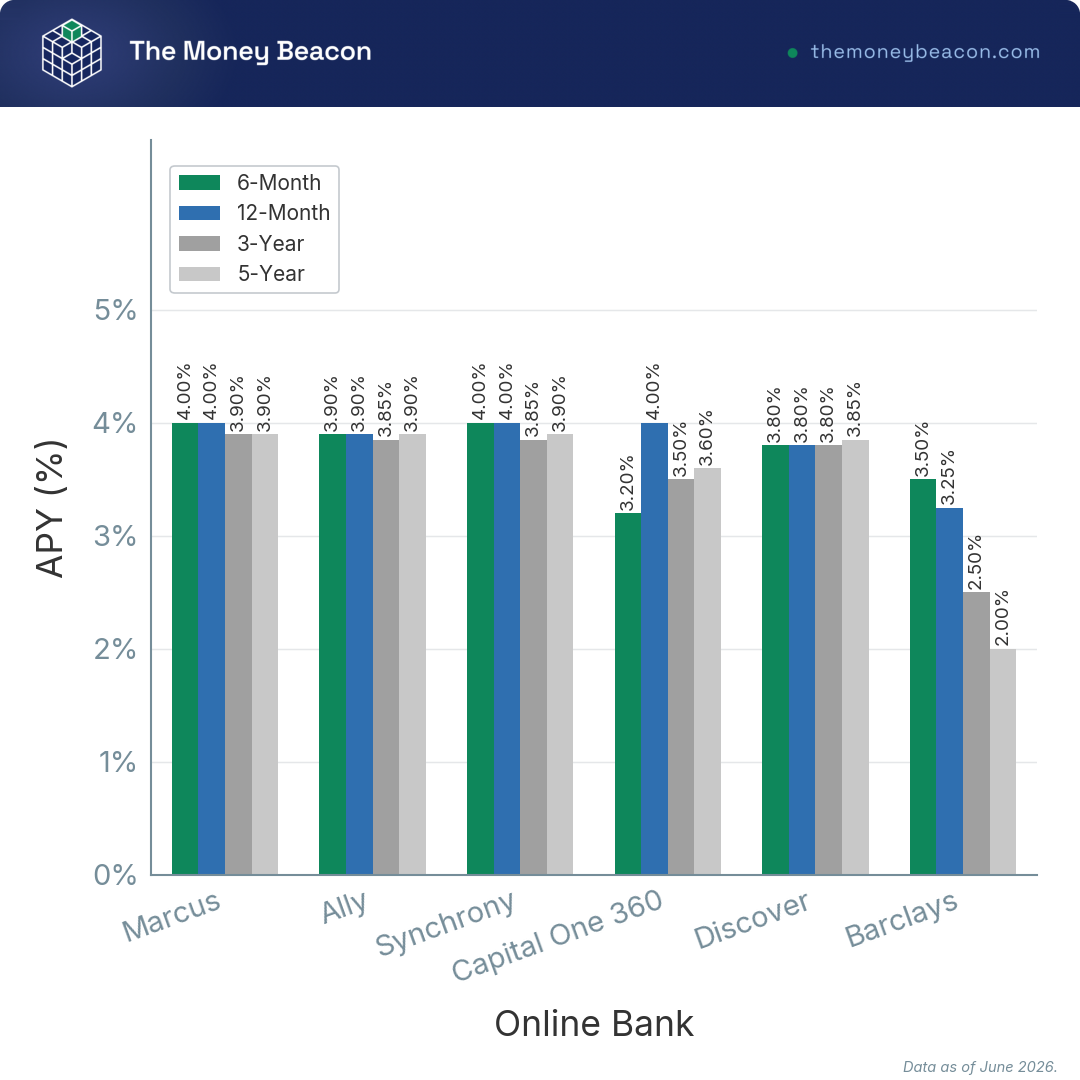
These are the highest certificate of deposit rates in the set at one year.
What breaking a CD costs at each bank
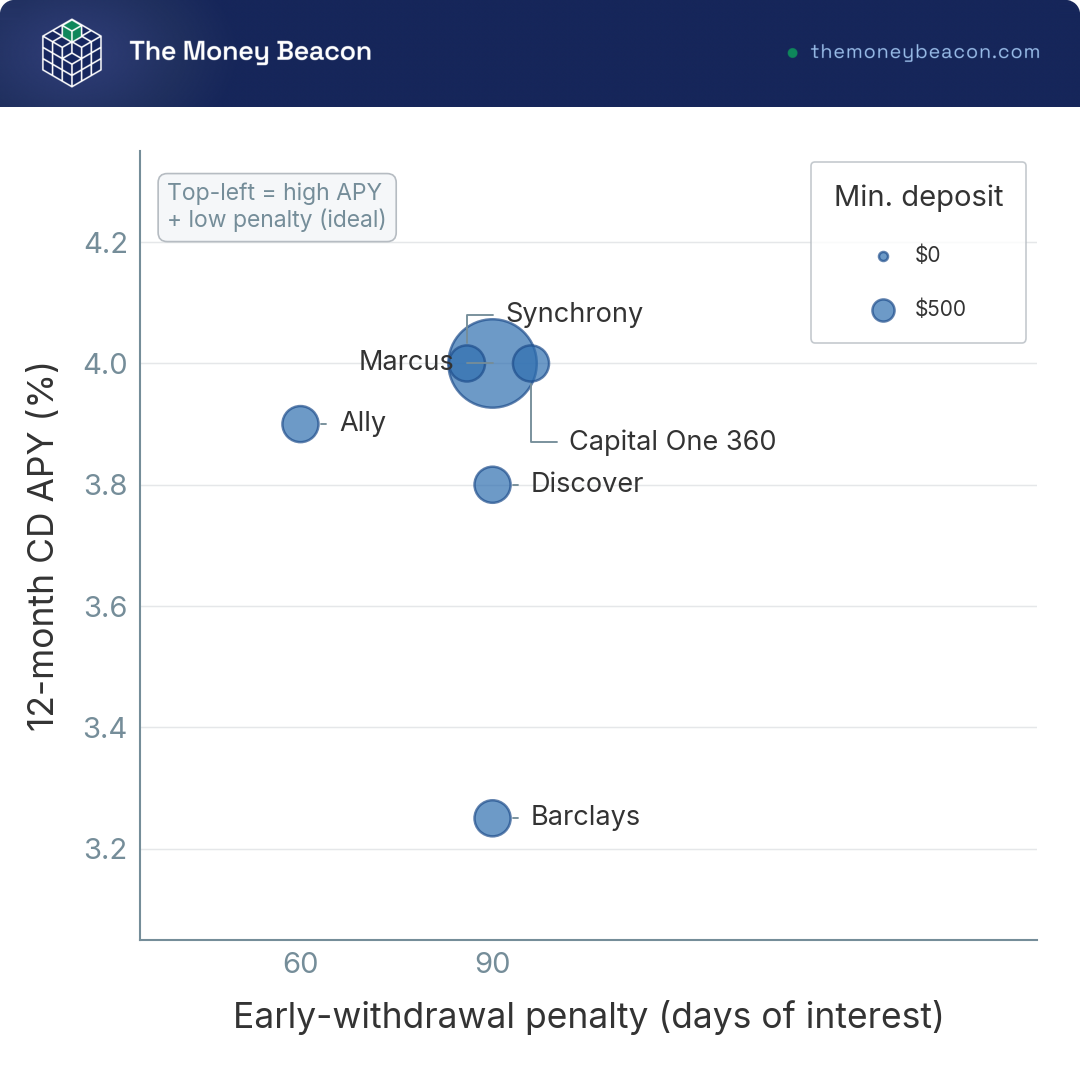
Short-term penalties barely make a difference: Ally charges 60 days; the rest charge 90 days. The long-term penalties are where the banks differ, and that difference matters because one premature withdrawal from a long-term CD can erase a year of interest. Ally is the low-penalty outlier, so it’s a good choice if you aren’t sure you’ll leave the money alone.
Who offers real flexibility: no-penalty and bump-up CDs
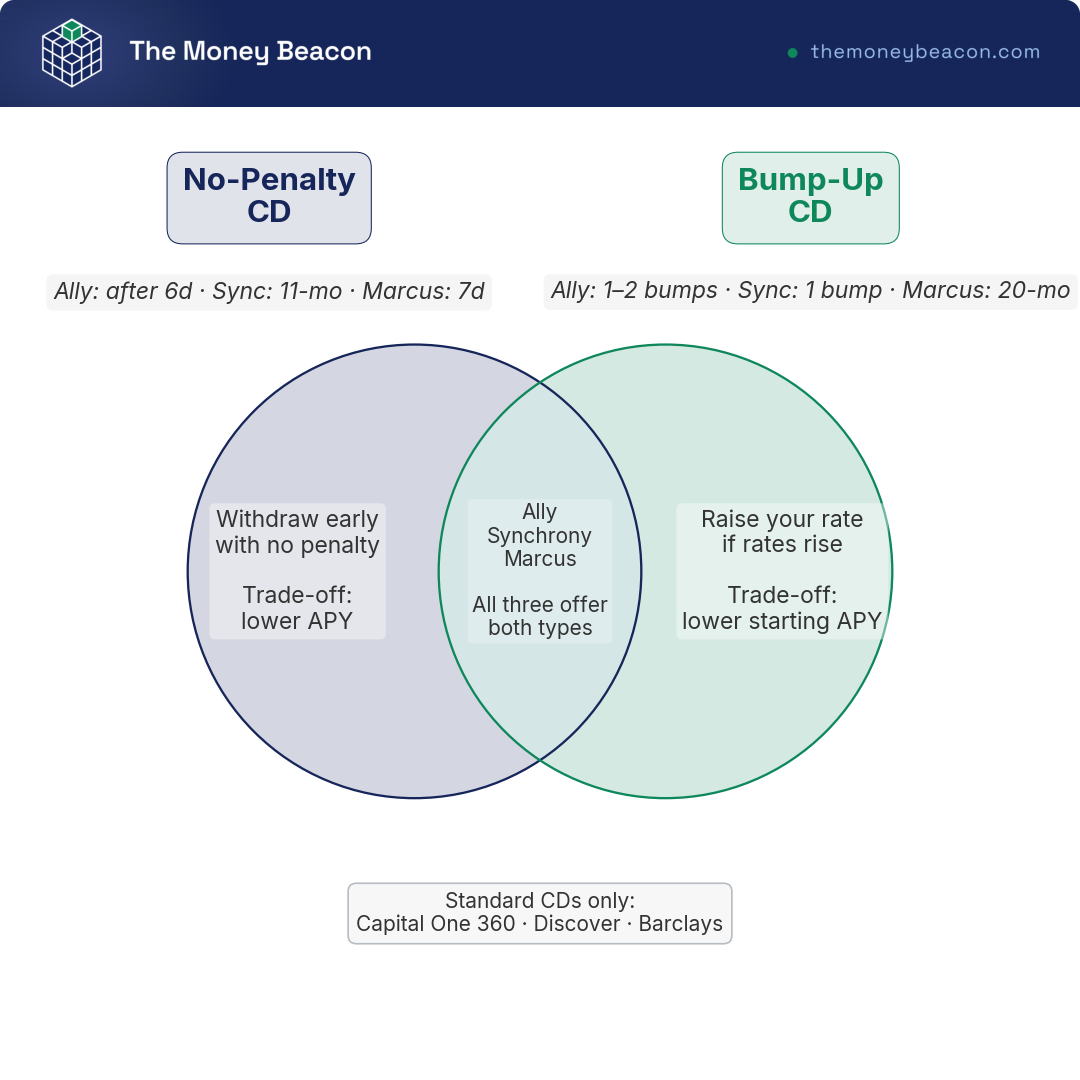
Only three banks offer a built-in escape hatch. The trade-off is simple: a special CD starts with a lower APY in exchange for an early exit option (the no-penalty version) or one or two rate increases during the term (the bump-up version). If you’re more concerned about access than yield, a no-penalty CD or a fully liquid money market account may serve you better than the highest fixed rate.
| Special CD | What it does | Trade-off | Offered by |
|---|---|---|---|
| No-Penalty CD | Withdraw the full balance early with no penalty (usually after about 6 to 7 days) | Lower APY than the standard CD | Ally, Synchrony, Marcus |
| Bump-Up / Raise Your Rate CD | Raise your rate once or twice if the bank’s rate rises | Lower starting APY; limited bumps | Ally, Synchrony, Marcus |
Data current as of June 2026.
Where each bank lands on flexibility
If flexibility is what you’re after, you’re really choosing among three names, and the deciding factors are penalty mildness and the minimum, not which special types exist.
What you actually keep: after-tax yield and FDIC coverage
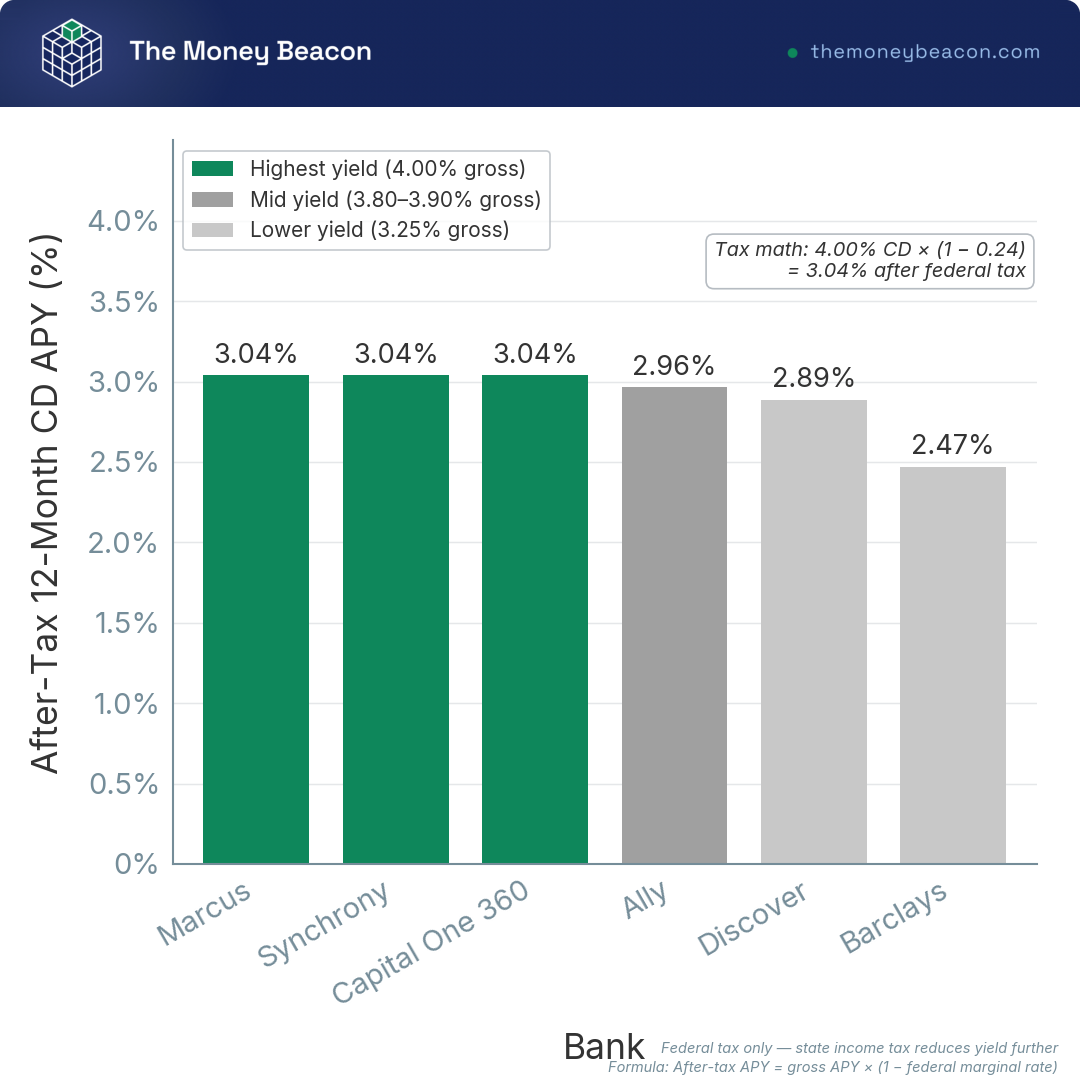
The leaderboard shrinks once the IRS takes its cut. CD interest is taxed as ordinary income on a 1099-INT, not at the lower long-term capital-gains rate. Therefore, at a 24% federal tax bracket, a 4.00% CD retains only about 3.04% before state taxes are applied. One small consolation: the early-withdrawal penalty itself is deductible if you ever pay it. On safety, FDIC insures $250,000 per depositor, per bank, per ownership category; if your balance nears that line, split it across ownership categories or use a second bank so every dollar stays covered.
Verdict by reader profile
So which one should you actually open? It comes down to your profile, read against the recap table. A rate maximizer would choose Synchrony or Marcus, both near 4.00% on the 1-year (Synchrony at a $0 minimum, Marcus asking $500). A liquidity-conscious saver should consider Ally, for the mild 60-day penalty, the flexible options, and a $0 minimum. A CD-ladder builder would lean toward Discover for the wide 3-month-to-10-year term range, or Ally for the $0 minimum and three CD types.
| Profile | What they optimize for | Likely best fit (verify rates first) |
|---|---|---|
| Rate maximizer | Top headline APY at the chosen term | Synchrony or Marcus |
| Liquidity-conscious saver | Exit without losing interest | Ally |
| CD-ladder builder | Wide term range, low or zero minimum | Discover or Ally |
Data current as of June 2026.
Tom’s take
I’ve shopped most of the big online banks, and the lesson is the same one I learned playing private banks against each other: make them compete, and never sign on the headline number alone. The gap between the top three and the bottom three here is smaller than you’d think, so the real edge isn’t a fraction more APY, it’s matching the bank to how you’ll actually use the money.
Lock a rate or ladder it? The 2026 decision
One last call before you fund anything: do you lock a single CD or build a ladder? A single long CD gives you the full long-term rate but locks every dollar, so any early exit triggers a penalty. A ladder blends terms, hands you a rung that matures each year, and spreads your reinvestment across several rates instead of betting it all on one maturity date. The June 2026 context affects this decision. With the Fed holding at 3.50% to 3.75% and a rate cut off the table, the direction of rates is genuinely uncertain. A ladder hedges both ways, whereas a single long-term CD only pays off if you’re confident that rates are about to fall. For most savers, a ladder is a better fit for a broader retirement savings plan.
| Ladder vs single CD | Ladder | One 5-year CD |
|---|---|---|
| Access | One rung matures yearly | Locked 5 years (penalty to exit) |
| Yield | Blended mix of terms | Full long-term rate |
| Reinvestment risk | Spread over years | Concentrated at maturity |
| Best when | Rate direction uncertain | You’re confident rates will fall |
Data current as of June 2026.
Building the ladder, step by step
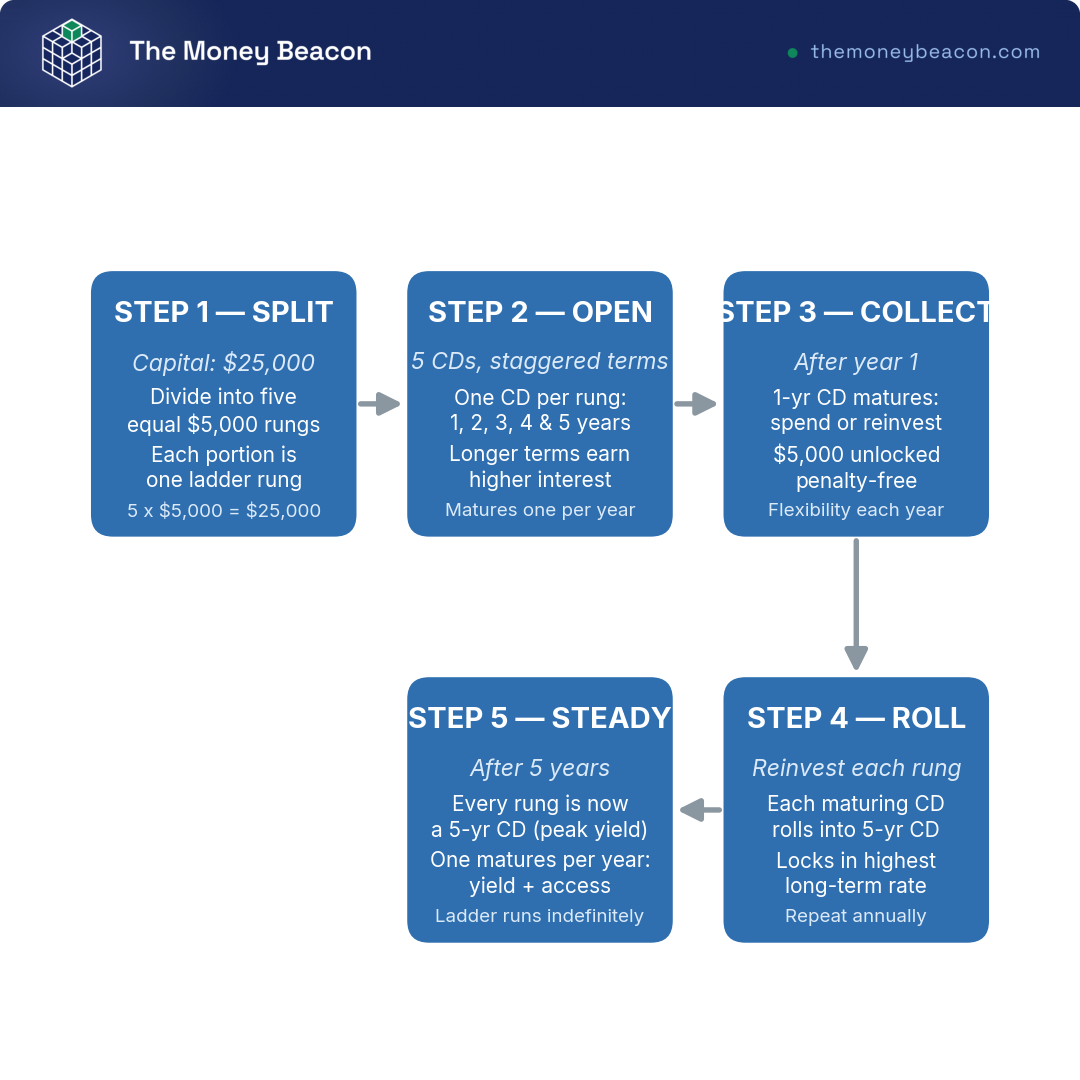
The process is simpler than it sounds. Split the total amount into five equal portions, say $25,000 into five $5,000 portions, and open one CD at 1, 2, 3, 4, and 5 years. Then, as each CD matures, reinvest it into a new 5-year CD. After five years, every rung is earning a long-term rate while one still matures each year, blending the higher yield of a long CD with annual access to a portion of your cash.
Conclusion
So here’s what it boils down to. The difference between the top and bottom of this field is smaller than marketing makes it seem, so chasing the highest APY is a losing game. Your outcome is actually decided by matching the bank to how you’ll use the money. Choose Synchrony or Marcus if you just want the top yield, which is close to 4.00%. Choose Ally if you might need to walk away early since its 60-day penalty and $0 minimum are the most lenient. Choose Discover or Ally if you’re laddering across terms.
And don’t skip the after-tax math. A CD’s interest gets taxed as ordinary income, so a headline 4.00% keeps closer to 3.04% at a 24% bracket before any state tax. Run the numbers before deciding whether the rate is worth locking up cash you can’t access.
When the direction of the rate is uncertain, a CD ladder beats a single long CD. Your next step is straightforward: choose your profile, re-verify today’s APY for your selected term on the bank’s rate page, and then open one CD or split your total into five rungs to start a CD ladder this week.
If you want to see where CDs fit in the bigger picture, here’s how to diversify your savings across time horizons. It’s worth weighing them against the best high-yield savings accounts, and checking the tax treatment of interest income before you sign.
Frequently Asked Questions
What CD rates are the highest right now?
Among the six online banks I compared, the rate leaders in June 2026 are Synchrony, Marcus, and Capital One 360, all near 4.00% APY on the 12-month term. Ally follows at about 3.90%, Discover at roughly 3.80%, and Barclays trails at around 3.25%. Those numbers beat the FDIC national average 12-month CD rate of about 1.65% by a wide margin, but they shift without notice, so check each bank’s own rate page the day you open. The top APY matters less than matching the term to when you actually need the money.
What happens if I withdraw money from a CD before it matures?
You pay an early-withdrawal penalty (EWP), quoted in days of interest. On a 12-month CD it runs from 60 days at Ally to 90 days at Marcus, Synchrony, and most peers. On very short terms, the penalty can exceed the interest earned and dip into principal, so you’d get back less than you deposited. The penalty is tax-deductible, and you can avoid it entirely by choosing a no-penalty CD if there’s a real chance you’ll need the cash early.
Is a no-penalty CD worth the lower APY?
It depends on the odds you’ll need the money before the term ends. A no-penalty CD lets you withdraw the full balance early (usually after about 6 to 7 days) with no cost, trading a lower APY for an exit option. Ally, Synchrony, and Marcus all offer one. If you trigger even one early-withdrawal penalty on a standard CD, you can easily erase more than the APY gap between the two products. For cash you’re certain you won’t need, the standard CD wins on yield; for cash you might need, the no-penalty version is the safer call. If you want full liquidity with no lockup at all, a high-yield savings account is worth comparing instead.
How does a CD ladder work?
You split your cash across several maturities, say 1 through 5 years, so one CD matures every year. Each time a rung matures you reinvest it into a new long-term CD. After a few years, every rung earns a long-term rate while one still comes due annually, blending higher yield with regular access. A ladder is especially useful when you’re unsure which way rates will move: with the Fed holding at 3.50%-3.75% and signaling no cuts through 2026, it hedges you whether rates hold, rise, or eventually fall. Discover is a natural fit for ladder builders, offering terms from 3 months to 10 years at a $0 minimum.
Is CD interest taxable?
Yes, and at a rate most savers underestimate. CD interest is ordinary income taxed at your marginal federal rate (10% to 37%), plus any applicable state tax, in the year it’s credited, even if you haven’t withdrawn a dollar. It doesn’t qualify for the lower long-term capital-gains rate. Your bank reports it on Form 1099-INT once interest hits $10. A 4.00% CD in a 24% bracket keeps only about 3.04% after federal tax, so comparing that after-tax figure against a state-tax-exempt Treasury bill is worth doing before you lock anything in. Our guide to diversifying your savings walks through how to match each dollar to the right account wrapper.
CD vs. high-yield savings account: which one should I choose?
The deciding factor is when you need the money. A high-yield savings account (HYSA) is fully liquid; you can move money anytime, and the APY adjusts with the Fed. A CD locks your rate for a fixed term, which is valuable when rates are expected to fall, but it charges a penalty for early exit. With the Fed signaling a hold-to-possible-hike stance through 2026, a HYSA gives you flexibility to capture any future rate increase without penalty. My rule: use a CD for cash you’re confident you won’t need for 12 months or more, and keep your emergency fund in a high-yield savings account where it stays accessible.




Comments
Questions and corrections welcome. We read everything.