


You keep hearing that real estate is how regular people build wealth, but in your head that means a 20% down payment, a credit application, and a phone that rings at 2 a.m. about a busted water heater. So you never start, and the one investment that quietly made a lot of Americans rich stays a thing other people do. The reality is friendlier than the cliché: figuring out how to invest in real estate no longer starts with a house at all. Today you can own a slice of income-producing property for the price of a single share in a real estate investment trust (REIT), roughly $100 in a brokerage account you may already have, or about $10 on a platform like Fundrise, while a leveraged rental still sits at the far end for people with the cash and the appetite for it.
In this guide, we lay the four realistic paths side by side, public REITs, direct rentals, house hacking, and crowdfunding, then show what each one actually costs and asks of your time. You will also see the returns in real dollars and the tax angles, depreciation and the 1031 exchange, that quietly separate the people who build wealth from the ones who just buy a headache.
1. Why Real Estate Belongs in Your Portfolio (and When It Doesn’t)
Before you wire a dollar into any product, one question decides everything: does real estate even deserve your next dollar, and if so, why? Real estate is a spectrum, not a single house, and the return it pays comes from four separate engines that beginners constantly blur together. Let’s pull them apart first, then weigh how the asset sits next to your stocks and where it should actually fall in your priority list.
1.1 The four forces that actually drive your return
The first mistake beginners make is treating “the return” on a property as one number. It is really four forces stacked together, and each one is captured by a different owner and taxed in a different way. The first is cash flow, the rent you collect minus every expense, which is net operating income (NOI) minus your mortgage payment. The second is appreciation, the slow rise in the property’s value. The third is loan paydown, where your tenant’s rent quietly retires your mortgage principal month after month. The fourth is the set of tax benefits, depreciation chief among them, that lower or defer what you owe.
Here is how the four forces line up on what they are, who pockets them, and how the tax code treats each.
| Force | What it is | Who captures it | Taxed how |
|---|---|---|---|
| Cash flow | Rent minus all expenses (NOI minus debt service) | Direct owners, equity REIT shareholders | Ordinary income, sheltered by depreciation |
| Appreciation | Rise in property value over time | Direct owners, equity REITs | LTCG at sale (0/15/20% + NIIT) |
| Loan paydown | Tenant’s rent retires your mortgage principal | Leveraged direct owners | Builds equity; taxed only at sale |
| Tax benefits | Depreciation, 199A, 1031 deferral | Direct owners, REIT holders (199A) | Reduces or defers tax owed |
So the wealth does not come from one place, and the slice everyone fixates on, the rent check, is rarely the one doing the heavy lifting. To see why, you have to watch the four forces fight it out on a real deal, which is exactly where the math gets interesting.
1.2 Where your return really comes from, and how it sits next to stocks
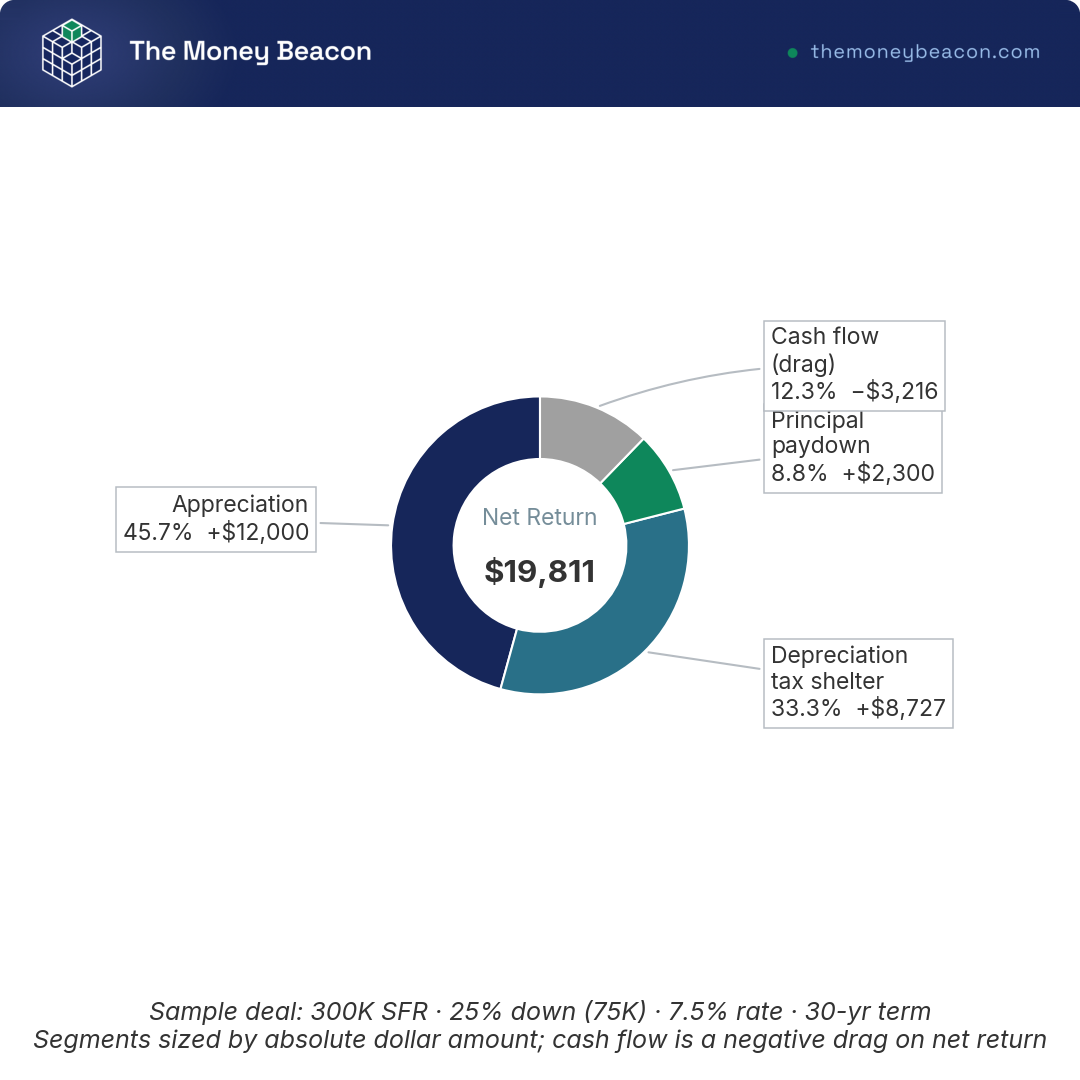
Take a $300,000 single-family rental, financed the normal way. In Year 1 the cash flow can easily run negative once the mortgage and reserves come out, and yet the deal still builds wealth. Your tenant pays down roughly $2,300 of principal in the first year. The property, at the long-run US home-price average of about 4% a year, gains around $12,000 in value. And depreciation hands you an $8,727 paper deduction that shelters the income without costing you a cent of cash. Add those up and the picture flips: cash flow is usually the smallest slice, and leverage plus appreciation is the engine.
That is the case for owning property at all, but the sharper case is what it adds to a portfolio you already hold in stocks and bonds. Direct property and public equities move differently, so one can hold up while the other sags. Publicly traded REITs trade like stocks all day and track the equity market more closely in the short run than a physical building does, but even they do not move in lockstep with the S&P 500: the REIT-to-S&P correlation sits near 0.37 in normal conditions, rising in a market panic without ever converging to 1.0. Mortgage REITs are the exception, because they behave more like leveraged bond portfolios and swing with interest rates.
None of this comes free, and the brochure leaves out the costs. Direct ownership is illiquid and concentrated, since one property is a single bet on a single street. It demands real management, and it exposes you to vacancy, problem tenants, and special assessments. On the hands-off side, non-traded REITs and crowdfunding can gate redemptions, meaning the sponsor can cap or suspend withdrawals just when you want your money back. Knowing the upside is only half the decision; the honest downside is what tells you whether you are ready to start.
1.3 Where real estate should sit in your financial priorities
Real estate is rarely your literal first dollar, and a quick readiness screen keeps you from buying before your foundations can hold the weight. The logic runs as a short chain of if/then gates. If you lack a 3-to-6-month emergency fund or you are carrying high-interest debt, then real estate waits; clear those first. If you have an employer match sitting uncaptured in your 401(k), then grab that match before any down payment, because a 50% or 100% match is a guaranteed return no property will beat. Only once those are handled does the path open: with $100 to $5,000 you start with a REIT exchange-traded fund (ETF), and with a real down payment plus a tolerance for work you size up a rental or a house hack.
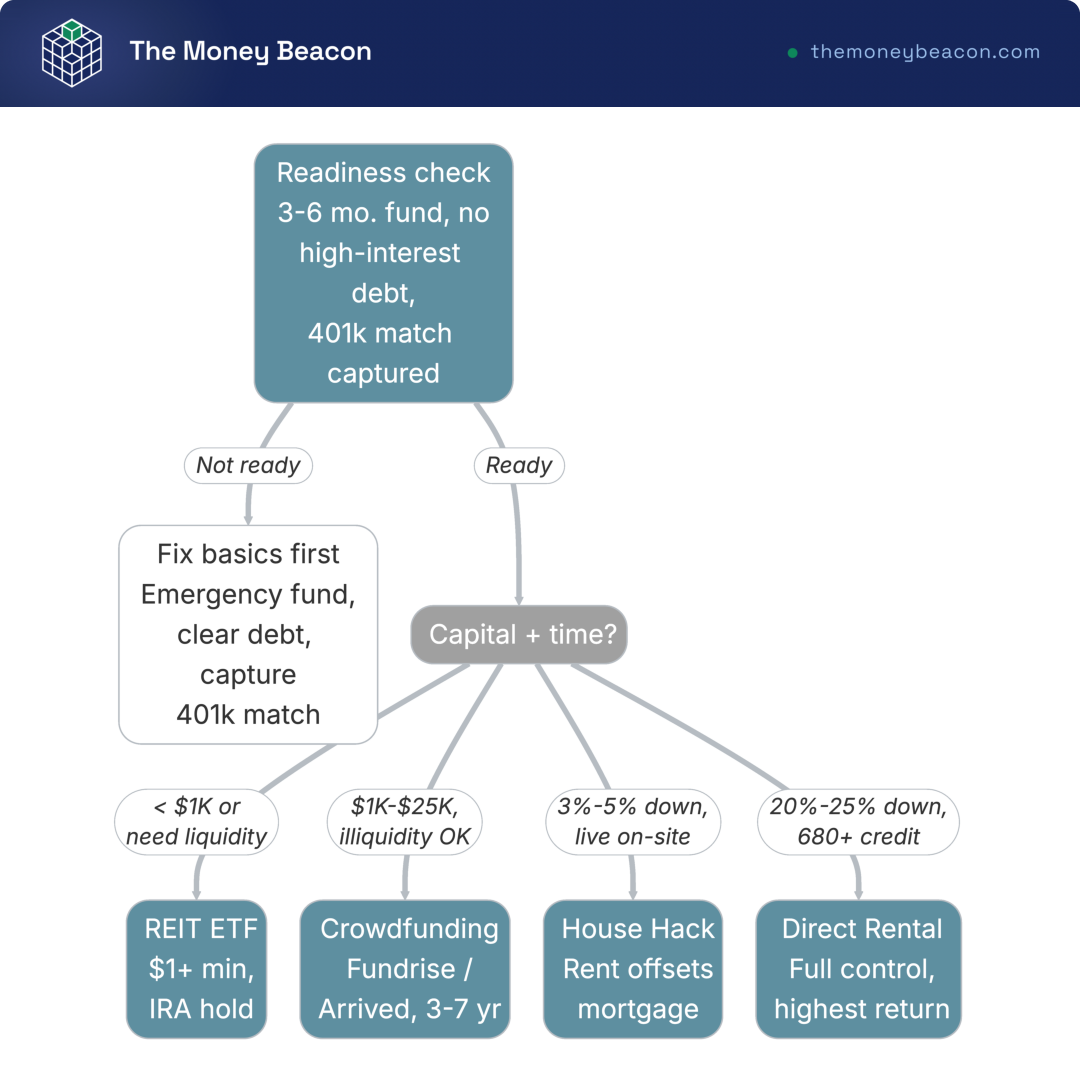
This screen is also a reminder that the property question lives inside the bigger retirement question, and if you have not yet worked out how much you actually need to retire, that number frames how much risk real estate should carry for you. Clear the gates, and the only thing left to settle is which door you walk through.
2. The Four Realistic Ways an Individual Can Invest
You know by now that real estate is worth considering and roughly where it belongs in your stack of priorities. The real question is what the actual on-ramps are. There are four realistic paths, and the cleanest way to see them is to line them up from the lowest-capital, most liquid option to the most capital-heavy and hands-on, so you can spot at a glance which one fits both your wallet and your free time.
2.1 The four paths at a glance: capital, liquidity, and effort
The four paths into real estate are public REITs, real estate crowdfunding, house hacking, and direct rentals, and they separate mostly on three things: how much cash you need, how fast you can get it back out, and how much of your own time the asset eats. A public REIT or REIT ETF is the most accessible door, costing as little as $1 to $100 for a single share, trading with same-day liquidity, and asking nothing of your time or your accreditation status. Crowdfunding sits next, with minimums from about $10 to $25,000, low liquidity locked behind multi-year holds, and accreditation that varies deal by deal.
The two ownership paths demand far more. House hacking lets you buy with just 3% to 5% down because you live in the property, but it is hands-on, since your tenants share your roof. A direct rental is the heaviest lift, needing 20% to 25% down plus closing costs and cash reserves, and it stays hands-on unless you pay someone to manage it. Notice the trade running through all four: the cheaper and more liquid the path, the less control and tax leverage it hands you, and the reverse holds as you move up the cost scale.
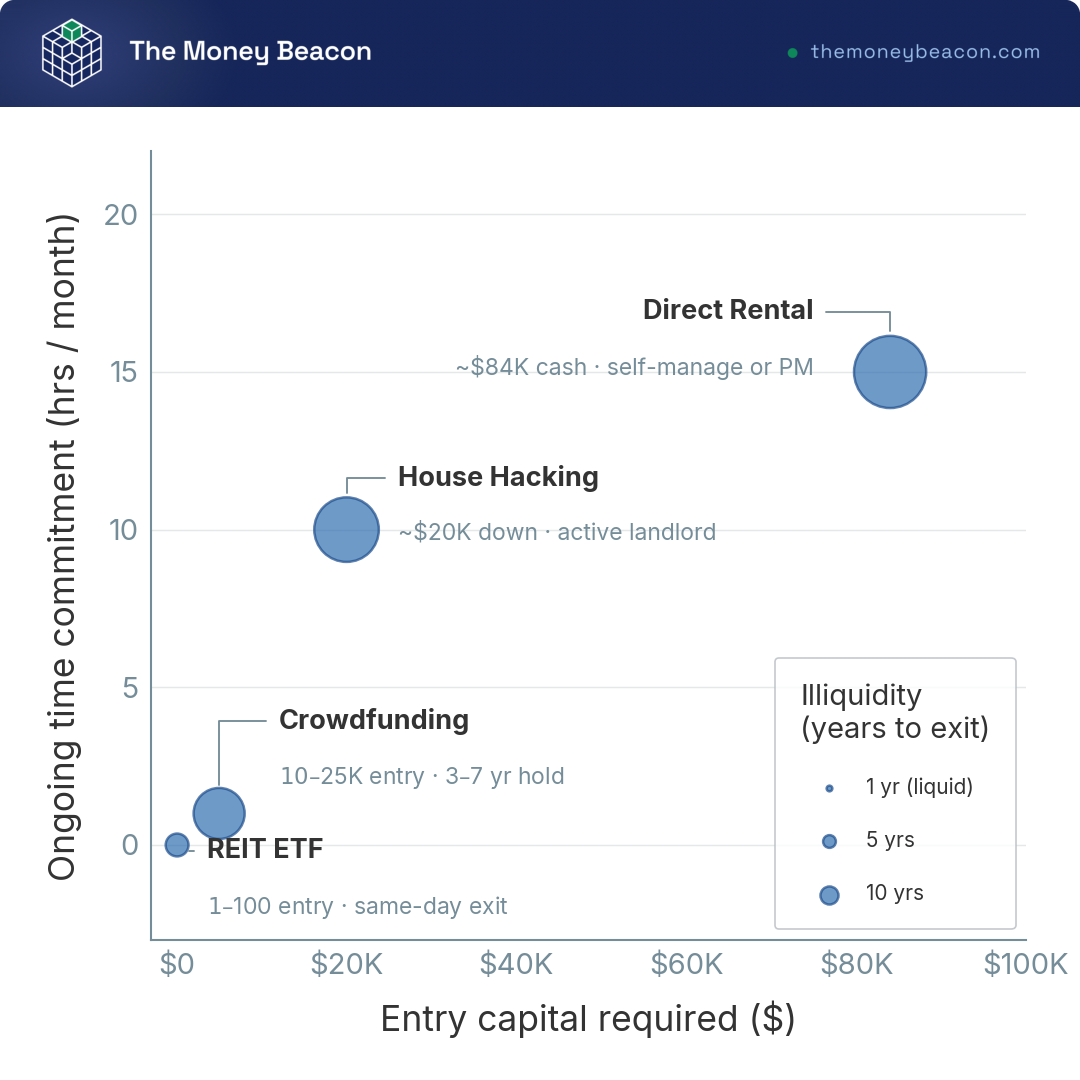
One building block ties these paths together and reshapes the math on the expensive end: leverage, the borrowed money you put to work alongside your own. It is what lets a 25%-down rental capture appreciation on the full purchase price, and it is why the same idea can build wealth or sink you. We lean on it heavily in the rental sections later. For now, the takeaway is simpler: the lowest door is the one most beginners should open first, and that door is the REIT.
3. REITs in Detail: The Easiest Way In
You have the four paths in view by now. So let’s have a look at the easiest one, because for most beginners it is also the right first move. A REIT (real estate investment trust) is a company that owns income-producing property and, to keep its tax status, must distribute at least 90% of its taxable income to shareholders while passing the IRC Section 856 asset and income tests. You buy shares in a brokerage or an individual retirement account (IRA), same-day, for the price of one share: no tenants, no mortgage, full liquidity. The sub-types look alike but behave very differently, the dividends are taxed in a way most people misread, and one liquidity trap is waiting at the end, so it pays to work through them in order before you buy.
3.1 Equity REITs, mortgage REITs, and REIT ETFs
The word “REIT” hides three sub-types that behave nothing alike, and reading them as one product is a classic and costly mix-up. An equity REIT owns physical buildings and earns rent. A mortgage REIT (mREIT) owns mortgages and mortgage-backed securities and earns the spread between its borrowing cost and the interest it collects. A REIT ETF is simply a basket of REITs you buy in one ticker. The table sets them side by side.
| REIT type | Owns | Income source | Typical yield (June 2026) | Main risk |
|---|---|---|---|---|
| Equity REIT | Physical property | Rent | ~3.6% | Property/occupancy cycle |
| Mortgage REIT (mREIT) | Mortgages/MBS | Interest spread | ~12% | Rate/spread, dividend cuts |
| REIT ETF | Basket of REITs | Pass-through dividends | ~3.6% | Diversified equity-REIT risk |
Data current as of June 2026.
That roughly 12% mortgage-REIT yield is the trap in the table. An mREIT yields more because it is a leveraged bet on the interest-rate spread, not because it is a safe high-yield account. When rates rise sharply, borrowing costs climb, the spread compresses, asset values fall, and these REITs cut their dividends and lose value at the same time. Treat that headline yield as a warning label, not an invitation. Individual equity REITs such as Realty Income, Prologis, and Public Storage get cited here as illustrations of the sub-types, never as picks. For a beginner, the cleaner move is a broad ETF, which is the next thing to choose well.
3.2 Choosing a low-cost REIT ETF
Once you decide a basket beats a single stock, the choice narrows to a handful of broad, cheap funds, and the differences are small but worth knowing. The three workhorses are VNQ, SCHH, and FREL, and they differ mainly on sponsor, cost, and exactly what they hold.
| ETF | Sponsor | Expense ratio | Notes |
|---|---|---|---|
| VNQ | Vanguard | 0.13% | Broad US equity REITs |
| SCHH | Schwab | 0.07% | Excludes mortgage REITs |
| FREL | Fidelity | 0.084% | Broad US REIT exposure |
Data current as of June 2026.
All three give you diversified equity-REIT exposure for a rounding error in fees, with Schwab’s SCHH the cheapest and the only one that deliberately leaves mortgage REITs out. The practical point is how little it takes to start: with under $1,000 and a need for liquidity, you can buy a broad REIT ETF for the price of one share, and VNQ traded near $98 in June 2026, so a single share runs under $100. For the same reason we favor broad index funds over stock picking elsewhere, the bias here is a broad ETF over individual REIT picks, a logic we lay out in full in our guide to the best low-cost index funds and ETFs. Owning the fund is the easy part; keeping the IRS out of your dividends is where the real money hides.
3.3 How REIT dividends are taxed, and whether to hold in an IRA
Here is the most misunderstood thing about REITs: that fat dividend is not one number for tax purposes, it is several buckets, each taxed differently. Most of it lands as ordinary income, a smaller slice as qualified dividends, and the rest as return of capital or capital-gain distributions. The table breaks out the buckets and whether each one qualifies for the Section 199A deduction.
| Dividend portion | Tax treatment | 199A QBI deduction? |
|---|---|---|
| Ordinary income portion (most of it) | Ordinary income rates (10%-37%) | Yes, 20% deduction under Section 199A |
| Qualified dividend portion (small) | LTCG rates (0/15/20%) | No (already preferential) |
| Return of capital | Not taxed now; lowers basis | No |
| Capital gain distribution | LTCG rates | No |
The bright spot is the Section 199A deduction. It lets you deduct 20% of the ordinary REIT-dividend slice, so you are taxed on only 80% of it: a taxpayer in the 24% bracket pays an effective ~19.2% on that portion rather than 24%. Better still, the REIT component of 199A is not limited by your W-2 wages or by any income threshold, so high earners keep it, and 2025 federal tax legislation made the deduction permanent for 2026. If your modified adjusted gross income clears $200,000 single or $250,000 married filing jointly, layer the 3.8% net investment income tax (NIIT) on top; it is additional, not a replacement.
Hank’s take

because almost all of a REIT dividend is ordinary income, where you hold it matters more than which fund you pick. Park a broad REIT ETF in a Roth or traditional IRA and you erase the annual tax drag entirely; the 199A deduction is a consolation prize for a taxable account, and inside an IRA it does nothing at all. After years of picking apart the numbers, that account placement is the single highest-leverage REIT decision a regular investor makes.
So the rule writes itself. Because most REIT income is ordinary, a Roth or traditional IRA usually beats a taxable account, since it shelters that ordinary-income drag completely. If you must hold REITs taxably, at least the 199A deduction softens the hit. Account placement is one of the most reliable ways to keep more of what you earn, a theme we extend across our roundup of the most reliable ways to lower your tax bill. Tax handled, one trap is left, and it is the one that catches people who chased a higher payout.
3.4 Public vs non-traded REITs: the liquidity trap
The product is clear and the taxes are sorted, but one distinction can quietly lock up your money: whether the REIT trades on an exchange or not. A public REIT lists on an exchange and sells in seconds; a non-traded REIT does not, and that single difference cascades into fees, pricing, and your ability to get out.
| Feature | Public (exchange-traded) REIT | Non-traded REIT |
|---|---|---|
| Liquidity | Sell any market day | Redemption windows only; gates possible |
| Upfront load | $0 (just commission, usually $0) | Historically high; SEC notes fees can reach 9%-10%, up to 15% of the offering price |
| Pricing | Live market price | Sponsor-set NAV, less transparent |
| Redemption | Instant | Monthly/quarterly caps; can suspend |
Data current as of June 2026.
The contrast is not a subtlety. A non-traded REIT can skim up to 15% of your investment in upfront load before a dollar goes to work, price itself at a sponsor-set value you cannot verify against a market, and cap or suspend redemptions when you most want out. The Securities and Exchange Commission (SEC) and the Financial Industry Regulatory Authority (FINRA) have both issued investor alerts warning about exactly these fees and liquidity limits, and the conclusion writes itself: for most beginners, exchange-traded REIT ETFs win. As for how much to hold, a 5% to 10% portfolio allocation is a sensible guideline, and if you already own your home you carry concentrated residential exposure, so you might tilt the ETF toward commercial and industrial subtypes.
REITs solve the hands-off problem cleanly, but they cap your upside at whatever the trust earns. You get no leverage of your own and no depreciation of your own to shelter the income. For readers who want that control and the full tax toolkit, the next move is to price out a rental deal and see whether the numbers actually work at 2026 rates.
4. Buying a Rental: The Numbers That Decide a Deal
A REIT hands you exposure without control, so the next move prices out the path that gives you both: a rental you own outright. We promised to lean on leverage here, and this is where it earns its keep. Before any walkthrough, though, you need the vocabulary every later number depends on, because a deal lives or dies on four metrics most beginners never bother to run.
4.1 Cap rate, cash-on-cash, and the 1% and 50% rules
Start with net operating income (NOI), the foundation under everything else. NOI is gross rent minus vacancy and operating expenses (taxes, insurance, management, maintenance, and capex reserves), and it deliberately leaves the mortgage out. From there the two return metrics fall into place. The cap rate is NOI divided by the purchase price, the unleveraged yield of the building, and it typically runs about 4% to 7% depending on the market tier. Cash-on-cash is annual pre-tax cash flow divided by the cash you put in, the return on your actual money once the mortgage is in the picture, and investors usually want it in the 6% to 12% range.
Two quick screens finish the set. The 1% rule says monthly rent should reach at least 1% of the price, so a $300,000 home would need $3,000 a month to clear it. The 50% rule assumes operating expenses eat roughly half the rent, a fast reserve estimator before you have real numbers in hand. Here is the full set side by side.
| Metric | Formula | What it tells you | Benchmark |
|---|---|---|---|
| Cap rate | NOI / purchase price | Unleveraged yield | ~4%-7% typical, varies by market tier |
| Cash-on-cash | Annual pre-tax cash flow / cash invested | Leveraged return on your cash | ~6%-12% sought |
| 1% rule | Monthly rent >= 1% of price | Quick screen, not a guarantee | $300k home -> $3,000/mo rent |
| 50% rule | Operating expenses ~ 50% of rent | Reserve estimator | Excludes mortgage |
Data current as of June 2026.
One caveat is worth mentioning: in many 2026 markets, prices have outrun rents, and few properties clear the 1% rule at all. Failing it is a warning, not a disqualifier, because a deal can still work on appreciation and paydown. With the metrics defined, the next question is the one your bank account has to answer.
4.2 What it really costs to get in
The down payment is the number everyone fixates on, and it is only a slice of the cash you actually need. An investment property asks for more down than your own home does, because these loans default more often, so plan on 20% to 25% rather than the 3% to 5% an owner-occupant might put up. On a $300,000 property, that is $60,000 to $75,000 before you have paid for a single thing else. Here is how the rest of the cash stacks up.
| Cash item | Typical amount on $300,000 | Notes |
|---|---|---|
| Down payment (20%-25%) | $60,000-$75,000 | Investment property; higher than owner-occupied |
| Closing costs (2%-5%) | $6,000-$15,000 | Title, appraisal, recording, escrow, lender fees |
| Cash reserves | 6+ months PITI | Lenders often require; protects against vacancy |
| Initial repairs/turnover | Varies | Make-ready before first tenant |
Data current as of June 2026.
Add it up and the floor is clear: between the down payment, the closing costs, and the reserves lenders often demand, a direct rental needs tens of thousands in cash. This is why $5,000 or $10,000, plenty for a REIT ETF, does not buy you a rental. What it does buy, once you have the cash, is the right to choose how you finance the rest.
4.3 Financing an investment property in 2026
The loan you pick sets the rate, and the rate, as you will see shortly, decides whether the deal makes or loses money. Three options cover most investors, and they split on down payment, the premium over an owner-occupied rate, and who they suit. A conventional investment loan fits a W-2 buyer who can document income. A DSCR loan qualifies you on the property’s rent covering the debt (a debt service coverage ratio, or DSCR, of roughly 1.0 to 1.25) rather than on your personal income, which makes it the practical route for self-employed investors. The owner-occupant loans sit at the bottom for the cheapest rates, but they are reserved for house hacking, not pure rentals.
| Loan type | Down payment | Rate vs owner-occupied | Best for |
|---|---|---|---|
| Conventional investment | 20%-25% | +0.5 to 1.0 pts higher | W-2 buyers with income docs |
| DSCR loan | 20%-25% | +0.75 to 2.0 pts higher | Investors qualifying on rent, not personal income |
| FHA (owner-occupant only) | 3.5% | Lowest | House hacking, not pure rentals |
| Conventional owner-occupant | 3%-5% | Low | House hacking |
Data current as of June 2026.
A few process details are worth mentioning before you shop. The 2026 baseline conforming loan limit sits at $832,750 and rises in designated high-cost areas. By law, the lender must hand you the Closing Disclosure at least three business days before you close, and most purchases run 30 to 45 days from accepted offer to keys. Because the spread between owner-occupied and investment rates drives the entire rental math, it pays to watch where the benchmark sits, and you can track current 30-year and ARM mortgage rates as your starting reference before adding the investor premium. Financing settled, the next step is learning to run a property through the numbers in the right order.
4.4 Running the numbers and self-managing vs hiring a manager
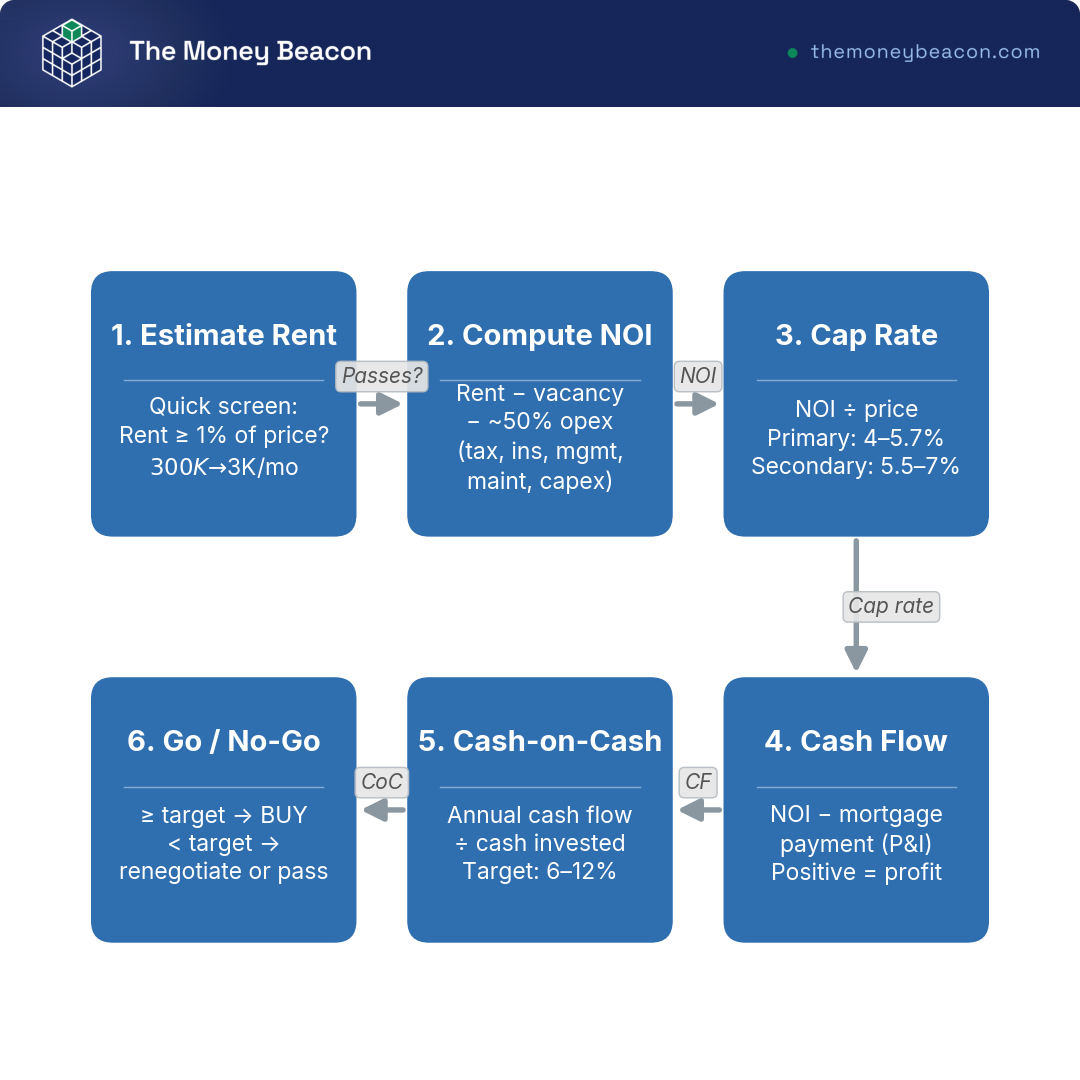
So what does analyzing a deal actually look like, from listing to a decision? The order matters, because each number feeds the next. You estimate the rent, subtract vacancy and the 50% operating reserve to land on NOI, divide NOI by the price for the cap rate, subtract the mortgage to get monthly cash flow, divide that annual cash flow by your cash in for cash-on-cash, and only then make a go or no-go call. Run them out of sequence and you fool yourself with a cap rate that ignores the loan.
Once a deal pencils out, you face a choice that quietly reshapes the return: manage it yourself or pay someone. Self-managing costs your time but keeps the rent whole, and it fits an owner who lives nearby, holds a unit or two, and is handy with a wrench. A property manager runs 8% to 12% of gross rent, with 10% the common standard, plus a leasing fee of 50% to 100% of one month’s rent each time they place a tenant. That suits a remote owner, a multi-unit portfolio, or a busy W-2 earner. The real question is whether you want a second job or a more passive position.
Tom’s take
I hold rental property with a mortgage on it, and the honest lesson is that self-managing is a job, not a side hobby. The first time a tenant calls about a flooded basement on a Sunday, you understand exactly what that 10% management fee buys. I pay it on the properties I can’t watch closely, and I keep the ones I can reach within an hour.
The sequence is clear, and so is the staffing call. Now watch a real deal run through it, because the result at 2026 rates is not what most beginners expect.
4.5 A full deal walkthrough, dollar by dollar
Take the same $300,000 single-family rental, financed the way most investors finance one. You put 25% down, borrow $225,000 at a 7.5% investment-property rate on a 30-year term, and add roughly 3% in closing costs. The cash that leaves your account totals $84,000. The rent comes in at $2,700 a month, and from there the expenses do their work.
| Line | Amount |
|---|---|
| Purchase price | $300,000 |
| Down payment (25%) | $75,000 |
| Loan amount | $225,000 |
| Closing costs (3%) | $9,000 |
| Total cash invested | $84,000 |
| Gross monthly rent | $2,700 |
| Vacancy (5%) | -$135 |
| Property tax (est.) | -$300 |
| Insurance | -$120 |
| Management (10%) | -$270 |
| Maintenance + capex reserve (10%) | -$270 |
| NOI (monthly) | $1,305 |
| Mortgage P&I (7.5%, $225k) | -$1,573 |
| Monthly cash flow | -$268 |
Data current as of June 2026.
Read the bottom line and the lesson lands hard. After the mortgage, this deal runs $268 in the red every month, which is a realistic 2026 outcome, not a worst case. The annual NOI of $15,660 gives an unleveraged cap rate of 5.2%, a respectable yield on paper, yet the financing turns the cash flow negative. The investor still comes out ahead over time, because the roughly $2,300 of Year-1 principal paydown plus appreciation more than offset the monthly drain, but none of that shows up in the checking account. And here is the figure that should make you sit up: if the rate were 6.5% instead of 7.5%, the P&I drops to about $1,422 and the deal turns roughly neutral. One point of mortgage rate is the whole ballgame.
4.6 Why rent of $2,700 still loses money each month
A reader looking only at $2,700 in rent might assume the owner is comfortably ahead, which is exactly the trap. The rent is healthy; the problem is everything that lines up behind it. Vacancy skims $135, property tax and insurance take another $420 together, management and the maintenance reserve claim $540 more, and the mortgage alone swallows $1,573. The chart traces each cut from the top line down to what is left.
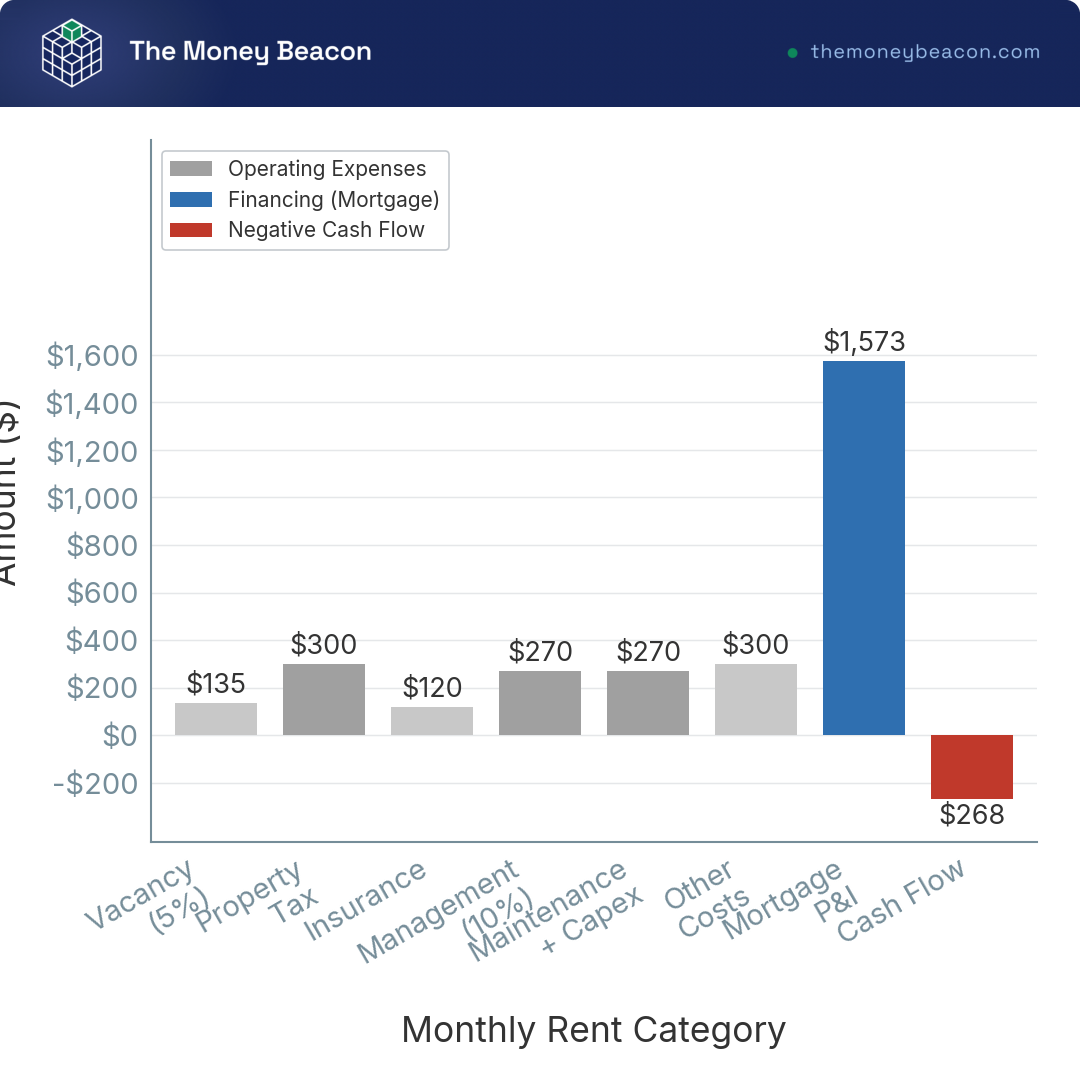
The operating expenses here run close to half the rent, which is the 50% rule doing its job as a sanity check, and the mortgage on top is what pushes the owner into the red. A strong rent number tells you almost nothing on its own, because the deal is decided after the reserves and the loan come out, not before. Since the rate carries that much weight, it is worth seeing exactly how the cash flow moves when it does.
4.7 At what mortgage rate the deal breaks even
Hold the property fixed and slide only the mortgage rate, and the monthly cash flow swings from bleeding to breaking even. On the sample $225,000 loan with $1,305 of monthly NOI, a rate near 9% buries you, and as the rate falls toward 5% the cash flow climbs, crossing zero around 6.5%. The line chart shows the whole arc.
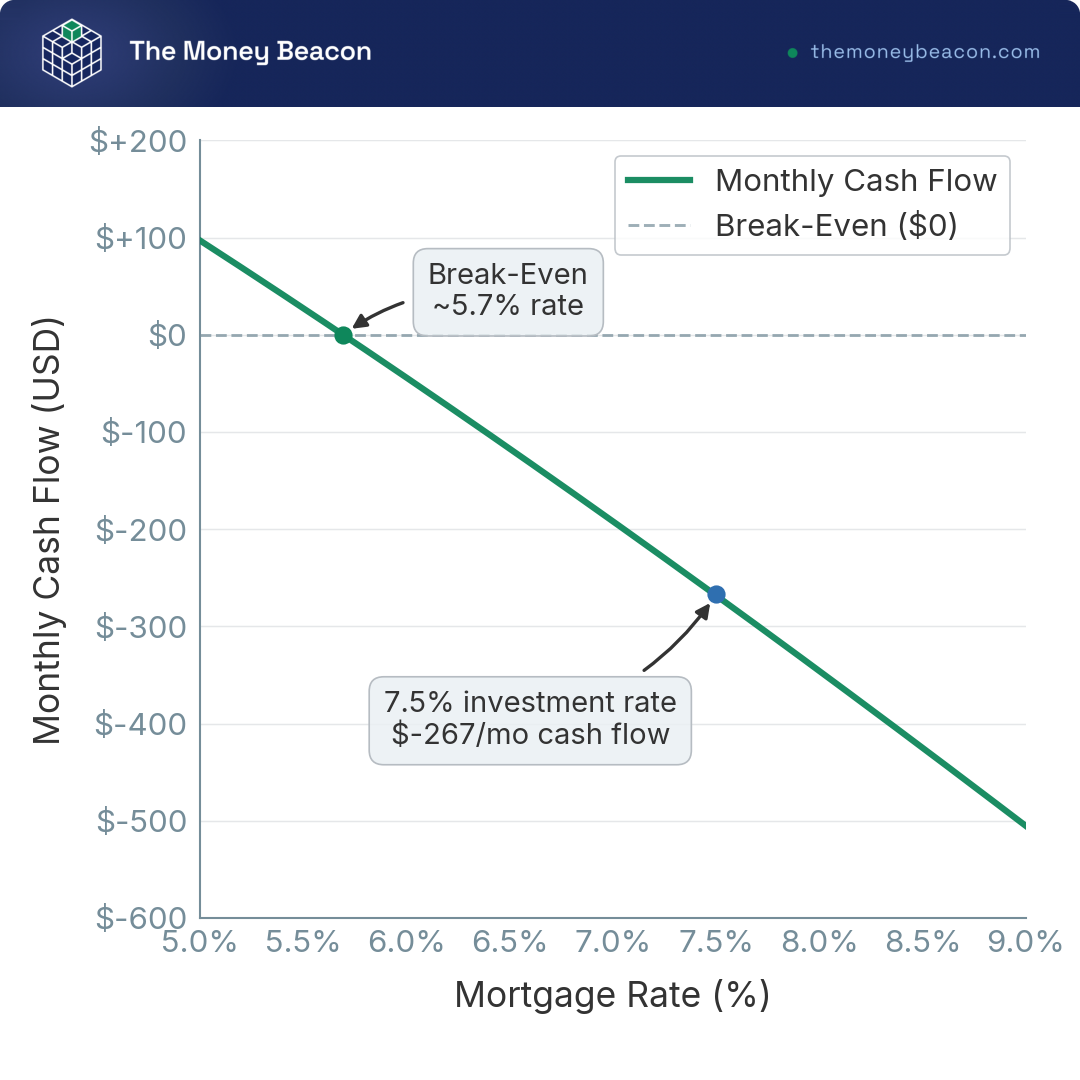
The takeaway is blunt: at today’s investor rates, which sit 0.5 to 1.0 point above the roughly 6.5% owner-occupied average, many rentals are leveraged bets on appreciation, not passive income machines. A single point on the rate is the line between losing money monthly and treading water. That negative cash flow, remember, is the number before the depreciation shelter you met earlier enters the picture, and that shelter is the piece that quietly rescues a deal losing money on paper. If a full rental is more cash than you can or want to commit, there are cheaper doors into direct ownership.
5. Lower-Capital On-Ramps: House Hacking and Crowdfunding
You have now watched a full rental resolve to a monthly loss at 2026 rates, and the cash to get in ran to $84,000. Plenty of would-be investors do not have that, or do not want to risk it on one street. So what are the cheaper ways to own real estate directly, or to buy into private deals without a mortgage at all? Two paths answer that, starting with the lowest-capital way to own a building outright.
5.1 House hacking with FHA and conventional owner-occupant loans
House hacking works by exploiting a gap the lenders themselves create: owner-occupant loans are far cheaper and ask far less down than investor loans. Because you live in the property, you qualify for those owner-occupant terms on a 2-to-4-unit building, then rent the units you do not occupy. Two loan types fit. An FHA loan wants just 3.5% down with a 580-plus credit score, on the condition that you occupy within 60 days, intend to stay at least 12 months, and buy 1 to 4 units. A conventional owner-occupant loan runs 3% to 5% down on a primary residence, again 1 to 4 units. The decision tree below routes you to one or the other.
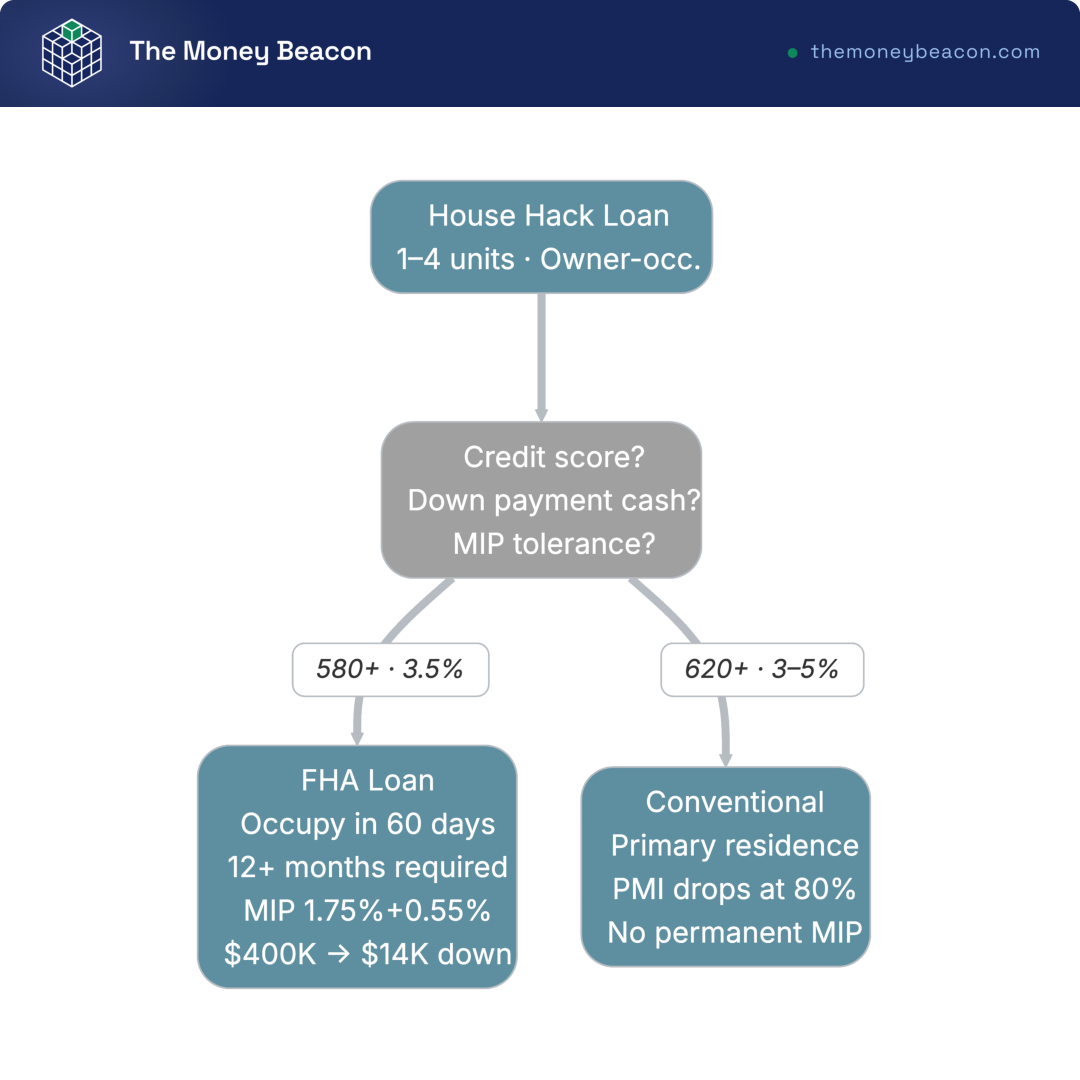
The cash gap is the whole point. On a $400,000 duplex, an FHA buyer puts down $14,000 and controls a $400,000 asset, a fraction of what a 25%-down investor would need on the same building. Budget honestly for the cost of that low down payment, though: FHA charges an upfront mortgage insurance premium (MIP) of 1.75% of the loan, plus an annual MIP of 0.50% to 0.75% on most 30-year loans. If you are weighing the down payment and closing math for the first time, our guide for a first-time buyer weighing down payments and closing costs walks through the same trade-offs from the owner-occupant side. With the financing chosen, the question becomes how much the arrangement actually saves you.
5.2 The house-hacking math and its blended tax treatment
Here is where the gap turns into real money. Live in one unit of a duplex and rent the other for $1,600. If your all-in housing payment, principal, interest, taxes, insurance, and MIP, comes to $2,900, the tenant’s rent cuts your effective housing cost to $1,300 a month, often below what you would pay to rent a comparable unit outright. Meanwhile you build equity and the tenant pays down your loan. Move out later and rent your own unit too, and the place simply becomes a standard rental.
The tax treatment is where a house hack gets genuinely interesting, because it blends two regimes at once. The Section 121 exclusion can shield up to $250,000 of gain for a single filer, or $500,000 married filing jointly, on the portion you used as your primary residence, provided you owned and lived there for 2 of the last 5 years. The catch is that depreciation taken on the rented portion is still recaptured at sale, regardless of the exclusion on your half. That split, part residence and part rental, is the quiet complication, and it is one piece of the larger tax puzzle that decides what you actually keep. For readers who want private real estate without a mortgage at all, the path widens further.
5.3 Crowdfunding platforms: minimums, fees, and access
If owning a building, even a house-hacked one, is more than you want to take on, crowdfunding platforms pool small investors into REITs or individual deals for far less commitment. They diverge sharply, though, on minimums, fees, accreditation, and how trapped your money is. Fundrise opens at $10 in a taxable account or $1,000 in an IRA, takes non-accredited investors, charges around 1% a year, and offers quarterly redemption that can gate. Arrived starts at $100, also non-accredited, with a roughly 3.5% sourcing fee plus about 0.15% in annual assets-under-management charges, and you hold to term. RealtyMogul asks $5,000 with mixed accreditation and 3-to-7-year-plus holds, while CrowdStreet ($25,000) and EquityMultiple ($5,000) are accredited-only and run deal-length illiquid.
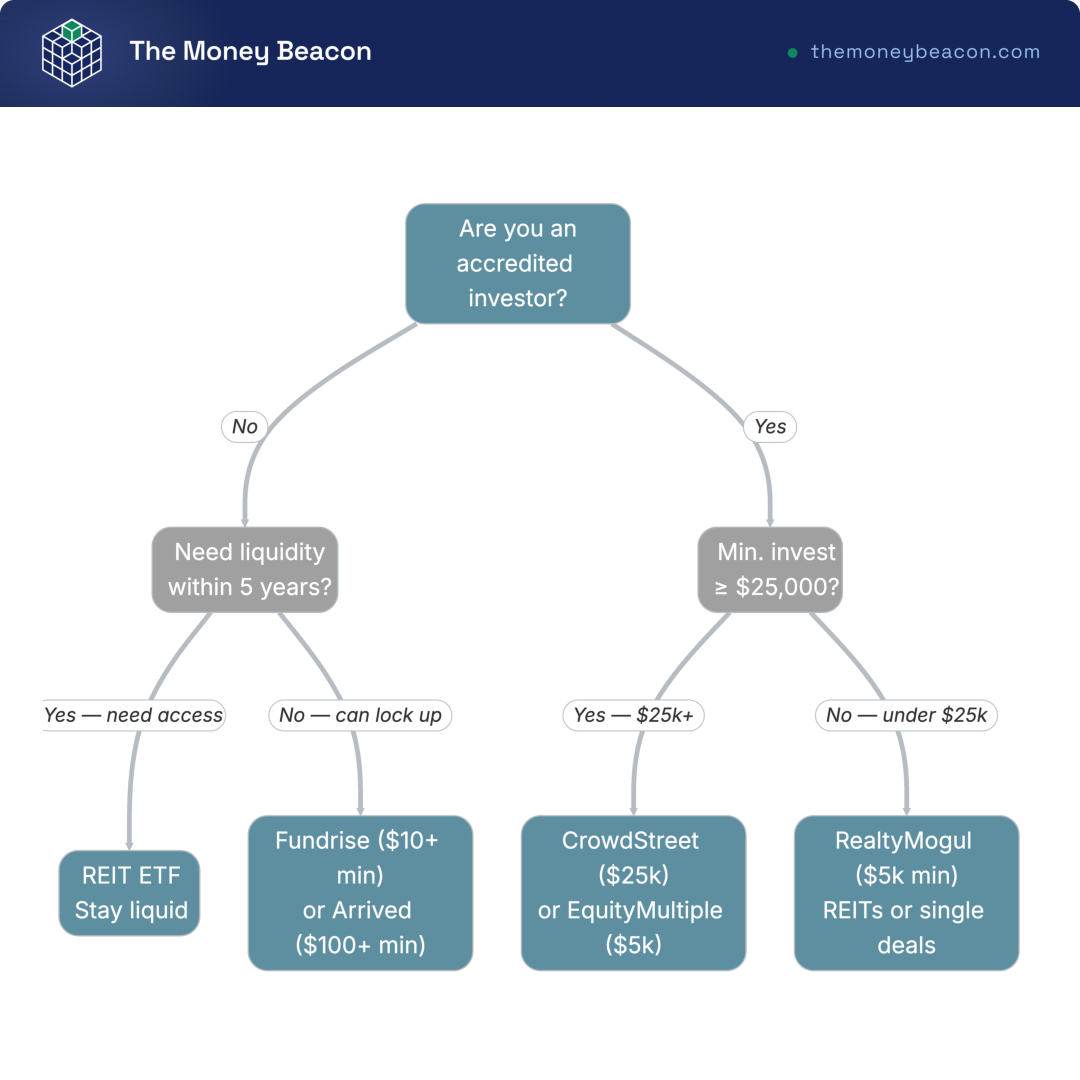
That accredited-only label is the gate on the higher-minimum platforms, so it pays to know where you stand. An accredited investor, in the SEC’s definition, earns over $200,000 single or $300,000 joint for each of the prior two years, or holds a net worth above $1,000,000 excluding the primary residence. The split matters for access: the non-accredited platforms (Fundrise, Arrived) register under Regulation A, while the accredited deals run under Regulation D, a structure the JOBS Act modernized to open private real estate to a wider pool. Knowing which platform fits is only half the work, because the deal itself still has to survive a close read.
5.4 Reading a crowdfunding deal before you commit
Picking a platform gets you in the door; vetting the individual deal keeps you from regret. Five things deserve a hard look before you wire a dollar. Check the sponsor’s track record on prior deals. Add up the full fee stack, acquisition, asset management, disposition, and the promote the sponsor keeps on the upside. Separate projected returns from guaranteed ones, because projections are marketing, not promises. Confirm the hold period, and read the redemption terms word for word. The timeline below shows where the cash actually moves over a deal’s life.
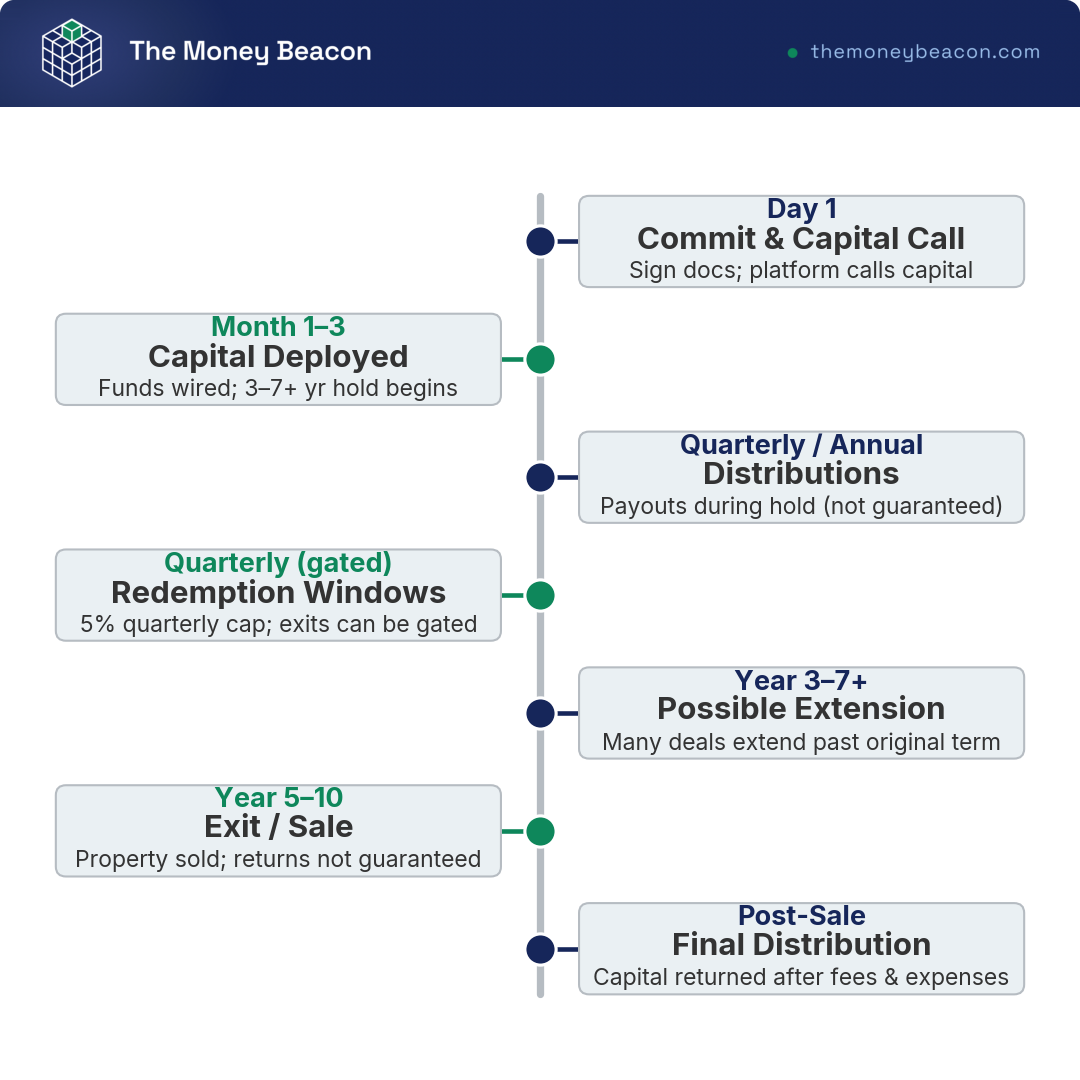
The single confusion that costs people here is assuming the money is reachable. Crowdfunding and non-traded REITs can gate redemptions, with 5% quarterly caps common and the right to suspend them entirely written into the offering documents. Read that offering circular line by line, and treat the money as locked for the full stated hold, not a day less. None of these paths, the rental, the house hack, or the crowdfunded deal, makes full sense until you see how the tax code reshapes each one, and that is where a deal losing $268 a month on paper can still come out ahead.
6. The Tax Angles That Quietly Drive the Math
That $268 monthly loss on the sample rental looks like a reason to walk away, until you remember it is a pre-tax number. The tax code reshapes every path you have priced so far, and on a direct rental it quietly does the heavy lifting that turns a paper loss into a deal that still builds wealth. So let me open the engine in the order it actually runs: depreciation hands you an annual shelter, that shelter creates a bill when you sell, a 1031 exchange can defer the bill, and the passive-loss rules decide who gets to use the shelter at all.
6.1 Depreciation and the recapture bill at sale
We start with the deduction, because it is the most generous one most beginners ignore. The IRS lets you write off the wear-out of a residential rental building, not the land, on a straight-line schedule over 27.5 years. On the $300,000 property, with land valued at $60,000, the depreciable basis is $240,000, so the math is simply $240,000 divided by 27.5, or $8,727 a year. That is a paper loss with no cash leaving your pocket behind it. Here is the trick: you take this deduction without spending a dollar, because the cash already left when you bought the building, and the deduction just spreads that cost across the years you own it.
Watch what it does to the deal that ran $268 a month in the red. If the property nets $5,000 of cash income but throws off $8,727 of depreciation, you report a loss on paper of roughly $3,700 and may owe nothing on the rent at all. The cash drain in your checking account is real, yet your tax return shows a shelter, and in the right circumstances that paper loss reaches beyond the rent to offset other income. This is the quiet rescue that makes a cash-flow-negative rental still build wealth, because the principal paydown and appreciation stack on top of a year where the IRS takes nothing.
One nuance worth flagging here: depreciation is not really optional. The IRS treats it as “allowed or allowable,” which means it gets recaptured when you sell whether or not you ever claimed it, so skipping it forfeits the shelter while keeping the bill. For 2026, keep in mind that the building’s structural shell (walls, roof, standard HVAC) still rides the 27.5-year schedule and does not qualify for bonus depreciation, even though certain shorter-lived components identified in a cost segregation study can.
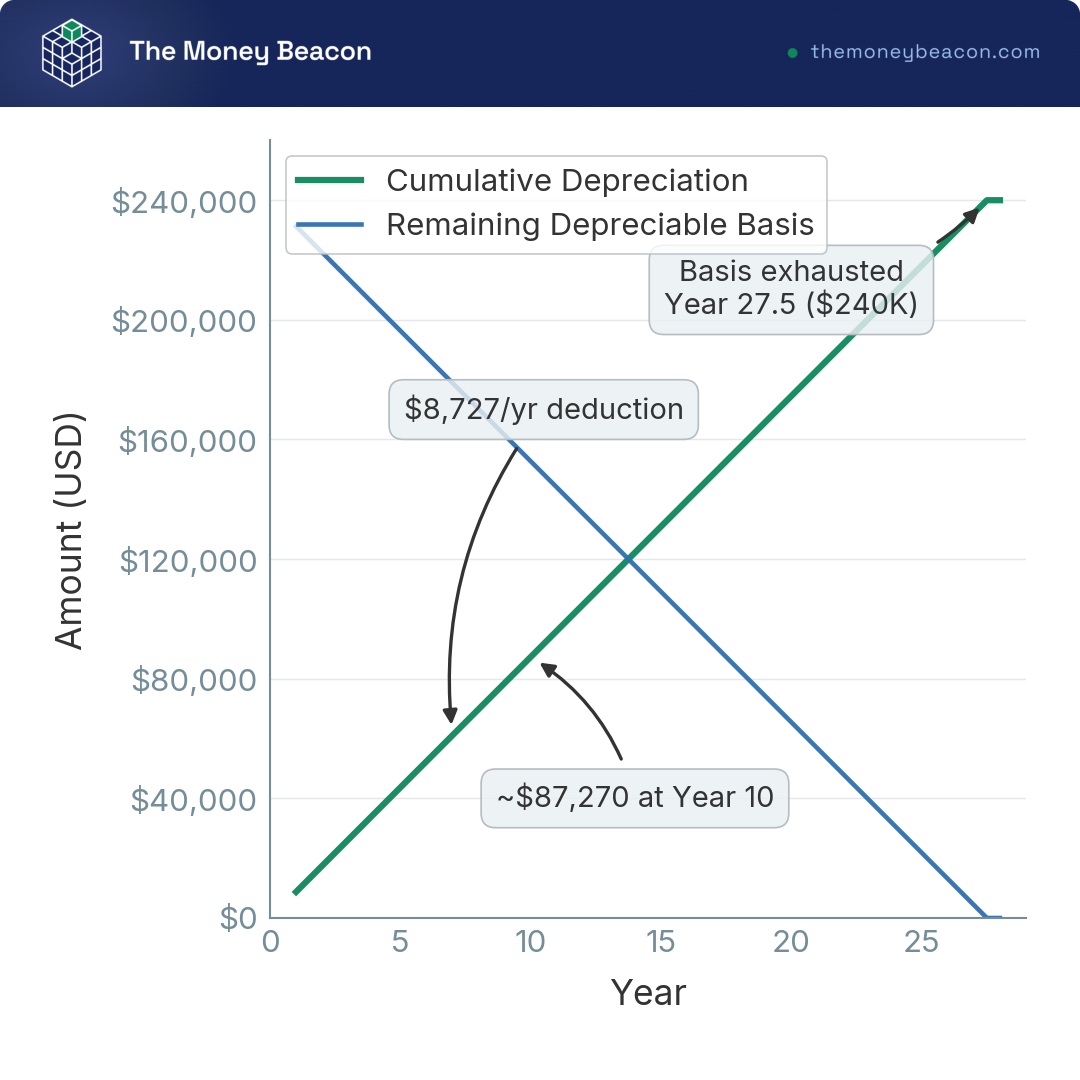
Now for the catch the shelter sets up. When you sell, the depreciation you took (or could have taken) is recaptured and taxed as unrecaptured Section 1250 gain at a maximum federal rate of 25%, while any gain above your original basis is taxed at long-term capital-gains rates of 0%, 15%, or 20%, plus the 3.8% NIIT if your income clears the threshold. Hold the $300,000 property ten years and you accumulate $87,270 of depreciation, so recapture alone could cost up to $21,818 (25% of $87,270) at sale unless you defer it. That is the bill, and the next section is how you push it down the road.
6.2 The 1031 exchange: deferring the gain by trading up
So you owe up to $21,818 the moment you sell, unless you never really sell. That is the idea behind a Section 1031 like-kind exchange, which lets you defer both the capital-gains tax and the depreciation recapture by rolling the proceeds into another investment property through a qualified intermediary (QI) who holds the funds so you never touch them. The rules are specific, and two of them are clocks that do not forgive a late filing.
A 1031 exchange real estate transaction has to clear a tight set of conditions. The replacement must be like-kind investment property, real property swapped for real property held for investment or business use. You must identify the replacement within 45 days of closing the sale and close on it within 180 days (or by your tax-return due date including extensions, if that comes first). The replacement also has to carry equal or greater value and debt, because any shortfall, the “boot,” is taxed in the year of the exchange. The 95% and 3-property rules then cap how many targets you are allowed to name. Both deadlines are strict and non-extendable outside a declared disaster, so missing either one by a single day makes the entire gain taxable at once. The QI fee for a standard delayed exchange runs $750 to $1,500, and a primary residence does not qualify, which is why this tool belongs to investors trading up rather than to someone selling their only rental and leaving real estate behind.
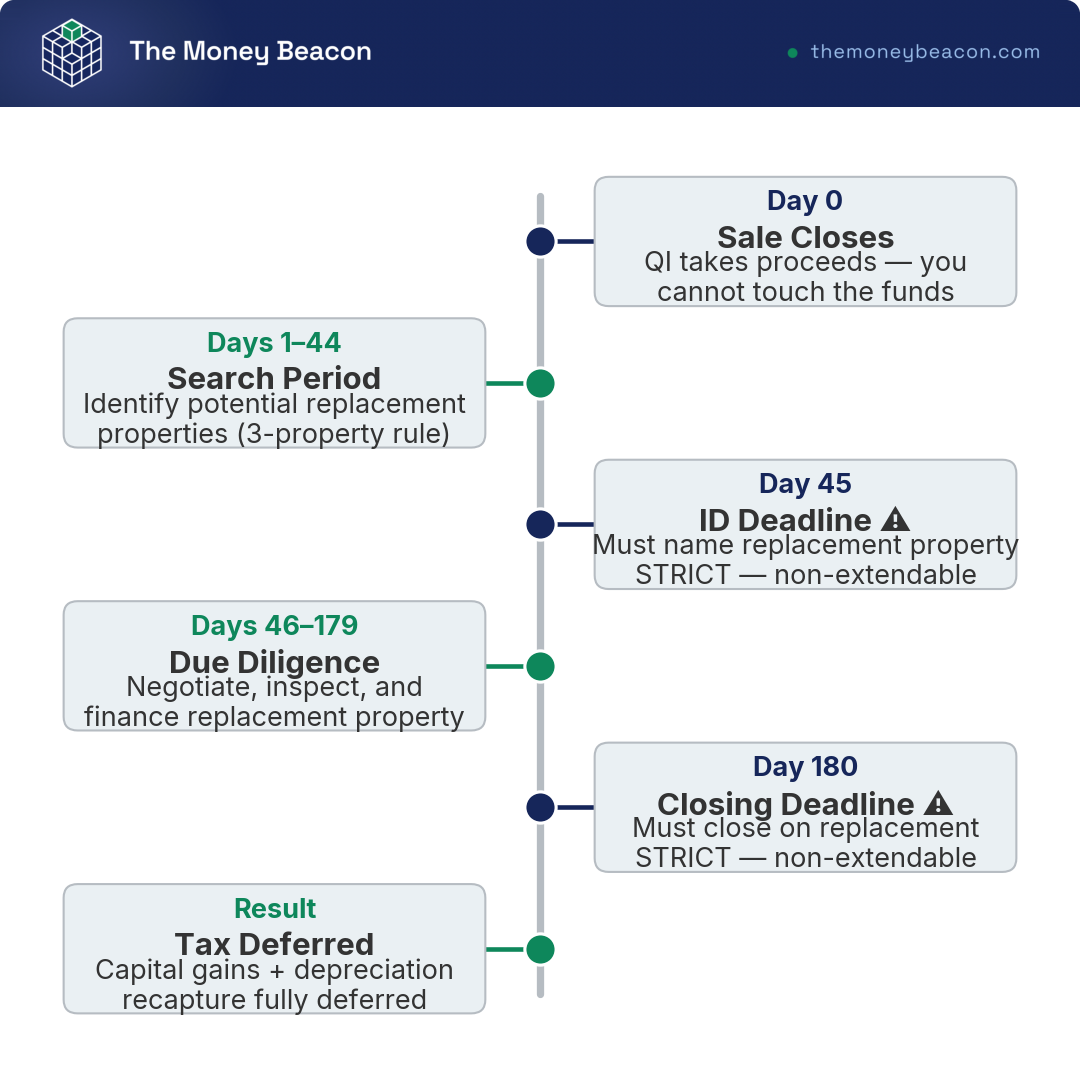
The practical move is to line up the QI before you close the sale, not after, because once the proceeds hit your bank account the exchange is dead. Defer correctly and the gain keeps compounding inside the next, larger property instead of getting clipped by the IRS. That is the whole appeal: you keep the capital working rather than handing a quarter of your accumulated depreciation to the government in one year.
Hank’s take
the 1031 is one of the few places where the tax code rewards patience instead of punishing it. When you follow how policy moves capital, you notice that deferral is a quiet form of leverage, because the dollars you would have paid in tax stay invested and keep earning. Investors who chain exchanges across decades and never sell outright can pass property to heirs at a stepped-up basis, and the deferred bill can effectively disappear. That is not a loophole to game; it is a structural feature worth planning around early.
6.3 Passive losses, REPS, and why REIT holders skip all this
The depreciation shelter sounds universal, but whether you can actually use that paper loss depends on your income, and this is where high earners get a surprise. Under Section 469, rental losses are passive, which means they generally offset only passive income, not your W-2 salary. Two carve-outs decide who escapes that limit, and the table sets them side by side.
| Rule | Who it helps | Limit |
|---|---|---|
| $25,000 active-participation allowance | Active landlords | Phases out between MAGI $100,000 and $150,000 |
| Real estate professional status (REPS) | 750+ hours a year and more than 50% of personal-service work in real estate | Makes losses non-passive, deductible against ordinary income |
Data current as of June 2026.
Read the phase-out line and the warning is clear: a high-income W-2 earner above $150,000 of modified adjusted gross income (MAGI) usually cannot deduct rental paper losses in the current year. Below $100,000 of MAGI an active landlord can use the full $25,000 allowance, but it shrinks across the $100,000 to $150,000 band and is gone above it. Those losses do not vanish, they suspend and carry forward until the property throws off passive income or you sell it, at which point they finally come into play.
Reaching REPS is the other door, but it is a high bar. It demands 750-plus hours a year, more than half of your total working time spent in real estate, and on top of that material participation measured through any one of seven IRS tests, the most common being more than 500 hours in the activity. If you are holding down a full-time job elsewhere, clearing both the hours test and the more-than-half test is effectively impossible, so that door stays shut for most readers. The point is not to discourage you, it is to make sure you plan around the suspended-loss reality instead of budgeting for a tax break you cannot legally take.
Here is the clean contrast that closes the tax engine. A REIT shareholder skips every line above. The REIT handles depreciation internally, and you simply collect dividends taxed the way we covered earlier, with the 199A benefit baked in, reported to you on a 1099-DIV rather than the Schedule E a direct landlord files. That is the cleanest tax path for a hands-off investor, and it is one more reason the lowest door is the right first one for most readers. Account placement and timing decisions like these are some of the most reliable ways to lower your tax bill across any investment, not just real estate. You now have the tax math in hand for every path, which leaves the only question that matters: which path is yours, and what do you do first?
7. Choosing Your Path and Taking the First Step
You now have the full picture across all four paths and the tax treatment that reshapes each one. The job left is to turn that picture into a decision you can act on this month.
7.1 A decision framework keyed to your cash and time
The honest filter is not how ambitious you are, it is how much cash, credit, and time you can actually put on the table. Match the path to those three, and the right first move usually picks itself. The ladder runs from the lowest commitment to the highest, and most readers should start a rung or two below where their ambition wants them to.
The if/then logic is straightforward once you read it against your own numbers. With under $1,000 and a need for liquidity, you buy a broad REIT ETF inside an IRA, which is the move with the lowest cost of being wrong, since you can sell it any market day. With $1,000 to $25,000 and a genuine tolerance for years of illiquidity, a non-accredited crowdfunding platform or another slice of a REIT ETF opens up. With a 3% to 5% down payment and a real willingness to live in the building alongside tenants, you house hack, the cheapest way into direct ownership. With 20% to 25% down, a 680-plus credit score, reserves, and real time to give, a direct rental is on the table. And with accredited status, $25,000 or more, and a long horizon, the higher-minimum private deals come into range. That is how to get into real estate without overreaching: let the path match the wallet, the credit, and the calendar, not the daydream.
If your honest read is that you want exposure with zero management and zero learning curve, the REIT ETF in a tax-sheltered account is hard to beat, and it pairs naturally with a broader hands-off setup. Readers who want the whole portfolio on autopilot often run real estate exposure alongside a hands-off robo-advisor handling their stock and bond allocation. With the path chosen, the next thing to protect is that path from the errors that trip up beginners.
7.2 Common mistakes, your first 30 days, and when to call a pro
Almost every beginner mistake in real estate maps back to a confusion this guide already untangled, which is reassuring, because it means you can sidestep them. The recurring ones are worth naming so you recognize each as it appears.
- Treating mortgage REITs as safe high-yield, when that ~12% is a leveraged rate bet that cuts dividends when rates spike.
- Buying a rental on the 1% rule alone, with no reserves for vacancy and capex.
- Ignoring depreciation recapture and getting blindsided by the tax bill at sale.
- Assuming crowdfunding is liquid, when redemption gates are written into the documents.
- Holding REITs in a taxable account when an IRA would shelter the ordinary dividends.
- Forgetting that a high W-2 income above $150,000 MAGI suspends rental paper losses.
- Missing a 45-day or 180-day deadline and voiding an entire 1031 deferral.
With the traps named, your first 30 days are about small, concrete steps rather than a big plunge. Confirm your emergency fund is funded and no high-interest debt is hanging over you. Open or fund a brokerage account or IRA, then buy a single share of a broad REIT ETF just to learn the mechanics of owning real estate. If you are leaning toward ownership, get pre-approved and pull rent comps, then build a one-page deal spreadsheet that runs NOI, cap rate, and cash-on-cash. And if crowdfunding tempts you, read one platform’s offering circular cover to cover before you wire a cent. The cleanest place to start is simply to open a brokerage or IRA account if you do not already have one, since every path except direct ownership runs through it.
Know, too, when to stop doing it yourself. Bring in a CPA before your first rental tax filing, for the depreciation setup, basis allocation, and passive-loss tracking, and again before any 1031. Bring in a real estate attorney for entity structuring, multi-member deals, and state landlord-tenant compliance. And a qualified intermediary is mandatory, not optional, for any 1031, since you legally cannot hold the proceeds yourself. Paying for the right pro at the right moment is cheap next to a botched filing or a blown deferral.
7.3 The whole guide at a glance
One table pulls the entire guide together, lining up the four paths on what they cost to start, how liquid they are, what they tend to return in 2026, the tax angle that decides each one, and the reader each fits best. Every figure in it traces back to a section you have now worked through.
| Path | Cash to start | Liquidity | Typical return profile (2026) | Decisive tax angle | Best-fit reader |
|---|---|---|---|---|---|
| REIT ETF | $1-$100 | High | ~3.6% yield + price growth | 199A 20% on ordinary dividends; hold in IRA | Any beginner wanting liquid diversification |
| Crowdfunding | $10-$25,000 | Low (3-7+ yr) | Target 6%-12%, not guaranteed | Passes through depreciation; K-1 or 1099 | Patient investor wanting private deals |
| House hack | 3.5%-5% down | Low | Cuts housing cost + equity build | Section 121 on residence portion; partial depreciation | Owner-occupant willing to live with tenants |
| Direct rental | 20%-25% down + reserves | Low | Cash flow + paydown + appreciation; often cash-flow negative at 2026 rates | 27.5-yr depreciation, recapture at 25%, 1031 deferral | High-capital, hands-on investor |
Yields, returns, and rate context current as of June 2026.
Read across the rows and the spectrum from the introduction comes full circle: $1 in a REIT and a six-figure rental are both real estate, but they ask completely different things of your cash, your time, and your tax return. The path that fits is the one that matches all three today, not the one you wish you were ready for. With the map complete and the first moves laid out, the only thing left is to take the step that fits your situation.
Conclusion
Real estate isn’t a house, it’s a spectrum, and the right entry point is the one that matches your cash, your time, and how much risk you can stomach right now. A public REIT or REIT ETF asks as little as $100 and trades same-day, crowdfunding starts low but locks your money up for years, house hacking buys a building with 3% to 5% down because you live in it, and a direct rental sits at the heavy end with 20% to 25% down plus reserves. The cheaper and more liquid the door, the less control and tax leverage it hands you, which is why most readers should start a rung below where their ambition wants them to.
For most beginners that lowest door is a broad REIT ETF inside an IRA, where roughly $100 buys diversified, liquid exposure and the IRA shelters the ordinary dividends that would otherwise drag on a taxable account. A rental sits at the far end, and the honest lesson is this: a deal can run $268 a month in the red at 2026 rates and still build wealth, because principal paydown, appreciation, and an $8,727 depreciation deduction do the work the rent check can’t. Here’s the part to hold onto. The tax engine, depreciation now and a 1031 exchange later, is what separates the investors who compound from the ones who just bought themselves a headache. None of it starts, though, until your foundations can hold the weight, so clear high-interest debt and a 3-to-6-month emergency fund first, and grab any uncaptured 401(k) match before a single down payment.
Two limitations are worth remembering. A mortgage REIT yielding around 12% is a leveraged bet on the rate spread, not a safe high-yield account, so read that number as a warning label. And if your modified adjusted gross income clears $150,000, the passive-loss rules usually suspend the rental paper losses you were counting on, which changes the math before you ever sign.
Your first move is small this week: open or fund a brokerage or IRA account, since every path except direct ownership runs through one. From there you can sharpen the through-line that quietly decides your real return by working through the most reliable ways to lower your tax bill, then set real estate inside the bigger picture with our guide to how much you actually need to retire.
Frequently Asked Questions
How much money do I need to start investing in real estate?
Far less than most people assume. The lowest-friction entry is a broad REIT ETF such as VNQ, SCHH, or FREL, bought in any brokerage or IRA for the price of one share; VNQ traded near $98 in June 2026, so a single share runs under $100 with full daily liquidity. Below that, Fundrise accepts about $10 into pooled real estate and Arrived starts near $100, though that money is far less liquid. A direct rental is a different scale entirely, since a $300,000 property typically needs roughly $70,000 to $85,000 across the down payment, closing costs, and reserves. House hacking narrows the gap, because an FHA 3.5% down payment on a $400,000 duplex is about $14,000 plus closing and reserves.
Are REITs a good investment for beginners?
For most beginners who want real-estate exposure without a mortgage or tenants, a broad exchange-traded REIT ETF is the cleanest starting point: liquid, low-cost, and diversified across many properties. Just be careful to separate equity REITs, which own buildings and yield around 3.6%, from mortgage REITs, which yield near 12% because they are leveraged bets on the interest-rate spread that cut dividends when rates rise and should never be read as safe income. Because most REIT dividends are taxed as ordinary income, holding REITs inside a Roth or traditional IRA usually beats a taxable account, and a 5% to 10% portfolio allocation is a common guideline.
Is buying a rental property worth it in 2026 with current mortgage rates?
It can be, but the math is tighter than in the low-rate years. With investment-property rates running roughly 0.5 to 1.0 point above the ~6.5% owner-occupied 30-year average (data current as of June 2026), many deals are cash-flow negative on day one. In the worked $300,000 example at a 7.5% rate, the property loses about $268 a month and depends on principal paydown, appreciation, and tax shelter to build wealth; at 6.5% the same deal turns roughly cash-flow neutral. Run the full numbers, keep solid reserves, and treat a cash-flow-negative deal as a leveraged bet on appreciation rather than a passive income machine. You can compare current mortgage rates and lenders before you underwrite a deal.
What is house hacking and can I really live for free?
House hacking means buying a 1-to-4-unit property as your primary residence with low-down-payment owner-occupant financing (3.5% FHA or 3% to 5% conventional), living in one unit, and renting out the rest. You rarely live entirely free, but the math is powerful: if your all-in payment is $2,900 and a tenant pays $1,600, your effective housing cost drops to about $1,300, often below local rent, while the tenant pays down your loan and you build equity. Budget honestly for FHA mortgage insurance (1.75% upfront and 0.50% to 0.75% annually), and remember the rented portion is later subject to depreciation recapture even though Section 121 can shelter the gain on your residence portion.
Is real estate crowdfunding safe, and are the returns real?
It can diversify a small portfolio into private real estate, but the trade-offs are real: money is typically locked up for 3 to 7 years or more, fees stack across asset management, advisory, and sponsor promote, and advertised returns are targets, not guarantees. Redemption windows can be gated or suspended, with 5% quarterly caps common. So vet the sponsor track record, the full fee stack, the hold period, and the redemption terms by reading the offering circular line by line. For most beginners, a liquid REIT ETF gives similar real-estate exposure with daily liquidity and lower fees; crowdfunding really suits patient investors who specifically want private-deal exposure and can leave the money untouched for the full hold.
How does depreciation actually lower my taxes on a rental?
The IRS lets you deduct the wearing-out of a residential rental building, though never the land, straight-line over 27.5 years under MACRS. On a $300,000 property with $60,000 of land, the $240,000 building gives $240,000 / 27.5 = $8,727 a year, a paper loss that shelters rental cash income without any cash leaving your pocket, claimed on Schedule E. It is well worth doing, because depreciation is treated as “allowed or allowable,” so it is recaptured at sale whether or not you actually took it. Skipping it forfeits the annual shelter while keeping the tax bill at sale, which is why it pays to coordinate it with your other tax-lowering moves.
What is a 1031 exchange and who should use one?
A 1031 exchange swaps one investment property for another and defers both the capital-gains tax and the depreciation recapture. You must use a qualified intermediary to hold the proceeds, identify a replacement within 45 days, and close within 180 days; those deadlines are strict and non-extendable, and the replacement must be of equal or greater value or the difference, known as “boot,” is taxed. It suits investors trading up to larger properties who want to keep their capital working rather than pay tax now. It is overkill for someone selling their only rental and exiting real estate, since the deferral simply postpones the bill, and a primary residence does not qualify in the first place.
Should I hold REITs in a Roth IRA or a taxable brokerage account?
Because most REIT dividends are ordinary (non-qualified) income, holding REITs in a Roth or traditional IRA usually beats a taxable account, since the IRA shelters that annual ordinary-income tax drag entirely. The Section 199A 20% QBI deduction that helps in a taxable account only softens, but never eliminates, that drag, and it is irrelevant inside an IRA where distributions are already tax-deferred or tax-free. If you must hold REITs taxably, the 199A deduction at least lowers the effective rate on the ordinary slice. When you are deciding where to park them, it helps to compare the brokerage and IRA accounts on fees and fund access first.




Comments
Questions and corrections welcome. We read everything.