


You have built up real home equity, a lender is dangling a low introductory HELOC rate, and the pitch sounds almost too easy. Here’s the trouble: few homeowners actually know how the line gets sized, when the cheap interest-only payments end and jump, or how high a variable rate tied to prime can really climb. Fewer still can tell you whether a home equity loan or a cash-out refinance would serve them better for the same goal. Get those wrong and you put the roof over your head on the line. US homeowners are sitting on near-record tappable equity, roughly $11 trillion in 2026, so more people than ever are weighing whether to borrow against the house. Plenty do it without a clear picture of what the credit really costs once the rate floats and the payment resets.
So here’s what I’ll walk you through: exactly how a home equity line of credit works from the inside out, what it truly costs, and where the risks hide. You’ll also see the math for sizing your own line and the framework for choosing between a HELOC, a home equity loan, and a cash-out refinance.
1. What a HELOC Actually Is and How It Differs From Other Home Loans
Before you decide whether to borrow against your house, you need a clear answer to one question: what exactly is a HELOC, and why would you reach for it instead of a credit card or a personal loan? We start from what you already own, build up to the revolving line secured against it, then set that line next to its cheaper-or-not-cheaper alternatives so you can see the rate gap that justifies the whole product.
1.1 Home equity and the revolving line secured by your house
Start with the number underpinning everything else. Home equity is the current market value of your home minus every balance secured by it. A house worth $500,000 with a $300,000 first mortgage carries $200,000 of gross equity, and that figure is the raw material a lender works with. Here’s the catch, though: equity and borrowable equity are not the same thing. Lenders let you tap only a slice of the value, because they keep a cushion between what you owe and what the house could fetch in a forced sale, so a good chunk of your equity has to stay untouched.
A home equity line of credit (HELOC) turns that borrowable slice into a revolving line. The lender approves a credit limit, places a lien (usually a second lien sitting behind your first mortgage) on the home, and lets you draw cash as you need it during a set window called the draw period. You pay interest only on the outstanding balance, not the full limit, and as you repay principal that availability comes back, the way it does on a credit card backed by real estate. That re-borrowing flexibility is the HELOC’s defining trait and the reason it behaves nothing like a one-time lump-sum loan.
That flexibility cuts both ways, depending on what you do with the money. The defensible uses are home renovations, bridging the gap on a home purchase, or holding a standby reserve you may never touch. The risky ones are consolidating unsecured debt or funding plain consumption, because you are moving that debt onto the house. The borrowers who reach for this line of equity are a broad group: W-2 employees, 1099 contractors and small-business owners who want a flexible reserve, and retirees with paid-down homes who want cheap liquidity without selling investments. What pulls all of them in is the rate gap, which the chart below makes plain.
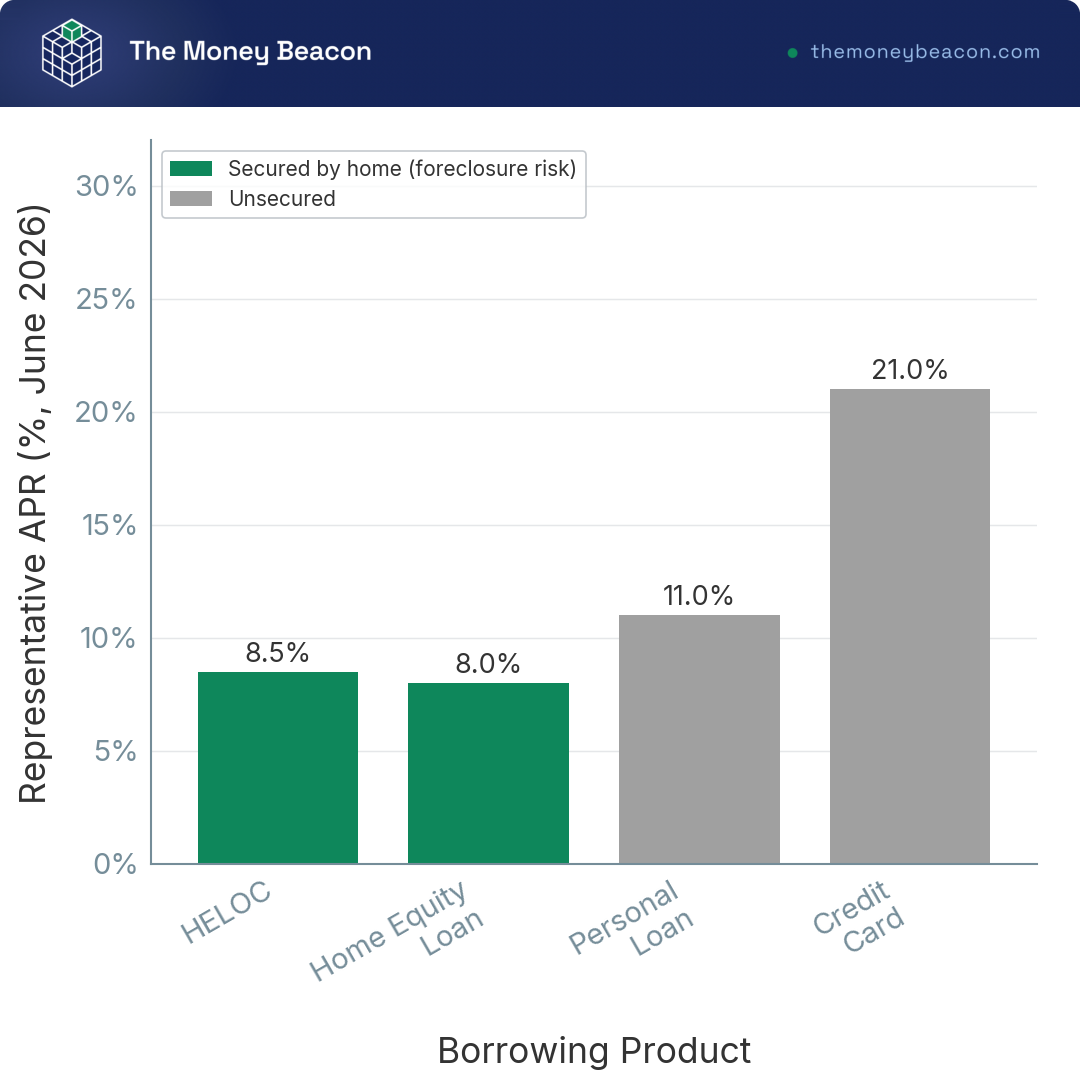
The two cheap bars are the ones secured by your home, and that is no coincidence. Putting up collateral is exactly what buys the lower rate, and that trade-off is the one we keep coming back to. Before we price it, it helps to know that one option used unsecured, the personal loan, sits in its own category, and we break down where it lands in our guide to the personal loan market.
1.2 The consumer protections built into a HELOC
A line secured by your home sounds like a lopsided deal in the lender’s favor, so it pays to know the rules that sit on your side of the table. Federal law wraps a HELOC in real protections, starting before you sign and running for the life of the line.
The Truth in Lending Act (TILA) and its Regulation Z force the lender to hand you standardized disclosures: the APR, the fee schedule, and a terms booklet at application, so you can compare offers on the same footing. On a primary residence you also get a 3-business-day right of rescission, a window after closing in which you can cancel the whole thing with no penalty, no questions asked. The High-Cost Mortgage Provisions (HOEPA) layer on extra protections when fees or the APR cross high-cost triggers, and those apply to open-end home-equity plans like HELOCs. The table pins down what each rule actually does for you.
| Rule / law | What it does for you | Authority |
|---|---|---|
| Truth in Lending Act (TILA) / Regulation Z | Standardized HELOC disclosures, APR, fee and term booklet at application | CFPB (12 CFR 1026.40) |
| 3-day right of rescission | Cancel a HELOC on your primary residence within 3 business days of closing | TILA / Reg Z (12 CFR 1026.23) |
| HOEPA | High-cost mortgage protections (fee/APR triggers); these apply to open-end home-equity plans, including HELOCs | Reg Z / CFPB (12 CFR 1026.32) |
| Deposit insurance on the lender | FDIC (banks) / NCUA (credit unions) insure your deposits, not your loan | FDIC / NCUA ($250,000 per depositor, per institution, per ownership category) |
One protection people reach for by mistake is deposit insurance. The FDIC and NCUA insure your deposits up to $250,000 per depositor if the bank or credit union fails, and they have nothing to do with whether you owe on a HELOC. The Securities Investor Protection Corporation (SIPC), which covers a failed brokerage, is unrelated to home lending entirely. The rescission right is the one that matters most for an owner-occupier, and it gives you three days to walk away once the terms are in front of you in black and white. That safety net only makes sense once you see how much cheaper a secured line is than the alternatives, so let’s put real rates on it.
1.3 HELOC vs credit card vs personal loan: why the rate gap matters
Why borrow against the house at all when a credit card is already in your wallet? The answer is the spread between the rates, and it is wide enough to drive the entire decision. A credit card averages about 21% APR across all commercial-bank accounts, the Federal Reserve’s G.19 measure, while a HELOC in 2026 runs roughly 7% to 9.5%. An unsecured personal loan lands in between, anywhere from about 6% to 36% by credit profile, with a commercial-bank average near 11% on a 24-month loan. The table lines up the three on the features that actually differ.
| Feature | HELOC | Credit card | Personal loan |
|---|---|---|---|
| Secured by home? | Yes (junior lien) | No | Usually no |
| Rate type | Variable (prime + margin) | Variable, much higher | Usually fixed |
| Typical APR (2026) | ~7% to 9.5%+ | ~21% | ~6% to 36% (about 11% average on a 24-month bank loan) |
| Re-borrow without reapplying? | Yes, during draw | Yes | No |
| Foreclosure risk? | Yes | No | No |
Data current as of June 2026.
So the home equity credit wins on price by a mile, but read the last row before you get excited. The credit card and the personal loan can wreck your credit score if you default, yet neither one can take your house. The HELOC can. That is the whole bargain in a single line: you trade roughly 12 points of interest for the risk that a missed payment, in the worst case, ends in foreclosure. Whether that trade is smart depends entirely on what you borrow for and how much line you can actually get, which is the next thing to work out. If your goal is short-term spending you plan to clear fast, our comparison of the best credit card offers is the cheaper place to start.
2. How Lenders Size Your Credit Line: LTV, CLTV, and Qualifying
You know what a HELOC is and why the rate is tempting. The next question is the practical one: how much can you actually borrow, and what do you need to qualify? We turn your home value into a borrowable ceiling with a single formula, then walk through the credit, income, and appraisal gates that decide whether the lender hands you that ceiling.
2.1 LTV, CLTV, and the formula that sizes your line
Two acronyms do all the work here, and they are simpler than they look. Loan-to-value (LTV) is one loan balance divided by the home’s value. Combined loan-to-value (CLTV) is all the liens against the home, including the new HELOC limit, divided by that same value. CLTV is the one a HELOC lender cares about, because it captures everything you owe on the house at once.
Lenders size your line against a maximum CLTV, commonly 80% to 85%, sometimes 90% for strong borrowers, and up to 95% at a few credit unions such as Navy Federal. The formula falls straight out of that ceiling:
Maximum HELOC = (Max CLTV times Home value) minus First mortgage balance.
That single equation is the heart of sizing a line, and the flowchart below turns it into a repeatable five-step process you can run on your own numbers before you ever call a lender.
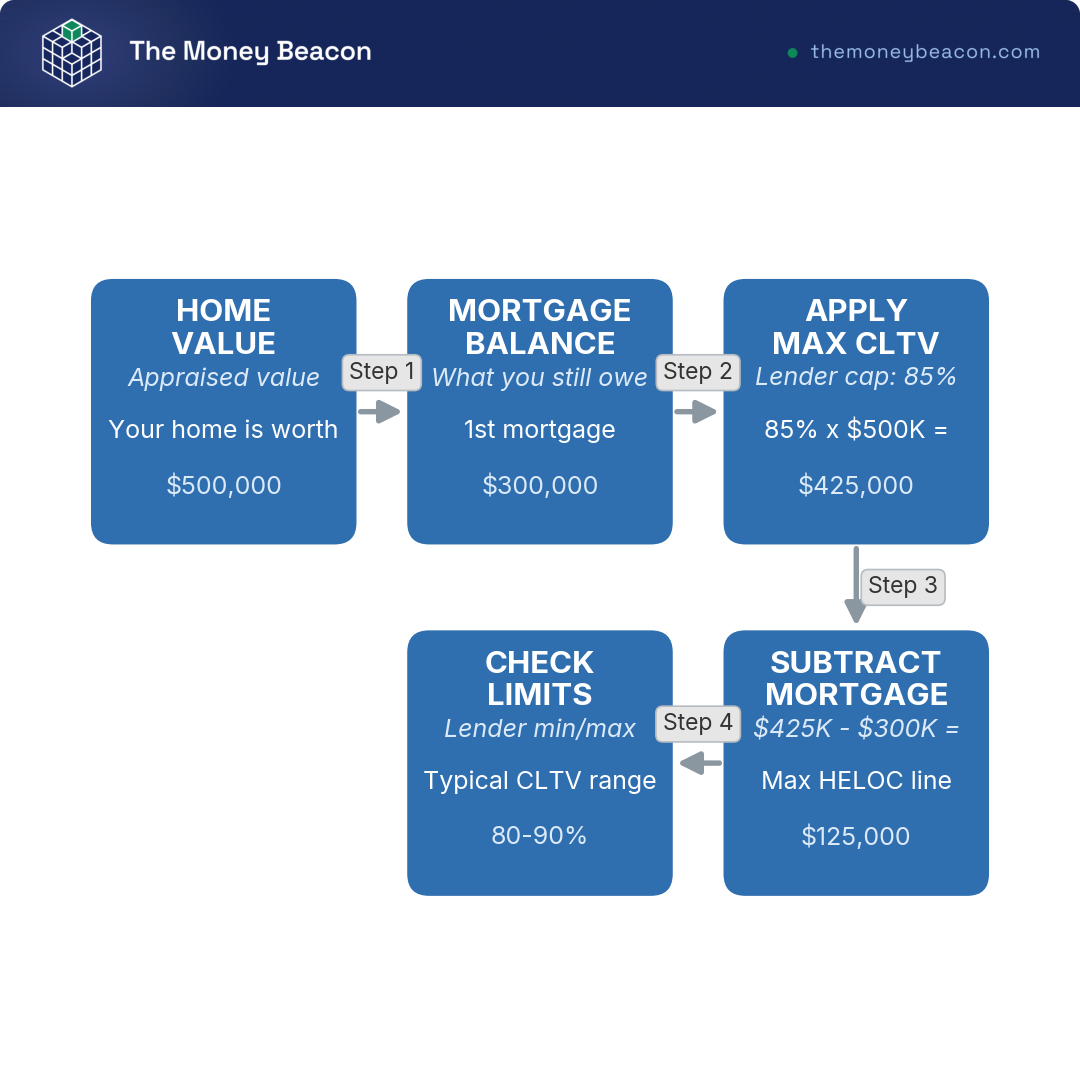
The flowchart looks tidy, but the lesson hiding inside it trips up most homeowners: gross equity is not your line. The CLTV ceiling caps you well below what you “own,” and the gap between the two is where the math gets real, so let’s run it.
2.2 The math: turning a $500,000 home into a line
Take the same house from earlier: a $500,000 home with a $300,000 first mortgage. On paper you have $200,000 of gross equity, and it is tempting to assume that is the number you can borrow. It is not. At an 85% CLTV cap, the most total debt the lender allows is 85% of $500,000, or $425,000. Subtract the $300,000 you already owe and your maximum line is $125,000, not $200,000. The table walks each input to that result.
| Input | Value |
|---|---|
| Appraised home value | $500,000.00 |
| First mortgage balance | $300,000.00 |
| Gross equity | $200,000.00 |
| Lender max CLTV | 85% |
| Max total debt allowed (85% of $500,000) | $425,000.00 |
| Maximum HELOC line ($425,000 minus $300,000) | $125,000.00 |
Data current as of June 2026.
So it is the CLTV cap, not your gross equity, that sets the number, and a few points either way move it a lot. At a stricter 80% cap the same home yields a $100,000 line; at a generous 90% cap it stretches to $150,000. Notice what an 80% ceiling really demands: you have to keep at least 20% equity in the house after the line is in place, which is why the popular “do I need 20% equity?” question has a yes-ish answer. Thin-equity owners, the people who bought recently or already borrowed heavily, often find the formula hands them little or nothing. Sizing the line is only half the approval, though, because the lender still has to decide you can repay it.
2.3 Credit score, income, DTI, and the appraisal
The formula tells you the ceiling; your financial profile decides whether you reach it. Three numbers carry most of the weight, and the table below shows where the thresholds tend to sit.
| Criterion | Typical entry | Better terms | Notes |
|---|---|---|---|
| Credit score | ~620 floor | 660 to 680+ preferred; 700-740+ for the best pricing | Pulled from Equifax/Experian/TransUnion |
| DTI (debt-to-income) | Up to ~43% | Lower DTI = larger line | Many lenders cap at 43% or lower; ability-to-repay underwriting applies |
| Income documentation | W-2s, pay stubs, tax returns | 2 yrs returns/1099 for self-employed | Self-employed scrutinized more |
| Equity retained | 10%-20% after line | More equity = better pricing | Tied to CLTV cap |
Data current as of June 2026.
A credit score around 620 is the usual floor, 660 to 680 and up gets you in the door comfortably, and 700 to 740-plus earns the best pricing. Your debt-to-income ratio (DTI), the monthly debt payments divided by gross monthly income, is often capped near 43%, and a lower DTI buys you a larger line. Sitting underneath both is the appraisal, because the appraised value is what feeds the CLTV math, so a low appraisal can shrink or kill the line outright. Lenders value the home in several ways, from a full interior appraisal down to a drive-by, a desktop review, or an automated valuation model (AVM), a software estimate. Some waive the full appraisal for smaller lines or strong AVM confidence, which is what “HELOC without appraisal” offers really mean: Figure runs an AVM-based process on lines up to $400,000, and Connexus and Rate run similar programs. When a full appraisal is ordered, expect it to take roughly 6 to 20 days from order to report.
2.4 Qualifying when you are self-employed or 1099
If your income lands on a 1099 instead of a W-2, the qualifying bar moves, and it pays to know why before you apply. Lenders cannot read a steady salary off a pay stub, so they ask for more proof and they read it more skeptically.
Expect to produce two years of tax returns, a year-to-date profit-and-loss statement, and sometimes bank statements. The friction point is how lenders treat variable income: they average it across the period rather than taking your best year, and they may apply add-backs that adjust the figure up or down. For an entrepreneur whose income swings, that averaging can land well below what you feel you earn, which is the single most common snag we see for self-employed borrowers. The practical move is to assemble clean books before you apply and expect more scrutiny, not less. With the line sized and the gates cleared, the question shifts from how much you can borrow to what you will actually pay, month by month.
3. The Two Phases of a HELOC: Draw Period and Repayment Period
A HELOC does not charge you the same way for its whole life. It lives in two phases, a low-payment draw period and a higher-payment repayment period, and the jump between them catches unprepared borrowers off guard. We follow the loan through both lives, put real dollars on the jump, then map your options for the moment the draw ends.
3.1 The draw period and the repayment period
The draw period is the easy years. It commonly runs 10 years (lenders range from 5 to 10, with 10 the standard), and during it you can borrow and repay freely up to your limit. Many HELOCs let you make interest-only payments in this phase, which keeps the monthly bill low. The trap inside that convenience is that interest-only means no principal is getting paid down, so your balance is not shrinking unless you choose to pay extra. Interest-only is not the same as free.
Then the draw period ends and the repayment period begins, commonly running up to 20 years (lenders range from 10 to 20). You can no longer borrow, and the balance now fully amortizes, meaning each payment finally includes principal as well as interest. Because principal is suddenly in the mix, the payment can roughly double, the jolt everyone calls payment shock. A handful of HELOCs skip the gradual repayment entirely and demand a balloon payment, the full balance at once, at end-of-draw, which is the most dangerous structure for a borrower who has not planned for it. The chart below traces the monthly payment across the full 30-year horizon, including a scenario where the rate climbs by repayment time.
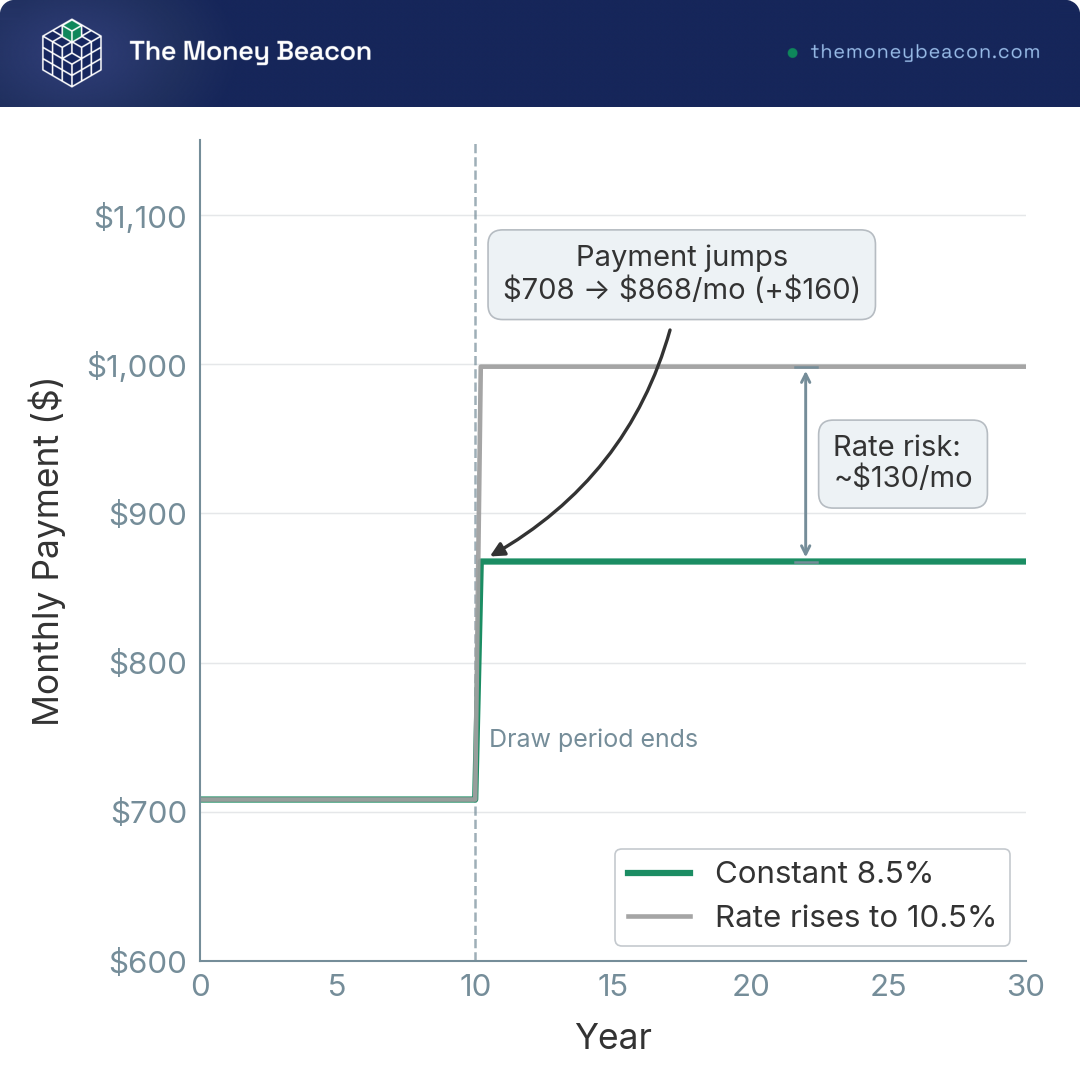
The step up in that chart is the payment shock, and it is far easier to absorb when you have seen the actual dollars in advance. So let’s put them on the table.
3.2 The payment-shock example in real dollars
Here is a clean example. Assume a $100,000 balance at an 8.5% APR, which is roughly prime at 6.75% plus a 1.75-point margin for a typical borrower. During the draw, interest-only, the payment is $708.33 a month. The same $100,000 amortized over a 20-year repayment runs about $867.82, and over a tighter 15-year term it climbs to about $984.74. The table pins the exact figures.
| Phase | Structure | Monthly payment (approx.) |
|---|---|---|
| Draw, interest-only | $100,000 times 8.5% divided by 12 | $708.33 |
| Repayment, amortizing | $100,000 over 20 years at 8.5% | ~$867.82 |
| Repayment if balance is $100,000 over 15 years at 8.5% | shorter term | ~$984.74 |
Illustrative; rate assumed fixed for clarity. Data current as of June 2026.
Even holding the rate flat, moving from interest-only to a 20-year amortizing payment lifts the monthly outlay by about 22% here, and that is the gentle version. If the variable rate has also drifted up by the time repayment starts, the jump is steeper. Cut the balance in half and the math halves with it: a $50,000 balance runs about $354 a month interest-only and about $434 amortizing over 20 years. This linear scaling is exactly why “how much does a $50,000 or $100,000 HELOC cost per month” has no single answer. The payment depends on the rate, the phase, and the term, so anyone quoting you one figure is leaving out two of the three. Knowing the jump is coming is one thing; having a plan for the day it lands is another.
Hank’s take

follow the Fed’s rate path closely and the payment-shock chart looks even less comfortable, because the amortization jump and a higher index can land in the same year. The borrowers who get hurt are the ones who budgeted off the interest-only payment as if it were permanent.
3.3 End-of-draw options: refinance, repay, or reset
When the draw period closes, you are not stuck with whatever payment the repayment schedule throws at you. You have four moves, and the right one depends mostly on whether you can repay the balance and how your first-mortgage rate compares to the market.
You can let it amortize and simply absorb the higher payment, which works when the balance is small or your budget has the room. You can pay it off outright if you have the cash or sold an asset to cover it. You can refinance the HELOC into a fresh line or a fixed home equity loan, resetting the draw or locking a rate. Or you can roll the balance into a cash-out refinance, folding it into a new first mortgage, which makes sense only when that first-mortgage rate is genuinely attractive. The decision tree below branches on those same two questions and points you to the outcome that fits.
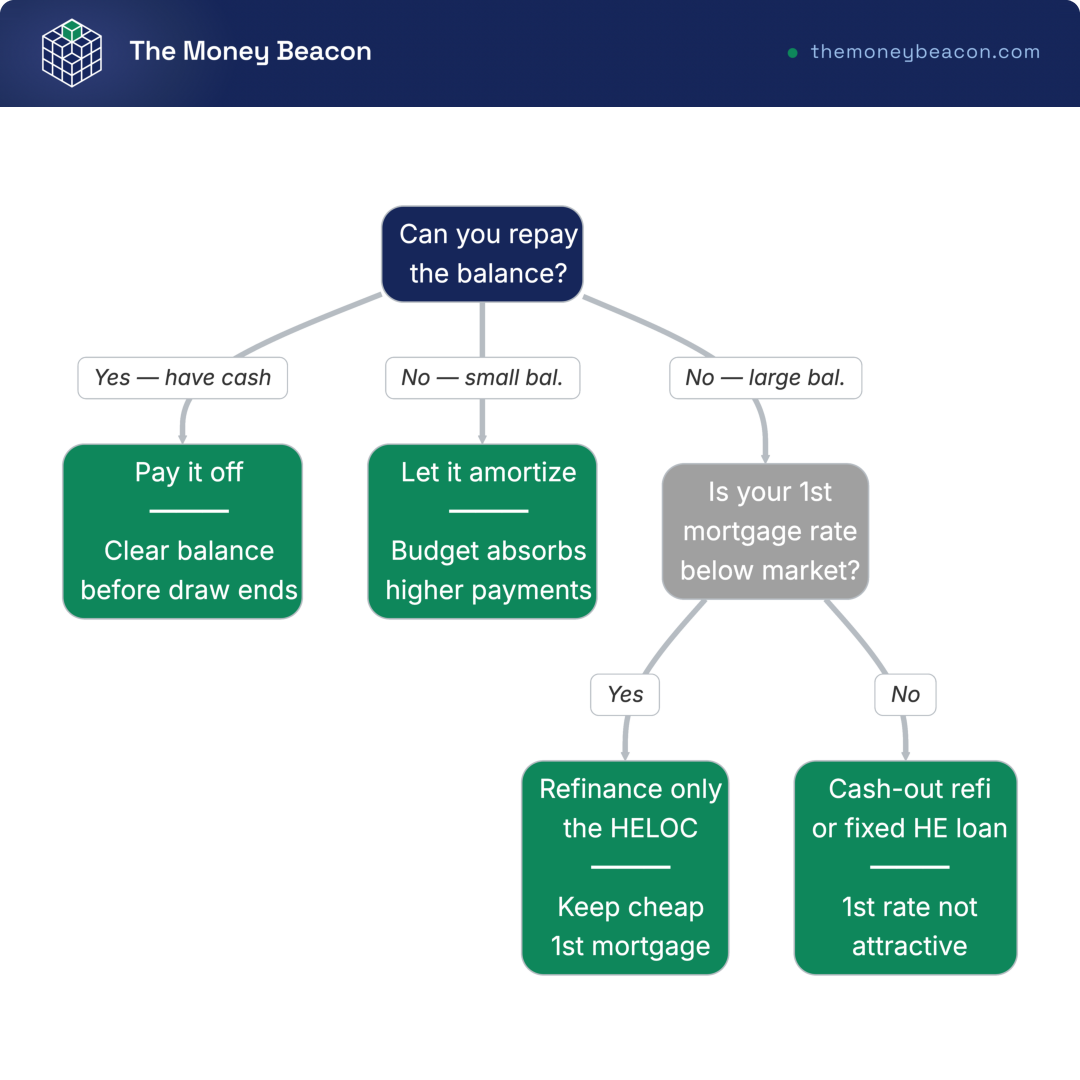
Two of those four moves involve refinancing equity loan balances into a new product, and the smart choice there hinges on rates we have so far held constant for clarity. If repaying early is on the table, it is worth pricing the alternatives, and you can compare today’s refinance lenders before the draw window closes. Every payment figure so far assumed a fixed rate, yet a HELOC rate floats, and what makes it float, the prime rate and the lender’s margin, is exactly where we go next.
4. Why the Rate Is Variable: The Prime Rate and Margin
So far every payment in this guide leaned on one quiet assumption: a fixed rate. Real HELOC rates do not hold still, and the reason is worth understanding before you sign anything, because it decides how much that monthly number can move on you. Your rate is built from two pieces, one you control at origination and one the Federal Reserve controls for the life of the line. Let’s take the two pieces apart, follow a Fed decision all the way into your monthly bill, then look at the caps and floors that fence the rate in.
4.1 Prime plus margin, and how the Fed moves your payment
Start with the simple equation behind every variable HELOC. Your APR is the prime rate plus a fixed margin. The prime rate is a published benchmark, the same number for everyone, and it moves with the federal funds rate. The margin is the lender’s markup, set when you open the line based on your credit, your CLTV, and the lender, and it generally stays put for the entire life of the line. Put a borrower with a 1.00-point margin against prime at 6.75% and you get a 7.75% APR; a weaker borrower priced at prime plus 2.50% lands at 9.25% on the very same day. The margin is where your file shows up in the price, so it is the piece you negotiate.
The other piece, prime, you do not negotiate at all, because it answers to the Fed. Prime tracks the federal funds target with a remarkably stable relationship: it sits at the federal funds target plus 3.00 percentage points. With the target range at 3.50% to 3.75% as of June 2026, prime is 6.75%, and that is no coincidence. The practical consequence lands straight in your budget. When the Fed cuts the federal funds rate by a quarter point, your HELOC rate drops about 0.25 points at the next adjustment; when it hikes, your rate climbs the same way. Your margin never changes, but the index underneath it can move every time the Fed meets, so a HELOC payment is really a bet on the path of monetary policy.
How much has that index actually moved? The timeline below traces prime from its recent peak down to where it sits today, which is the clearest way to see what “variable” has meant for borrowers over the last few years.
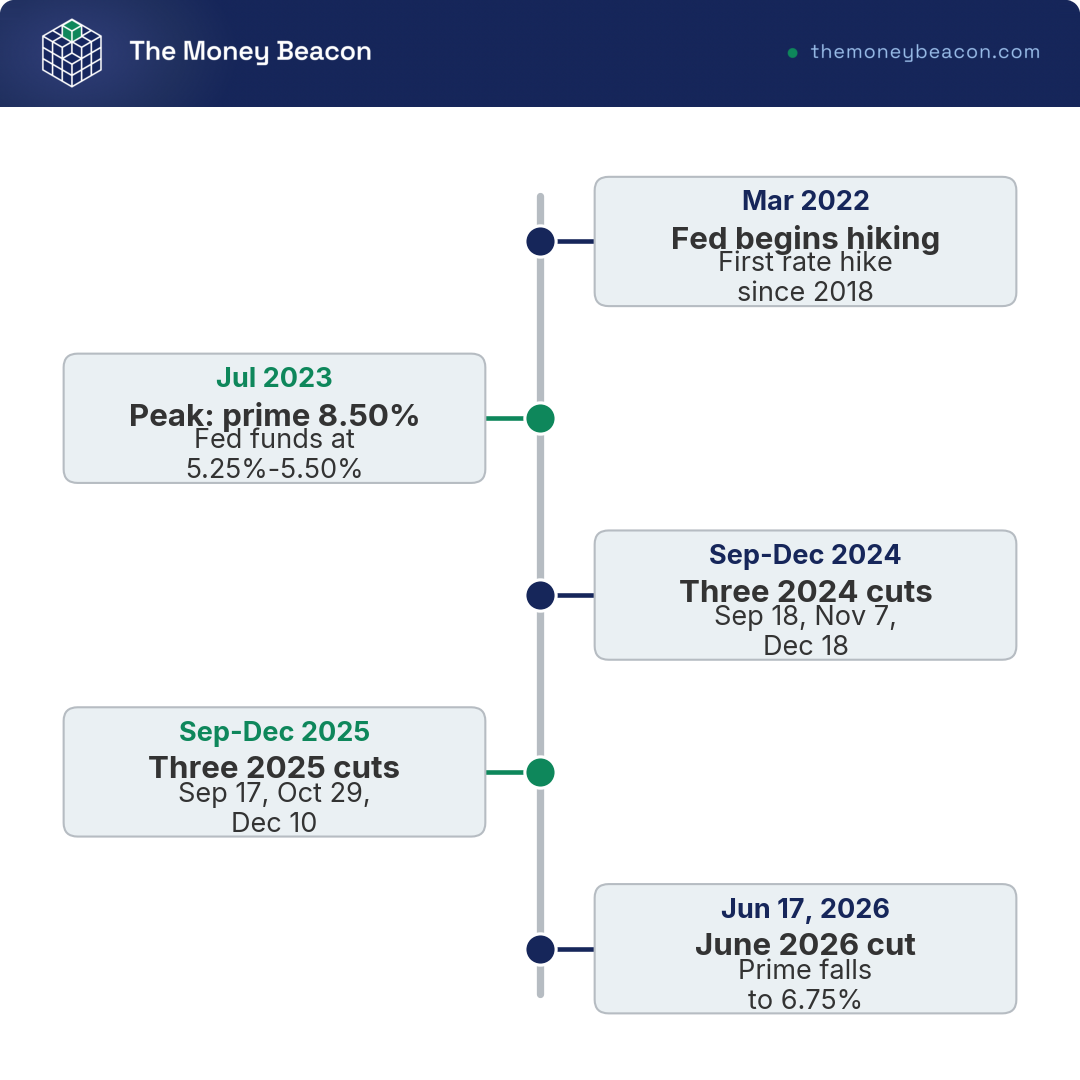
Hikes through 2022 and into 2023 pushed prime to an 8.50% peak, and then the cuts arrived, a run that began in 2024, continued through 2025, and brought the index down to 6.75% by mid-2026. A borrower who opened a line near that peak watched their equity home interest rate fall by more than a point and a half without lifting a finger, purely because the Fed turned. The same machinery runs in reverse, which is exactly why a cap matters.
4.2 Caps, floors, teaser rates, and fixed-rate locks
The rate can move, but it cannot move without limit, and the boundaries are written into your disclosure. The one that matters most is the lifetime cap, the maximum APR the lender can ever charge you over the life of the line. Regulation Z requires every variable-rate HELOC to state this number, so it is never a surprise if you read the paperwork. Many lenders set the lifetime cap around 18%, though disclosures range from 12.5% on the friendlier end up to roughly 21% on a few. At the other extreme sits a floor, a minimum APR below which your rate cannot fall, which protects the lender’s yield when the Fed cuts hard. Some lines also carry periodic caps, which limit how far the rate can jump in any single adjustment, though those are less common on HELOCs than on adjustable-rate mortgages.
Then there is the number lenders love to advertise: the teaser rate. This is a discounted fixed rate for an opening window, typically 6 to 12 months, after which the line reverts to the ordinary prime-plus-margin formula. A low intro number tells you almost nothing about what the line costs once that window closes. The figure that actually governs your decade with this loan is the margin, so compare offers on the margin, the caps, and the early-closure terms, not the teaser. We come back to those early-closure terms shortly, because they have a real cost attached.
One more feature is worth knowing before we add up the bill, because it turns your home equity line of credit interest rates from a moving target into a partly fixed one. Many lenders offer a fixed-rate lock, sometimes called a conversion option, which lets you carve all or part of your outstanding variable balance into a fixed-rate, fixed-term sub-loan. This is the hybrid HELOC, and it lets you keep the flexibility of the line while pinning down the rate on a large draw. The trade-off is that the fixed rate offered usually runs higher than today’s variable rate, and the lock typically carries a fee, around $100, plus a minimum lock amount that varies by lender (PNC, for instance, sets its minimum near $5,000). You know now what sets your rate and what bounds it; the next question is what the line costs beyond the interest itself.
5. The Real Costs and Risks: Fees, Volatility, and Foreclosure
Interest is the headline cost of a HELOC, but it is not the whole bill, and the rate is not the only thing that can hurt you. A line carries fees you pay before you draw a dollar and fees that recur every year, a payment that can climb well past today’s number, and a collateral risk that no other consumer loan shares. Let’s total the upfront costs first, add the ongoing ones, then stress-test the payment against the worst case the rate can deliver before turning to the two risks that put the house itself on the table.
5.1 Upfront costs: closing costs and appraisal
A HELOC closes a lot like a mortgage, which means it arrives with its own stack of upfront charges. The table below lays out the line items you are likely to see and what each one tends to run.
| Cost item | Typical range | Notes |
|---|---|---|
| Application / origination fee | ~$15-$75 (some lenders charge a percentage instead) | Some lenders waive |
| Appraisal | ~$350-$800 | Waived if AVM accepted |
| Title search / title insurance | ~$500-$5,000, or 2%-5% of the line | Varies by state and line size |
| Recording / attorney / settlement | varies by state | Some states require attorney closings |
| All-in closing costs | ~2%-5% of the line, or $0 on “no-closing-cost” offers | “No-cost” offers often carry an early-closure fee |
Data current as of June 2026.
Add it up and a typical HELOC costs roughly 2% to 5% of the line to open, which on a $125,000 line is somewhere between $2,500 and $6,250. That is where the “no-closing-cost” offer starts to look irresistible, and where you should slow down. A lender that eats your closing costs has to recover them somewhere, and it does, usually through a slightly higher margin baked into every month of interest, or through an early-closure fee triggered if you close the line inside a set window, often the first 24 to 36 months. A no-closing-cost HELOC is rarely free; it is a financing decision, not a gift.
Tom’s take
I’ve shopped most of the big private banks for exactly this kind of secured borrowing, and the lesson carries straight over to a HELOC: you make them compete and you read the “free” offer twice. The lender that waives closing costs is usually the one charging you back on the margin, and none of them lead with that.
5.2 Ongoing fees: annual, inactivity, early-closure
Upfront charges are the ones people brace for, but the smaller recurring fees are the ones that catch borrowers off guard years later. The next table groups the ongoing charges and tells you when each one tends to hit.
| Fee | Typical amount | When charged |
|---|---|---|
| Annual / maintenance fee | ~$50-$250/yr (often $0 the first year, and some lenders charge none) | Yearly |
| Inactivity / non-usage fee | ~$5-$50 (many lenders, including Navy Federal and Bank of America, charge none) | If you don’t draw / fall below a minimum |
| Early-closure / termination | $0-$500+ (varies; may appear as a prepayment or clawback charge) | Close within clawback window |
| Fixed-rate lock / conversion | ~$100 per lock | Each conversion |
| Per-draw transaction fee | lender-specific | Some lenders only |
| Minimum draw at origination | e.g., draw $X at closing | Some lenders require an initial draw |
Data current as of June 2026.
Two of these deserve a second look, because they punish the exact behavior a cautious borrower expects to be rewarded for. The inactivity fee bills you for not using the line, which stings if you opened it as a standby reserve you hoped never to touch; the good news is that many lenders, Navy Federal and Bank of America among them, charge none. The early-closure fee is the sharper one, since paying down your balance early is usually free, but formally closing the line inside the clawback window can cost you up to $500 or more, especially on those no-closing-cost offers. The practical move is to read the inactivity and early-closure terms before you sign, not after. Fees are a known quantity you can shop for, while the rate is not, so the harder budgeting question is what happens if the index climbs.
5.3 Rate volatility and budgeting the worst case
Here is the mistake that does the most damage: budgeting off today’s interest-only payment as if the rate were nailed down. It floats, so the honest way to size a line is to budget against the lifetime cap, not the comfortable number on the opening statement. The bar chart below shows what the same balance costs as the rate ratchets up, and the spread between the bars is the whole argument for caution.
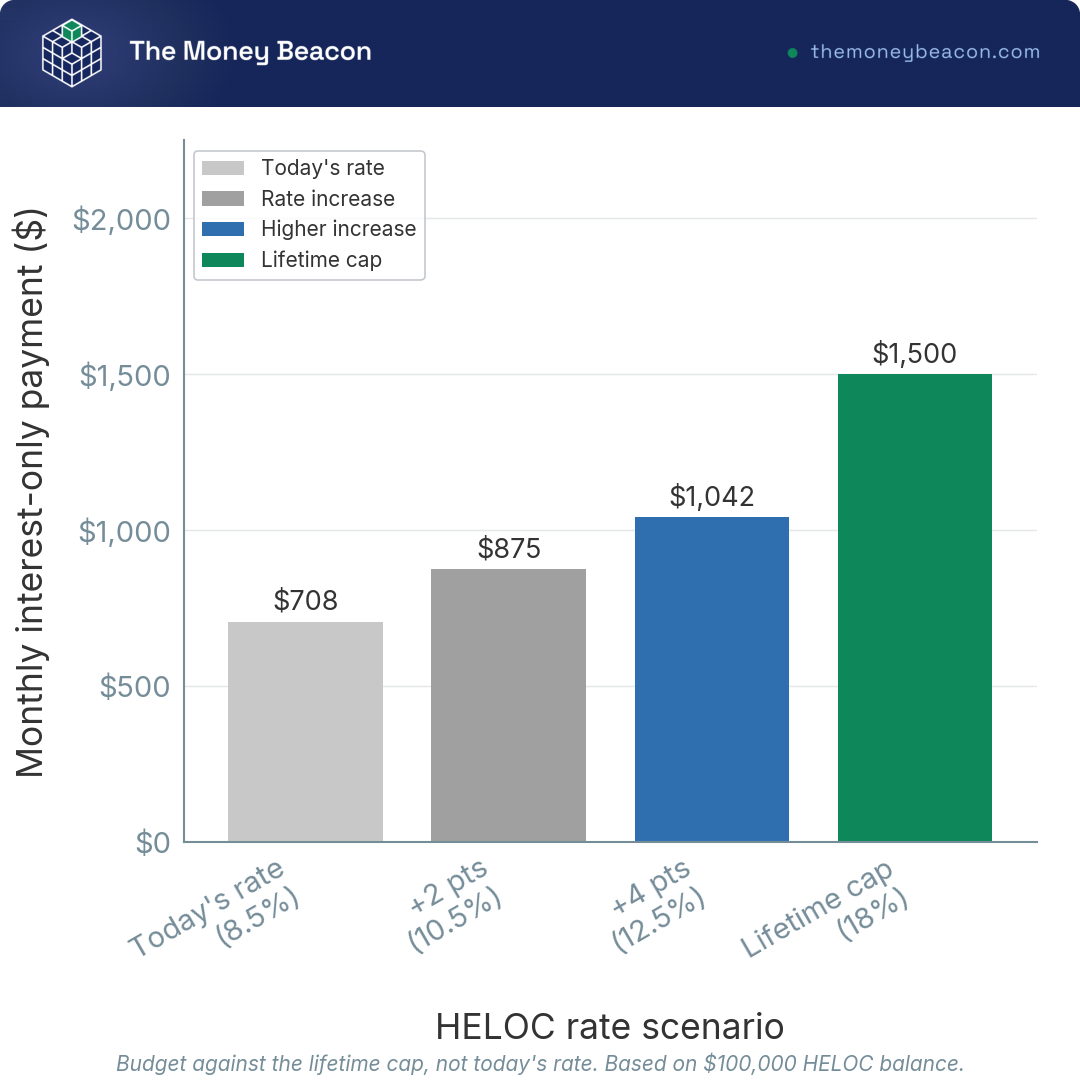
Run the dollars and the point lands hard. A $100,000 balance at today’s 8.5% costs about $708 a month interest-only, the figure from earlier in this guide. Push that same balance to the 18% lifetime cap and the interest-only payment jumps to roughly $1,500 a month, more than double, with no extra principal borrowed and no change in your behavior. You do not need to believe rates will hit 18% to take this seriously; you only need to ask whether your budget survives if they climb part of the way there. The disciplined approach is to stress-test home equity line of credit rates at 3 to 4 points above where they sit today, confirm you can still make that payment, and only then decide how large a line you can responsibly carry. A line you can only afford at today’s rate is a line you cannot really afford.
5.4 Your home is collateral: foreclosure risk and frozen lines
The rate risk is about how much you pay; this next risk is about what you can lose, and it is the one that separates a HELOC from every unsecured option. Your home secures the line, which means default can end in foreclosure even though the HELOC is usually a junior lien sitting behind your first mortgage. The exact mechanics are not uniform across the country, because foreclosure procedures, timelines, and homestead protections vary by state, judicial versus non-judicial processes, different deficiency-judgment rules, and different redemption rights. The constant is the stake: the asset on the line is the roof over your head.
That stake is what makes one popular use of a HELOC genuinely dangerous. Roll your credit-card balances onto the line and you convert unsecured, dischargeable debt into debt that can cost you the house if things go wrong, trading a credit-score risk for a shelter risk. If consolidating high-rate balances is the goal, it is worth weighing the routes that pay down debt without your home at stake first, since the secured route is the one with the harshest downside.
There is a second, quieter risk that surprises people who treat an undrawn line as a guaranteed emergency fund. Lenders can freeze or reduce the unused portion of your HELOC if home values fall and your CLTV slips out of range, if your credit deteriorates, or if they suspend the program outright. Regulation Z (12 CFR 1026.40) keeps this within specified, temporary circumstances and bars the lender from cutting your limit below what you already owe in a way that would force a higher payment, but the line can still shrink. This is exactly what happened broadly in past downturns, and the lesson is blunt: undrawn availability is not guaranteed cash, so keep your CLTV conservative and do not lean on a line that can vanish precisely when you need it.
5.5 Cost and risk for investment and second-property owners
Everything to this point has assumed your primary residence, which is the base case lenders price most generously. Borrow against a rental or a second home and the terms shift in three directions at once. A non-owner-occupied HELOC typically carries a higher rate, roughly a +1.00-point premium over an equivalent primary-residence line, on the view that an investment property is the first thing a stretched borrower stops paying. The maximum CLTV tightens too, commonly capped near 75% rather than the 80% to 85% available on a primary home, so the same equity yields a smaller line. Underwriting runs stricter across the board, and these lines do not get the primary-residence rescission treatment that gives an owner-occupier three days to walk away. None of this rules out home equity financing on an investment property, but it does mean you pay more, borrow less, and clear a higher bar to do it.
You now have the full cost picture: the rate engine, the fees on both ends, the worst-case payment, and the collateral risk that sits underneath all of it. One variable still missing changes the real, after-tax cost of every dollar of interest, and that is whether the IRS lets you deduct it. That question, the buy-build-improve test and the hurdles around it, is where we go next.
6. Is HELOC Interest Tax Deductible? The Current Rules
One input is still missing from the true cost of a HELOC, and it is the tax angle, because a deductible dollar of interest is cheaper than a dollar you pay with after-tax money. Ask most homeowners and they will tell you the answer is a simple yes, and most of them are wrong. Whether the IRS lets you write off a single dollar of HELOC interest runs through three gates: what you spent the money on, how much total housing debt you carry, and whether you itemize at all. We work through them in that order, because failing the first one makes the other two irrelevant.
6.1 The buy, build, or improve test and why consolidation fails it
The first gate is the one that surprises people, and it does the most damage when it is misunderstood. Under IRC Section 163(h), spelled out in IRS Publication 936, interest on a HELOC or a home equity loan is deductible only if you used the borrowed money to buy, build, or substantially improve the home that secures the loan. Spend the funds on a kitchen remodel or an addition, and the interest may qualify. Spend them on a car, tuition, a vacation, or paying off credit cards, and the interest is simply not deductible, no matter that the loan is secured by your house.
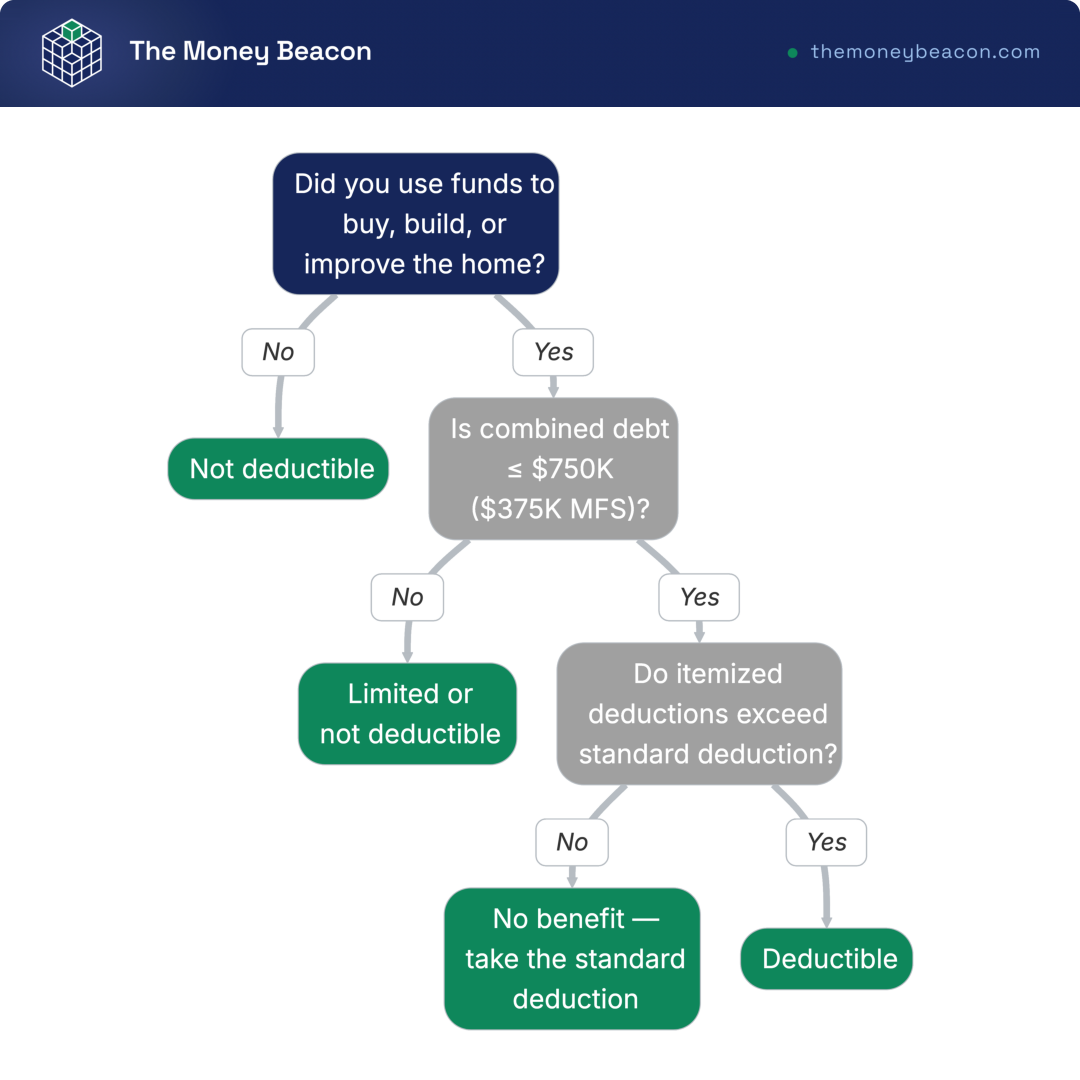
That last point is where the popular belief breaks. The idea that “all mortgage interest is deductible” has been false for home-equity debt since 2018, and it tends to bite hardest on the most common use of all: debt consolidation. Roll your credit cards onto a HELOC and you may lower the rate, but the interest on a debt-consolidation HELOC is generally not deductible, because consolidation fails the buy-build-improve test outright. And this is no longer a temporary quirk waiting to expire. The 2025 tax law, the One Big Beautiful Bill Act signed July 4, 2025, made the restriction permanent, so the old pre-2018 treatment is not coming back. The simple rule worth keeping in mind: money spent on the home may be deductible, money spent on anything else, assume it is not. The decision tree below walks all three gates in order.
Hank’s take
the part most borrowers underestimate is how few people ever reach the final gate. Even when the use of funds qualifies, the deduction is worth nothing unless your itemized total clears the standard deduction, and the large majority of households take the standard deduction. Treat the tax break as a bonus if it lands, never as the reason to borrow.
So clearing the use-of-funds gate is necessary, but it is not enough on its own. Even a clean renovation HELOC runs into two more screens before the deduction is worth a dollar to you, and that is where the limits and the itemizing math come in. For the broader picture of moves that reduce your taxable income, this deduction is one lever among several, and rarely the strongest.
6.2 The debt limits and whether itemizing is worth it
Say your funds passed the use test. The second gate is a ceiling on how much housing debt can generate deductible interest in the first place. The deduction is capped by an acquisition-debt limit that combines your first mortgage and your home-equity debt, and the cap depends on your filing status and when the debt was taken on. Here is where each filing status lands.
| Filing status | Combined acquisition-debt limit (post-TCJA) |
|---|---|
| Married filing jointly / single | $750,000 (debt secured after December 15, 2017) |
| Married filing separately | $375,000 |
| Pre-Dec 15, 2017 grandfathered debt | $1,000,000 / $500,000 MFS |
Data current as of June 2026.
For most borrowers the $750,000 ceiling is generous enough that it never binds, so the third gate is the one that quietly disqualifies them. The interest only helps you if you itemize, and itemizing beats the standard deduction only when your total itemized deductions add up to more than it. For tax year 2026 the standard deduction is $16,100 for single filers, $32,200 for married filing jointly, and $24,150 for head of household, and those are high bars to clear. A married couple needs more than $32,200 in mortgage interest, state and local taxes, charitable gifts, and the like combined before a single dollar of HELOC interest helps them. Plenty of homeowners never get there, which means the deduction is worth nothing to them regardless of how they spent the money. The after-tax cost of a HELOC, then, is the sticker rate for most people and a slightly lower rate only for the itemizers who also passed the use test. That tax wrinkle sits alongside the broader question of how investment income is taxed, the same itemize-or-not logic that shapes more of your return than the headline rate suggests. With the true after-tax cost now fully assembled, you can finally stack the HELOC against its two rivals and decide.
7. HELOC vs Home Equity Loan vs Cash-Out Refinance: Choosing and Acting
You now know what a HELOC costs in interest, fees, and after-tax dollars, but it is not the only way to turn home equity into cash. Two other products compete for the same job, and the right choice is a goal question, not a contest for “best.” We line the three up side by side, match your situation to the right one with real dollar math, then close with a do-and-avoid checklist and a single summary to act on.
7.1 The two alternatives, side by side with the HELOC
The HELOC’s two rivals solve different problems. A home equity loan is a one-time fixed-rate lump sum repaid in equal installments, with no payment shock, no rate risk, and no re-borrowing, so it suits a single known cost. In June 2026 fixed home-equity-loan rates average roughly 7.9% to 8.1%, with the best offers near 6.5% to 6.75%. A cash-out refinance is a different animal entirely: it replaces your first mortgage with a larger one and hands you the difference in cash, resetting your rate and term in the process. It makes sense only when the new first-mortgage rate is at or below your current one, and it carries the full closing costs of a first mortgage, often 3% to 6% of the loan. In June 2026 cash-out refinance rates sit near 6.5% (about 6.47% on a 30-year, per Freddie Mac PMMS). The table contrasts all three across the dimensions that decide the call.
| Dimension | HELOC | Home equity loan | Cash-out refinance |
|---|---|---|---|
| Lien position | 2nd (usually) | 2nd | 1st (replaces) |
| Disbursement | Revolving, draw as needed | Lump sum | Lump sum |
| Rate type | Variable (prime + margin) | Fixed | Fixed or ARM |
| Typical rate (2026) | ~7% to 9.5%+ | ~7.9% to 8.1% average (best ~6.5%-6.75%) | ~6.5% (about 6.47% on a 30-year, per Freddie Mac PMMS) |
| Payment shock? | Yes (end of draw) | No | No |
| Closing costs | Low / often $0 | Low-moderate | High (3%-6%) |
| Re-borrow? | Yes | No | No |
| Best for | Ongoing / uncertain needs | One fixed cost | Need cash + want to reset 1st mortgage |
Data current as of June 2026.
The cash-out refinance shows the lowest rate in the table, and that is exactly the trap. Its rate looks cheapest because it is a first mortgage, but taking it means re-pricing your entire existing loan at today’s rate, so a homeowner sitting on a 3% first mortgage from a few years ago would be trading away a far cheaper loan to access cash. Where current mortgage rates sit relative to your locked rate decides whether that trade is sane, so check mortgage rates before you assume the lowest number on the row is the cheapest option for you. The features that set the three apart are easier to hold in your head as a picture than a grid.
7.2 What the three products share and where they differ
Strip the three products down and the shared core is small but decisive. All three are secured by your home, which means all three carry foreclosure risk, the same stake we weighed earlier. From there they fan out. The home equity loan and the cash-out refinance both lock a fixed rate, so neither one floats the way a HELOC does. Only the HELOC is revolving, letting you draw and re-borrow during the draw period at a variable rate. And only the cash-out refinance replaces your first mortgage; the home equity loan, like the HELOC, sits behind it as a second lien. The diagram below maps that shared center and the distinct regions in one image.
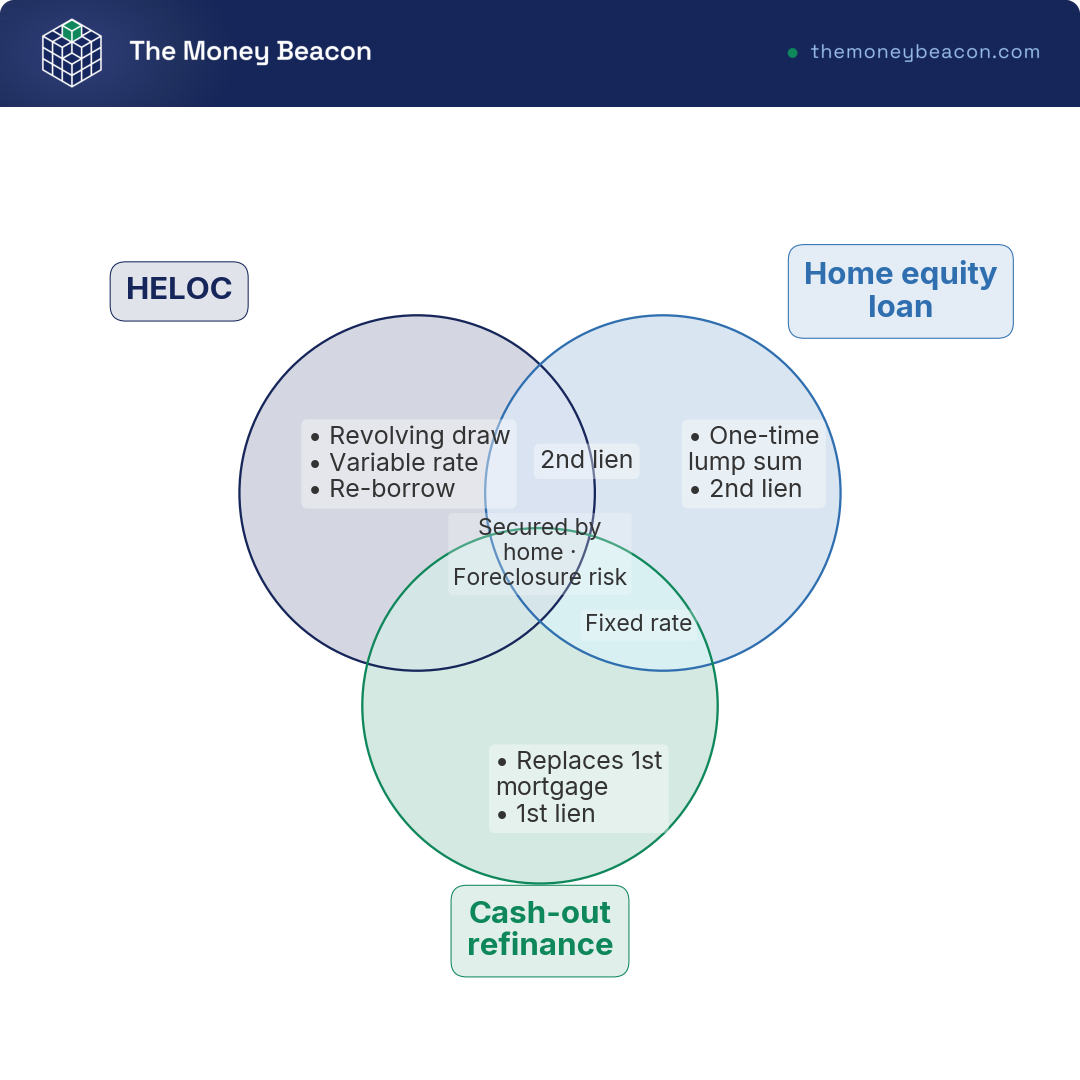
Seen this way, the choice narrows fast. If you want re-borrowing, only the HELOC offers it; if you want a fixed rate, the HELOC drops out; if you want to leave your first mortgage alone, the cash-out refinance drops out. So the next step is to turn those distinctions into a rule that points at your situation.
7.3 Which product fits your goal
The right product falls out of three questions about your actual need, not from which one looks cheapest on a rate sheet. The first question is frequency: do you need the cash once, or repeatedly over years? A single known amount with payment certainty favors a fixed home equity loan, while an ongoing, uncertain, or staged need, a multi-phase renovation, say, favors a HELOC, provided you can absorb its rate and payment-shock risk. The second question is your existing first-mortgage rate: a low locked rate argues hard against a cash-out refinance, because keeping that cheap loan intact is worth more than the slightly lower headline rate on the refi. The third is your tolerance for a variable rate and a future payment jump, which is the line between a HELOC and a fixed-rate product. The decision tree below threads those three questions into a single path.
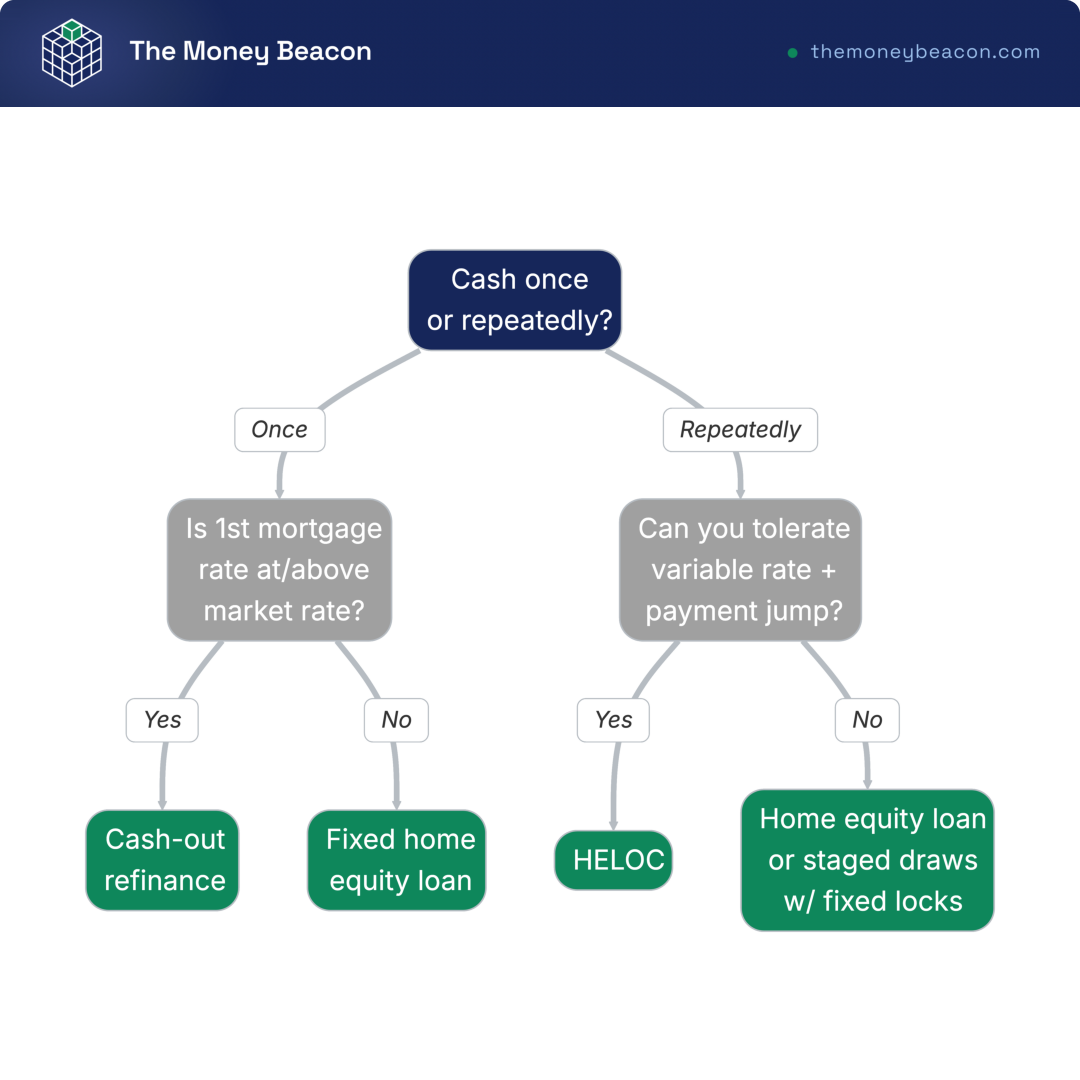
Notice that the question is never “which product is best,” because none of them is. The HELOC wins on flexibility and low upfront cost, the home equity loan wins on certainty, and the cash-out refinance wins only when you also want to reset a first mortgage that is already priced above the market. Match the product to the job, and the dollar math usually confirms the call rather than contradicting it.
7.4 The bottom-line cost: borrowing $50,000 three ways
Theory aside, what does the choice cost in real money? Put $50,000 on the table over a 10-year horizon and run it through each product. The HELOC carries the variable path we have used throughout, around 8.5%, the roughly $354-interest-only / $434-amortizing line from section 3.2. The fixed home equity loan sits near 8.0%, locking the payment from day one. The cash-out refinance shows the lowest rate at about 6.5%, but the total cost has to include re-pricing the entire first mortgage, not just the $50,000 you actually wanted. The bar chart below totals all three.
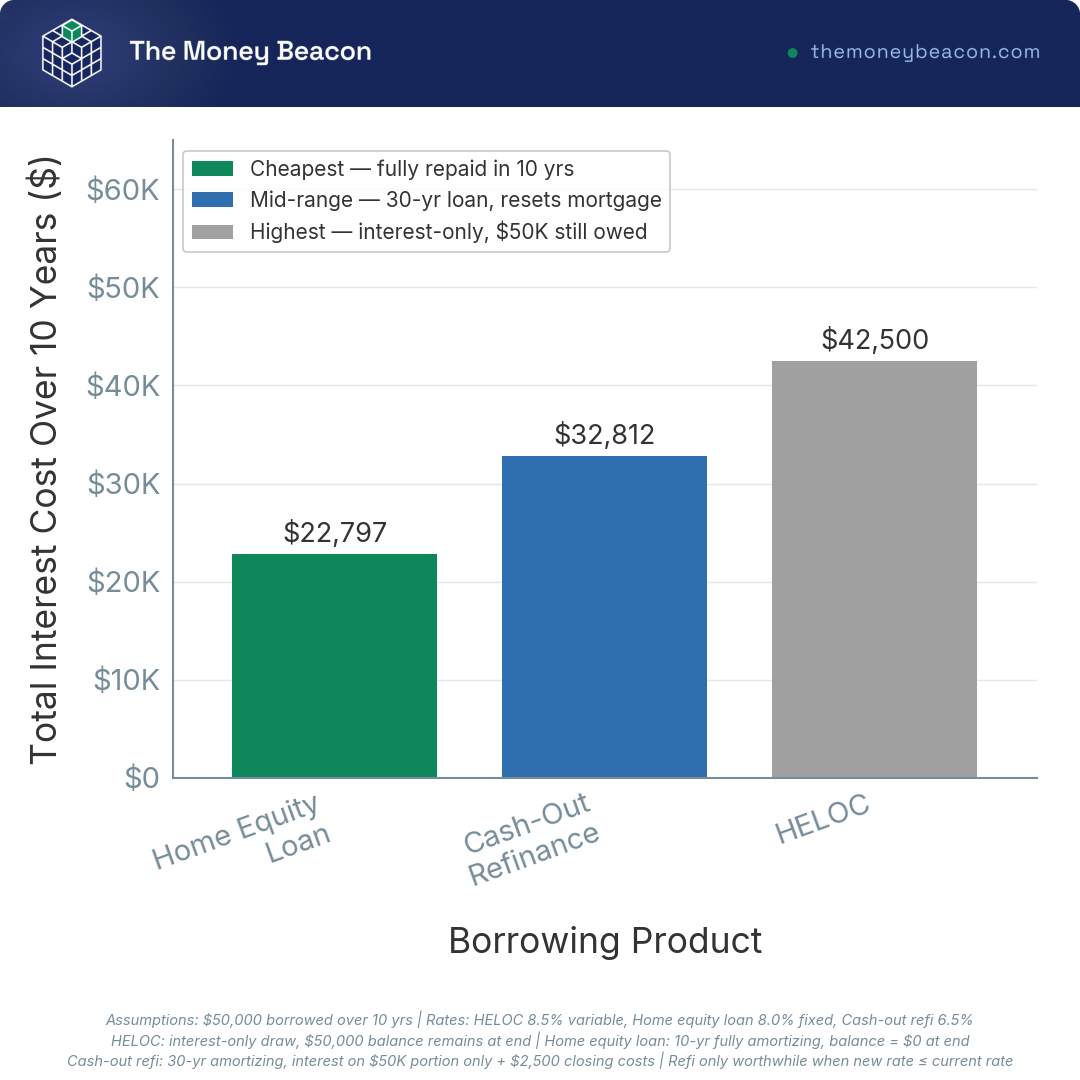
The chart drives home the point the rate sheet hides: the cash-out refinance’s low rate stops looking cheap once you count the cost of re-pricing a whole first mortgage to free up a comparatively small sum. For a homeowner holding a low locked first-mortgage rate, that re-pricing cost usually rules the refi out, leaving the HELOC or the fixed home equity loan as the sensible ways to borrow $50,000. The product is chosen; the next question is where to actually find it.
7.5 Where to shop: lender types and the edge cases
The same HELOC can carry very different terms depending on who writes it, so it pays to know how the three lender camps differ before you collect quotes. Large banks (Bank of America, PNC, U.S. Bank, Citizens, TD Bank) lean on relationship discounts and branch access. Credit unions (Navy Federal, PenFed) often run lower margins, though they require membership. Online and fintech lenders (Figure, Rocket Mortgage, Discover, Spring EQ) compete on fast funding and AVM appraisals that skip the in-person visit. The spread is real: representative June 2026 offers ran from about 5.50% APR at 80% max CLTV on the low end up to roughly 7.49% to 14.50% APR at up to about 90% max CLTV. The bar chart shows where the starting rates and CLTV caps tend to land by lender type.
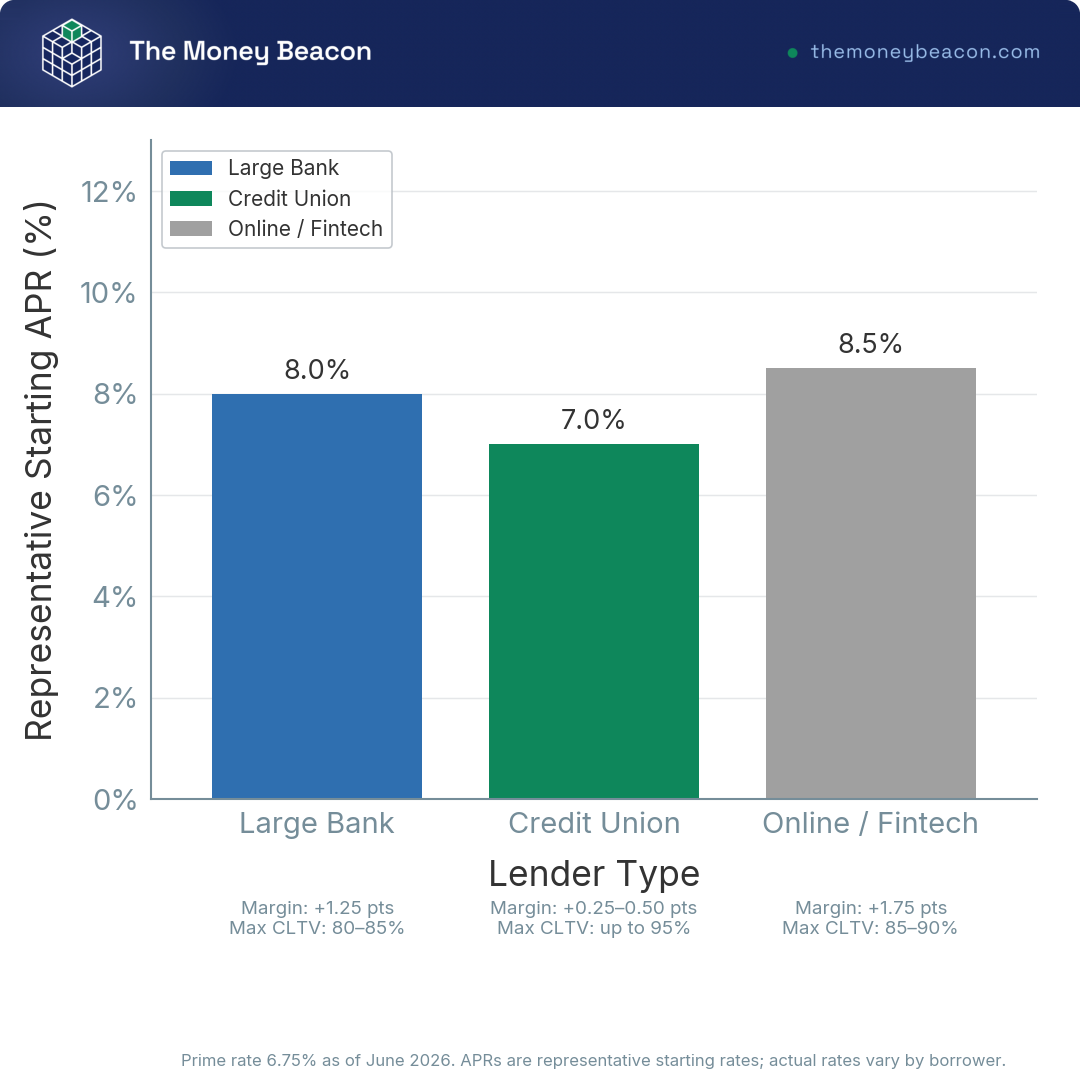
A few edge cases sit outside the standard quote. Investment and second properties pay the premium and the tighter CLTV cap we covered earlier. There is no reliable “bad-credit HELOC,” since most lenders hold a floor around 620 FICO and prefer 660 to 680 and up, so repairing the score first usually beats hunting for a lender who will overlook it. A first-lien HELOC, one that replaces a paid-off first mortgage rather than sitting behind it, exists but is lender-specific, and an underwater or thin-equity owner whose CLTV would breach the cap simply gets a denial. Since the cash-out refinance’s competitiveness still turns on the spread between your locked rate and the market, it is worth checking current mortgage rates against your existing one before you commit to any of the three. With the product chosen and the lender lined up, all that is left is to act without stepping on a rake.
7.6 Your action checklist and the bottom line
Pulling the whole guide together, a disciplined HELOC comes down to six moves, each one the answer to a mistake we have flagged along the way. Run them before you sign anything.
- Compute your real line as (max CLTV times home value) minus your first mortgage, not your gross equity, because confusing the two is the most common sizing error.
- Get two or three quotes and compare them on APR, margin, caps, and fees, never on the teaser rate that resets high after the intro window.
- Stress-test the payment at 3 to 4 points above today’s rate and at the lifetime cap, not at the comfortable interest-only number on the opening statement.
- Confirm whether the interest is deductible for your specific use, and assume it is not if the money is not going into the home.
- Read the early-closure and inactivity terms in full, rather than picking a “no-cost” offer blindly and triggering a clawback later.
- Keep your CLTV conservative instead of maxing the line, so a dip in home values cannot leave you frozen or overextended.
Get those six right and you have done the hard part. The table below maps each decision to what to check and a 2026 rule of thumb, every item drawn from somewhere earlier in this guide.
| Decision factor | What to check | Rule of thumb (2026) |
|---|---|---|
| How much can I borrow? | (Max CLTV times value) minus first mortgage | ~80%-85% CLTV cap; need ~15%-20% equity left |
| What rate? | Prime + margin | Prime 6.75% + margin; ~7% to 9.5%+ APR |
| Payment now vs later | Interest-only draw vs amortizing repayment | Payment can roughly double at end of draw |
| Draw / repayment terms | Length and balloon risk | Often 10-yr draw + up to 20-yr repayment; check for balloons |
| Upfront cost | Closing costs / appraisal | ~2%-5% or “no-cost” with early-closure fee |
| Ongoing cost | Annual / inactivity / lock fees | Often $0-$250/yr; watch inactivity fees |
| Tax break? | Buy/build/improve test + itemize | Renovation may deduct; consolidation does not |
| Foreclosure risk | Home is collateral | Default can cost the house; junior lien |
| HELOC vs loan vs refi | Need shape + first-mortgage rate | Ongoing, HELOC; one-time, home equity loan; reset 1st + low market rate, cash-out refi |
Data current as of June 2026.
Read top to bottom, the table is the whole decision in one glance: size the line off the CLTV ceiling, price it on margin and caps, budget for the payment jump and the worst-case rate, check the tax angle, respect the collateral risk, and pick the product that fits the shape of your need.
Conclusion
A HELOC is the cheapest way to borrow against your home, but you buy that low rate with the house itself as collateral, so the size of the line and the discipline behind it matter far more than the headline number. The math that should drive your call is the one I keep coming back to. Your line is not your gross equity. It is roughly your lender’s maximum CLTV, often 80% to 85%, times your home value, minus your first-mortgage balance. Size it against that ceiling, keep a real equity cushion, and you protect yourself from the two failures I see most often: a payment that resets higher than you planned for, and a rate that floats up with prime the moment the Fed moves.
Two things are worth keeping in mind. First, the interest-only payment during the draw period is not free money, because the principal is still sitting there waiting for you in the repayment period, where the monthly cost can roughly double. Budget against the lifetime cap, sometimes near 18%, not against today’s rate, and stress-test at three to four points above where you are now. Second, that tax break many borrowers assume is automatic usually isn’t. HELOC interest is deductible only when the funds buy, build, or substantially improve the home, and only if you itemize past a 2026 standard deduction of $32,200 for a married couple. A debt-consolidation HELOC almost never clears that bar.
The product choice itself comes down to the goal, not to whichever option sounds best. An ongoing or uncertain need favors a HELOC, a single fixed cost favors a home equity loan, and a cash-out refinance only makes sense when current rates sit at or below your existing first-mortgage rate.
To go further, you can compare cash-out and rate-and-term options in our mortgage refinance guide, weigh whether borrowing against the home really beats other routes in our debt consolidation guide, and check where today’s borrowing costs sit in our mortgage rates comparison.
FAQ: Your HELOC questions, answered
How much would a $50,000 HELOC cost per month? What about $100,000?
There is no single number, because the payment depends on the rate, the phase you are in, and the term. At an assumed 8.5% APR, a $50,000 balance runs about $354 a month interest-only during the draw period and about $434 a month once it amortizes over 20 years. Double the balance and you roughly double the payment: a $100,000 line costs about $708 a month interest-only and about $868 a month amortizing over 20 years. Since the rate is variable, every one of these figures climbs if the prime rate rises, so treat them as today’s snapshot rather than a fixed bill. If you want a single known payment instead of one that can move, a fixed home equity loan or a personal loan may suit a one-time cost better.
What happens when my HELOC draw period ends?
Once the draw period closes, you can no longer borrow against the line, and the outstanding balance shifts into the repayment period, where it fully amortizes over the repayment term, commonly up to 20 years. The payment usually jumps, because for the first time it includes principal rather than interest alone, the classic payment shock that catches unprepared borrowers off guard. Even at an unchanged rate, moving a $100,000 balance from interest-only to a 20-year amortizing payment lifts the monthly outlay by roughly 22%, and more if the variable rate has also risen by then. You have four ways out: repay the balance if you have the cash, let it amortize on the new schedule, refinance into a fresh HELOC or a fixed home equity loan, or roll it into a cash-out refinance. The smart move is to pick that plan well before the draw ends, not the month it does.
Is HELOC interest tax deductible in 2026?
Only under three conditions met together. You must have used the funds to buy, build, or substantially improve the home that secures the loan, you must itemize your deductions, and your combined home-acquisition debt must sit within the $750,000 limit ($375,000 if married filing separately). Interest on a HELOC used to consolidate credit-card balances or fund everyday spending is not deductible, and the 2025 tax law made that restriction permanent, so it will not revert to the older, friendlier treatment. One practical catch trips up many homeowners: the deduction only helps if your total itemized deductions beat the standard deduction, and most filers take the standard deduction, which leaves the HELOC break worth nothing to them regardless of how the money was spent.
Can I lose my house with a HELOC?
Yes, and this is the risk to take seriously before you sign. A HELOC is secured by your home, so a default can lead to foreclosure even though the line usually sits as a second lien behind your first mortgage. The exact procedures, timelines, and homestead protections vary by state, covering judicial versus non-judicial foreclosure, deficiency-judgment rules, and redemption rights, but the underlying exposure is the same everywhere: miss enough payments and the lender can move against the house. This is precisely why moving unsecured debt onto your home deserves a hard look, since consolidating credit cards into a HELOC converts dischargeable debt into debt that can cost you the roof over your head. If consolidation is the goal, weigh the trade-offs in our guide to consolidating debt before you put the house on the line.
Is a HELOC better than a home equity loan or a cash-out refinance?
Neither is best in the abstract, because the three products fit different goals. A HELOC wins when your need is ongoing, uncertain, or staged, and when you value the low upfront cost, though you accept variable-rate and payment-shock risk in exchange. A fixed home equity loan wins when you face a single known cost and want payment certainty from day one, with no rate surprises down the line. A cash-out refinance only makes sense when you also want to reset your first mortgage and current market rates sit at or below your existing rate, which rarely holds if you locked in a low rate in prior years, since replacing a cheap first mortgage with a costlier one usually wipes out the benefit. Frame it as a goal question rather than a hunt for the single best product, and if a refinance is on the table, run the rate-and-term versus cash-out math in our mortgage refinance comparison first.



Comments
Questions and corrections welcome. We read everything.