


Every large US broker now advertises $0 commissions on stock and exchange-traded fund (ETF) trades, so that number tells you almost nothing about which account to open. The costs that decide what you actually keep have moved somewhere you don’t look. They’re inside the expense ratio of the fund you buy, and in what you’re charged to leave. Mostly, though, they’re in what the broker pays you on money you haven’t invested yet.
Here’s what that looks like inside a Fidelity brokerage account. Cash that isn’t invested goes into what Fidelity calls the core position, and on a taxable account you pick from three. One yields 3.31% in mid-August 2026. Another pays 1.82%. Same account, same screen, one setting most people never open: on a $100,000 balance, that choice is worth about $1,490 a year.
That’s the kind of number a fee comparison never shows you, so I went at this the slow way. I read Fidelity’s published commission schedule line by line, pulled the expense ratios off its own fund pages, and went through its quarterly filing on how it routes your orders. That last one settles a claim you’ll see repeated a lot.
So this Fidelity Investments review settles what the account really costs, whether the ZERO index funds are the advantage they look like, and which core position deserves your cash. I end by naming who should open this account and who shouldn’t.
1. What The Fidelity Account actually is, and who you are contracting with
Two questions come before any figure: who owes you the account, and what it can hold.
1.1 Who you are actually contracting with
The name on the customer agreement isn’t “Fidelity.” It’s Fidelity Brokerage Services LLC (FBS), the entity that owes you the account. It’s registered with the Financial Industry Regulatory Authority (FINRA) under firm number 7784 and with the Securities and Exchange Commission (SEC) as broker-dealer 8-23292. Its status reads ACTIVE.
I ran that lookup rather than take it on faith; you can repeat it in a minute by typing 7784 into BrokerCheck. The same record shows 681 branch offices, a count of registered regulatory locations, not walk-in Investor Centers.
Two other entities matter. National Financial Services LLC (NFS) provides custody and clearing, so NFS actually holds your securities and cash. Above both is FMR LLC, privately held, reporting $19.9 trillion of assets under administration as of June 30, 2026.
That figure is a counterparty fact, not a quality claim.
1.2 What the account can hold, and the three things it cannot
The asset list is broad at the conventional end and closed in exactly three places.
| Asset class | Available in the taxable account | Cost note |
|---|---|---|
| US stocks and ETFs, including fractional shares | Fractional from $1 on NMS exchange-listed stocks | $0 online commission |
| Listed options | On tiered approval | $0 commission plus $0.65 per contract |
| Mutual funds | 3,700+ no-transaction-fee funds inside a FundsNetwork universe of over 10,000 | No-transaction-fee funds $0; transaction-fee funds $49.95 online |
| Bonds, brokered CDs, Treasurys | Secondary and new issue online | $1.00 per bond mark-up; Treasury auction $0 |
| Margin lending | On approval | Tiered rates from 11.825% down to 7.50% |
| Foreign ordinary shares | Yes | $50 per transaction on foreign ordinaries that are not DTC eligible |
| Crypto | No, not offered | Held at Fidelity Digital Assets, a separate national trust bank |
| Futures and forex | Not published as available in the brokerage account | n/a |
Data current as of August 2026.
Fidelity words the first one carefully: “neither FBS nor NFS offer crypto as a direct investment nor provide trading or custody services for such assets.” Read that list before you open anything.
People get one distinction backwards: The Fidelity Account is a tax wrapper, just like an individual retirement account (IRA), and a Roth IRA is a different wrapper, not a different investment.
2. What a $0-commission account really charges you
Fidelity advertises $0 and the number is real, but $0 describes one kind of order, not an account.
2.1 The $0 headline is an online-order claim, and here is exactly where it stops
Every charge is tied to a specific action you take, and none of them recurs.
Let’s start with the zeros. Online US stock, ETF and option trades carry a $0 commission, and so do the account service fee, the late settlement fee, paper statements and the minimum to open. No inactivity fee is published either.
Then come the charges that do exist. An option contract costs $0.65. A trade through Fidelity’s automated telephone service, FAST, costs $12.95, and $32.95 with a representative. A forced margin liquidation costs $32.95 too. Buying a FundsNetwork transaction-fee mutual fund online costs $49.95, with an upper band of $100 on some funds. Selling a no-transaction-fee (NTF) fund inside 60 days costs $49.95 as well, a separate charge.
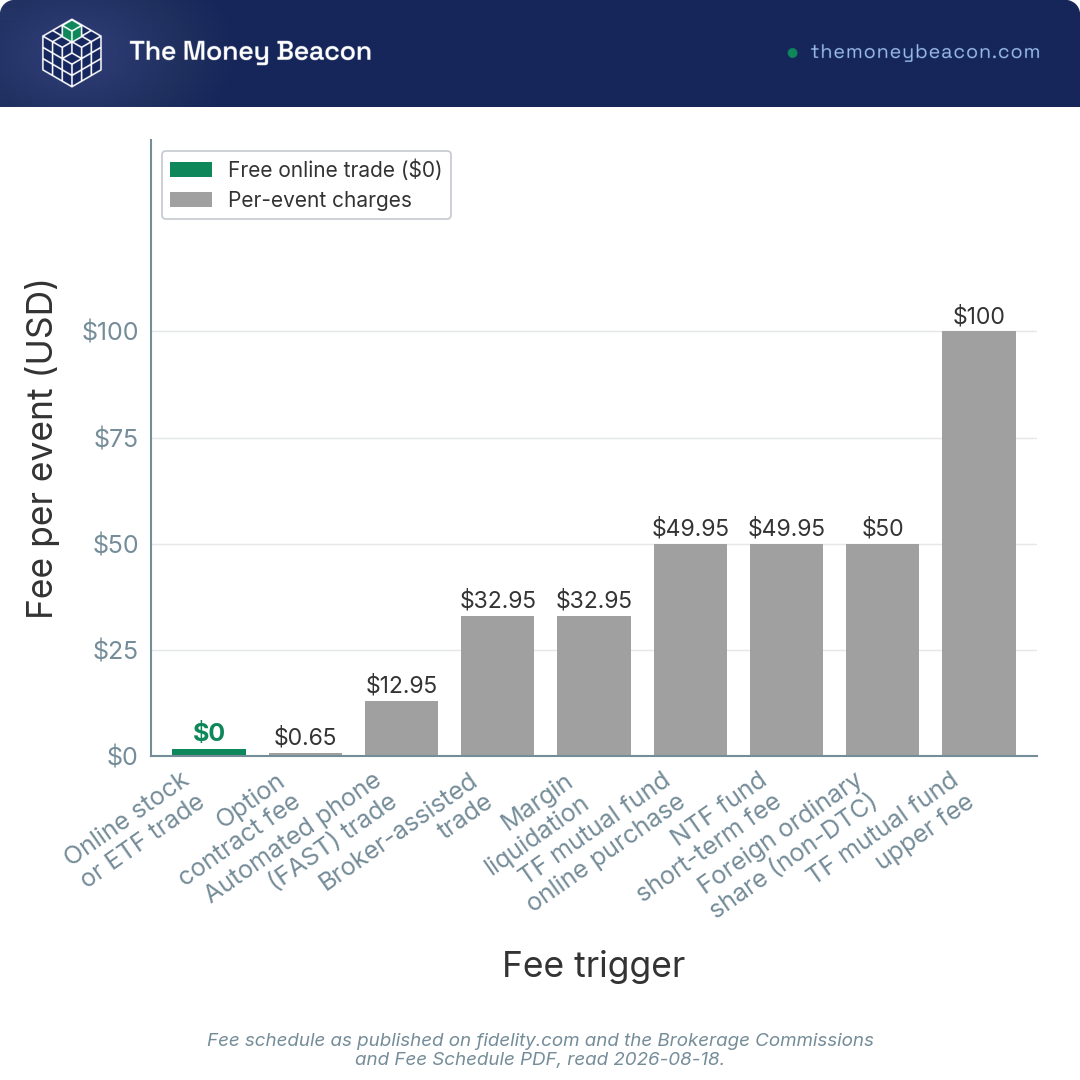
The identical trade is $0 online and $32.95 by phone, the widest multiple in the schedule. You’re charged for the channel, not the asset.
Two subtleties matter. The NTF list isn’t the fund universe: with 3,700+ no-transaction-fee funds inside a FundsNetwork universe of over 10,000, roughly two thirds of reachable funds carry a fee. And the $100 transaction-based ETF service fee is a live clause on a named list that currently has no ETFs, so check it before buying a niche ETF. Dollar-cost-averaging in? Each Automatic Account Builder purchase costs $5, not $49.95.
Nobody prices the exit until they want one. Moving the account to another broker, the transfer known as an ACAT, costs $0. So does an outgoing domestic wire, and so does closing an IRA. Free to leave is rarer than it sounds, and seven brokers score very differently on the same dimensions.
2.2 Fidelity does take payment for order flow, and it publishes what it is worth
So who pays for all those zeros?
Fidelity’s own Rule 606 filing for FBS, second quarter of 2026, answers that in one sentence: “FBS, through its affiliated broker-dealer NFS, receives payment for order flow (PFOF) for orders that are executed by this wholesale market-maker.” So much for the claim, repeated all over the internet, that Fidelity refuses PFOF.
The published rates are small: up to $0.0008 per share on marketable equity orders and up to $0.003 on non-marketable ones. On options, it’s $0.30 to $0.40 per contract marketable single-leg, $0.40 to $0.50 non-marketable, $0.40 to $0.48 multi-leg.
Let’s put a number beside that. On a 1,000-share equity order the maximum routing payment is $0.0008 times 1,000, so $0.80. Fidelity publishes average price improvement of $26.69 on that same order size for April 1, 2025 to March 31, 2026, roughly 33 times the routing payment.
Options are the weaker case. Ten marketable single-leg contracts cost you $6.50 in contract fees while generating up to $4.00 of payment, about 62% of the commission you already paid. I went looking twice for a per-contract options price-improvement figure to set against that, and Fidelity publishes none.
Hank’s take

arguing about payment for order flow on principle gets you nowhere. After years spent picking apart data, the reflex I trust is to price it: pull the routing filing, put the payment next to the published execution number, and see which is bigger.
2.3 Trader+, free market data, and the two limits that catch people out
That’s the money. What about the software?
Fidelity presents Trader+ as the current desktop application, “available for free,” and Active Trader Pro on the same page as “Active Trader Pro Classic, our legacy platform.” Get those two backwards and you’re comparing a platform Fidelity has moved on from.
| Platform or entitlement | Status per Fidelity | Cost |
|---|---|---|
| Fidelity Trader+ | Current flagship desktop platform | “available for free” |
| Active Trader Pro Classic | “our legacy platform” | No platform charge published |
| Real-time, streaming and Level II quotes | Listed entitlements | $0 annually |
Data current as of August 2026.
The market-data row is the one to notice: at plenty of competing platforms streaming and Level II depth cost extra. Bundled research covers eleven outside houses, Argus and FactSet among them. The bond ladder tool is free, and phone support runs around the clock.
Two limits catch people out. Extended hours take limit orders only, premarket 7:00 a.m. to 9:28 a.m. ET and after-hours 4:00 p.m. to 8:00 p.m. ET. A stop-loss isn’t live in those sessions, and a market order entered at 7:30 a.m. won’t execute. Fractional and dollar-based orders are market-hours only.
One disclosure failure is worth naming. Fidelity’s current pricing page carries a Fidelity, Schwab and Vanguard fee comparison stamped, by Fidelity, “All data is sourced from public websites as of 8/1/18.” Eight years old, on a live pricing page.
3. Fidelity ZERO funds: a real edge, or a bet that you never move brokers
Now the feature Fidelity actually markets: four index funds at a 0.00% expense ratio. Is it the edge it looks like?
3.1 What a 0.00% expense ratio is actually worth, in dollars
An expense ratio is the slice of your money the fund keeps each year, taken out before you ever see a statement. Four Fidelity funds report 0.00% net as of December 30, 2025: FZROX, FZILX, FNILX and FZIPX, none with an investment minimum.
The comparison fund is FSKAX, Fidelity’s conventional total-market index fund, at 0.015% as of April 29, 2026. The difference is 1.5 basis points a year, a basis point being one hundredth of a percentage point.
So what is 1.5 basis points worth? On $10,000, $1.50 a year. On $25,000, $3.75. On $100,000, $15.00.
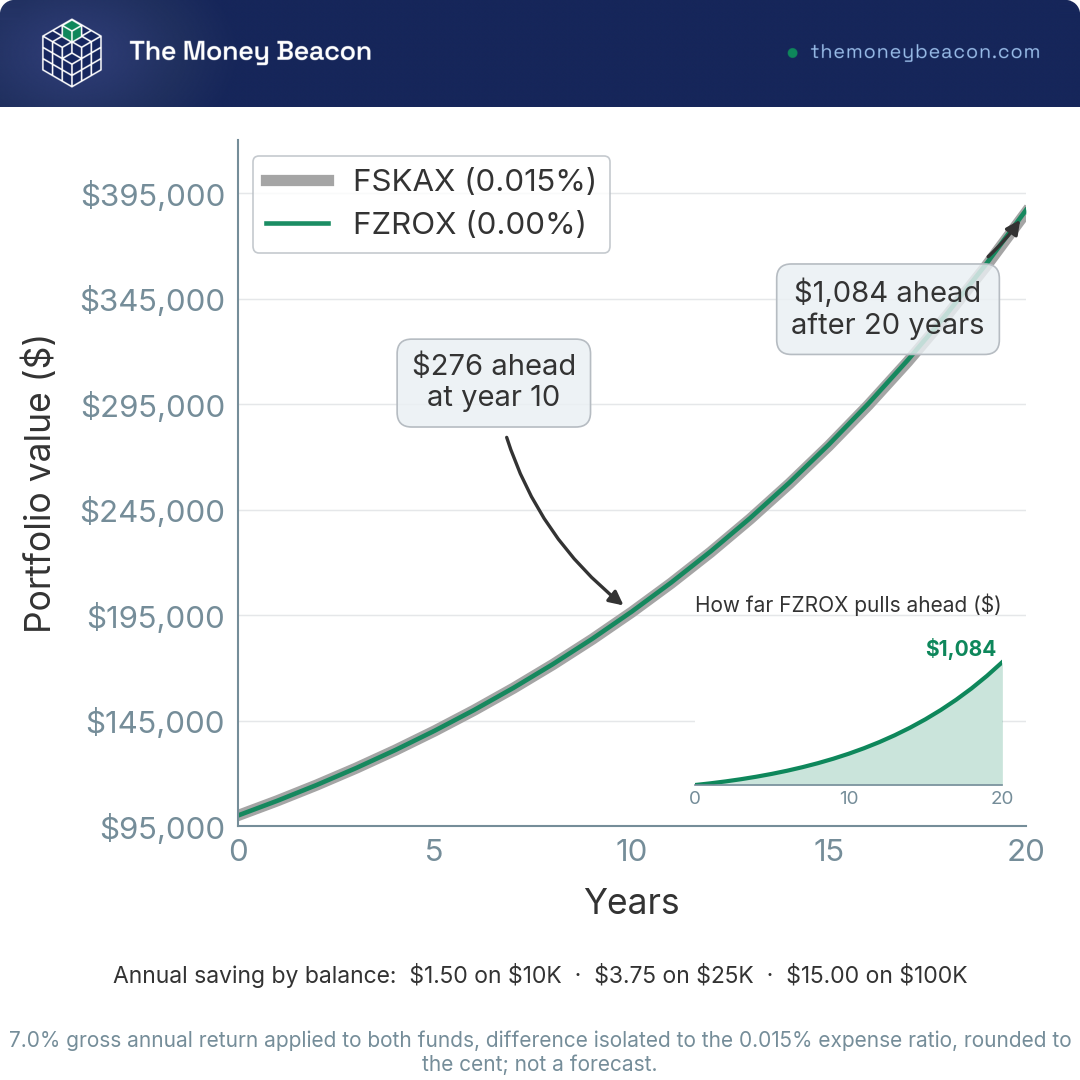
Put $100,000 in at a 7.0% gross return applied to both funds, the only difference being the expense ratio. The ZERO fund finishes about $276 ahead after ten years, about $1,084 after twenty. That’s a model, not a forecast, and past performance doesn’t guarantee future results.
One detail complicates the comparison. Every ZERO fund tracks an index Fidelity builds itself, and its US Total Investable Market Index draws on the largest 3,000 US companies. FSKAX tracks the third-party Dow Jones US Total Stock Market Index across roughly 5,000. “Total market” means two different universes, and the difference is the small-cap tail.
The performance objection doesn’t hold up, though: over five years the two funds landed within three basis points a year of each other. That’s a reminder that the wrapper matters more than the headline fee.
3.2 The string attached: leaving a taxable account means selling
The saving is real, so what does keeping it cost you?
The eligibility wording is the pivot: the ZERO funds are “available to individual retail investors who purchase their shares through a Fidelity brokerage account.” Fidelity separately warns that certain proprietary funds may not be eligible for in-kind transfers, without naming one.
Put those two together and you get an inference, and I’ll call it that: a fund sold only through Fidelity brokerage accounts, at a firm issuing that warning, is unlikely to be receivable by an outside broker. An ACATS transfer out then becomes a probable liquidation.
In a taxable account, liquidation is a realization event. Take $100,000 in FZROX held twenty years at 7.0%. It grows to roughly $386,968, about $286,968 of that embedded gain. Realizing it at the 15% federal long-term rate (the middle of the 0%, 15% and 20% band) costs about $43,045, before state tax and the 3.8% Net Investment Income Tax. It’s taxed at the long-term capital gains rate only because you held it past a year.
Turn the breakeven around: the whole $1,084 of twenty-year saving is wiped out by 15% tax on just $7,227 of gain.
| If | Then | Because |
|---|---|---|
| IRA, Roth IRA or 401(k) | Use the ZERO fund | Leaving never triggers tax |
| Taxable, and Fidelity is permanent for you | Use the ZERO fund | You capture 1.5 basis points, never the exit |
| Taxable, and you might move brokers | Use FSKAX, or a broadly held ETF | 1.5 basis points is smaller than any exit tax |
| You may gift, donate or bequeath it | Prefer the portable holding | In-kind transfer and inheritance need portability |
Data current as of August 2026.
One exception the table doesn’t carry: stepped-up basis at death is still in force for 2026, so a genuine hold-until-death investor never pays the exit. For everyone else, in a taxable account the portable fund wins.
So the account’s showcase feature is the one holding I’d keep out of it.
4. Uninvested cash: the one setting worth more than your fund choice
Choosing the 0.00% fund over FSKAX saved you $15.00 a year on $100,000. The same pattern repeats here. Not a fund. A setting.
4.1 The core position: three choices on one screen, 149 basis points apart
The core position decides where your uninvested cash sits. Deposits, sale proceeds, dividends and interest all land there.
| Core position | Ticker | What it legally is | Published rate or yield | As of |
|---|---|---|---|---|
| Fidelity Government Money Market Fund | SPAXX | A 1940 Act money market fund (a security) | 3.31% 7-day yield | 08/14/2026 |
| Fidelity Treasury Fund | FZFXX | A 1940 Act money market fund (a security) | 3.34% 7-day yield, 0.42% expense ratio | 08/11/2026 yield, 04/30/2026 expense ratio |
| Taxable Interest Bearing Cash Option | FCASH | A free credit balance held by the broker, not a fund | 1.82% | 12/12/2025 |
Data current as of August 2026.
Which one are you in if you never change it? Fidelity states the default on a new retail brokerage account is the Fidelity Government Money Market Fund. The good one, which is exactly why the screen goes unopened for years. The risk isn’t landing in FCASH, it’s picking it.
SPAXX against FZFXX is close to a coin flip, three basis points apart on as-of dates three days apart. Your pick turns on holdings and state tax treatment, not yield. SPAXX against FCASH is a different animal.
There’s a sequencing trap here. Money sent before 4:00 p.m. ET on a business day can be tradable the same afternoon, so the setting is locked in before you look at it. Changing it costs nothing, needs no sale, and takes effect the next business day.
4.2 What that setting is worth in dollars, and what Schwab defaults to
One caveat before the math. The two figures carry different as-of dates, 08/14/2026 for SPAXX and 12/12/2025 for FCASH. I pulled the FCASH page again in August 2026 and it still reads 1.82%, still stamped December 12, 2025. That means Fidelity has not republished it, not that it has moved. Its own Aug-17-2026 rate page shows a 1.82% rate on the Federal Deposit Insurance Corporation (FDIC) deposit sweep against 3.31% on the money market overflow that same August date. The 149 basis point spread is live.
Now the dollars. On $10,000 of idle cash SPAXX pays you $331.00 a year against FCASH’s $182.00, handing back $149.00. On $25,000, $827.50 against $455.00, handing back $372.50. On $100,000, $3,310.00 against $1,820.00, handing back $1,490.00. Compounded, $25,000 left untouched for ten years produces about $34,623 at 3.31% and about $29,941 at 1.82%, roughly $4,682 apart. A setting nobody reads outranks the fund decision by about a hundred to one.
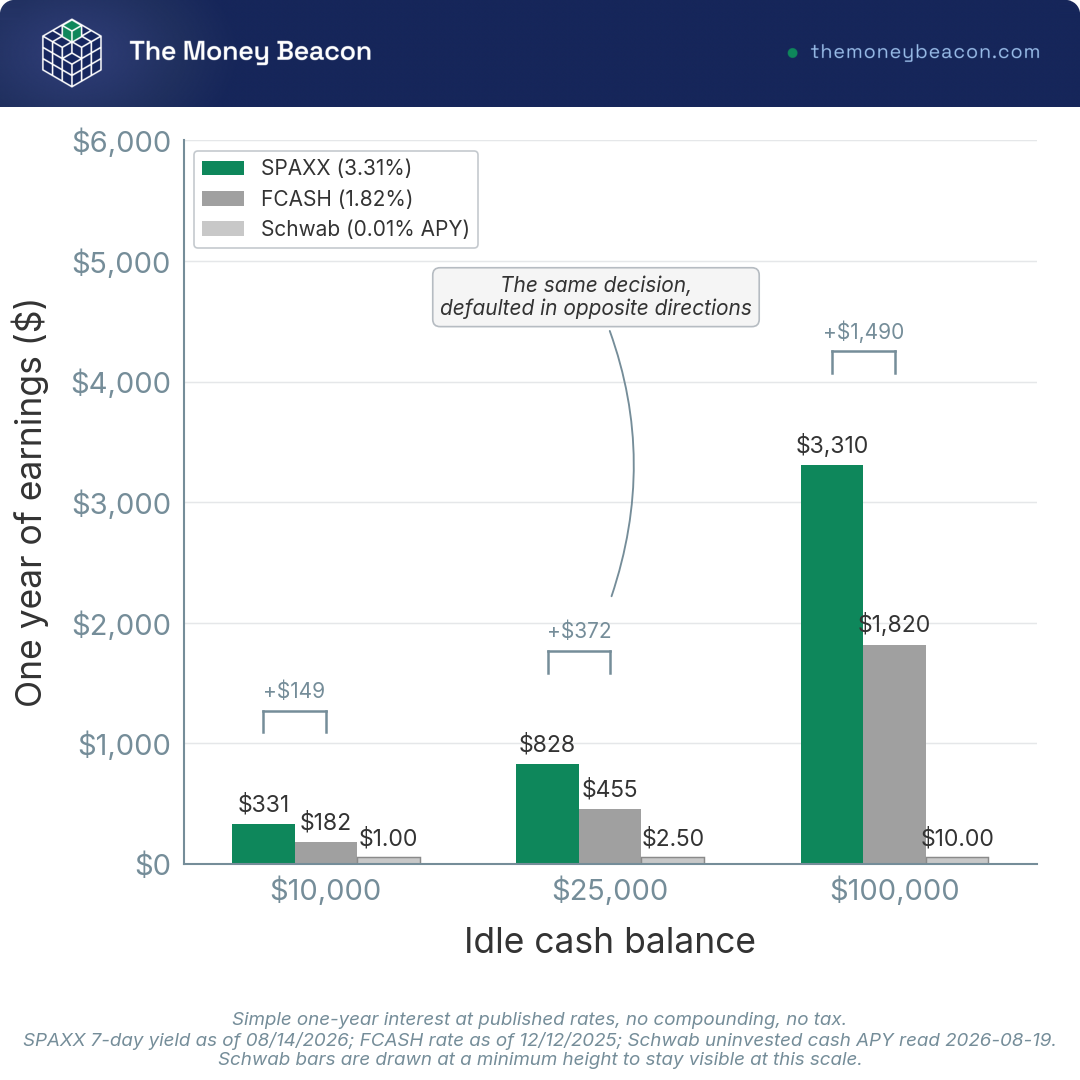
Does any broker default the other way? Compare what idle cash earns: Charles Schwab publishes 0.01% APY on uninvested brokerage cash, an annual percentage yield (APY), against Fidelity’s 3.31% seven-day yield. On $25,000 that difference is roughly $825 a year, the same decision defaulted in opposite directions.
4.3 FDIC insurance is not on this menu, and SIPC is not deposit insurance
Is that cash insured? Not by the FDIC. Fidelity names the accounts its FDIC-Insured Deposit Sweep Program covers as “Fidelity Cash Management and IRA accounts”, and the sweep isn’t among the non-retirement core-position choices. Coverage means opening a Cash Management Account (CMA) alongside, a second account rather than a setting.
It costs yield too. The sweep pays 1.84% APY as of Aug-17-2026 while the money market overflow on the identical page pays 3.31%, so the insurance costs roughly 147 basis points. Inside it, $245,000 goes to each program bank against a $250,000 FDIC limit, up to $4 million aggregate.
The brokerage account carries Securities Investor Protection Corporation (SIPC) coverage instead: $500,000 in securities, including a $250,000 cash sub-limit. Above that sits $1 billion of aggregate excess-of-SIPC coverage, with $1.9 million per customer on cash awaiting investment.
Now let’s clear up the usual confusion. SIPC responds when the broker fails and securities or cash go missing, never when a portfolio falls in value. FDIC responds when an insured bank fails, and never covers a money market fund.
One asymmetry follows that few people notice. Money market fund shares count as securities, so SPAXX and FZFXX sit under the $500,000 limit. FCASH is a credit balance, so it falls under the $250,000 sub-limit. The lower-yielding option has the tighter coverage limit too.
5. The verdict: who should open The Fidelity Account, and who should not
So how does this account compare with the two you would otherwise open, and is it right for you?
5.1 Fidelity next to Schwab and Vanguard, on the lines that actually decide it
| Positioning label | Fidelity | Charles Schwab | Vanguard |
|---|---|---|---|
| Online US stock/ETF commission | $0 | $0 | $0 (Vanguard ETFs and stocks online) |
| Option contract fee | $0.65 | $0.65 | $1.00 per contract |
| Broker-assisted stock/ETF trade | $32.95 | $0 + $25 service charge | $25 |
| Transaction-fee mutual fund, online | $49.95 | Up to $74.95 per purchase | $20 |
| Full account transfer out | $0 | Not published on the pricing page | $100 account closure and full transfer out |
| Annual account service fee | $0 | Not published on the pricing page | $25 annual |
| Default yield on uninvested brokerage cash | 3.31% (SPAXX 7-day, 08/14/2026) | 0.01% APY | Not retrieved |
| US OTC equities, online | Not separately priced | $6.95 | Not published on the fee page |
| Futures | Not published as available | $2.25 per contract | Not published on the fee page |
Data current as of August 2026.
Two rows go against Fidelity and I won’t soften them. Vanguard charges $20 for an online transaction-fee mutual fund against Fidelity’s $49.95, and $25 broker-assisted against $32.95. Three lines run Fidelity’s way: the option contract fee, the annual service fee, and the $100 to close and transfer out against Fidelity’s $0 exit.
Two Schwab cells carry no figure because its pricing page doesn’t publish those lines, so read nothing into them.
5.2 The ruling: a yes with two conditions, and four profiles who should look elsewhere
Four readers should shop elsewhere first. Anyone who wants FDIC-insured cash inside the brokerage account, because the sweep covers Cash Management and IRA accounts only and getting it means a second account at 1.84% APY. A futures or forex trader, because neither is published as available here. A crypto-first investor, because “neither FBS nor NFS offer crypto as a direct investment.” And a heavy international trader or a small margin borrower, because the foreign exchange wire costs up to 3% of principal and margin starts at 11.825% under a $25,000 debit balance.
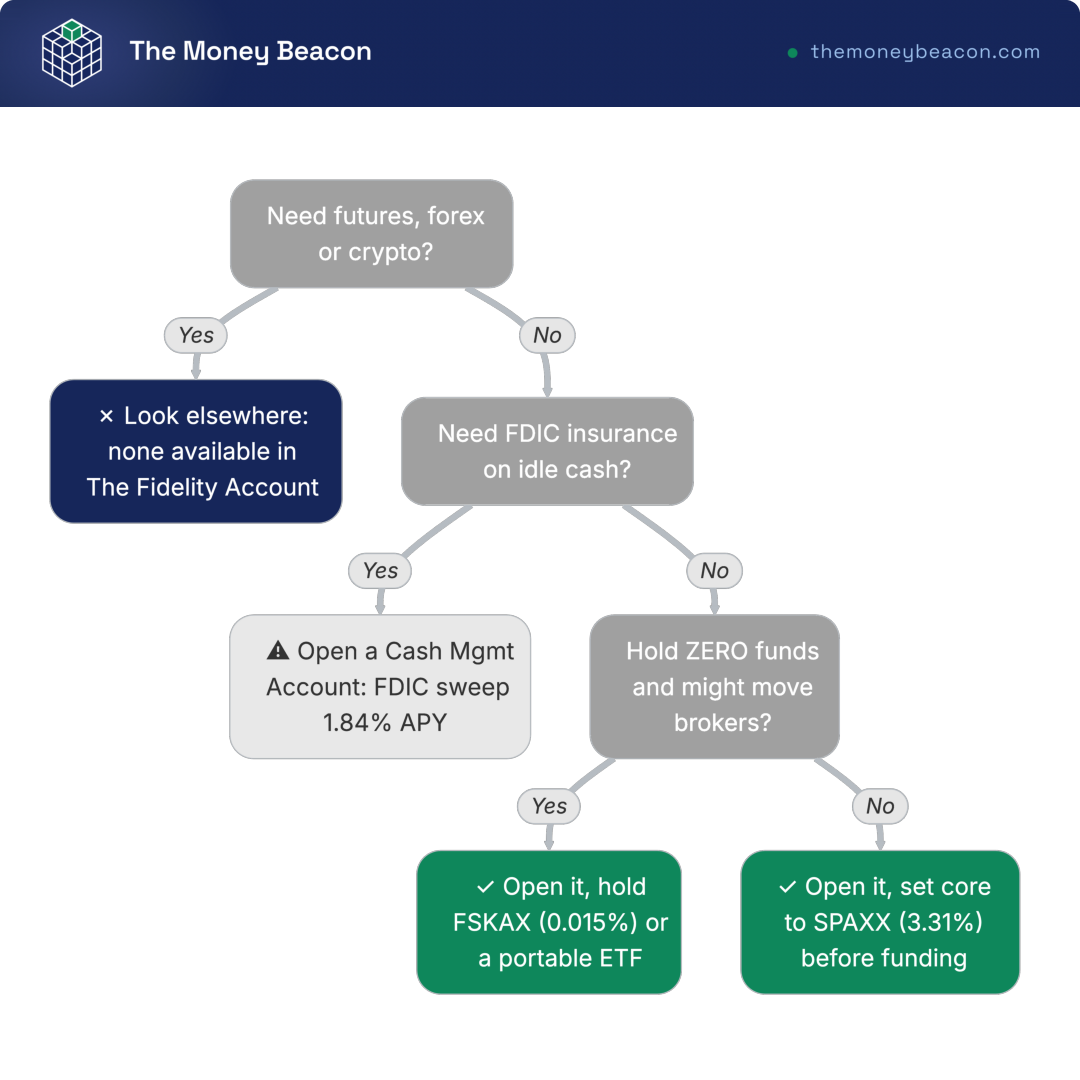
Now the fits. Best is the long-term self-directed index investor holding meaningful cash, on a fee surface of zeros, a default core position paying 3.31% and a conventional index fund at 0.015%. Then the investor consolidating scattered accounts, on $0 to transfer in, $0 to transfer out and ACATS in 3 to 5 business days. Then the retirement saver running IRAs beside the taxable account, since the ZERO funds are unambiguously free where no exit tax exists. And the short-horizon saver building a Treasury ladder, on a free ladder tool, $0 online auction orders and a $50 mark-up cap on bonds maturing inside a year.
For those readers the ruling is favorable and conditional, and both conditions are settings rather than features. Set the core position to SPAXX before the money arrives, and keep the ZERO funds out of the taxable account unless you’re certain Fidelity is permanent for you.
Conclusion
Every broker on your shortlist advertises $0 commissions, and in this review that number decided almost nothing. What moved the answer was settings, not prices: which core position holds your uninvested cash, and which fund you hold inside which wrapper. Fidelity gets the first one right by default. It still leaves you a way to get the second one wrong.
You can read a commission schedule line by line for an hour and never reach the number worth about $1,490 a year on $100,000, because it isn’t a fee at all. It’s what the broker pays you on cash you haven’t invested yet. And unlike almost everything else in finance, you can change it in two minutes without selling a thing.
So do that first. Open the core position screen and confirm it reads SPAXX before you fund the account, because on a $25,000 cash balance that one check is worth roughly $372.50 a year. Want insured cash instead? That’s a Cash Management Account opened alongside, not a setting inside this one. And if there’s any chance you move brokers later, keep the ZERO funds out of your taxable account, however good 0.00% reads on the page.
To dig deeper, our comparison of high-yield savings accounts shows what insured cash pays outside a brokerage. Our guide to spreading savings across the right accounts matches each goal to a horizon, and our retirement planning guide sets the order to fill accounts in before a taxable one.
FAQ: Fidelity brokerage account questions
Is there a minimum deposit to open a Fidelity brokerage account?
No. Fidelity publishes a $0 minimum initial investment for The Fidelity Account and states there are “no account fees and no minimums” on a retail brokerage account. The account service fee is $0 too, so an empty account costs nothing to keep open. The real floor isn’t the account, it’s the first trade: a fractional order needs $1 of an exchange-listed US stock, and the four ZERO index funds and SPAXX carry no investment minimum. That $1 entry is the whole barrier, and our beginner’s guide to investing in the stock market covers what to do next.
Are Fidelity’s ZERO index funds really free, and what is the catch?
The 0.00% net expense ratio is real, published on FZROX, FZILX, FNILX and FZIPX as of December 30, 2025. The catch isn’t cost, it’s availability. Those funds are sold only to retail investors buying through a Fidelity brokerage account, and Fidelity separately warns that certain proprietary funds may not be eligible for in-kind transfers, without publishing anything fund-specific either way. In a taxable account that probably turns leaving into a sale rather than a transfer. Against FSKAX at 0.015%, the saving is worth about $1,084 on $100,000 over twenty years, and a 15% tax on $7,227 of gain erases all of it.
What does Fidelity charge to transfer my account to another broker?
Nothing, and I went through the current commissions page line by line rather than take the marketing at its word. A transfer of assets out is $0, an outgoing domestic bank wire is $0, and closing an IRA is $0. A full transfer through ACATS, the industry system brokers use to move accounts between firms, typically finishes in 3 to 5 business days. The exit cost worth worrying about isn’t a fee at all. It’s the capital gains tax on selling a ZERO fund position that can’t travel with you out of a taxable account.
Does Fidelity pay interest on uninvested cash?
Yes, and how much depends on one setting called the core position. A taxable account gives you three choices: SPAXX at a 3.31% 7-day yield as of August 14, 2026, FZFXX at 3.34% as of August 11, 2026, and FCASH at 1.82% as of December 12, 2025. Fidelity states the default on a new retail brokerage account is the Fidelity Government Money Market Fund, which is the good outcome. On $25,000 of idle cash, the difference between that default and FCASH is $372.50 a year. Changing the setting is free, needs no sale, and takes effect the next business day.
Is my money safe at Fidelity, and what do SIPC and FDIC actually cover?
They answer two different failures, and neither covers losing money in the market. The Securities Investor Protection Corporation (SIPC) responds if the broker fails and securities or cash go missing, covering $500,000 in securities including a $250,000 sub-limit for cash, plus $1 billion of aggregate excess-of-SIPC coverage and $1.9 million per customer on cash awaiting investment. Federal Deposit Insurance Corporation (FDIC) coverage reaches only the deposit sweep on Cash Management and IRA accounts, never a taxable brokerage account. Money market fund shares count as securities, so SPAXX is covered under the $500,000 limit while FCASH, a credit balance, counts as cash under the smaller one.
Does Fidelity accept payment for order flow?
Yes, and it says so itself. The Fidelity Brokerage Services filing under SEC Rule 606 for the second quarter of 2026 states that the firm, through its affiliate NFS, receives payment for order flow on orders executed by a wholesale market-maker, at up to $0.0008 per share on marketable equity orders. What matters is the outcome, not the principle. On a 1,000-share order the maximum payment is $0.80, while Fidelity publishes average price improvement of $26.69 on that same order size. Options are the weaker case, at $0.30 to $0.50 per contract with no published price-improvement figure to set against it.
Can I trade futures, forex or crypto in a Fidelity brokerage account?
No to crypto, and futures and forex are not published as available. Fidelity’s own wording names its broker-dealer and its clearing arm: “neither FBS nor NFS offer crypto as a direct investment nor provide trading or custody services for such assets.” Crypto goes instead to Fidelity Digital Assets, a separate national trust bank whose holdings carry neither SIPC nor FDIC protection. Futures and forex aren’t published as available inside the brokerage account either. If one of the three is central to how you invest, this is the wrong account, and our guide to investing in crypto is a better place to start on the third.




Comments
Questions and corrections welcome. We read everything.