


You have a target allocation you actually believe in, and no practical way to hold it. Rebalancing a dozen positions by hand is tedious, your monthly contribution never divides neatly into whole shares, and most platforms that automate the work charge you a percentage of everything you own to do it. That’s the bind self-directed investors keep getting stuck in, and it’s the problem M1 Finance was built to solve.
Except M1 changed the way it charges for it. The paid M1 Plus tier is gone, replaced by a $3 monthly Platform Fee that’s waived only if your total M1 assets reach $10,000 for at least one day of the 30-day billing cycle.
Flip that around and it’s a fee that only applies to small accounts. That’s $36 a year, and on a $5,000 balance it works out to 0.72%.
Compare that with the 0.25% a robo-adviser charges to run the whole portfolio for you. Fidelity charges $0 at any balance, with no threshold to clear.
So the real question isn’t whether automatic portfolio rebalancing is worth having, because it is. It’s whether M1’s version is worth what M1 now asks for it, and the answer isn’t the same for every account.
The first thing I went looking for was what M1 costs, and the fee that decides it isn’t in the marketing copy. It’s in a disclosure titled Platform Fee. In this review I price M1 at real balances, show you what actually happens when you tell the platform to buy something, and take a side. Before any of that means much, you need to know what M1 Finance actually is in 2026, because the lineup it sells today isn’t the one most reviews describe.
1. What M1 Finance Actually Is in 2026, and What It No Longer Sells
So what are you joining? M1 sells one mechanism, and everything else is arranged around it.
1.1 The Pie system is the product: what trades, and what never does
A Pie is a portfolio written as target percentages. Each holding is a Slice with its own target weight, and a Pie can itself be a Slice inside another Pie, so your allocations nest.
The engine is Dynamic Rebalancing, M1’s name for automatic portfolio rebalancing. Deposits buy the underweight Slices, withdrawals sell the overweight ones, and your portfolio moves back toward target without a sale, which usually means no taxable event.
Fractional shares are what make that work. A fifteen-Slice target funded with $300 a month is arithmetic no whole-share broker can execute, and M1 keeps it to the percentage across more than 6,000 US-listed stocks and exchange-traded funds (ETFs). So the decision that drives your returns isn’t the Pie, it’s the index funds and ETFs it actually holds.
What actually makes M1 trade, then?
Table: What causes trading at M1, and when
| Event | Does it trade? | When | Note |
|---|---|---|---|
| First deposit | Yes | Next window | Only if Auto-Invest is on |
| Later deposit or withdrawal | Yes | Next window | Dynamic Rebalancing picks the Slices |
| Editing target percentages | No immediate trading | Gradually, via later flows | Absorbed over time |
| Removing a Slice from a Pie | Yes | Next window | Liquidates and reinvests even with Auto-Invest off |
| Manual rebalance request | Yes | Next window | Sells overweight, buys underweight |
| Manual buy or sell order | Yes | Next window | Processed ahead of automated trades |
Two rows are traps. Cut a Slice from 20% to 5%, wait for a sale, and nothing happens, because editing a target triggers no trading. Deleting it does the opposite: removing a Slice liquidates it even with Auto-Invest off, which in a taxable account is a realized gain you didn’t plan. Lower the weight instead.
1.2 Invest, Borrow, Earn: read the products M1 has quietly retired
M1 Plus was replaced by the Platform Fee model on May 15, 2024, and it isn’t the only thing that’s gone. The live lineup is Invest, Borrow and Earn, not Invest, Borrow and Spend. The old M1 Spend address redirects to a marketing post, so the checking account and debit card are retired. M1 also discloses that the Owner’s Rewards Card no longer accepts new applications.
Two products are still advertised but you can’t open them. The High-Yield Savings Account is paused to new openings, and M1 Personal Loans are not currently being originated. Remember that second one, because it closes one of the two escape routes from the monthly fee.
That’s a lineup that’s narrowing, not broadening, and it’s worth knowing before you commit to M1 for ten years. If the paused savings account is what you came for, you’ll do better with high-yield savings accounts still open to new deposits.
One more gate comes from M1’s Terms of Use. You must be 18 or older and either a US citizen living in the US or a US Permanent Resident with a current US address, so a US citizen who moves abroad can’t open or keep an M1 account.
2. What M1 Costs You in a Year, at Your Own Balance
The $3 isn’t news by now, but the disclosure that sets it out gives details the product pages never do, and those details determine who ends up paying it.
2.1 The $3 Platform Fee and the $10,000 cliff
Trading at M1 is commission-free, so M1 Finance fees are platform charges, not trading ones. The Platform Fee disclosure, updated May 2026, sets it at $3 a month. If an individual retirement account (IRA) is your only open account, you pay a $3 monthly IRA Fee instead. Never both.
The waiver counts $10,000 or more across Individual, Joint, Traditional and Roth IRA, Trust, Custodial, Crypto, High-Yield Savings and High-Yield Cash balances. And it needs one qualifying day in the cycle, not a monthly average. That’s a generous way to read a threshold. The second waiver is an active M1 Personal Loan, and since M1 isn’t originating those, the $10,000 asset test is the only waiver a new client can actually get.
Then comes the sharp edge. If the payment account is short of cash, M1 may collect that $3 by selling securities, and a $3 sale in a taxable account still produces a realized gain or loss and a line on next year’s tax form.
Table: The M1 Platform Fee, precisely
| Item | Rule |
|---|---|
| Platform Fee | $3 per month for users who do not meet the waiver |
| IRA Fee | $3 per month for users whose only open account is an IRA |
| Both at once? | Never. If the Platform Fee is paid, the IRA Fee is waived |
| Absolute cap | $3 per month maximum, regardless of how many accounts |
| Waiver 1 | $10,000+ in total M1 assets for at least one day in the 30-day cycle |
| Waiver 2 | An active M1 Personal Loan (a product not currently being originated) |
| Billing cycle | 30 days |
| Collection | Default account, then a cash-holding brokerage account, then a savings or cash account, then any brokerage account |
| If cash is short | M1 may automatically sell a portion of your securities to cover the fee |
Data current as of August 2026.
It’s cheap in absolute terms and all-or-nothing at one threshold. Set that against how the rest of the market prices small accounts and M1’s $10,000 cliff looks unusually blunt.
2.2 What $36 a year is really worth on a small account
$3 a month is $36 a year, and what it costs you depends on your balance.
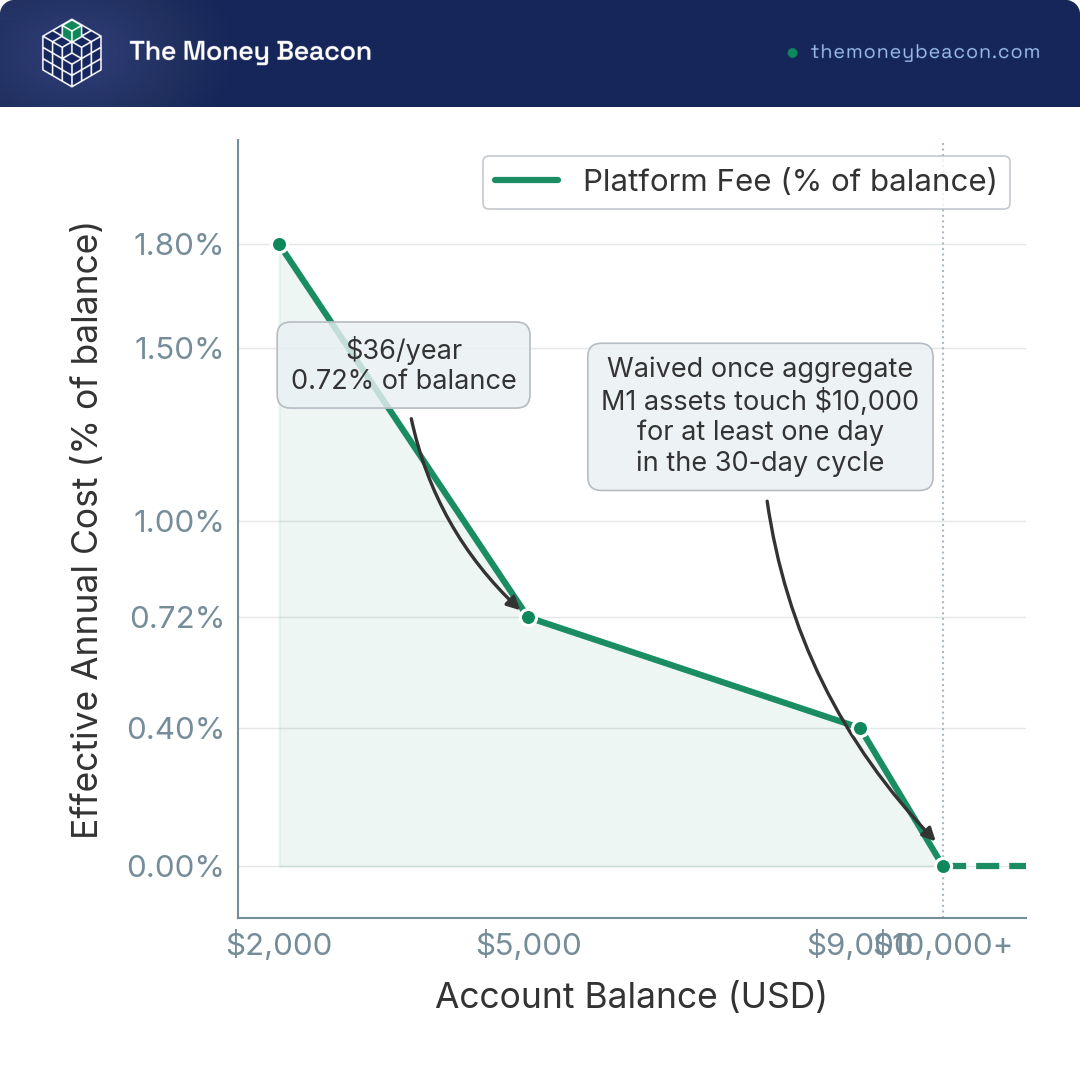
That’s 1.80% of a $2,000 account, 0.72% on $5,000, 0.40% on $9,000, and 0% at $10,000 and above. It’s a fee that only exists at the bottom. Fidelity publishes a $0 account service fee and $0 commissions on online US stock and ETF trades at any balance, with no threshold. So the smallest account at M1 pays a percentage a mainstream broker charges nobody. Read it beside Fidelity’s own near-zero fee schedule.
The rules don’t stop at $36. Let an M1 investment account drop to $50 or less and go 90 days without activity: M1 closes it and takes the balance as a Minimum Balance Fee of up to $50.
If your aggregate balance is near the threshold, getting it across $10,000 for a single day of the cycle is worth $36 a year.
2.3 The bill for leaving, which almost nobody prices on day one
So how does M1 Finance make money beyond that $3? Partly at the exit, the worst moment to meet a charge.
On M1’s own fee schedule, an outgoing account transfer through the Automated Customer Account Transfer Service (ACATS) is $100. Closing an IRA is another $100 per event, a Direct Registration System (DRS) transfer is $115 per security, and a transfer-on-death (TOD) account transfer is $200. In fairness, transfers in are $0, and direct Automated Clearing House (ACH) deposits to and from a linked bank are always free.
The fee isn’t the expensive part. Only whole shares transfer in kind on an outgoing ACATS, so every fractional position you hold is sold to cash on the way out, a realized gain on timing you didn’t choose.
For scale, Fidelity charges $0 to transfer out and Betterment’s own transfer-out fee is $75. If you might move custodians inside a few years, price the $100 and the tax on those fractions now.
3. Living With M1: The Trade Window, Your Idle Cash, and the Margin Line
The price is on the table now. But a platform can be cheap and still behave in ways that cost you, so I followed a dollar inside the account.
3.1 Two trade windows a day, and why the second one needs $25,000
You don’t choose when your order fills. M1 trades once or twice a day, in windows beginning around 9:30 am Eastern time (ET) and 3:00 pm ET on NYSE trading days. Changes submitted before 9:30 am ET usually make the morning window; anything submitted on a non-trading day completes the next morning.
The second window isn’t automatic. Using both in one day requires $25,000 or more in invested assets in that account, excluding uninvested cash, and the test is per account, not per household. M1’s own worked example settles it: a $15,000 Roth IRA gets one window, while a $28,000 individual account and a $147,000 traditional IRA each get two. The gate exists so customers don’t accidentally breach Financial Industry Regulatory Authority (FINRA) pattern day trading rules, and no payment unlocks it.
All customer orders are also treated as “not held,” which gives M1 price and time discretion. You aren’t placing a market order at a moment you pick. You’re handing over an instruction to be worked inside a batch, with no limit price, no stop, no time-in-force. It’s the opposite of a beginner’s path built around limit orders.
What does the batch actually cost you? For a monthly broad-market ETF buyer, the intraday price path on a $500 contribution is noise over a decade. It costs something real on a circuit-breaker day: M1 states a halted security may miss its window and, on a Level 1, 2 or 3 trigger, may not execute at all.
3.2 Is M1 Finance FDIC insured? The zero-interest default under every deposit
Every dollar you send goes somewhere before it’s invested, and at M1 that somewhere pays nothing and carries no Federal Deposit Insurance Corporation (FDIC) coverage. The Cash Account Sweep Program Disclosure Statement, effective on or after February 27, 2026, describes cash in the Primary Invest Account as “zero-interest bearing free credit balances,” and it takes no part in the sweep.
It starts earning only when you move it yourself, into the High-Yield Cash Account. That account pays a 3.10% annual percentage yield (APY) and needs an open M1 investment account plus a $100 minimum initial deposit for the stated rate. The money reaches an FDIC-insured partner bank in one to three business days. The High-Yield Savings Account pays the same 3.10% through B2 Bank NA with no minimum balance, and it’s the one paused to new openings.
Leave $20,000 in the investing account for a year and you’ve given up about $620. Leave $50,000 and it’s about $1,550, lost to a transfer nobody reminds you to make.
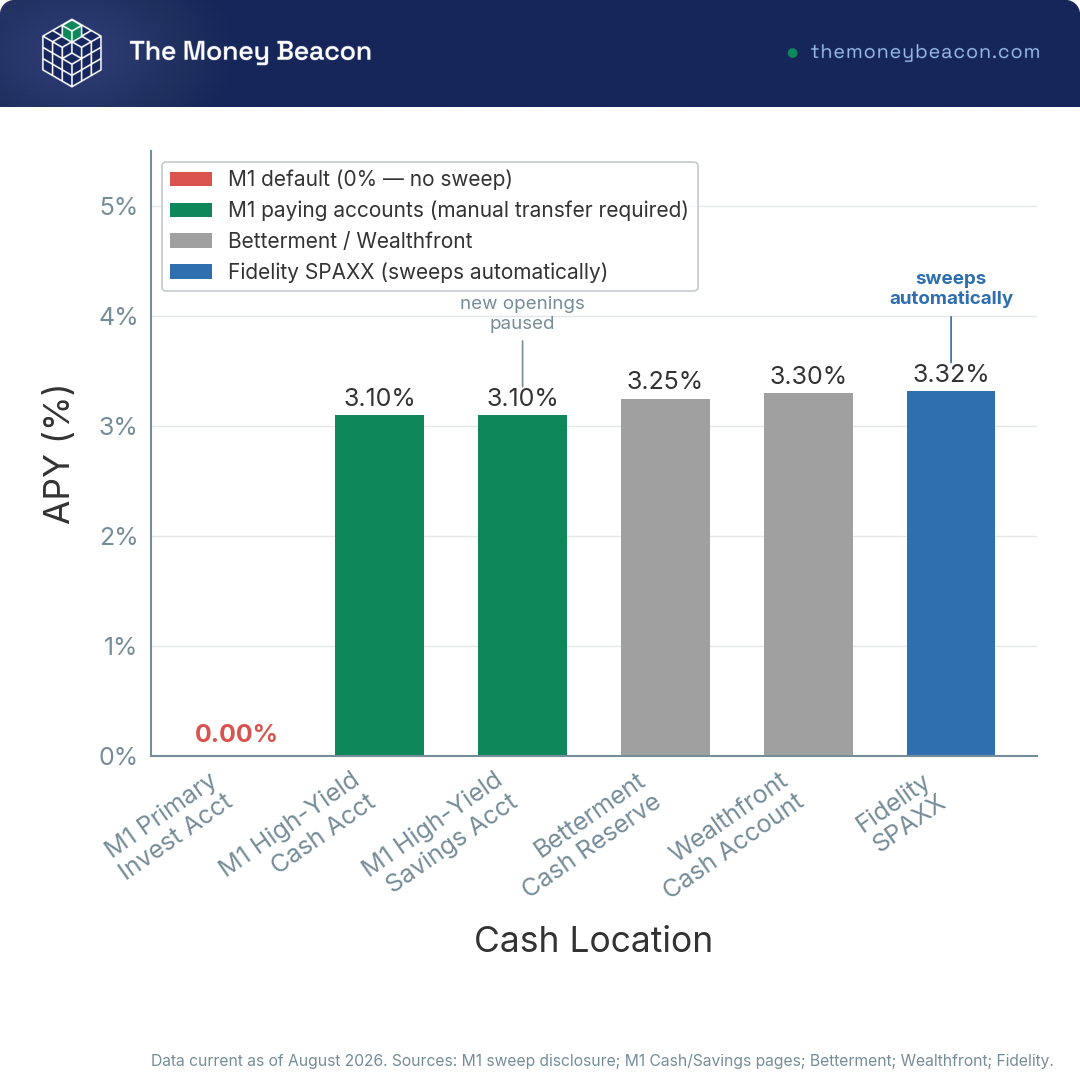
The bar on the left is the default, and it catches every deposit and every dollar of sale proceeds. Even after the transfer, M1’s 3.10% is the lowest rate of the four platforms in this review. Betterment Cash Reserve stood at 3.25%, and Wealthfront Cash at 3.30% inside Wealthfront’s own cash and fee setup. Fidelity’s core position SPAXX yielded 3.32% on August 24, 2026, and it sweeps automatically. At M1 nothing leaves the investing account on its own. Move idle cash the same day you deposit it.
3.3 Borrowing at 5.65%, and the margin call that comes with it
The third thing M1 does with a portfolio is lend against it, at a standing rate of 5.65% published February 2, 2026. You can borrow up to 50% of portfolio value with $2,000 or more invested in that account. Traditional, Roth and Simplified Employee Pension (SEP) IRAs and Custodial Accounts are excluded.
Fidelity’s published rate at a $25,000 debit balance is 11.325%. Borrow $25,000 and you owe $1,412.50 a year at M1 against $2,831.25 there.
Here’s the part borrowers skip. The maintenance requirement is FINRA’s 25% minimum, and M1 says it may require more on volatile positions. Borrow the full 50% and a 33% decline puts you on a margin call. Borrow $10,000 against a $100,000 portfolio and the market has to fall 86.7% first. Resolving a call means depositing cash or selling part of the portfolio, usually at the worst moment.
Tom’s take

I’ve run a securities-backed line of credit against my own ETF and private-equity positions for years, and the discipline is simple: the number the lender allows is never the number to borrow.
One caveat on that rate: a discount circulated in August 2026, a 1.66% reduction off M1’s standard rate. But it was invitation-only, for new clients, and ran only through September 30, 2026, so 5.65% is the rate a normal client pays.
Table: M1 Margin Loan terms
| Item | Term | Source date |
|---|---|---|
| Standing interest rate | 5.65% | February 2, 2026 |
| Maximum borrowing | Up to 50% of portfolio value | February 2, 2026 |
| Minimum to be eligible | $2,000+ invested, per account | February 1, 2026 |
| Eligible accounts | Individual, Joint and Trust with a Margin and Short Agreement | February 1, 2026 |
| Excluded accounts | Traditional, Roth and SEP IRAs, and Custodial Accounts | February 1, 2026 |
| Application | None. Available the next business day after eligibility | February 1, 2026 |
| Funding speed | Minutes into M1 accounts, up to 6 business days to external banks | February 1, 2026 |
| Maintenance requirement | FINRA minimum 25%; M1 may require more on volatile positions | November 5, 2025 |
| Repayment | Interest billed monthly, no minimum payment, no late fees | February 1, 2026 |
| Rate basis | Short-term rates and funding costs; tracks the federal funds rate | February 2, 2026 |
Data current as of August 2026.
Cheap money on a short leash. Execution, cash and credit are covered by now, and each is something your balance or your habits can change. What’s left are the limits that no balance can move, and what M1’s published record shows.
4. Where M1 Stops: Missing Products, Missing Order Control, and the Paper Trail
You can cross a threshold, and you can remember to move your cash. Neither buys you a product M1 doesn’t sell. So what can’t you do here at any balance, and does M1’s public record change how you read the rest?
4.1 The instruments and account types that are simply not there
I went looking for the ceiling on what M1 will let you buy. Its help center, updated January 28, 2026, gives it in one line: “Mutual funds, options, and OTC securities are not supported.”
Read that as an absence, not a charge. The fee schedule has no options line item because there’s no options product. Over-the-counter (OTC) positions transferred in can be sold but never bought. Only US-exchange-listed securities are available. And individual bonds and Treasurys aren’t supported directly, so fixed income exists here only through bond ETFs.
Order control belongs on the same list. Batched, not-held execution means you get no limit orders, no stop-losses and no time-in-force instructions, no matter what you pay.
Table: What M1 supports and what it does not
| Instrument | Available? | Detail |
|---|---|---|
| US-listed stocks | Yes | 6,000+ US stocks and ETFs, NYSE and NASDAQ |
| ETFs | Yes | Included in the 6,000+ universe |
| Fractional shares | Yes | Core to how Pies allocate |
| Mutual funds | No | Explicitly not supported |
| Options | Options trading is not offered | Not a hidden fee, a proven product absence |
| OTC securities | Buying not supported | Transferred positions may only be sold |
| Non-US-listed securities | No | “Only securities listed on U.S. exchanges are available” |
| Individual bonds, CDs, Treasurys | Not supported directly | Fixed income only through ETFs |
| Crypto | Yes, via Bakkt | 14 listed coins, 1% Bakkt fee, not in an IRA |
| Crypto-linked funds | Yes | BITO, ETHE, GBTC, GDLC in brokerage accounts and IRAs |
If you buy index funds every month, that list is complete enough to be boring. If you’re self-employed, the problem isn’t the holding, it’s the wrapper.
M1 opens Individual and Joint Brokerage accounts, Custodial accounts, Traditional, Roth and SEP IRAs, a Trust and a Crypto account through Bakkt, alongside the two cash products. Its own account-types article confirms four gaps: no solo 401(k), no SIMPLE IRA, no health savings account (HSA) and no 529 college plan. The SEP IRA ceiling is $72,000 for 2026, but a low-revenue sole proprietor can often shelter more in a solo 401(k) than in a SEP at the same income, because the solo plan stacks an employee deferral on top of the employer contribution. Our guide to how the match and deferral rules actually work shows where that room comes from.
4.2 An $850,000 FINRA fine, and two numbers M1 publishes against itself
Product gaps are a design choice. A disciplinary record isn’t, and M1’s is public.
FINRA BrokerCheck shows M1 Finance LLC registered and active since March 25, 2016, with 3 regulatory disclosure events as of August 2026. The documented one is in FINRA’s own news release: on March 18, 2024 FINRA censured M1 Finance LLC and fined it $850,000 over its social-media influencer program. That’s material and belongs in a review. But it’s a marketing case, not a fraud finding and not a custody failure.
Hank’s take
when I read an enforcement action, the first question I ask is what was actually harmed; a fine over how a firm advertises tells you about its marketing department and very little about whether your shares are safe.
Two pairs of M1’s own numbers also disagree with each other, and I’m reporting both pairs rather than choosing. The Cash Account page advertises $4.75 million of FDIC coverage. The sweep disclosure governing that account, revised January 27, 2026, states a Program Limit of $3 million per eligible depositor. The same page advertises transfer capacity of $120,000, while M1’s own FAQ gives a daily ACH limit of $50,000. Both pairs are M1’s, and neither gets resolved here.
One number I couldn’t get is the complaint volume against M1 at the Consumer Financial Protection Bureau, whose database wouldn’t return it. A failed retrieval isn’t a clean record.
The evidence is complete. What it’s worth depends on which reader you are.
5. The Verdict: Who M1 Finance Fits, and Who Should Walk Away
A spec sheet would stop at the measurements. Here’s the verdict.
5.1 Who should use M1 Finance: three readers, three different answers
Three readers show up for M1, and the same numbers point three different ways.
The first is a buy-and-hold allocator holding $10,000 or more. The waiver applies after one qualifying day per cycle, so the platform costs $0 a year. Dynamic Rebalancing works every deposit and withdrawal without a sale in the ordinary case. And $2,000 invested opens a 5.65% line of credit. Over twenty years, a fill inside a batched window costs this reader nothing measurable.
The second is starting out below $10,000 and counting every dollar of cost. That reader pays $36 a year: 0.72% on $5,000, 1.80% on $2,000. M1 can sell $3 of securities to collect it. And the second waiver is out of reach, because M1 isn’t originating Personal Loans. At 0.25% a year, our comparison of six robo-advisers rated on tax-loss harvesting and cost shows a whole $5,000 portfolio managed for $12.50.
The third wants something M1 doesn’t build: a limit or a stop order, mutual funds or options, individual Treasurys, or a self-employed retirement plan M1 has never opened.
Three tests sort you into one of them.
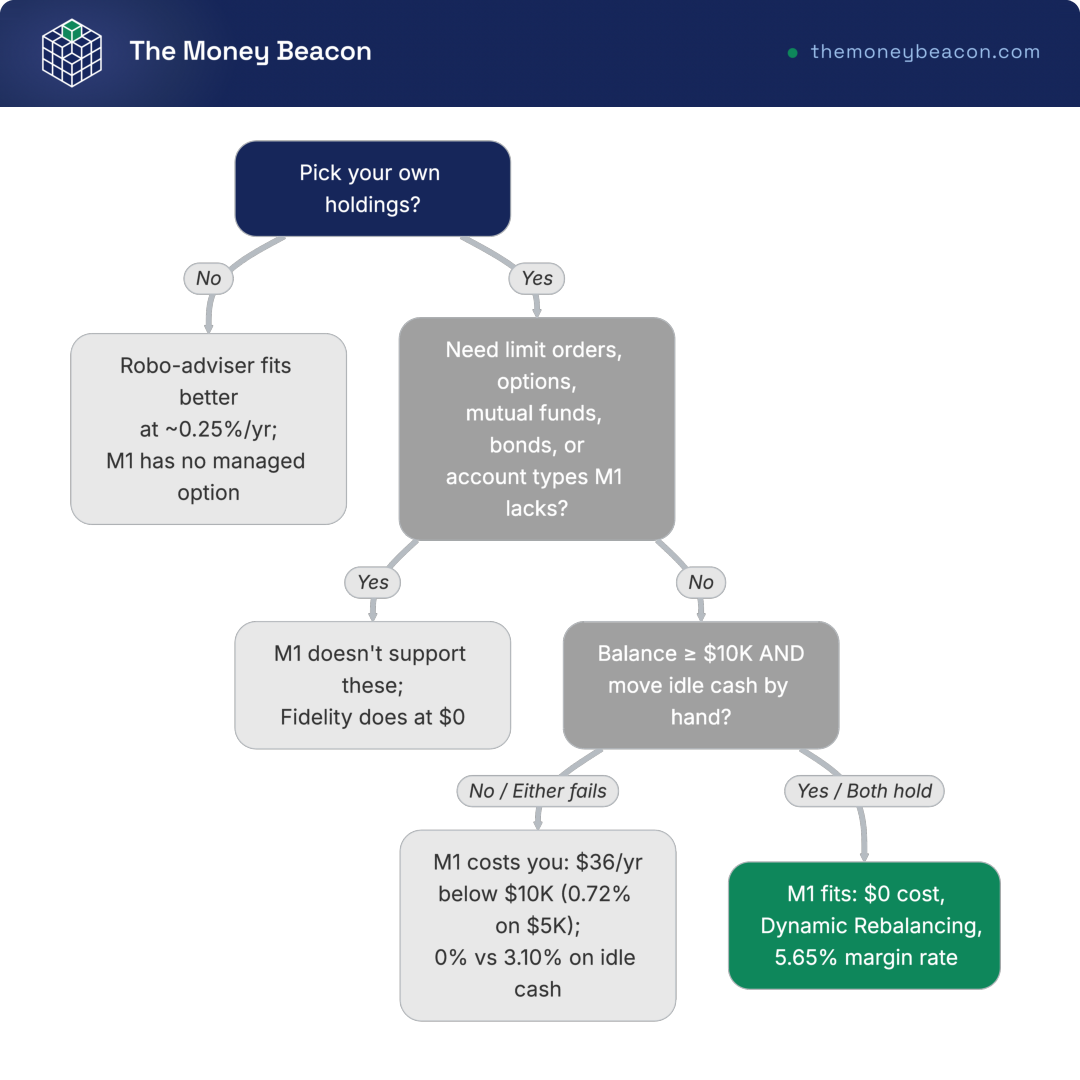
Two of those tests ask what you need. The last asks what you’ll actually do, and that’s the one people get wrong about themselves.
5.2 The ruling: M1 beats one camp permanently and never beats the other
Start with price, because it settles more of this than anything else does. Above $10,000, M1’s direct platform cost is $0 a year.
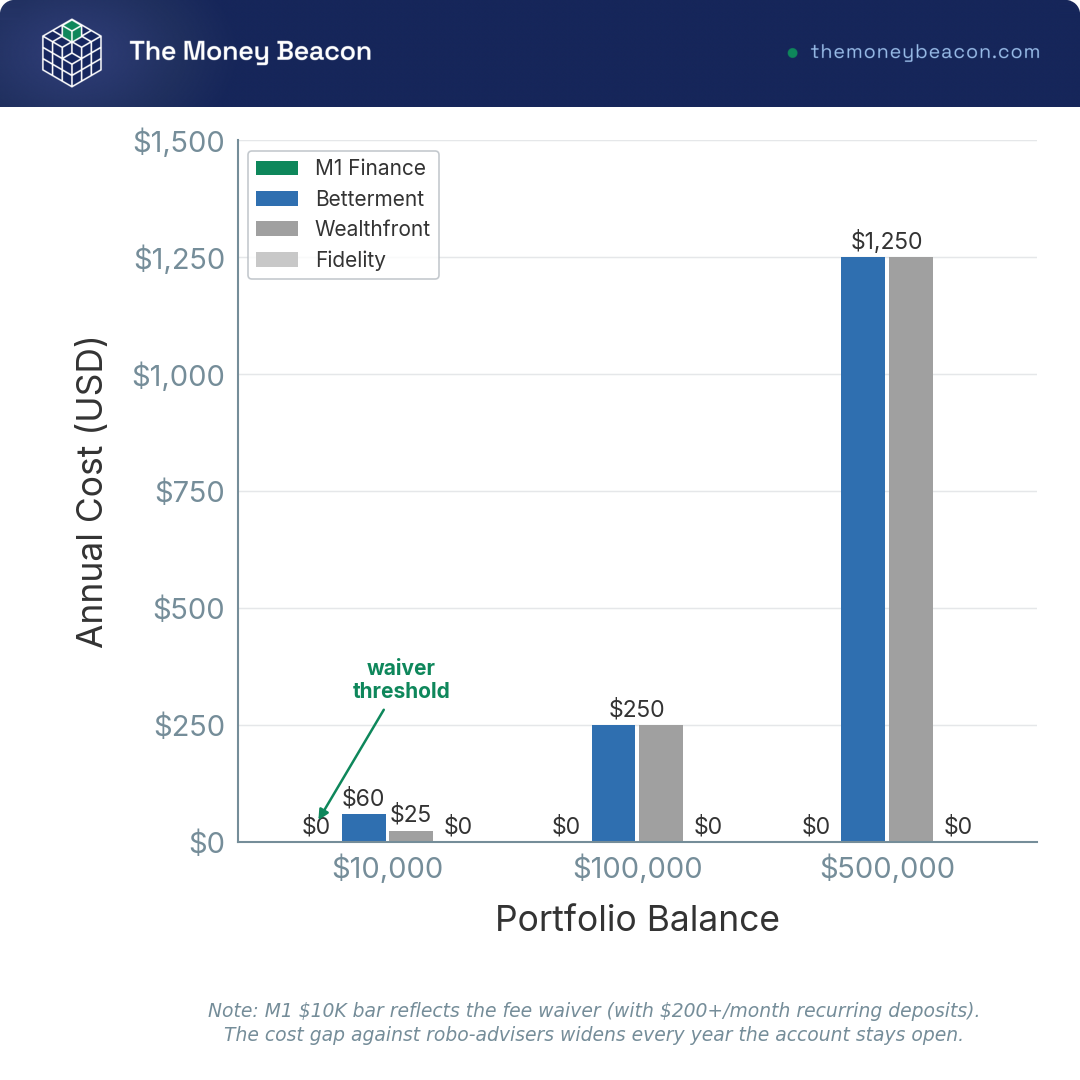
Against Fidelity that’s a tie above $10,000, and a loss below it. Against the robo-advisers it’s a win that compounds: $250 a year at $100,000 and $1,250 at $500,000, every year the account stays open.
So is M1 Finance worth it? Here are three answers.
The buy-and-hold allocator with $10,000 or more gets a yes, and a real one, on the single condition that you move idle cash into the Cash Account yourself. Nothing free holds a nested, multi-slice allocation to the percentage the way Dynamic Rebalancing does.
The fee-sensitive starter below $10,000 gets a no, at least for now. Push the aggregate balance across $10,000 for one day of a cycle and the answer flips, which makes this a timing call rather than a permanent one.
The investor who needs order control, or a product M1 doesn’t offer, or a self-employed plan it doesn’t open, gets a no at any balance, because a waiver fixes a price and this is a product gap.
If you’re in that first group, you’re getting automatic rebalancing for nothing. In either of the other two, a $0-fee mainstream broker or a robo-adviser answers the same need better.
Conclusion
Above $10,000, M1 hands you automatic rebalancing for $0 a year, and that’s rare. But the price I keep coming back to isn’t the $3. It’s the attention. Dynamic Rebalancing is the only part of M1 that works without you, so the waiver has to be earned every billing cycle, and your uninvested cash pays nothing until you move it yourself.
The idle cash is what quietly costs people money. M1’s own sweep disclosure says it plainly: the balance in your Primary Invest Account earns nothing, and it stays at 0% for as long as you leave it alone. Leave $5,000 uninvested for a year instead of earning 3.10% in the Cash Account and you’ve given up $155, more than four times the $36 Platform Fee that dominates every argument about what M1 costs.
So do one thing today, before anything else. Check the uninvested balance in your Primary Invest Account, transfer it into the Cash Account, and repeat that on every deposit you make from now on. It takes a minute, and it’s the only lever in this review that raises your return without touching your allocation.
To dig deeper, our review of what Schwab pays on idle cash shows the same default at a far larger broker. Our comparison of money market accounts covers where cash can earn well above 3.10%, and if M1’s product gaps ruled you out, our Vanguard review prices a mainstream alternative.
FAQ
Is M1 Finance free to use, or do you have to pay for a membership?
M1 dropped its paid membership tier for a flat Platform Fee model in May 2024. What’s left is a $3 monthly Platform Fee, or a $3 monthly IRA Fee if an individual retirement account (IRA) is your only open account, never both, and never more than $3 a month. Get your total M1 assets to $10,000 or more for one day inside the 30-day billing cycle and the fee disappears. Stock and ETF trades are commission-free; watch only for a cash-short payment account, since M1 can sell securities to cover its $3, which can trigger a small capital gain you didn’t plan for.
How often does M1 actually trade, and can you place a limit order?
M1 trades once or twice a day, in windows opening around 9:30 am and 3:00 pm Eastern time. The second window unlocks only once a specific account holds $25,000 or more in invested assets, cash excluded, and the test runs per account, not per household. There is no limit order, no stop order and no time-in-force instruction on the automated path: M1 treats every customer order as “not held,” which hands it discretion over price and timing inside the window. A manual order jumps the queue but still waits for the next window to fill.
Is M1 Finance safe, and what does SIPC actually protect?
M1 Finance LLC is the broker-dealer behind the app, a Securities and Exchange Commission (SEC) registered firm and a FINRA and Securities Investor Protection Corporation (SIPC) member since March 2016. SIPC covers up to $500,000 per customer, including a $250,000 sub-limit for cash, if the broker-dealer itself fails; it does not cover a stock that simply drops in value. Accounts cleared through Apex carry supplemental coverage on top, $37.5 million for securities and $900,000 for cash. Cash swept into the Cash Account or the High-Yield Savings Account is FDIC-insured instead, at $250,000 per depositor per bank. Crypto holdings get neither.
Can you hold a Roth IRA or a traditional IRA at M1 Finance?
Yes. M1 opens Traditional, Roth and Simplified Employee Pension (SEP) IRAs, three IRA types, alongside its taxable brokerage accounts. None of them can borrow against M1 Borrow; margin is only available on Individual, Joint and Trust accounts with a Margin and Short Agreement. If an IRA is your only M1 account, the $3 monthly IRA Fee replaces the Platform Fee rather than stacking on it, and the same $10,000 waiver applies. The SEP IRA’s 2026 ceiling is $72,000, useful if you’re self-employed, though our guide to Roth IRA limits and the traditional trade-off is the better read for deciding which wrapper to fund first.
Does M1 Finance charge a fee to transfer your account to another broker?
Yes, and it’s worth pricing before you commit to a broker for the long run. An outgoing transfer through the Automated Customer Account Transfer Service is $100, closing an IRA adds another $100, and a Direct Registration System transfer costs $115 per security. Transfers into M1, and ordinary ACH deposits and withdrawals, are free. The bigger cost usually isn’t the fee: only whole shares move to a new broker in kind, so every fractional Slice you hold gets sold to cash first, a gain you didn’t choose to realize.
Can you buy options, mutual funds, or bonds on M1 Finance?
No to all three, and M1 says so directly: its help center states that “mutual funds, options, and OTC securities are not supported.” The tradable universe is limited to more than 6,000 US-listed stocks and ETFs on the NYSE and NASDAQ, plus a short list of crypto coins through Bakkt and a few crypto-linked funds. Individual bonds and Treasurys aren’t offered either; the only way to hold fixed income here is a bond exchange-traded fund (ETF). A position with options or over-the-counter (OTC) shares that lands in your account from an outside transfer can be sold, never bought.
Has M1 Finance been fined or disciplined by a regulator?
Yes. FINRA’s BrokerCheck lists three regulatory disclosure events against M1 Finance LLC as of August 2026. The largest is an $850,000 fine FINRA imposed on March 18, 2024 over M1’s social media influencer program, followed by a second censure carrying a $400,000 fine in May 2024. A separate SEC-related matter closed in May 2025 with no enforcement action taken. None involves a custody failure or a finding of fraud, and M1’s registration stays active, but a reader comparing brokers deserves to know the record exists.




Comments
Questions and corrections welcome. We read everything.