


Choosing a travel rewards credit card in 2026 can be overwhelming. There are many options, and each “best travel credit cards” list says something different. The annual fees now run from $0 all the way up, and in January 2026 the Amex Platinum fee climbed to $895, so the wrong pick can cost you hundreds of dollars a year for lounge visits and credits you’ll never use. Here’s the catch: a card’s real value depends entirely on how you spend, on whether you fly often, where you book, and whether you ever move points to airline and hotel partners. Most people either overpay for perks they don’t touch or grab a flashy sign-up bonus and leave real money on the table.
So before I rank anything, I’ll show you exactly how I rated each card. After reading this article, you’ll know which travel rewards card is best for you, based on how much and on what you spend.
1. How we compared the seven travel rewards cards
So how do you actually tell seven near-identical premium cards apart, based on your own numbers instead of a marketing page?
The criteria every card is scored on
Every card here runs through the same checklist, row by row. I rate each one on its annual fee, its base earn (what every dollar of ordinary spending returns), its category earn (dining, travel, groceries, and so on), its welcome bonus, its portal redemption rate in cents per point (cpp), its statement credits, its lounge access, and the breadth of its airline and hotel transfer partners. Most of them also have a Global Entry or TSA PreCheck credit. One thing they all have in common is that they all charge 0% abroad, so I’ve dropped the foreign transaction fee as a deciding factor.
The bubble chart below plots the field on the two axes that matter most, cost against transfer flexibility, with the bigger bubbles flagging better lounge access.
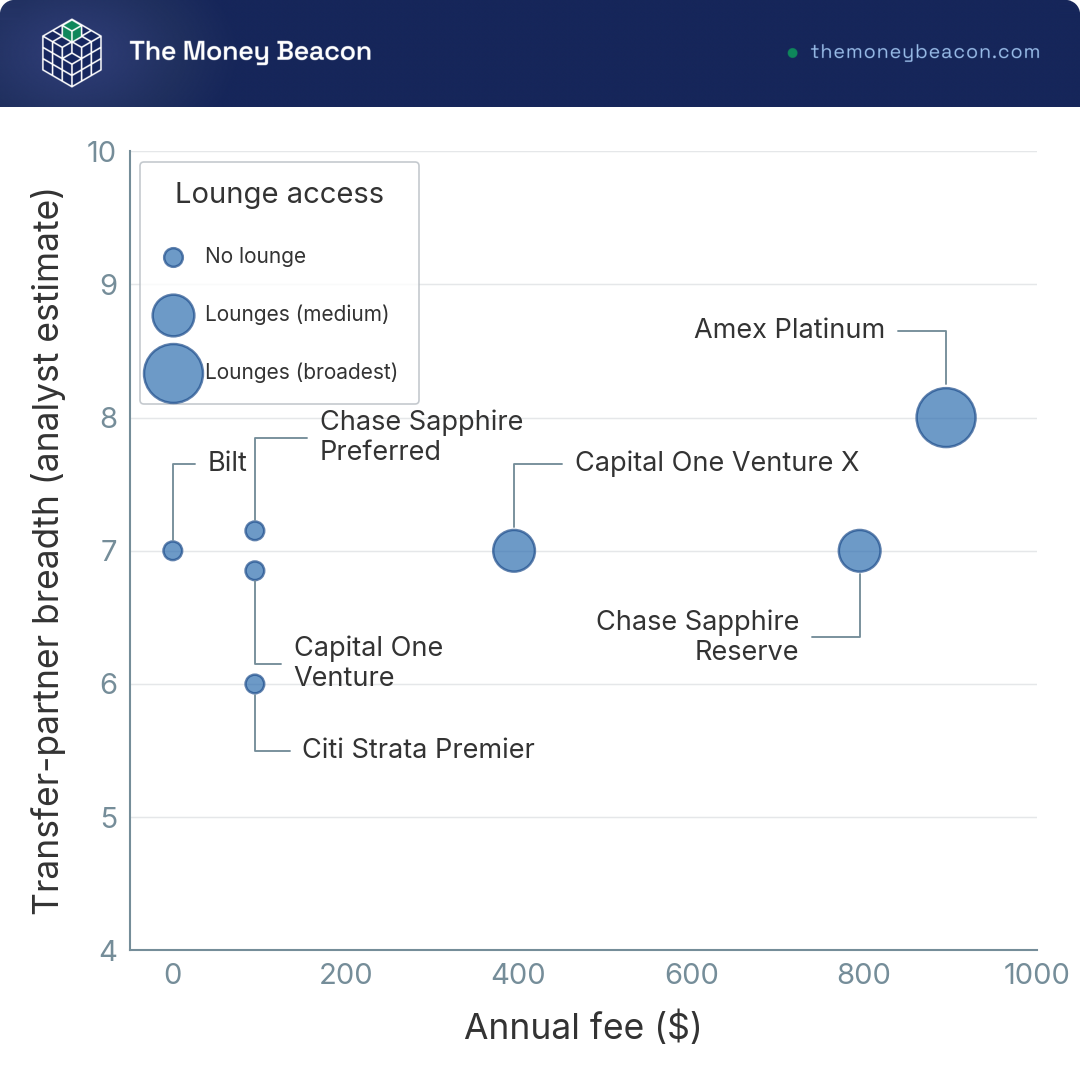
To make this a fair travel credit card comparison, each card is reviewed in the same way and in the same order. This means that any two of the cards can be compared side by side.
How to value a point and read the fee
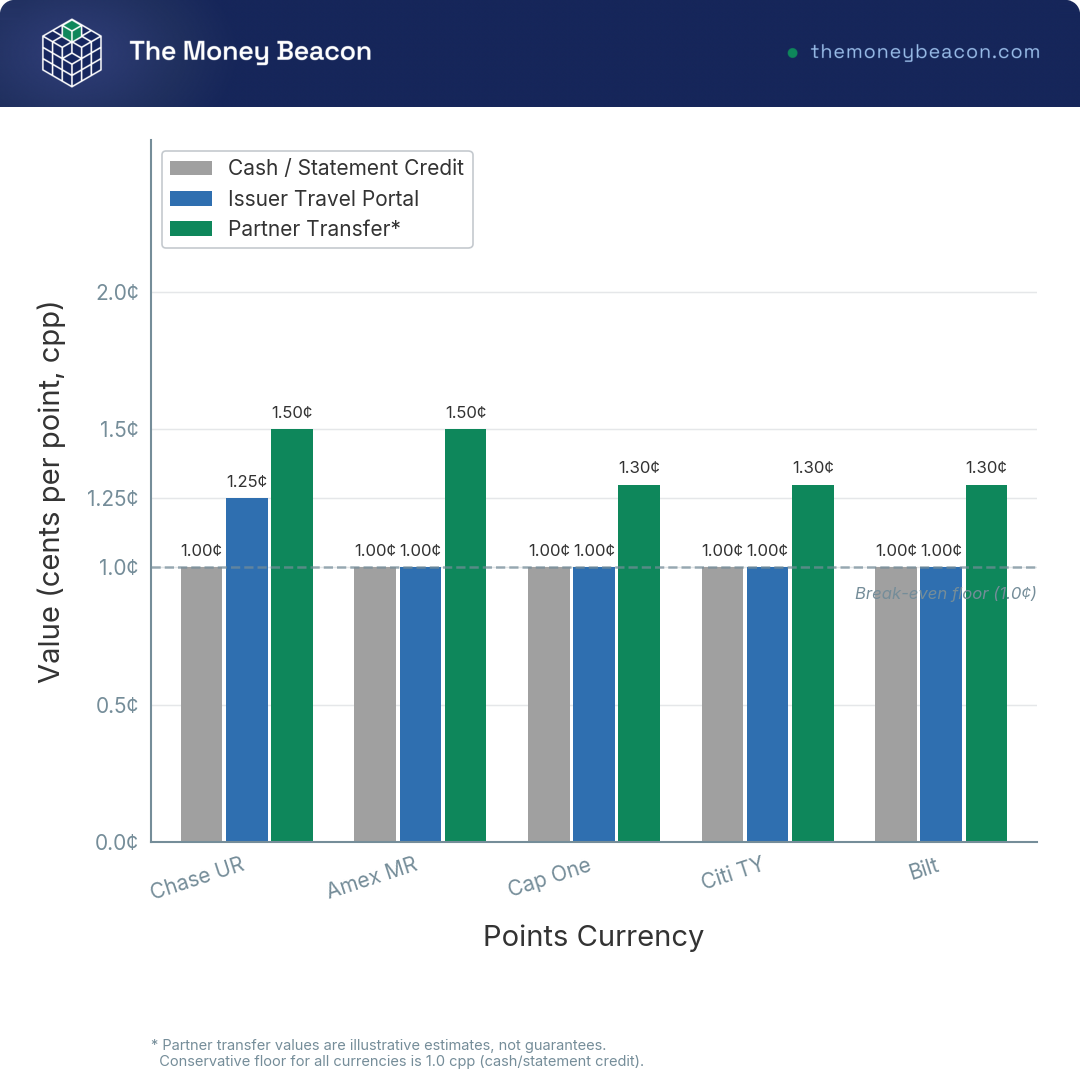
Before any card means anything, you need to know two things: what a point is worth, and what a card actually costs. A transferable point is worth about 1.0 cent when you cash it out or book through the issuer’s travel portal at the base rate. It’s worth significantly more only when you move it to the right airline or hotel partner. The only thing an issuer guarantees is that floor value, so I use 1.0 cpp for all the break-even math and treat transfer upside as a bonus, not a promise.
The fee works the same way, since the sticker price is rarely the real price. The rule I’ll apply to every card is simple. Your net fee is the annual fee minus the credits you’ll genuinely use. A $395 card that hands back a $300 travel credit you spend every year really costs you about $95. The same card costs the full $395 to someone who lets that credit expire. A high sticker fee can shrink toward zero, or stay punishing, entirely depending on you.
If you mostly want cash back instead, a flat-rate card that pays you back in cash is the simpler tool, and we walk through those in our cash back comparison. The best credit card for you is the one that offers the best rewards and lowest fees for your spending habits.
The seven cards at a glance
Here’s a look at the field, the travel credit cards of the comparison lined up on fee, flagship earn, welcome bonus, and the type of traveler each is best for.
| Card | Annual fee | Flagship earn | Welcome bonus (spend/window) | Best for |
|---|---|---|---|---|
| Sapphire Preferred | $95 | 5x Chase Travel; 3x dining | 100,000 pts / $5,000 / 3 mo (limited-time) | First premium points card |
| Sapphire Reserve | $795 | High Chase Travel portal + credits | 100,000 pts / $6,000 / 3 mo | Heavy travelers who use credits |
| Amex Platinum | $895 | 5x flights/prepaid hotels via Amex Travel | 175,000 MR / $12,000 / 6 mo (public offer) | Lounge access + credit maximizers |
| Venture X | $395 | 2x base, 10x hotels via Cap One Travel | 75,000 miles / $4,000 / 3 mo | Low-fee premium / simplicity |
| Venture | $95 | 2x flat on everything | 75,000 miles / $4,000 / 3 mo | Flat-earn simplicity |
| Citi Strata Premier | $95 | 3x on a broad bonus set | 60,000 pts / $4,000 / 3 mo (70,000 limited-time) | Broad everyday bonus categories |
| Bilt Mastercard | $0 | Points on housing (no fee) | Bilt Blue: $100 Bilt Cash on approval | Renters; no-fee points |
Data current as of June 2026. Welcome offers are point counts, not guaranteed dollars, and are limited-time.
With the ranking criteria in hand, it’s time to look at the card that most people new to points should consider first: the Chase Sapphire Preferred.
2. Chase Sapphire Preferred: the lowest-fee full-transfer card
Overview
For a $95 fee, you get the full set of Chase Ultimate Rewards transfer partners, 3x on dining and 5x on Chase Travel, plus a $100 annual hotel credit and a newly added Global Entry credit. It’s the best credit card for travel points if your goal is real transferable points without paying a premium fee.
Strengths
Its main strength is straightforward: full Ultimate Rewards transfer access, including World of Hyatt, for just $95. The earn structure is strong for the price, with 3x on dining and 3x on online groceries, streaming, gas, EV charging, and select vacation rentals. Two credits help you pay the fee: a $100 annual Chase Travel hotel credit and the new Global Entry or TSA PreCheck credit (up to $120 every four years).
Weaknesses
Chase got rid of the guaranteed 1.25 cpp redemption floor in October 2025, so new points now redeem at a 1.0 cpp baseline. A Points Boost feature can lift select bookings higher but isn’t guaranteed, so the portal is no longer a reliable premium over cash. Beyond that, there’s no lounge access, the base earn outside bonus categories is an unremarkable 1x, and the card is subject to under Chase’s 5/24 application rule.
Pricing & fees
| Item | Value (2026) |
|---|---|
| Annual fee | $95 |
| Earn rates | 5x Chase Travel; 3x dining, online groceries, select streaming; 3x gas, EV charging, and vacation rentals at top brands; 2x other travel; 1x base |
| Portal redemption | 1.0 cpp baseline (Points Boost up to ~1.5-1.75 cpp on select bookings); legacy 1.25 cpp on points earned before Oct 25, 2025, redeemable until Oct 26, 2027 |
| Welcome bonus | 100,000 pts after $5,000 / 3 mo (limited-time, all-time-high offer running mid-2026) |
| Annual hotel credit | $100 Chase Travel hotel credit (per account anniversary year) |
| Global Entry/TSA credit | Up to $120 every 4 years (newly added) |
| Purchase APR | 19.24%-27.49% variable |
| Foreign transaction fee | 0% |
Data current as of June 2026.
Run the net-fee rule and the math looks promising. Spend $1,000 a month on dining and 3x earns about 36,000 points a year, worth roughly $360 at the 1.0 cpp floor against $240 from a flat 2% card. That $120 of extra reward plus the $100 hotel credit clears the $95 fee on its own.
Who it’s for
This is the card for someone who wants the cheapest credible route into full transferable points and who actually spends on dining and travel. It’s the wrong pick if you need lounge access, or if you were counting on the old 1.25 cpp portal guarantee that no longer exists. If you are interested in how this stacks up against the best credit cards across every category, including cash back and balance transfer, consult the wider picture in best credit cards across every category.
3. Chase Sapphire Reserve: the credits-and-lounge Chase flagship
Overview
The Chase Sapphire Reserve is the premium step up in the Chase ecosystem. The fee is $795, and the card is built around four things a frequent traveler can actually use: a 1.5 cpp portal baseline, a $300 annual travel credit, a $500 prepaid-hotel credit, and lounge access. The best premium travel card for you in this ecosystem is the one whose credits you’ll genuinely redeem.
Strengths
The credit stack is the key. A $300 annual travel credit plus a $500 prepaid-hotel credit (delivered as two $250 increments) can offset a large share of the fee for anyone who travels regularly. You also get lounge access, with unlimited entry to Chase Sapphire Lounge by The Club locations (two guests free per visit, additional guests about $27 each) plus Priority Pass enrollment. The portal starts at a 1.5 cpp baseline, higher than the Preferred, with Points Boost able to lift select bookings further. Add 3x dining, a Global Entry credit, a 100,000-point welcome bonus, and 0% foreign transaction fees.
Weaknesses
The $795 fee is only worth it if you use the $300 and $500 credits; if you don’t, the card will quickly become expensive. Chase also removed the old 1.5x reward multiplier, so the base earn is now 1x for points earned after October 26, 2025. Authorized users cost $195 each. And because the value is spread across credits that reset on their own schedules, getting your money’s worth means tracking those resets, which is real, recurring work, not a set-and-forget arrangement.
Hank’s take

the behavioral-finance research is blunt on this kind of card: people systematically overrate credits they intend to use and underrate the friction of actually using them. If you know you won’t calendar a reset date, price the fee as the full $795 and decide from there.
Pricing & fees
Here’s the Reserve laid out on the same dimensions as the Preferred, so you can compare them directly.
| Item | Value (2026) |
|---|---|
| Annual fee | $795 (authorized user $195) |
| Earn rates | Elevated multiplier on Chase Travel bookings; 3x dining; 1x base (the prior 1.5x multiplier was removed for points earned after Oct 26, 2025) |
| Portal redemption | 1.5 cpp baseline; Points Boost can lift select bookings higher (review-site estimates up to ~2.0 cpp, not issuer-guaranteed) |
| Annual travel credit | $300, resets each account anniversary year |
| Additional hotel credit | $500/year for prepaid stays, delivered as two $250 increments |
| Welcome bonus | 100,000 pts after $6,000 / 3 mo |
| Global Entry/TSA credit | Up to $120 every 4 years |
| Purchase APR | 19.49%-27.99% variable |
| Foreign transaction fee | 0% |
Data current as of June 2026.
The net-fee rule is simple: it has two possible outcomes. If you spend the $300 travel credit and the $500 hotel credit, you can save $800 on a $795 fee, before the lounge visits; skip them and you’re paying close to full freight.
Who it’s for
This is the card for a frequent traveler who’ll use the full credit stack, get into the lounges several times a year, and want more options within the Chase ecosystem. It’s the wrong pick for someone who won’t track credit resets or who travels lightly, because for that person the credits go unspent and the $795 just sits there as a cost.
4. The Platinum Card from American Express: lounges and the credit stack
Overview
The Platinum Card from American Express is the maximalist pick in this whole field. The fee is $895, the highest of any card here, and it buys two things above all: the broadest lounge access in the comparison and a stack of statement credits worth more than $3,500 a year if you actually use all of them. This is a perks-and-credits card, not an everyday-earn card. The elevated earning is narrow on purpose, with 5x reserved for flights booked directly with airlines or through Amex Travel (up to $500,000 per calendar year) and 5x on prepaid hotels through Amex Travel, while everything else earns a plain 1x.
Strengths
The lounge network is the best part. You get Centurion Lounges, Priority Pass Select after enrollment, and Delta Sky Club access when you fly Delta (10 visits per Medallion Year, and unlimited once you cross $75,000 in annual eligible spending). On top of that you get the credit stack, and it’s where almost all the value lives. Counted up, the annual and monthly credits clear $3,500 in potential value across Resy, hotels, Uber Cash, airline incidentals, and more, each subject to enrollment and its own conditions. The Membership Rewards transfer network is strong, mostly at 1:1, and you also get a Global Entry or TSA PreCheck credit and of course the 0% foreign transaction fee.
Weaknesses
The everyday earn is the obvious soft spot. Outside of flights and prepaid hotels, you’re earning 1x on ordinary spending, so this is a poor “one card for everything.” The bigger trap is the structure of those credits. They’re coupon-book style and time-boxed, and they reset on the calendar year, so a credit you forget is a credit you forfeit. Skip them and that $895 fee balloons in net terms instead of shrinking. Two more limits: Amex acceptance is narrower abroad than Visa or Mastercard, and the welcome bonus is a once-per-lifetime offer, so you can’t re-earn it later.
Pricing & fees
Here’s the Platinum laid out line by line.
| Item | Value (2026) |
|---|---|
| Annual fee | $895 (authorized user $195 each) |
| Earn rates | 5x on flights booked direct with airlines or via Amex Travel (up to $500,000 per calendar year); 5x on prepaid hotels via Amex Travel; 1x base |
| Welcome bonus | As high as 175,000 points after $12,000 / 6 mo (standard US public offer; targeted offers vary) |
| Key credits | $3,500+ in potential annual value across multiple credits (Resy, Fine Hotels + Resorts and Hotel Collection, lululemon, Equinox, Uber Cash, airline incidentals, and others); credits reset on the calendar year |
| Global Entry/TSA credit | Up to $120 for Global Entry or up to $85 for TSA PreCheck |
| Pay Over Time APR | Variable, assigned per cardholder by creditworthiness; not a single published range |
| Foreign transaction fee | 0% |
Data current as of June 2026.
The $895 tag isn’t the price you actually pay; the credits decide that, and honestly this card only makes sense if you redeem them on schedule.
Who it’s for
This is the card for a traveler whose top priority is lounge access and who’ll methodically work through the full credit stack every year. If you’ll set calendar reminders for the Resy, Uber, and airline credits and actually redeem them, the lounge breadth makes the $895 reasonable. It’s the wrong pick for someone who wants strong everyday earn, or who knows they won’t track calendar-year resets and will let the credits expire unspent.
5. Capital One Venture X Rewards: low-fee premium, set and forget
Overview
The Capital One Venture X Rewards card answers a different question: how cheap and how easy can a premium card be? The fee is $395, and the whole thing is built around simplicity. You get a flat 2x on everything, a $300 annual travel credit, 10,000 anniversary miles, and lounge access. The main idea is that the credit and the miles roughly offset the fee on their own, with no coupon-book effort to track.
Strengths
The value math is refreshingly simple. A $300 annual travel credit through Capital One Travel, plus 10,000 anniversary miles worth about $100 toward travel, can offset most or all of the $395 fee for anyone who books a single trip a year. The earn structure stays just as simple, with a flat 2x base on all purchases and no categories to track, plus 10x on hotels and 5x on flights when you book through Capital One Travel. The primary cardholder gets lounge access through Capital One Lounges and Priority Pass, and the card charges 0% in foreign transaction fees.
Weaknesses
The simplicity comes with a few real limits. Authorized-user lounge access is no longer free: from February 1, 2026, each authorized user costs $125 per year to keep lounge entry, where it used to be included. The welcome bonus has also decreased to 75,000 miles, after the 100,000-mile offer ended January 5, 2026. On redemption, the portal sits at the 1.0 cpp floor, so there’s no premium multiplier to lean on. The transfer network is solid at roughly 22 partners, but it doesn’t include World of Hyatt, and the increased earning rates are only available through the portal.
Pricing & fees
Here’s the Venture X cheat-sheet with the dimensions as the other cards.
| Item | Value (2026) |
|---|---|
| Annual fee | $395 (authorized-user lounge access $125/year each from Feb 1, 2026) |
| Earn rates | 2x base on all purchases; 10x hotels and rental cars via Capital One Travel; 5x flights via Capital One Travel |
| Welcome bonus | 75,000 miles after $4,000 / 3 mo (the prior 100,000-mile offer ended January 5, 2026) |
| Annual travel credit | $300 via Capital One Travel |
| Anniversary bonus | 10,000 miles each anniversary (about $100 toward travel) |
| Global Entry/TSA credit | Up to $120 every 4 years |
| Purchase APR | 19.49% to 28.49% variable |
| Foreign transaction fee | 0% |
Data current as of June 2026.
Put the net-fee rule to work and the result is reassuring. Use the $300 credit and let the 10,000 anniversary miles land, and you’ve covered roughly $400 against a $395 fee, without tracking a single monthly reset.
Who it’s for
This is the card for someone who wants premium perks and lounge access but refuses to babysit monthly credits. It’s the wrong pick for someone who needs World of Hyatt transfers, or who plans to add several lounge-using authorized users now that each one costs $125 a year.
6. Capital One Venture Rewards: flat-earn simplicity, including abroad
Overview
The Capital One Venture Rewards card strips it down even further: 2x on every purchase, a $95 fee, and full Capital One miles transfer access, with nothing to track. There are no categories to manage and no credits to remember, just a flat return on everything you buy. A 0% foreign transaction fee makes it the simplicity pick for a light traveler who wants one card that behaves the same at home and on the road.
Strengths
The appeal is utmost simplicity. You earn a flat 2x on every purchase, the simplest “good return on everything” arrangement here, with 5x on hotels and rental cars when you book through Capital One Travel. You get the same Capital One transfer partners the pricier card offers, but at a $95 fee, plus a Global Entry or TSA PreCheck credit worth up to $120 every four years. Of course there are 0% in foreign transaction fees, despite its old reputation for charging them, so it’s genuinely easy to use abroad.
Weaknesses
The trade-offs are exactly what you’d expect from a stripped-down card. There are no statement credits, so the $95 fee is a real, unrecovered cost rather than something the card hands back. There’s no lounge access, and the portal redemption sits at the 1.0 cpp floor with no premium multiplier. The Capital One miles network lacks World of Hyatt, and the flat 2x earn trails a strong category card for anyone whose spending leans heavily into dining or travel, where a 3x rate would simply earn more.
Pricing & fees
Here’s the Venture laid out explicitly.
| Item | Value (2026) |
|---|---|
| Annual fee | $95 |
| Earn rates | 2x every purchase; 5x hotels and rental cars via Capital One Travel |
| Welcome bonus | 75,000 miles after $4,000 / 3 mo |
| Global Entry/TSA credit | Up to $120 every 4 years |
| Purchase APR | 19.49% to 28.49% variable |
| Foreign transaction fee | 0% |
Data current as of June 2026.
Who it’s for
This is the card for someone who wants one simple 2x card that behaves identically at home and abroad, with zero category tracking and no annual coupon-book to manage. It’s the wrong pick for a category-heavy spender who’d earn more on a 3x dining card, or for anyone who wants lounges or statement credits. If your real goal is cash in your pocket rather than transferable miles, a flat-rate no-fee cash back card may suit you better.
7. Citi Strata Premier: broad bonus categories and an American Airlines partner
Overview
The Citi Strata Premier is the other $95 card, built for a spender whose budget is scattered rather than concentrated. Instead of one or two strong categories, it pays 3x across a broad bonus set: air travel, hotels, restaurants, supermarkets, gas, and EV charging, plus 10x on hotels, cars, and attractions booked through Citi Travel. It earns Citi ThankYou points and is the only card in this comparison with American Airlines as a 1:1 transfer partner.
Strengths
The wide 3x set is the real strength. Most cards make you concentrate spending in one category to earn well; the Strata Premier pays the same 3x across an entire bonus set, so a spread-out budget earns strongly without any category juggling. On top of that you get 10x on hotels, cars, and attractions via Citi Travel. Citi ThankYou includes American Airlines AAdvantage at 1:1, alongside international carriers like Air France-KLM Flying Blue and Virgin Atlantic. A $100 annual Citi Travel hotel credit helps offset the fee, the welcome bonus runs 60,000 points (with a 70,000-point limited-time offer appearing), and of course the card charges 0% in foreign transaction fees.
Weaknesses
The card’s redemption ceiling is the trade-off. The portal and cash value stay at the 1.0 cpp floor, with mostly 1:1 transfers and limited upside, so there’s no premium multiplier to lean on. There’s no lounge access and no Global Entry credit, and the base earn outside the bonus set is a plain 1x. The hotel credit also comes with a string attached: it applies only to a single Citi Travel stay of $500 or more per calendar year, which reduces its flexibility.
Pricing & fees
Here’s the Strata Premier laid out on the same lines as the rest.
| Item | Value (2026) |
|---|---|
| Annual fee | $95 |
| Earn rates | 10x hotels/cars/attractions via Citi Travel; 3x air travel, hotels, restaurants, supermarkets, gas, EV charging; 1x base |
| Welcome bonus | 60,000 pts after $4,000 / 3 mo (a 70,000-pt limited-time offer has appeared) |
| Annual hotel credit | $100 off a single hotel stay of $500+ booked through Citi Travel, once per calendar year |
| Portal/cash value | 1.0 cpp floor (cash, statement credit, or Citi Travel); transfer upside via ThankYou partners, mostly 1:1 |
| Purchase APR | 20.24% to 28.24% variable |
| Foreign transaction fee | 0% |
Data current as of June 2026.
The fee math looks sweet for the right spender. Use the $100 hotel credit and the $95 fee is more than covered before you count a single point, and the broad 3x set keeps earning on spending other cards would only reward at 1x.
Who it’s for
This is the card for a spender whose budget is spread across groceries, gas, dining, and travel and who wants 3x on all of them at a low fee. The American Airlines partner is the clincher if you fly AA and want a transferable currency that feeds it. It’s the wrong pick for someone who wants lounge access, a Global Entry credit, or a high portal multiplier, because the Strata Premier trades those perks for breadth of earn.
8. Bilt Mastercard: the no-fee card that earns points on rent
Overview
The Bilt Mastercard is the outlier in this comparison, the one card that doesn’t play the same game as the others. It carries a $0 annual fee on the Blue card, and its single differentiator is that it earns transferable points on housing, rent or mortgage, with no processing surcharge. That feature is rare, which is what puts it among the travel credit cards with no annual fee worth a second look. Under the 2026 relaunch the housing earn is now tiered rather than flat. This is a housing-rewards card, not a premium travel card, and interpreting it any other way leads to disappointment.
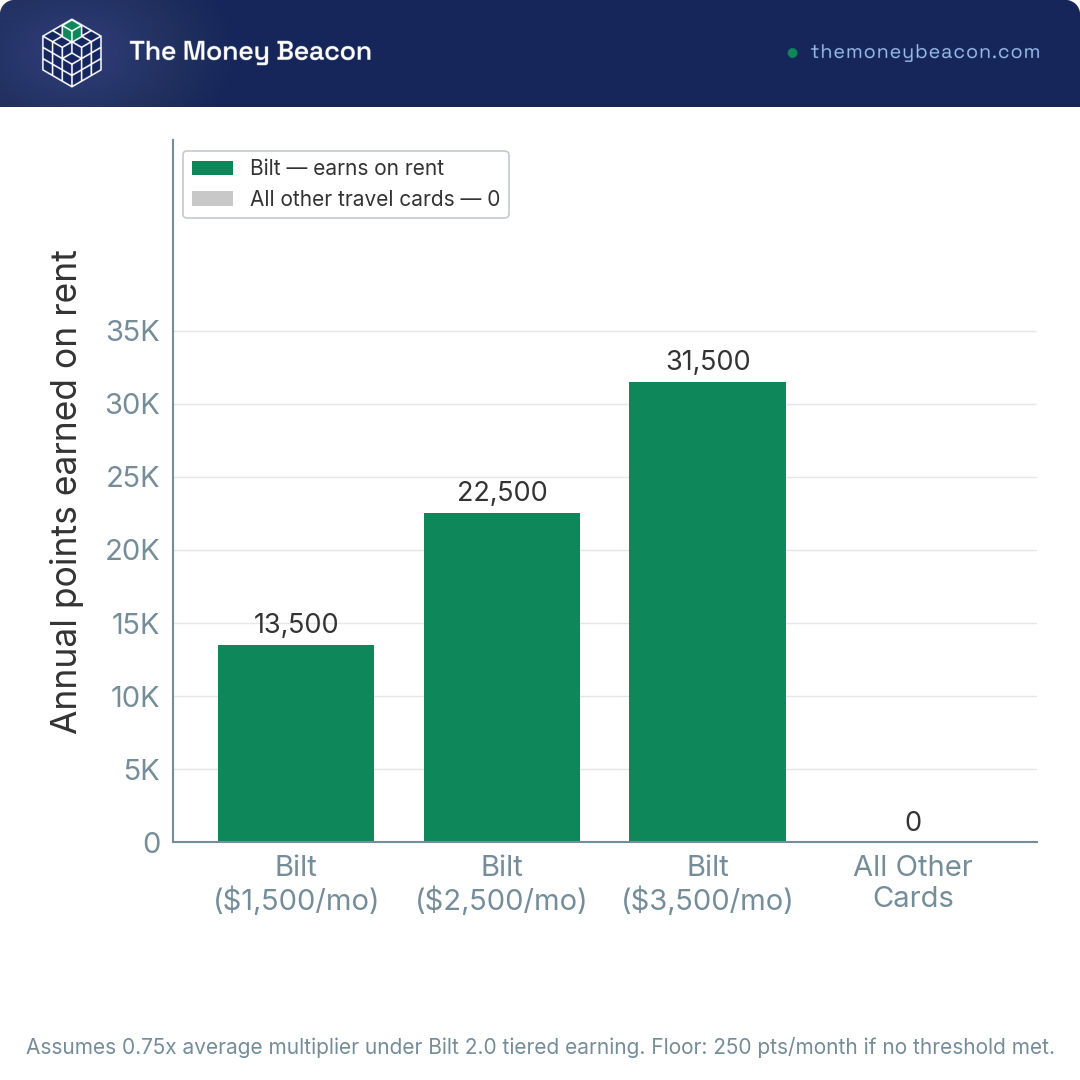
The chart below shows what that rent-earning feature is worth at three rent levels, set against the zero that every other card here earns on housing.
Strengths
The headline is the housing earn. Bilt is the only card here that earns transferable points on rent or mortgage at $0 annual fee and no surcharge when you pay through Bilt. Outside housing, the earn is solid: 3x on dining and grocery (up to roughly a $25,000-a-year cap) and 2x on travel. The transfer network is wide, about two dozen partners at 1:1, including World of Hyatt, a marquee hotel program. The card also charges 0% in foreign transaction fees.
Weaknesses
The catch is that the housing earn is tiered, not flat. Instead of a single rate, the multiplier on rent or mortgage scales with your non-housing spending, running from about 0.5x up to roughly 1.25x, with a floor of 250 points per month if you meet no threshold. A minimum-activity requirement applies each cycle, so you have to use the card to keep earning. Beyond that, there’s no lounge access, no statement credits, and no Global Entry credit, and the American Airlines partnership Bilt once offered ended on June 24, 2024 and is not available in 2026. The new lineup’s APR also runs high after an introductory period, so this is a card to pay in full, every cycle.
For anyone weighing whether to keep renting or buy, the points are a small factor next to the bigger ownership math, which we walk through in our guide to whether owning property does more for your net worth than renting.
Pricing & fees
Here’s the Bilt Blue on the same lines as the rest, with the tiered housing earn spelled out.
| Item | Value (2026) |
|---|---|
| Annual fee | $0 (Bilt Blue) |
| Earn rates | 3x dining and grocery (up to a ~$25,000/year cap); 2x travel; 1x everyday base; housing (rent/mortgage) earns a tiered 0.5x-1.25x based on non-housing spend (250 pts/month floor) |
| Activity requirement | Minimum activity per statement cycle to earn (historically 5 transactions; Bilt 2.0 also uses spend thresholds relative to housing) |
| Welcome bonus | Bilt Blue: $100 Bilt Cash on approval (higher-tier cards offer larger bonuses) |
| Transfer partners | About two dozen airline/hotel partners at 1:1 (Accor a 3:2 exception); includes World of Hyatt; no American Airlines |
| Purchase APR | 26.74% to 34.74% variable (after a 12-month introductory period on the new lineup) |
| Foreign transaction fee | 0% |
Data current as of June 2026.
With no annual fee, there’s nothing to break even against. The whole question is simpler: are the points you earn on housing, at your tier, worth the activity requirement and the discipline of paying in full?
Tom’s take
I own rental property, so I think about housing as the biggest line in a budget. For a renter, earning anything on that line for free is free money, but I’d run my own tier first; at the low end, 0.5x on rent is thin, and the card only makes sense if you’ll actually hit a higher threshold.
Who it’s for
This is the card for a renter, especially in a high-cost city, who pays a large monthly rent in a way Bilt can capture and wants free transferable points on it. The value is the housing earn, full stop. It’s the wrong pick for someone seeking lounges, statement credits, or American Airlines transfers, because as a pure travel card the Bilt is mid-pack and worth holding only for that one feature.
With all seven cards reviewed on the same five lines, we can put them side by side.
9. The verdict: which travel card fits which reader
The full comparison recap table
Here is the single source of truth for every comparative claim in this article, so you can read down a row and rank the field on the dimension that matters to you.
| Criterion | Sapphire Preferred | Sapphire Reserve | Amex Platinum | Venture X | Venture | Strata Premier | Bilt |
|---|---|---|---|---|---|---|---|
| Annual fee | $95 | $795 | $895 | $395 | $95 | $95 | $0 |
| Base earn | 1x | 1x | 1x | 2x | 2x | 1x | 1x |
| Top category | 5x Chase Travel | Elevated Chase Travel | 5x flights/prepaid hotels | 10x hotels (portal) | 2x flat | 10x Citi Travel; 3x broad set | Housing (tiered) |
| Dining earn | 3x | 3x | 1x | 2x | 2x | 3x | 3x |
| Rent/housing earn | None | None | None | None | None | None | 0.5x-1.25x (tiered) |
| Welcome bonus | 100k | 100k | 175k MR | 75k | 75k | 60k (70k LTO) | $100 Bilt Cash |
| Portal cpp | 1.0 baseline (Boost to ~1.75) | 1.5 baseline (Boost higher) | Not disclosed (transfer) | 1.0 (transfer) | 1.0 (transfer) | 1.0 (transfer) | 1.0 (transfer) |
| Lounge access | No | Yes | Yes (broadest) | Yes (primary; AU $125/yr) | No | No | No |
| Global Entry credit | Yes (up to $120) | Yes (up to $120) | Yes (up to $120) | Yes (up to $120) | Yes (up to $120) | No | No |
| FX fee | 0% | 0% | 0% | 0% | 0% | 0% | 0% |
| US legacy 1:1 partner | United, Southwest | United, Southwest | Delta | None (no AA, no Hyatt) | None (no AA, no Hyatt) | American Airlines | None (lost AA; has Hyatt) |
Data current as of June 2026. LTO = limited-time offer. Welcome bonuses and Points Boost rates change frequently.
Who earns the most, and on what
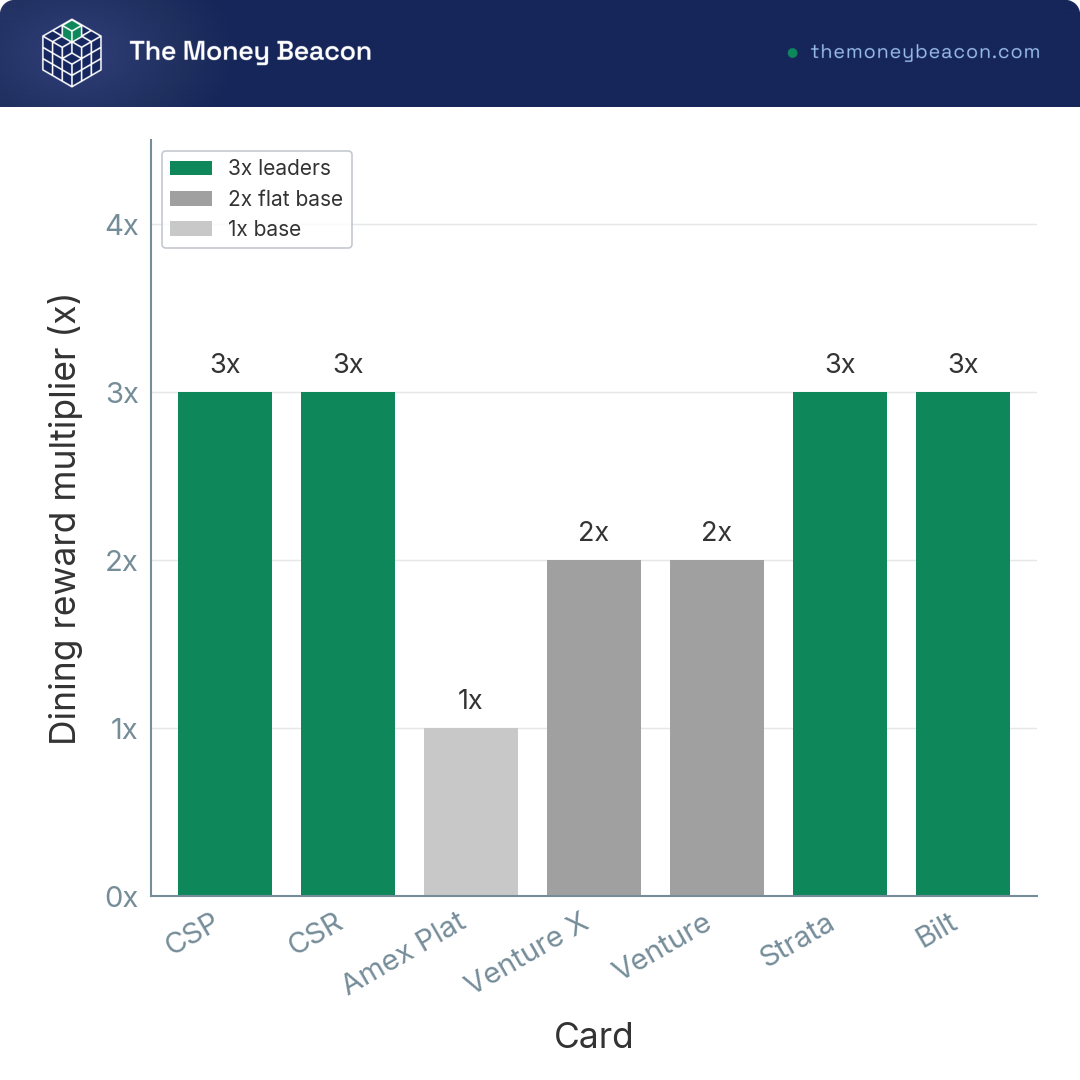
Which card earns the most depends entirely on where your money goes. For a dining-heavy spender, the 3x leaders pull ahead, while the Amex Platinum, despite its $895 fee, drops to a plain 1x on everyday dining, the most expensive card here yet the weakest on a category travelers lean into.
What each card really costs after credits
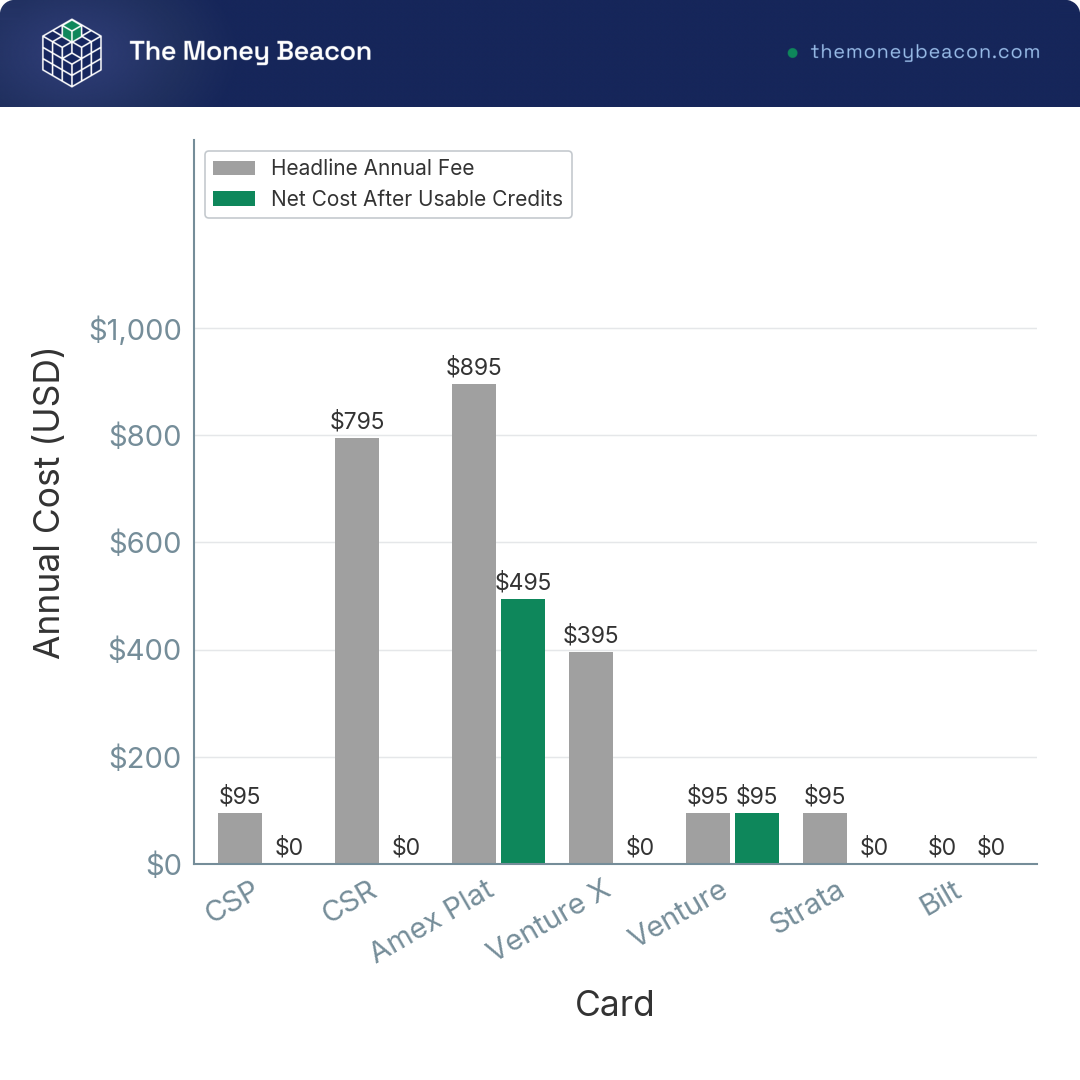
A headline fee tells you almost nothing until you subtract the credits you’ll actually use. Apply the net-fee rule across all seven and the spread is wide: the $895 Amex Platinum can shrink toward zero or stay near $895, the Venture X and Reserve swing on whether their credits get spent, the $95 cards barely move, and Bilt starts at zero and stays there.
Welcome bonuses on a common scale
Put the welcome bonuses side by side and they look dramatic, but they need translating. At the 1.0 cpp floor, a 100,000-point bonus is worth about $1,000, a 175,000-point Amex offer around $1,750, and the 60,000-to-75,000 ranges roughly $600 to $750. Bilt is the odd one out: its offer is $100 in Bilt Cash, not a point haul.
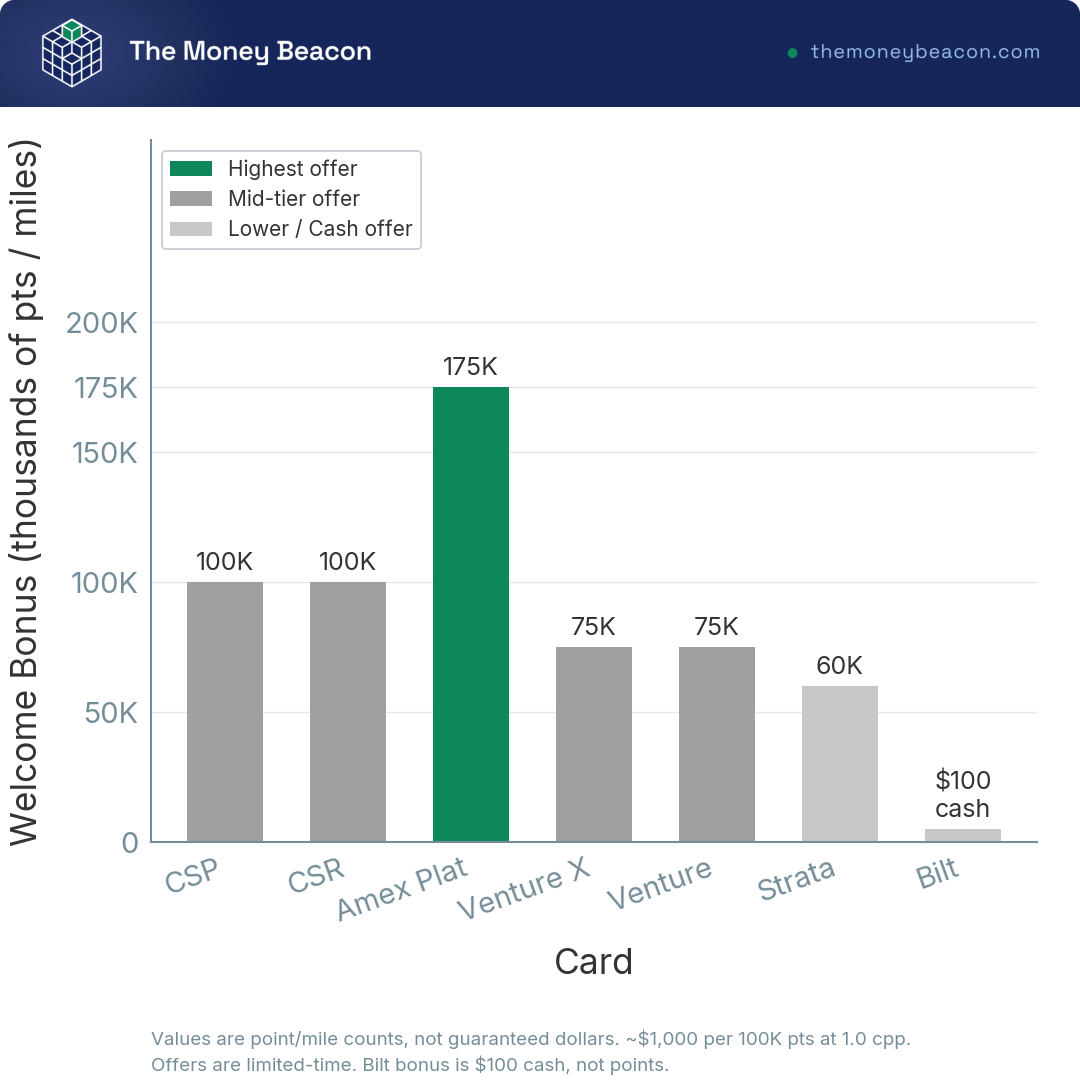
A bonus is real money, but it’s one-time, so don’t let a single opening offer decide a card you’ll carry for years.
Does a fee card actually beat a free 2% card
Does paying a fee ever beat a free flat 2% card? Run the three-year cumulative model for a spender putting $40,000 a year on a card, net of annual fees, and the answer is a clear yes, but only past a point. A free 2% card starts ahead because it has no fee to overcome, yet a category card like the Sapphire Preferred, or a credit-heavy card like the Venture X, overtakes it once the extra earn and the usable credits outrun the fee.
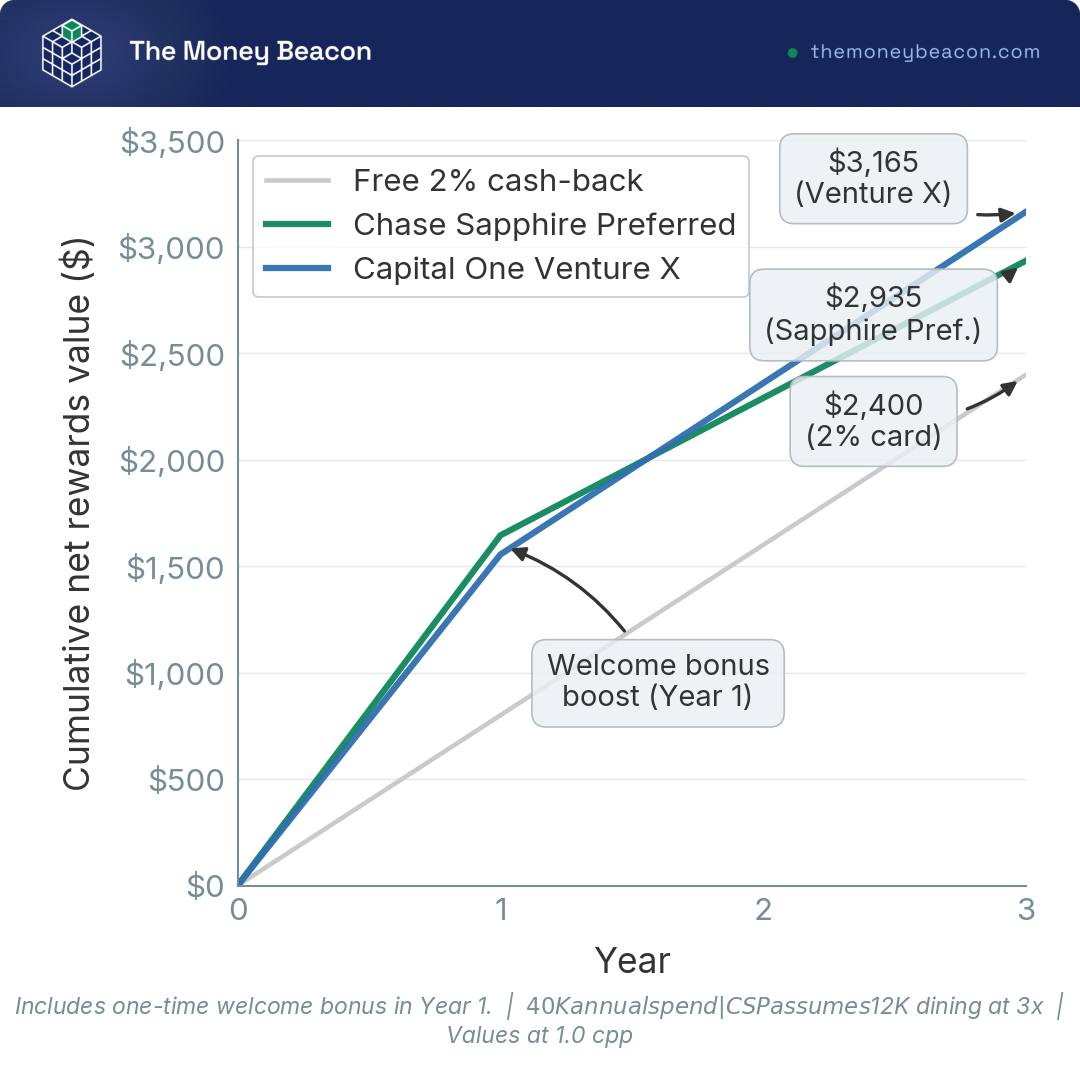
So travel cards with no annual fee only stay ahead for the lighter spender; past the crossover, the fee card wins.
How redemption works, and where to be careful
Earning the points is the easy half; redeeming them well is where value is won or lost. A partner transfer follows a strict order of operations, and getting it out of sequence is the most common way readers strand points. Confirm the award space first, on the partner’s own site, before you move anything. Only then initiate the transfer in your issuer portal, wait for the points to post (instant for some partners, several days for others), and book once they land.
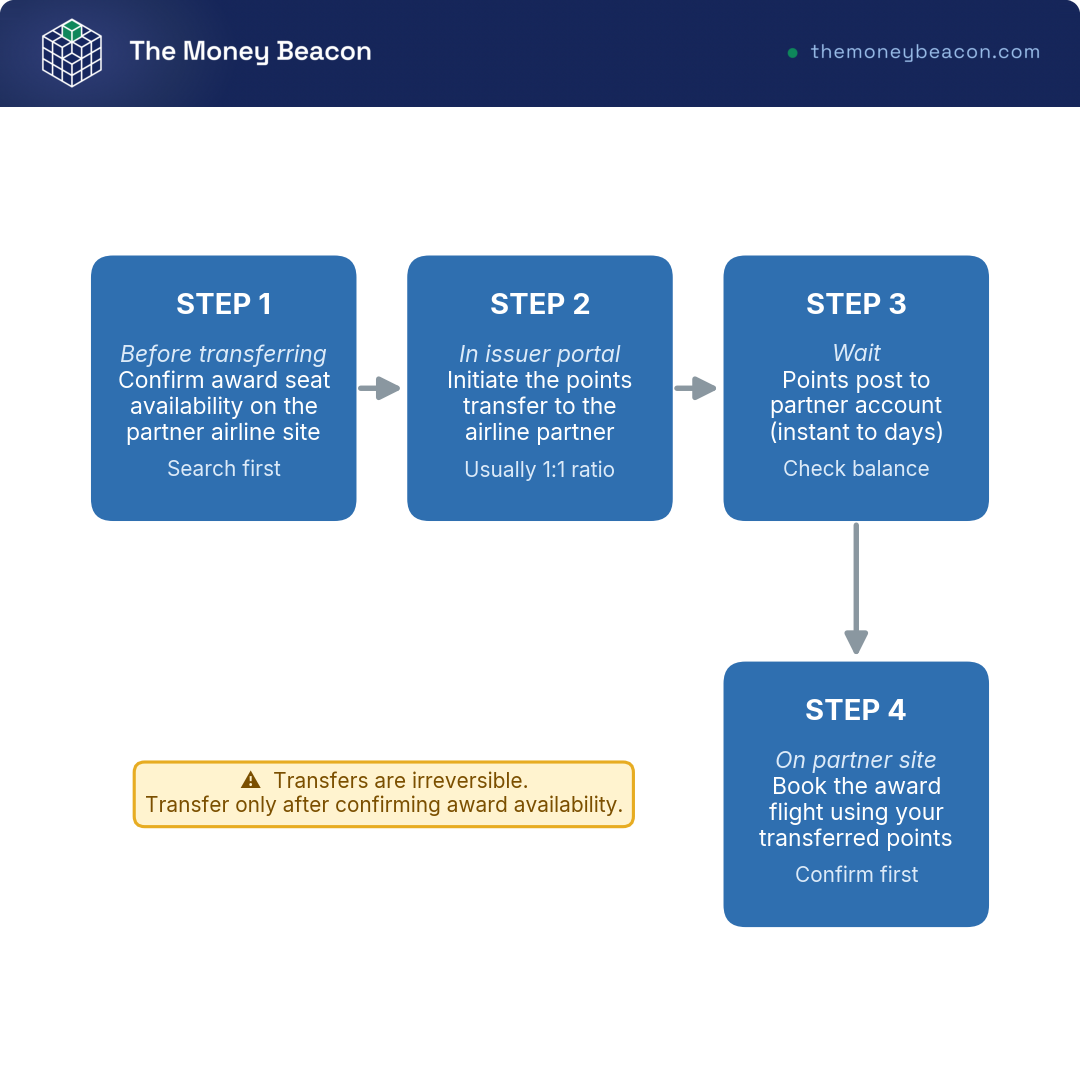
The one rule that matters above all: transfers are irreversible. Move points to a partner and you can’t move them back, so never transfer on speculation, only against a seat you’ve already confirmed is available.
Verdict by reader profile
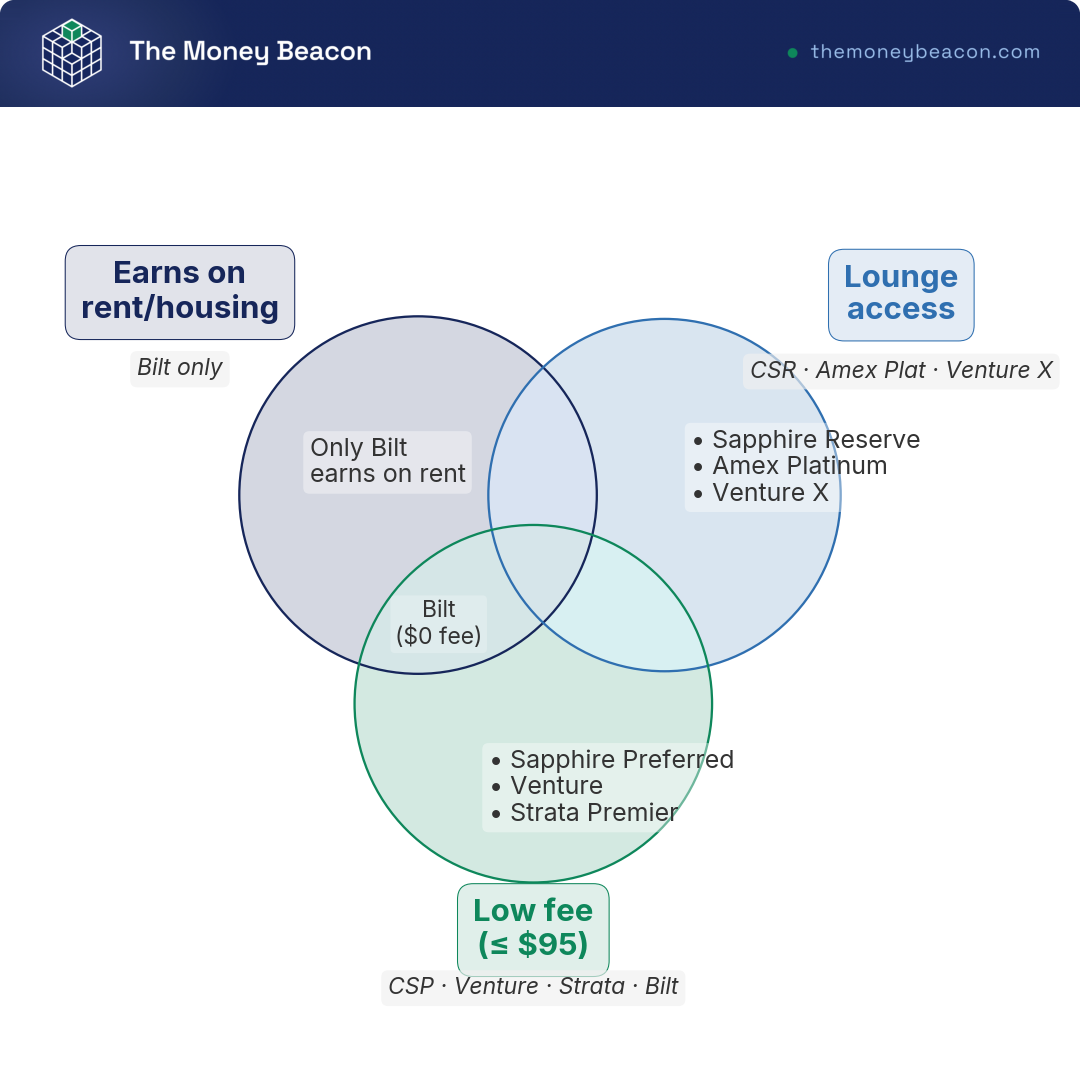
No single card wins for everyone, so here is a one-line verdict for five common profiles.
- The occasional traveler or points beginner should start with the Sapphire Preferred for the cheapest route to full transfer access, or the Venture if flat 2x simplicity matters more than category earn.
- The frequent flyer who values a higher portal rate and lounges should take the Sapphire Reserve, provided the $300 and $500 credits get used.
- The premium-perks maximizer should choose the Amex Platinum for the broadest lounge access and the $3,500-plus credit stack, but only if every credit gets redeemed.
- The no-fee renter should hold the Bilt Blue for free transferable points on housing, subject to the tiered earn and the activity rule.
- The simplicity seeker who wants premium perks without a coupon-book to manage should pick the Venture X, whose $300 credit and 10,000 anniversary miles can offset the fee on autopilot.
If you’re still torn between two of these profiles, walk yourself through the decision tree in the conclusion, which turns these choices into a few yes-or-no questions. And if you want the wider field beyond travel, our roundup of the best cards across cash back, travel, and balance transfers sets these seven against every other category.
Conclusion
The right travel card never comes off a “best of” list; it comes out of your own spending. Once you map where your money actually goes, the field narrows fast. A dining-heavy budget rewards a 3x card like the Sapphire Preferred or the Strata Premier, a scattered budget rewards a broad bonus set, and a renter who can route housing through Bilt earns on a line every other card ignores. The fee question answers itself the same way, because a premium card is only as expensive as the credits you leave unspent, so an $895 Amex Platinum can shrink toward zero for the right user and stay near $895 for the wrong one.
Two points are worth remembering from this comparison. First, run the net-fee math on your real numbers before you apply, since a free 2% card stays ahead until your extra earn and usable credits clear the fee, often around the $40,000-a-year mark we modeled. Second, transfers are irreversible: confirm the award seat on the partner’s own site before you move a single point, because stranded points are the most common way readers lose value. So your next step is simple, write down last year’s spending by category, then test the two cards that fit it against the recap table.
For the wider picture, our roundup of the strongest US cards in every category places these seven against cash back and balance transfer rivals. If travel rewards turn out to be a poor match for how you spend, our breakdown of the top flat and tiered cash back cards may earn you more with far less effort. And if a balance is dragging on you, our guide to the longest 0% intro APR offers shows how to clear it before chasing any points.
Frequently asked questions
What is the best travel rewards card of 2026 for most people?
For most people new to points, the Chase Sapphire Preferred is the strongest all-around starting card: a $95 fee, 3x on dining, full Ultimate Rewards transfer access, a $100 annual hotel credit, and a newly added Global Entry credit. The honest answer still depends on how you spend. A renter is better off with Bilt, and a heavy traveler who will actually use the credits can net more from the Venture X. One change to know: the Preferred’s portal redemption is now a 1.0 cent-per-point baseline, no longer a guaranteed 1.25.
How do I calculate whether a card’s annual fee pays for itself?
Add up the statement credits you will genuinely use, then add the extra rewards the card earns over a flat 2% cash-back card on your real spending. If that total beats the fee, the card pays for itself. On dining-heavy spending, a 3x card’s extra rewards plus a hotel credit can clear a $95 fee before any transfer upside. If you barely travel, a plain cash-back card often wins after fees.
Can I earn travel points on rent without paying a fee?
Yes. The Bilt Blue Card earns transferable points on rent or mortgage with no annual fee and, unlike most cards, without the usual processing surcharge. Under the 2026 program the rent multiplier is tiered, so it scales with your non-housing spend, and a minimum-activity requirement applies.
Do travel rewards cards charge foreign transaction fees?
None of the seven cards in this comparison charges a foreign transaction fee. All are 0%, including the Capital One Venture, which despite its old reputation now matches its peers. The real differentiators overseas are acceptance, since Visa and Mastercard travel wider than Amex, and which transfer partners fit your routes. For a wider look across categories, see our best credit cards comparison.
Can I transfer my points from one card issuer to another?
No. Points stay inside their issuer ecosystem, so you can’t move Chase Ultimate Rewards to American Express, or Capital One miles to Citi. What you can usually do is combine points across your own cards within one ecosystem, for example a Chase cash-back card into a Sapphire, or transfer to one household member at your address. Choose your ecosystem first, because that choice locks in your transfer options later.
Are credit card rewards taxable?
Rewards you earn by spending, whether cash back or points on purchases, are generally treated by the IRS as non-taxable rebates rather than income. A bonus that requires no spending can be taxable, so keep any 1099-MISC an issuer sends for a no-spend bonus (see IRS Memorandum 202417021 and IRS Publication 525). For how this fits the broader picture, our investment taxes guide covers the rebate-versus-income line in more detail.



Comments
Questions and corrections welcome. We read everything.