


Your bank charges you to keep your own money there. Maybe it’s a monthly maintenance fee you’ve stopped noticing, or the overdraft fee that hit the week rent cleared before your paycheck did. Chime advertises a checking account with neither, and 10.4 million people were using it as of June 30, 2026. So the ads work. What they don’t answer is the question you’re actually asking: should this be the account your paycheck lands in every two weeks?
One fact has to come first, because it changes what every other number in this account means. Chime is not a bank. It’s a financial technology company, and the banking services come from two chartered partners, The Bancorp Bank and Stride Bank. Chime’s own disclosure page puts it in plain words: Chime is not insured by the Federal Deposit Insurance Corporation (FDIC), and the two partner banks are the insured members. That isn’t a scandal; it’s how most app accounts are built. It does mean the fee schedule you’ll live under belongs to a bank’s agreement, not to the app on your phone.
And “fee-free” is a claim about a published fee schedule, not about an account. I went through it line by line in Stride Bank’s deposit agreement, not on the page advertising no fees. It lists three fees Chime charges, and one of them is $2.50 every time you take cash out of an out-of-network machine.
So what does this account cost over a full year, and what are the early paycheck and the overdraft cushion worth in dollars? In this Chime review I put a figure on both, name what the account can’t do at all, and end on who should open it and who should not.
1. Chime is not a bank, and that changes what you actually own
If Chime isn’t the bank, then who is Chime’s bank? It isn’t a technicality: the fee schedule, the limits on your own money and the terms of the overdraft cushion are all written by somebody else.
1.1 The four layers behind one app
Chime’s disclosure page states it without hedging: banking services are provided by The Bancorp Bank, N.A. or Stride Bank, N.A., both FDIC members. That “or” is doing real work.
Chime Financial, Inc. builds the app, runs the card program and decides who gets SpotMe coverage. Stride Bank, N.A. issues the account, and its Deposit Account Agreement says so in the opening line. The Bancorp Bank, N.A. provides SpotMe under separate terms, and Visa supplies card acceptance and Visa Plus Alliance ATM access.
Two banks also means two contracts that don’t share a revision date: the checking agreement at Rev. 02/2026 and the SpotMe terms at Rev. 04/2026.
1.2 Pass-through FDIC insurance, and the conditions attached to it
So is Chime legit in the way that matters? The insurance is real; it just reaches you by a longer route than most people picture.
Certain conditions have to be met before your pass-through coverage applies, up to $250,000 per depositor, per insured bank, per ownership category.
Then there’s the line in the deposit agreement almost nobody reads. You appoint Stride Bank as your agent to pool your funds with other holders’ funds and deposit that pool in one or more FDIC-insured banks. You hold a beneficial interest in a pool, not a titled account at a bank you picked.
Those conditions come from 12 CFR Part 330: the records have to show the agency nature of the account and identify each principal’s share.
I went looking for Chime in the FDIC’s BankFind database and found nothing. That’s correct rather than alarming, because BankFind indexes legal entities and Chime is a brand. Search “The Bancorp Bank, National Association” and you get FDIC certificate 35444.
Deposit insurance answers a bank failure, not a frozen account. What has actually cost fintech customers money this decade is operational failure: people locked out of funds never at risk of vanishing, as the May 2024 Synapse Financial Technologies bankruptcy showed for other apps. Chime wasn’t a Synapse customer.
1.3 What you can actually open, and what it takes to get in
The checking account is the hub, issued by Stride. The savings account attaches to it with no conditions: a $0 minimum opening deposit and no minimum balance requirement. The debit card has no monthly fee and ships in 7 to 10 business days.
Beyond that, SpotMe is the fee-free overdraft cushion from The Bancorp Bank. MyPay advances up to $500 against pay you’ve already earned, free if you wait 24 hours, or 3% instantly, with a $2 minimum and a $5 maximum. Credit Builder is a secured credit card at $0 a year and a 0% annual percentage rate (APR), with no credit check. And Chime Checkbook mails an uncertified paper check, fee-free, in 3 to 9 business days, 50 states only.
That’s the whole lineup, and all of it is banking. If you’d rather have investing beside the checking, SoFi is a banking and investing platform under one login.
Getting in is easy: 18 or over, a US citizen or resident of the 50 states, and no credit check. Start with the checking account, because the savings account can’t exist without it.
2. The fee-free claim, priced line by line
You know whose fee schedule governs the account by now. What’s in it is the other half of the story, because a fee-free account can still cost you money every month.
2.1 The fees that are not there, and the four costs that survive
There’s no monthly maintenance fee, no minimum-balance fee, no overdraft fee and no non-sufficient-funds fee. The Fee Schedule inside Stride Bank’s Deposit Account Agreement lists every fee the bank charges, and none of those four is on it. Add a $0 minimum opening deposit and no foreign transaction fee on card purchases abroad, a perk you’d normally pay an annual fee to get on a card built for travel rewards and fee waivers.
Now for the survivors.
The three fees Chime charges, and the fourth the retailer charges
| Cost | Amount | Who charges it | Trigger |
|---|---|---|---|
| Out-of-network ATM withdrawal | $2.50 per transaction, plus any operator fee | Chime, plus the ATM owner | Using an ATM outside Allpoint, Visa Plus Alliance or FCTI at 7-Eleven and Speedway |
| Over-the-counter (teller) cash withdrawal | $2.50 per transaction | Chime | Withdrawing at a bank or credit union counter |
| Instant Transfer Out | 1.75% of the amount transferred | Chime | Moving money out instantly rather than by standard ACH |
| Retail cash deposit outside Walgreens and Duane Reade | Retailer-set, “typically range from $3 to $5 per transaction” | The retailer | Depositing cash at a partner store |
Data current as of August 2026.
Every surviving fee is triggered by cash or by speed, never by keeping money in the account. A standard transfer out over the Automated Clearing House (ACH) network is free and takes a couple of days; instant costs 1.75%.
The free side is large: over 47,000 fee-free ATMs across Allpoint, the Visa Plus Alliance machines inside that network, and FCTI machines in 7-Eleven and Speedway stores. Plus free cash deposits at Walgreens and Duane Reade. So that $2.50 is a geography question, which is why our comparison of six no-fee checking accounts by their real ATM costs rates them on the network.
2.2 What your cash habit costs you in a year
A per-transaction fee tells you nothing until you multiply it by your own routine. So let’s run the math on a household taking out $200 in cash twice a month.
Out of network, each withdrawal costs Chime’s $2.50 plus whatever the machine’s owner charges. No US regulator publishes an average operator surcharge, so I’m assuming $3.00 and telling you it’s an assumption. That gives ($2.50 + $3.00) x 2 x 12, or $132 a year to reach your own money. At a teller instead, it’s $2.50 x 2 x 12, or $60. Inside the free network, it’s $0.
Here are the three channels on that identical habit.
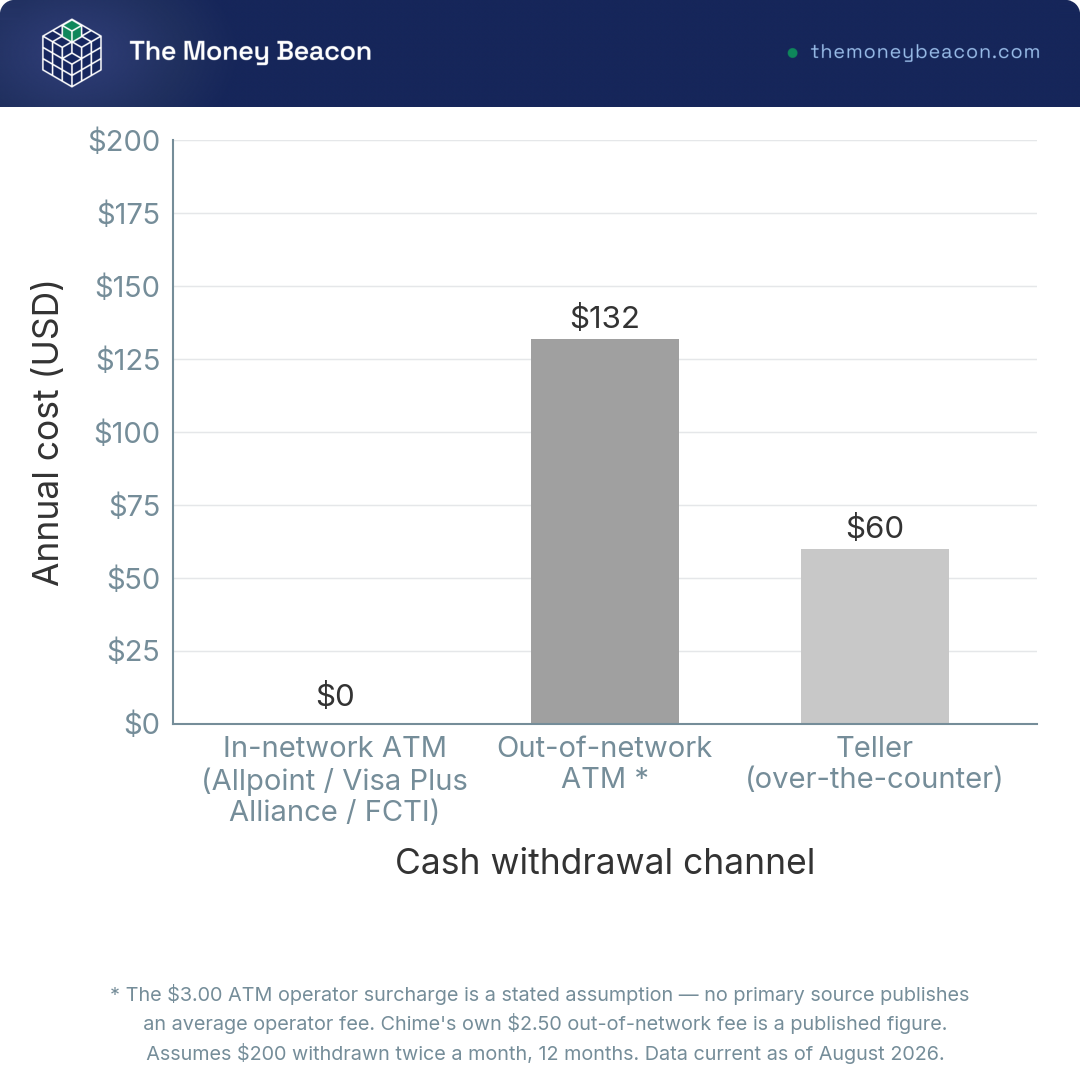
Cash deposits make it worse. Depositing $600 a month at a partner store that isn’t Walgreens or Duane Reade, at $4 a deposit, adds $48 a year. Stack that on the $132 and you’re at roughly $180 a year on an account advertised at zero.
A traditional bank prices you by your balance and waives the fee once you keep enough in it. Chime doesn’t work that way. It prices you by how much of your money is physical.
Hank’s take

the behavioral-finance research is blunt about this. People judge an account by the fee line on a statement, not by the routine that quietly triggers one, and a $0 account costing $180 a year is that blind spot in reverse.
3. Early pay, SpotMe and the savings ladder: what the features are really worth
That’s the baseline every feature has to be measured against. Do the three things people switch for hold up once each one is priced?
3.1 Early direct deposit belongs to your employer, not to Chime
The pitch is “get your direct deposit up to 2 days early.” The disclosures read differently, because early access depends on when the payer submits the payment file, and Chime makes the funds available on the day that file is received.
That’s the whole feature. Chime isn’t advancing you money; it just doesn’t wait for the effective date your employer chose. Two people at different employers, holding identical accounts, will see different behavior, and neither account is broken.
What’s it worth? A $2,500 paycheck arriving two days early at Chime’s top savings rate of 3.75% earns $2,500 x 0.0375 x (2/365), or $0.51 per pay period. Across 26 paychecks that’s about $13 a year. Set that against a single avoided overdraft fee at a traditional bank, which I’ll assume at $35 rather than pretend to source. Early pay is worth what it prevents, not what it earns.
An IRS tax refund isn’t eligible for early posting, however often you’ve read otherwise. Social Security and other benefits payments are, subject to the payer’s own timing.
3.2 SpotMe: $20 to start, $200 at the ceiling, and one exclusion that matters
SpotMe is where the headline and the terms describe two different numbers. The product page says “overdraft up to $200.” The same page says your limit starts at $20 and may go up to $200 depending on your account activity, history and other risk factors. That gap is the real Chime SpotMe limit.
Qualifying is a numbers test. You need a single Qualifying Direct Deposit of $200 or more, or Qualifying Direct Deposits adding up to $400 or more, over the preceding 34-day period. That means an ACH deposit from an employer, payroll provider, gig economy payer or benefits payer, or an Original Credit Transaction (OCT) from a gig economy payer. That clause brings 1099 contractors in.
Once you’re in, the terms are clean. No interest, no fees, and the tip is optional rather than a condition of eligibility. Repayment is automatic out of your next deposit and takes priority over everything else, so the following paycheck arrives smaller by whatever you were spotted.
The full cycle runs like this.
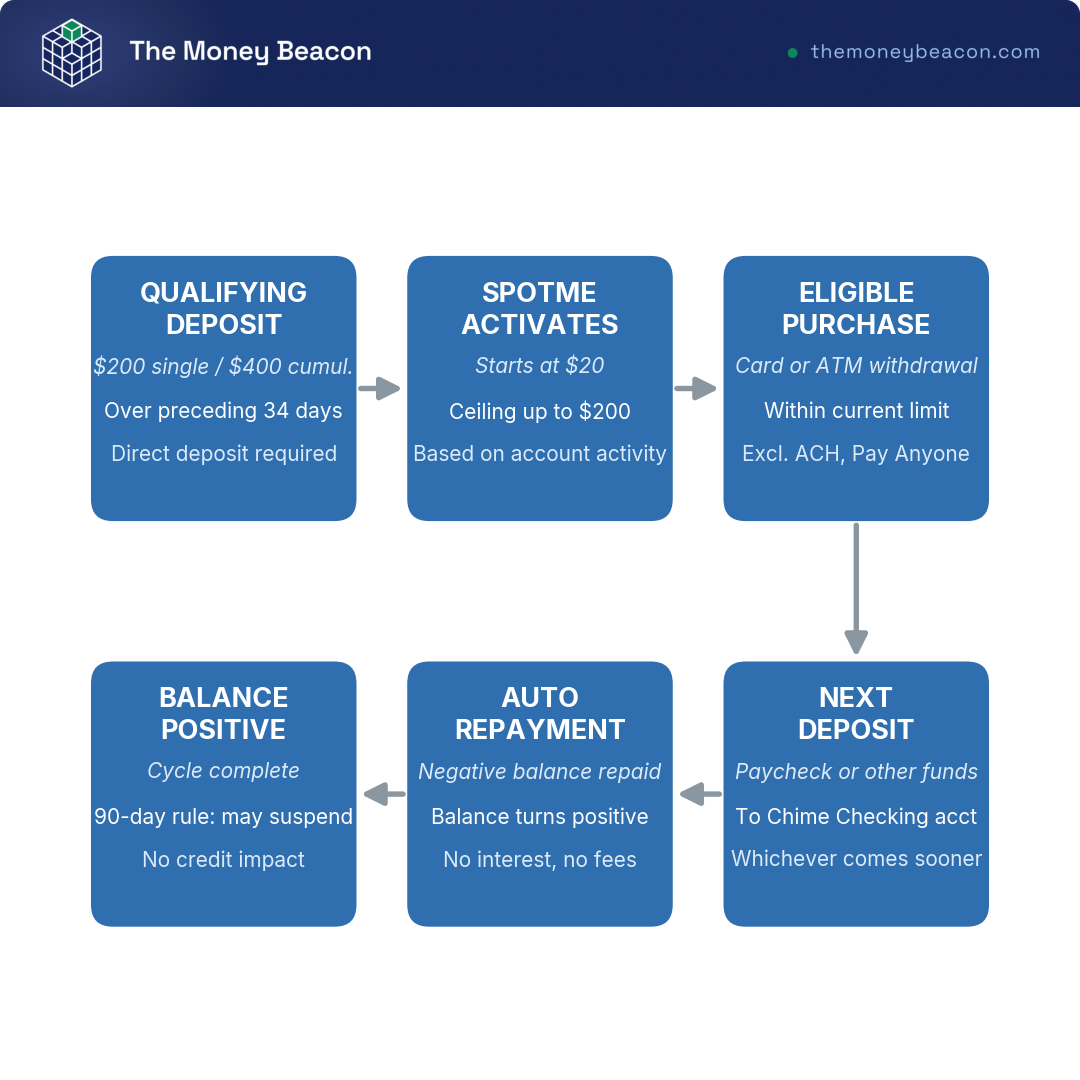
A limit reviewed downward is as ordinary as one reviewed up. And a negative balance unrepaid at 90 days can get the checking account suspended, though non-repayment doesn’t touch your credit.
Then there’s the exclusion. SpotMe isn’t available for Pay Anyone or Split Bill, for Chime Checkbook, for ACH transfers including direct debits, or for transfers into savings. In plain terms, SpotMe protects card spending, not autopay. The rent, the utility bill and the insurance premium are exactly the debits it won’t cover. This is a card-and-ATM cushion, not a line of credit.
3.3 The savings ladder: 0.75%, 2.75%, 3.75% and the price of the last rung
The third feature is the rate, and the Chime APY isn’t one number. It’s three, set by the size of the direct deposit you route there.
The standard tier pays 0.75% annual percentage yield (APY) with no deposit condition, no minimum balance and no cap on interest earned. Chime Plus pays 2.75% on a single qualifying direct deposit of $200, or $400 in total across a month. Chime Prime pays 3.75% and requires $3,000 a month.
Apply those rates to a $5,000 emergency fund and they turn into dollars: $37.50 a year at standard, $137.50 at Plus, $187.50 at Prime.
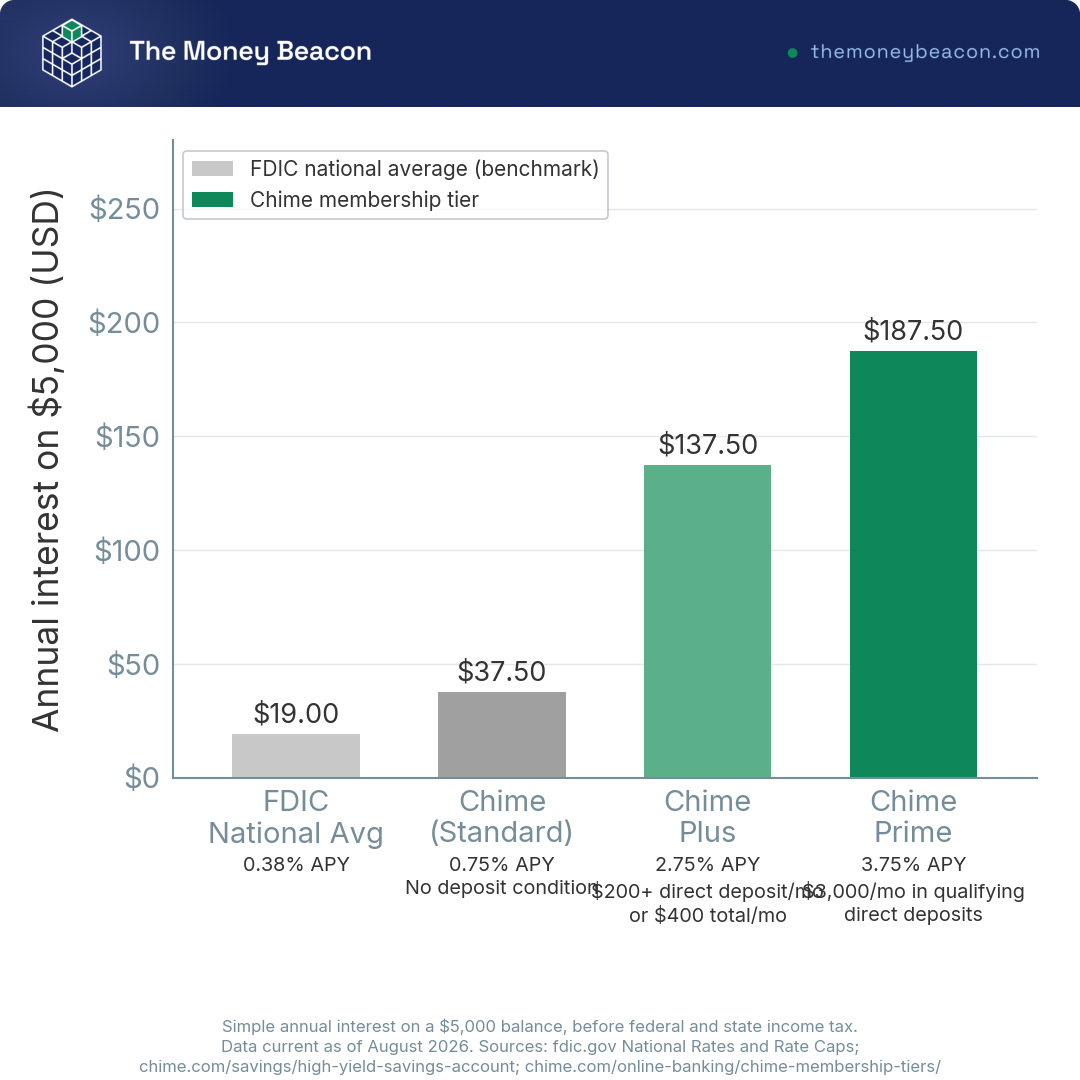
The rung that pays for itself is Plus. It costs nothing beyond routing one $200 payroll deposit, the same threshold that switches SpotMe on, and it’s worth $100 a year on $5,000. Prime needs an undivided $3,000 a month and returns $50 more on that balance, or $100 a year on $10,000.
The national average savings rate is 0.38%, so even the do-nothing tier is roughly double it and Plus is more than seven times it. Plus isn’t the top of the market, and our comparison of seven no-fee accounts paying up to 3.65% APY is the reference point here.
There’s a tax note too. Savings interest is ordinary income, reported on Form 1099-INT above the $10 threshold. It’s taxed at your marginal rate, not at the lower long-term capital-gains rates, and we cover why ordinary income is taxed differently than capital gains. At a 22% federal bracket you keep about $146 of that $187.50, before state tax.
The features price out well for a household whose money moves electronically, which makes the next question unavoidable: where does the account fall short?
4. Where the account hits a wall, and how it sits beside Varo, Current and Dave
Chime says no in two directions: ceilings you can plan around, and things Chime doesn’t do at any price.
4.1 The published caps, and the services the account does not have
Stride Bank publishes the ceilings your ordinary month runs into.
The published caps a household will actually hit
| Activity | Published limit at account opening |
|---|---|
| ATM withdrawals | No limit on the number per day, up to $515.00 per day |
| Over-the-counter (teller) withdrawals | No limit on the number per day, up to $515.00 per day |
| Cash deposits | 5 per day; $3,000 per deposit; $3,000 per calendar day; $10,000 per calendar month |
| Instant Transfer Out | $500 per calendar month, at 1.75% of the amount |
Source: Chime Deposit Account Agreement, Rev. 02/2026. Data current as of August 2026.
The cash limits are the ones you’ll hit first. $515 a day is one car repair paid at the counter, and $10,000 a month is a real ceiling for cash income.
Then come the absences, which no fee schedule can price. No wires, in or out. No joint account, so no second FDIC ownership category for a couple.
No cashier’s or certified check either, and the uncertified one Chime Checkbook mails won’t stand in at a closing. No branches, no notary, no medallion guarantee. And the agreement allows personal use only, so a cash-paid side business can’t run through it at all.
4.2 Chime beside Varo, Current and Dave
Three apps come up whenever Chime does.
Positioning: Chime beside Varo, Current and Dave
| Line item | Chime | Varo | Current | Dave |
|---|---|---|---|---|
| Monthly maintenance fee | None | No monthly fees | None; $5.00 per month only after 12 consecutive months of inactivity | Membership fee up to $5 per month |
| Out-of-network ATM fee | $2.50 plus operator fee | Fees apply to out-of-network withdrawals; amount not published | $3.50 per transaction, also applying to over-the-counter withdrawals | Fee-free at 7-Eleven and other spots; out-of-network fee not published |
| Cash deposit fee | Free at Walgreens and Duane Reade; $3 to $5 elsewhere | Fees apply to cash deposits; amount not published | $3.50 per transaction at participating partners | Cash add at 90K stores; fee not published |
Sources: chime.com, varomoney.com, current.com, dave.com. Data current as of August 2026.
On cash, Chime is cheaper than the one rival that publishes an amount: $2.50 plus the operator’s fee against Current’s flat $3.50.
Savings doesn’t compare as cleanly. Varo’s 3.75% matches Chime Prime but stops at $5,000 and requires $1,000 in qualifying deposits, then drops to 1.00%. Current’s 4.00% is a Boost rate rather than an annual percentage yield, capped at $6,000 total. Dave’s Goal account pays 0.00%.
So you get hard ceilings, absences with no workaround, and the only savings rate in this review that keeps paying past $5,000. Who does that leave?
5. The verdict: only account, second account, or the wrong account
Everything priced so far points at one split, and it isn’t about how much money you have. It’s about what form your money moves in.
5.1 Who Chime fits, and who it does not
Here’s the ruling.
Chime fits the W-2 employee paid by ACH direct deposit who spends on a card and takes cash in network. That household genuinely pays $0 a year, and one $200 qualifying deposit switches on SpotMe and Chime Plus together. It fits the reader rebuilding after a negative banking history too, with no credit check and Credit Builder at $0 a year and 0% APR.
It does not fit the cash-intensive household: roughly $180 a year in the profile I ran, a $10,000 monthly ceiling on cash deposits, and personal-use-only terms that rule out a cash-paid side business. It does not fit as an only account for anyone needing a wire, certified funds, a two-name account or coverage above $250,000. Those are absences rather than prices. Past that limit you need a second institution anyway, and our comparison of six online money market accounts on rate and spending access is where I’d look.
The sharpest no-fit of all: SpotMe excludes ACH direct debits, so an autopay household on a thin balance watches rent, utilities and insurance get returned while the card keeps working.
Verdict logic: reader profile and fit
| Reader profile | Verdict | The datum that decides it |
|---|---|---|
| W-2 employee paid by direct deposit, card spender, in-network cash | Fits as a primary account | $0 in fees under the Rev. 02/2026 Fee Schedule; SpotMe and Plus both unlocked by the same $200 deposit |
| Reader rebuilding after a negative banking history | Fits, and may have no better option | No credit check to open; Credit Builder at $0 a year, 0% APR |
| Autopay household running a thin balance | Does not fit as the only account | SpotMe excludes ACH direct debits |
| Cash-heavy household or cash-paid side business | Does not fit | $10,000 monthly cash cap; $3 to $5 retail deposit fees; $2.50 teller withdrawals; no business use |
Data current as of August 2026.
5.2 Only account, main account with a companion, or second account
All of it resolves into one test.
Does your money move electronically, and does your paycheck arrive as an ACH direct deposit? Two yeses make Chime a strong primary account. One no makes it a good second account. Two nos make it the wrong account.
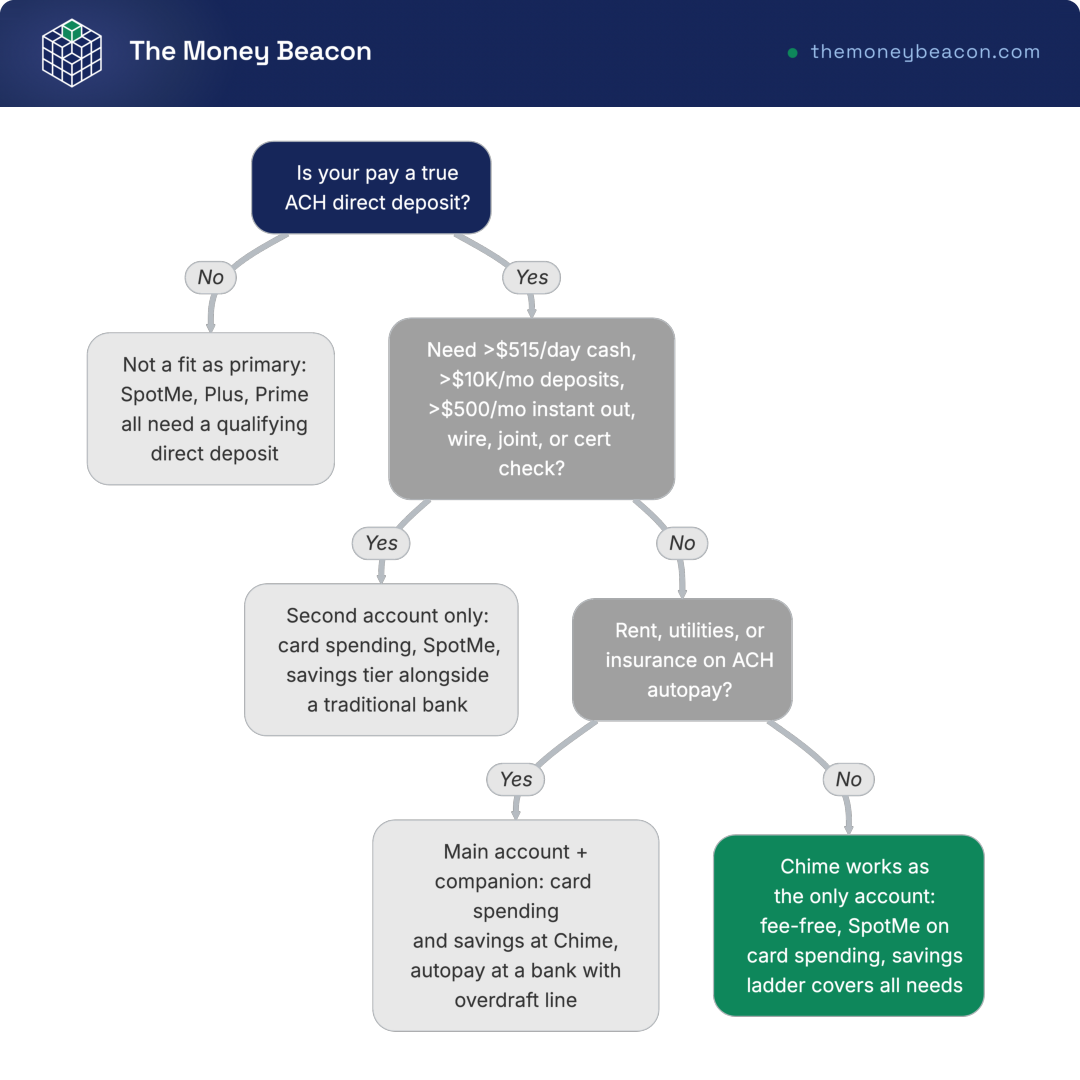
Most households should run the hybrid. Split the direct deposit between Chime and a credit union, a bank, or a high-yield savings and no-fee checking pairing if you’d rather stay online. Keep card spending, SpotMe and the savings tier at Chime. Leave autopay where there’s a real overdraft line and a branch, and put cash in wherever it’s free. That’s matching each account to its own purpose, not hedging.
The price of that safety isn’t zero. A split that still clears $200 a month keeps Chime Plus, but only an undivided $3,000 a month reaches Prime, so the second account costs you one percentage point of yield, which is $100 a year on a $10,000 balance.
Conclusion
Chime’s fee schedule is honest. It just doesn’t describe an account; it describes a routine, and “free” here is a fact about how your money moves, not about the product. Route an ACH paycheck in, spend on the card, take cash from the 47,000 in-network machines, and you pay nothing all year while Chime Plus pays 2.75% on the side. Keep the same account, change the habit, and it bills you roughly $180. That $180 never shows up as a line item called fees. It arrives $2.50 at a time.
That’s what I’d want to know before signing up, and it’s why I’d run Chime beside a real bank rather than move everything over. That safety costs you the top savings rung: one percentage point of yield, or $100 a year on a $10,000 balance. I’d pay that for a wire I can send the week a closing date moves.
So here’s what to do today. Pull up your last three months of transactions and count two things: the out-of-network ATM withdrawals, and the cash deposits. Multiply by $2.50 plus about $3 of operator fee, and you’re holding your own number instead of mine.
If that number comes back at zero, the cash you aren’t spending shouldn’t sit in checking. Our comparison of the certificate of deposit (CD) rates worth locking money into covers where money you won’t need for a year belongs. And a debit card pays you nothing on the spending you’re routing through it, so our comparison of the cards that actually pay on everyday spending is the other half of this setup.
FAQ
Is Chime FDIC insured?
Not directly, and Chime’s own disclosure says so in plain language: “Chime is not FDIC-insured.” Chime is a financial technology company, not a bank. The Chime Checking Account is issued by Stride Bank, N.A. and SpotMe by The Bancorp Bank, N.A., and deposits get pass-through coverage through those partner banks once certain conditions are met, up to $250,000 per depositor, per insured bank, per ownership category. That protects against the partner bank failing, not against a freeze or a dispute at Chime itself. To confirm the insured status yourself, search FDIC BankFind for “Stride Bank, National Association” or “The Bancorp Bank, National Association.” Searching “Chime” returns nothing, because it is a brand, not a chartered bank.
Is Chime an actual checking account?
Yes. The Chime Checking Account carries a real routing and account number, issued by Stride Bank, N.A., and it accepts direct deposit, ACH transfers and debit card spending the same way a traditional checking account does. What is different is who is behind the app: Chime builds the interface, decides who qualifies for SpotMe, and runs support, while Stride Bank holds the deposits and sets the binding fee schedule. That split is worth remembering the first time a dispute or a fee question needs an answer, since the deposit agreement, not the marketing page, governs.
What is the real downside of Chime?
Three things bite most often. Cash costs money: $2.50 for an out-of-network ATM withdrawal plus the machine owner’s own charge, $2.50 at a teller, and typically $3 to $5 at retail cash-deposit partners other than Walgreens and Duane Reade. SpotMe does not cover ACH direct debits, so it will not save an autopay bill from bouncing. And Chime publishes that it offers no wire transfers and no joint accounts, so a household heading toward a closing date or running a shared budget still needs a second account. That is exactly why running Chime alongside, rather than instead of, a traditional bank or credit union is the more practical setup for most households.
Why is Chime being sued?
What is established and documented is broader than any one case: US regulators tightened the rules on fintechs describing themselves as a “bank.” The FDIC’s final rule on misuse of the word “bank,” adopted in December 2023 and effective April 1, 2024, is the reason Chime’s disclosure page now states outright that Chime is not FDIC-insured. Beyond that established rule, several regulator-side questions about Chime specifically, including any Consumer Financial Protection Bureau (CFPB) complaint volume or enforcement history and a reported California state settlement, are not confirmed against a primary source here and are not printed as fact. Check the CFPB Consumer Complaint Database or the relevant state regulator directly for the current record.
How do I actually get the full $200 SpotMe limit?
Nobody starts there. Chime says the SpotMe limit “starts at $20 and may go up to $200 depending on your account activity, history, and other risk factors.” To qualify at all, you need a single qualifying direct deposit of $200, or $400 cumulatively, in the preceding 34 days, and only payroll-type deposits count toward it. A transfer from another bank does not qualify. Moving a payroll deposit over, even a partial one, is the reliable route in; the climb from $20 to $200 after that is discretionary and not published on a fixed schedule.
Can I borrow $1,000 from Chime?
No. SpotMe’s published ceiling is $200, and MyPay’s is $500. SpotMe lets an eligible card transaction or ATM withdrawal go negative with no interest and no fee. MyPay advances earned pay, free within 24 hours or for a 3% instant fee (a $2 minimum, $5 maximum), repaid automatically from the next qualifying direct deposit. Neither is reported to the credit bureaus, so neither builds or damages credit. For anything close to $1,000, a household is better off pricing an actual personal loan than stretching Chime’s advance features past what they are built for.
Does Chime pay a competitive rate on savings?
It depends on the tier you reach. Chime publishes 0.75% standard, 2.75% at Chime Plus and 3.75% at Chime Prime, with no minimum balance and no cap on interest earned. Plus unlocks with one $200 qualifying direct deposit or $400 a month in total; Prime needs $3,000 a month. On a $5,000 balance that is $37.50, $137.50 or $187.50 a year, before tax, and savings interest is taxed as ordinary income rather than at the lower long-term capital gains rate, so there are better-sheltered places for money you will not touch for a while. At the standard tier, Chime savings is a convenient parking spot rather than a competitive home for that money.




Comments
Questions and corrections welcome. We read everything.