


Most of your cash probably sits in one place: a single checking or big-bank savings account you opened years ago and never touched again. It feels safe and it feels handy, so the money stays put. The quiet problem is that this kind of account is one of the worst-paying homes for cash you can find, and the gap is bigger than most savers realize.
As of June 2026, Chase and Bank of America still pay 0.01% on standard savings, while a competitive high-yield savings account pays close to 4.00%. On a $20,000 balance, that is roughly $800 of interest you give up every single year, just for leaving the money where it landed. Your emergency fund earns almost nothing, and inflation quietly eats away at what is left, month after month.
The fix is not chasing the single highest rate. It is matching every dollar to when you will actually need it: cash you might touch this month, money earmarked for a goal a few years out, and savings you will not touch for a decade. So that is the order we work through here, one account at a time, so you can build a system that earns more and keeps every dollar insured and liquid exactly where it has to be.
1. Why One Savings Account Quietly Costs You Money
What is one low-rate account actually costing you each year, and what does “diversifying savings” really mean once you get past the buzzword? Let’s start with the cost in real dollars, then settle the one distinction savers confuse constantly: the account your money sits in versus what the money is actually invested in. From there, the whole framework comes down to three questions you ask of every dollar.
1.1 The hidden cost of idle cash, and why an account is not an asset class
That $800 gap on a $20,000 balance is real, but it is only one row in a bigger picture. The same 0.01% versus 4.00% spread scales straight up and down with your balance, and the bigger your pile of idle cash, the more you forfeit by leaving it where it landed.
Here is what a single year of that gap looks like across a few common balances, comparing a 0.01% megabank savings account against a competitive high-yield savings account (HYSA) near 4.00%.
| Balance | At 0.01% (megabank) | At 4.00% (HYSA) | Annual difference |
|---|---|---|---|
| $5,000 | $0.50 | $200 | ~$200 |
| $10,000 | $1.00 | $400 | ~$399 |
| $20,000 | $2.00 | $800 | ~$798 |
| $50,000 | $5.00 | $2,000 | ~$1,995 |
Data current as of June 2026.
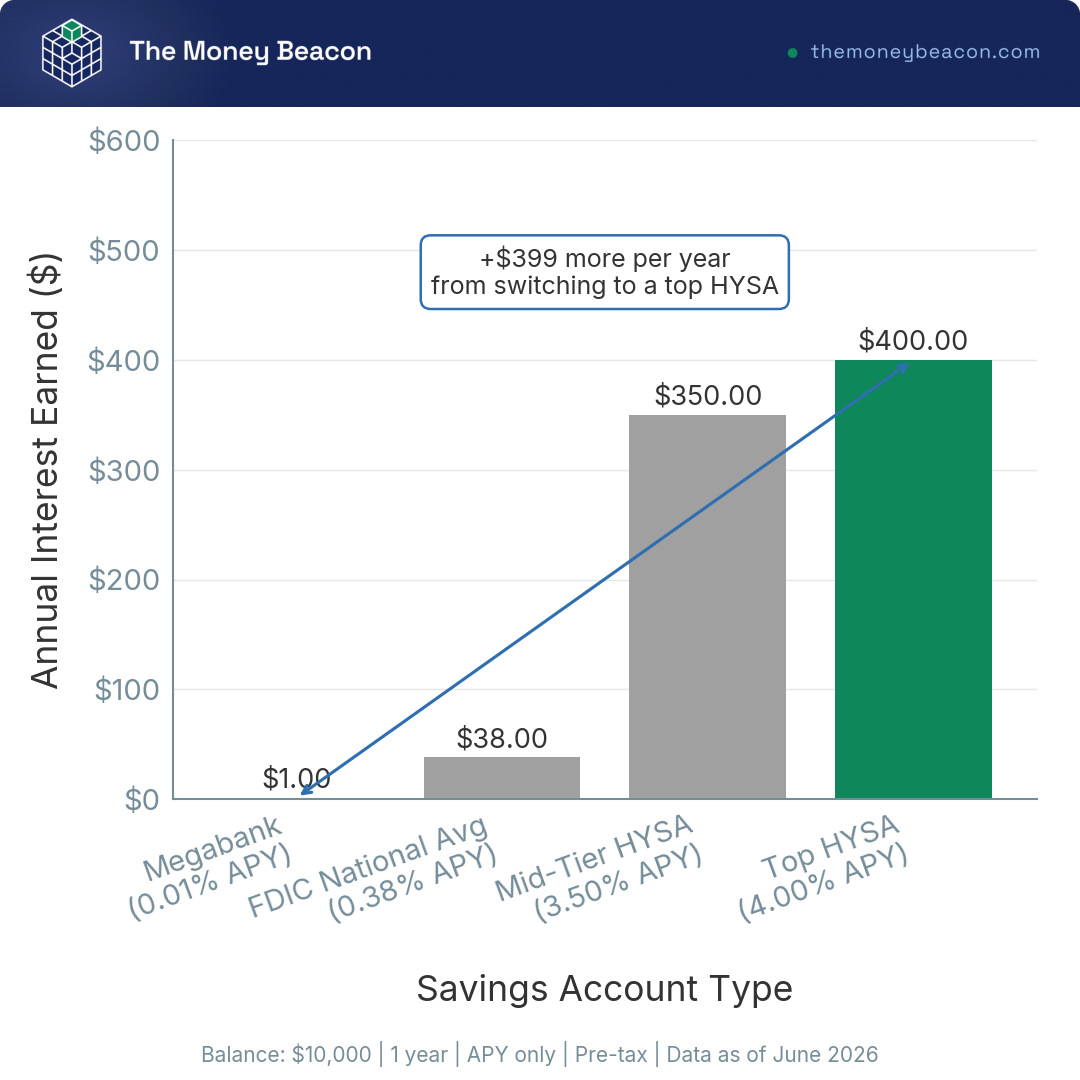
At $50,000, leaving the money idle costs you close to $2,000 a year, enough to notice. And the megabank floor is not even the median: the FDIC national average savings rate is only about 0.38%, well under 1%, so even “doing better than Chase” can still mean earning almost nothing. If your cash is sitting below roughly 3% APY, moving it to a no-fee HYSA is the single biggest low-effort win you can make, and on $20,000 it recovers around $800 a year. There is no lock-up and no risk to your principal; not doing it is leaving free money on the table.
Now the distinction that makes the rest of this guide click. Savers constantly confuse the account with the asset class, and they are two different levels of the same decision. The account, or wrapper, is where your money sits and how it gets taxed and insured: a HYSA, an MMA, a CD, a Roth IRA, a 401(k), an HSA, a 529, or a taxable brokerage. The asset class, or vehicle, is what the money is actually invested in: cash, T-bills, I bonds, stocks, index funds, ETFs, or money market funds.
Why does this matter in practice? Because an exchange-traded fund (ETF) lives inside an account, not instead of one, so lining up “Roth IRA” against “ETF” as if you had to choose between them is a category error. One last thing worth keeping in mind: a money market account at a bank is not the same thing as a money market mutual fund at a broker, and we draw that bright line clearly later on. Keep the two levels separate and every product comparison ahead gets easier. If you want to act on the cost figure right now, the fix is simply opening a competitive FDIC-insured savings account and moving the idle cash over, which is exactly where we go in our high-yield savings comparison.
1.2 The three questions that decide where every dollar belongs
The wrapper-versus-vehicle distinction tells you what your options are. The next question is which option each specific dollar belongs in, and that comes down to three plain questions you ask of the money itself.
The first is when will you need it? That is the time horizon, and it sorts every dollar into now (under a year), soon (one to five years), or later (five years or more). The second is how safe must it be? Some money has to be principal-protected and insured no matter what; other money can ride market ups and downs. The third is how liquid must it be? You decide whether you can lock the cash away, tolerate a penalty window, or need same-day access. Answer those three and the horizon does most of the routing for you.
That horizon-first logic maps cleanly onto a default home for each bucket, which is the backbone of the entire plan that follows.
| Horizon | Safety need | Liquidity need | Default vehicle |
|---|---|---|---|
| < 1 year (emergency fund, near-term bills) | High, insured | High, days | HYSA or MMA |
| 1-5 years (car, down payment, wedding) | High, insured/Treasury | Medium, penalty-tolerant | CD ladder, I bonds, T-bills |
| 5+ years (long-term wealth) | Can accept market risk | Low | Low-cost brokerage (index funds/ETFs) |
The rest of this guide is really just that table, justified one branch at a time. Money you might touch this month wants a HYSA built for an emergency fund, money earmarked for a goal a few years out wants a CD ladder or I bonds, and money you will not need for a decade belongs in a low-cost brokerage. Start where the payoff is fastest and the rules are simplest, which means building that first bucket before anything else.
2. Build the Emergency Fund First, in a High-Yield Savings Account
Before you invest a single dollar, one bucket comes first. How much cash should you set aside, where should it live, and how do you actually open the thing in an afternoon? We size the fund to your job stability, show why a HYSA beats both checking and stocks for the job, shortlist the no-fee providers, and finish with a six-step setup you can run in one sitting.
2.1 How big the fund should be, by income stability
So how many months of expenses are we really talking about? The anchor is the Consumer Financial Protection Bureau’s guidance of three to six months of living expenses, but the CFPB itself stresses that the right number depends on your situation. Income stability is what moves the dial.
The steadier your paycheck, the smaller the cushion you need; the lumpier your income, the bigger it has to be. The table below sizes the fund by profile, and the logic behind each row is worth reading, not just the number.
| Profile | Suggested target | Rationale |
|---|---|---|
| Dual-income W-2 household, stable jobs | 3 months | Two incomes cushion a single job loss |
| Single-income W-2 household | 4-6 months | One income, one point of failure |
| 1099 contractor / freelancer | 6-9+ months | Variable, lumpy income; no employer benefits |
| Small-business owner / gig worker | 6-12 months | Revenue volatility, personal-business overlap |
| Pre-retiree / retiree | 6-12 months in cash | Avoid selling investments in a downturn |
Data current as of June 2026.
If you earn a 1099 income, freelance, or run your own shop, this is the row to take seriously. Your income arrives in uneven chunks, no employer benefits bridge a gap, and a slow quarter can land at the same time as a surprise bill, so a 6-to-12-month fund is the realistic target, not the cautious one. You may have seen the “3-6-9” shorthand floating around: roughly three months for very stable dual income, six for a typical single earner, nine or more for variable income. Treat it as a memory aid rather than an official rule, then size the fund to your own income volatility.
2.2 Why a HYSA, not checking or a brokerage, holds it
You know how big the fund should be by now. The next question is where it sits, because the emergency fund has exactly one job: be there, in full, the day you need it. That single requirement rules out two popular but wrong homes.
A brokerage is out because of market risk; a 20% drawdown the week you get laid off is the worst case, and putting the fund in stocks forces you to sell at the bottom precisely when you can least afford to. Checking is out for the opposite reason, a near-zero yield that quietly underpays you. A HYSA threads the needle with FDIC-insured principal, a yield in the rough 3.0% to 4.3% range, and money in your hands within one to three business days.
The table sorts the candidates on the four things that matter for emergency cash: is the principal safe, what does it yield, how fast can you reach it, and is it the right tool at all.
| Vehicle | Principal safe? | Typical yield | Access speed | Verdict |
|---|---|---|---|---|
| Checking | Yes (FDIC) | ~0.00%-0.05% | Instant | Keep ~1 month here only |
| Megabank savings | Yes (FDIC) | ~0.01% | 1-3 days | Underpays badly |
| HYSA | Yes (FDIC) | ~3.0%-4.3% | 1-3 days | Best home for the core fund |
| MMA | Yes (FDIC) | ~3.0%-4.3% | 1-3 days, checks/debit | Fine alternative |
| Brokerage index fund | No (market risk) | Variable | 1-3 days settle + risk | Wrong tool for emergencies |
Keep roughly one month of expenses in checking for day-to-day spending, and park the core fund in the HYSA. A money market account (MMA) is a perfectly fine alternative with similar insurance and yield, and we settle the account-versus-fund wrinkle behind that name shortly. If you have not already paired a lean spending account with the savings side, this is the moment to set up a no-fee checking account that does not nibble at the balance with monthly fees.
2.3 How to choose a high-yield savings account
With the fund sized and its home settled, the only thing left is picking the actual account. Five things matter when you compare: the APY, whether that rate is a teaser or a standing rate, fees and minimums, FDIC membership, and how fast transfers clear.
Here is where the leading online providers sit as of mid-June 2026, so you can compare on the standing rate rather than a headline.
| Provider | APY | Min. to open | Monthly fee | Notes |
|---|---|---|---|---|
| Ally Bank Online Savings | 3.00% | $0 | $0 | No minimums; buckets feature |
| Marcus by Goldman Sachs | ~3.40% | $0 | $0 | No minimum opening deposit |
| Capital One 360 Performance Savings | 3.00% | $0 | $0 | No minimum, no fee |
| Discover Online Savings | ~3.50% | $0 | $0 | No fees |
| American Express National Bank | ~3.10% | $0 | $0 | No minimum, no fee |
| SoFi Savings | ~3.30% | $0 | $0 | Top APY needs an eligible direct deposit |
Data current as of June 2026. APYs are variable and move with the fed funds rate.
These providers cluster in the 3.0% to 3.5% band, while the most competitive offers at the top of the market reach roughly 4.00% to 4.3%. Compare the standing APY, the balance caps, and the conditions, not the number on the banner. And if you spot an account advertising 7% or more, read it with suspicion: such rates are almost always promotional or conditional, capped at a small balance, limited to a short window, or tied to a credit-union reward account with membership and direct-deposit hoops, after which the standing rate on an ordinary balance drops back into that 3.0% to 4.3% range. One option worth a look for organizing the fund is opening an account with Ally Bank with its savings buckets, which lets you split one account into labeled goals.
2.4 Set it up in six steps
The account is chosen; now to actually fund it, start to finish, in one sitting. The whole setup is six linear steps, and the visual below walks them left to right so you can see the flow before you start clicking.
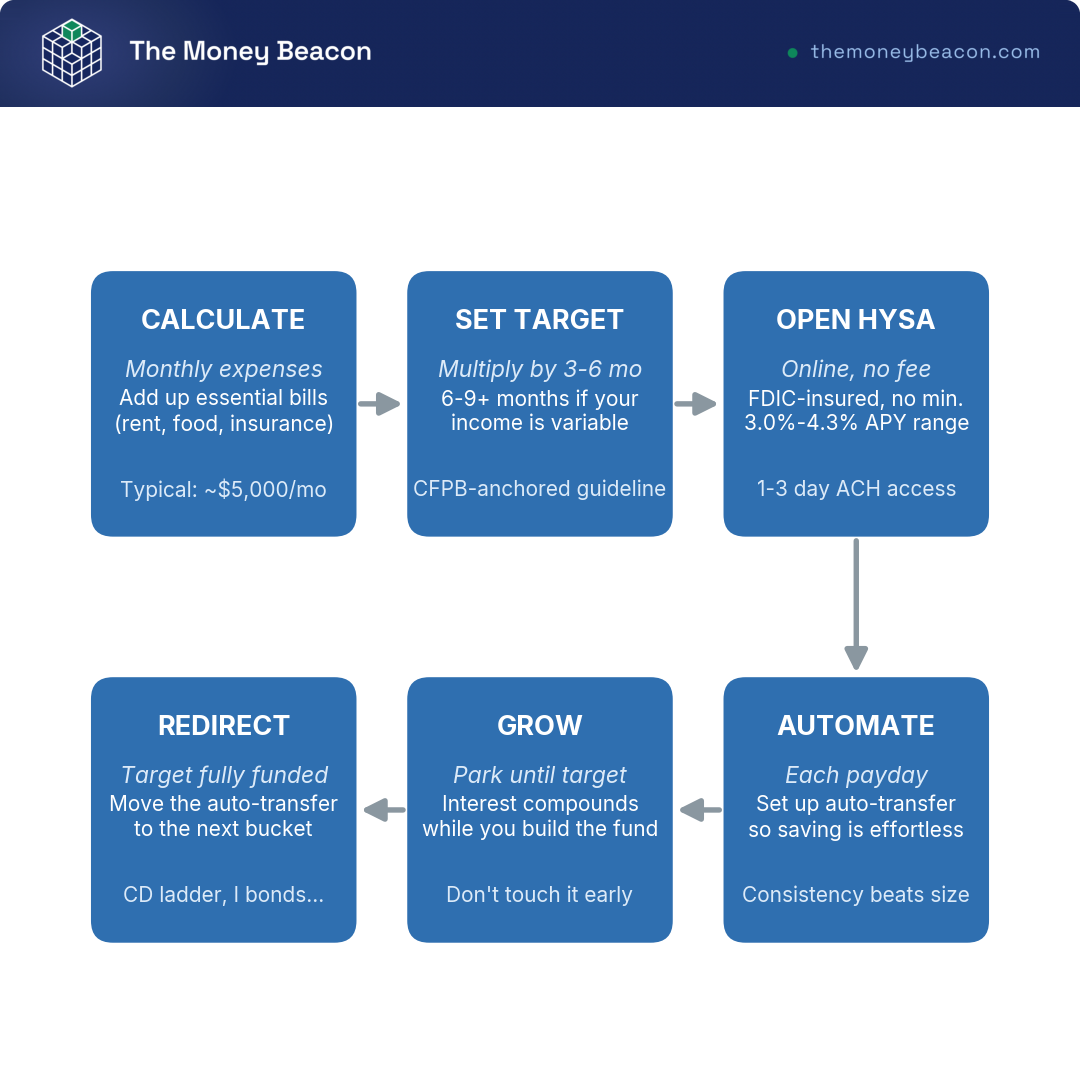
First, calculate your monthly essential expenses, the rent or mortgage, utilities, food, insurance, and minimum debt payments. Second, multiply that number by your target months from the profile table. Third, open a no-fee, no-minimum, FDIC-insured HYSA online. Fourth, set an automatic transfer to land each payday. Fifth, let it park until the target is hit. Sixth, once the fund is full, redirect that same automatic transfer to the next bucket.
The step that actually gets the fund built is the automatic transfer, because automation, not willpower, is what fills the account. You decide once, then the money moves on its own every payday. And if your cash is still sitting at 0.01% while you read this, step three is the one to do today; the lost interest is reason enough not to wait for the weekend.
3. The Building Blocks: Every Place Cash Can Live
You have the framework and a funded first bucket by now. Beyond a savings account, what are your actual options for holding cash, and how does each one really work? We go from the most accessible vehicle to the most technical: savings and money market accounts, then certificates of deposit and their penalties, then Series I bonds, and finally what lives inside a brokerage account.
3.1 High-yield savings and money market accounts (HYSA and MMA)
Start with the two you already half-know, because they are close cousins. Both a HYSA and an MMA are FDIC-insured bank deposit accounts paying a variable rate in a similar range, so on safety and yield they are near-twins.
The practical difference is convenience. An MMA often adds check-writing, a debit card, or ATM access, and it sometimes uses tiered rates with a higher minimum balance; a HYSA is leaner, usually with low or no minimums and no checks. To see how that plays out in real dollars, the chart below puts $10,000 against four different rates, from the 0.01% megabank floor up to a 4.00% HYSA.
Now the bright line worth drawing clearly: a money market account at a bank is FDIC-insured, while a money market mutual fund at a broker is not. Same three words, completely different protection, and we come back to the fund side in section 3.4. One more thing has changed quietly: the old Regulation D rule that capped certain savings and MMA withdrawals at six per month had its federal hard cap removed in 2020, and it stays removed, though individual banks may still set their own limits. If you want to see how the strongest MMAs stack up against a plain HYSA on rate and access, that comparison lives in our money market accounts comparison.
3.2 Certificates of deposit and the early-withdrawal penalty
After the fully liquid accounts comes the first vehicle that asks you to give something up. A certificate of deposit (CD) locks a fixed, FDIC-insured rate for a set term, trading away liquidity for a rate that cannot drop on you mid-term.
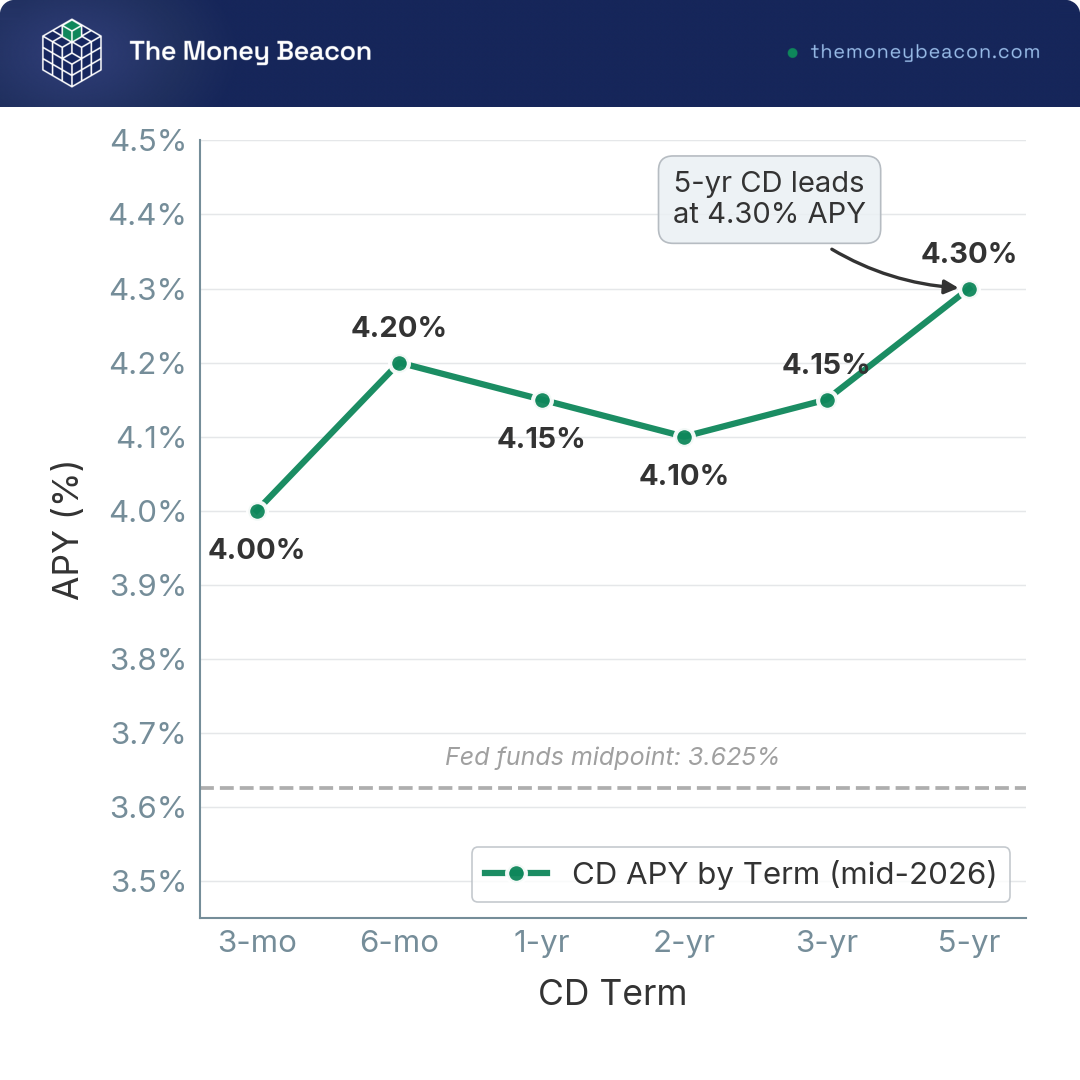
As of mid-June 2026, the rates across terms sit close together: roughly 4.00% on a 3-month CD, around 4.20% at 6 months, near 4.15% at one year, and about 4.30% on a 5-year. The curve is nearly flat, so locking long buys you very little extra yield right now, a point the term curve makes visually in section 6. The catch is what happens if you need the money early, and the penalty is real cash off your interest.
| CD term | Typical penalty | Effect on a $10,000 CD example |
|---|---|---|
| ≤ 1 year | ~3 months’ interest (about 90 days) | ~$104 forfeited at 4.15% |
| 1-3 years | ~6 months’ interest (about 180 days) | ~$208 forfeited at 4.15% |
| 4-5 years | ~9-12 months’ interest (up to 365 days) | ~$430 forfeited at 4.30% |
Penalty conventions vary by bank; verify the disclosure. Data current as of June 2026.
Break a 5-year CD early and you can hand back around $430 in interest on a $10,000 deposit, so the penalty is not a rounding error. Conventions differ by bank: Capital One charges three months’ interest on terms of 12 months or less and six months on longer terms, while Bank of America’s Flexible CD waives the penalty after the first six days. If you want a rate lock without the liquidity trap, a no-penalty CD lets you pull the full balance after about seven days at a slightly lower APY. Read the penalty disclosure before you lock, and keep any money you might need within six months liquid rather than tied up. When you are ready to shop the actual offers, you can compare current CD rates and terms across banks.
3.3 Series I savings bonds
CDs lock in a bank rate; the next vehicle locks in something different, a rate that moves with inflation and comes from the US Treasury instead of a bank. A Series I savings bond (I bond) pays a composite rate built from a fixed component set for the life of the bond and an inflation component that resets every six months.
For May through October 2026, that composite rate is 4.26%, with a 0.90% fixed component, the positive fixed piece being what makes a current I bond worth holding for the long run. You buy them through TreasuryDirect, capped at $10,000 per person per calendar year electronically, plus up to $5,000 in paper bonds through a federal tax refund. The holding rules are strict and worth knowing before you buy, which the timeline below lays out from purchase to final maturity.
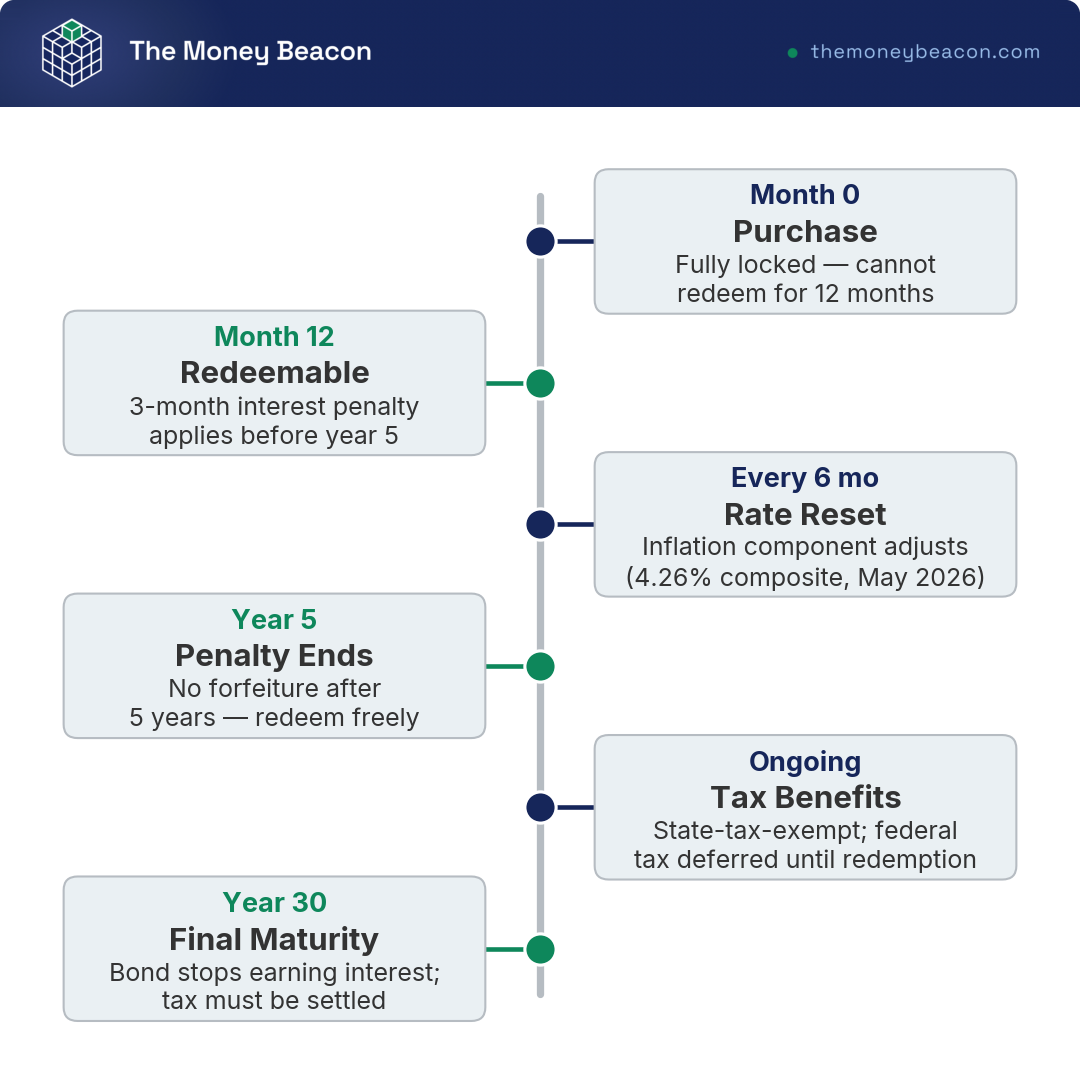
The mechanics matter: you cannot redeem an I bond at all in the first 12 months, you forfeit the last three months of interest if you cash out before year five, and after five years there is no penalty at all. On the tax side, federal tax is deferred until you redeem, and the interest is exempt from state and local tax, though the full backing and tax treatment is something we compare properly in the next section. A quick contrast worth knowing: a Series EE bond pays a lower 2.40% fixed rate but carries a Treasury guarantee to double in value if held 20 years, which suits a fixed long-horizon goal rather than a one-to-five-year one.
3.4 Inside a brokerage: money market funds, T-bills, and index funds
The last building blocks do not live at a bank at all. They sit inside a brokerage account, which changes the protection story: these are not FDIC-insured, and the broker’s SIPC coverage protects against the firm failing, not against the market falling.
Three categories are worth knowing here. A government money market fund (MMF) yields about 3.27% on a 7-day basis and a prime MMF about 3.45%, both very low-volatility but uninsured. Treasury bills (T-bills) are direct Treasury debt of 4 to 52 weeks, carry US Treasury backing, and make a close cash substitute for the 3-to-12-month horizon. The table sets the brokerage asset classes side by side on yield, volatility, and what stands behind them.
| Asset class | Typical yield/return | Volatility | Insurance |
|---|---|---|---|
| Government MMF | ~3.27% (7-day) | Very low | None (SIPC on broker failure) |
| Prime MMF | ~3.45% (7-day) | Very low | None (SIPC on broker failure) |
| T-bills (4-52 wk) | tracks short rates | Very low | US Treasury backing |
| Broad bond index fund | ~4%-5% yield | Low-medium | None; market risk |
| Total-market stock index fund | long-run ~7%-10% nominal | High | None; market risk |
Data current as of June 2026.
The pattern is clear once you read down the insurance column: MMFs and index funds carry no deposit insurance and the index funds carry real market risk, while T-bills lean on Treasury backing instead. For the 5+ year bucket, a total-market stock index fund or ETF historically earns far more than cash, and you can hold flagship versions at Vanguard, Fidelity, or Schwab for expense ratios of roughly 0.03% to 0.04%, a rounding error against the return. If you want to see how the low-cost index funds and ETFs that fill that long-term bucket compare on cost and coverage, that breakdown is in our index funds and ETFs comparison.
Hank’s take

follow the Fed closely and you notice how lazily megabanks pass rate moves through to savers; they raise loan rates the same day and leave deposit rates near zero for years. The part most savers underestimate is how much that gap, compounded by inflation, quietly eats their idle cash.
You now know what each vehicle is and roughly what it pays. But the headline APY is only half the story; what actually decides which vehicle wins for each dollar is what we compare next.
4. Safety, Liquidity, and Taxes: How to Compare the Vehicles
You know every vehicle by now, and roughly what each one pays. A headline APY still hides three things, though: who actually insures the money, how fast you can reach it, and how the interest is taxed. Let’s work through those three in order, starting with the protection behind each dollar, then how and how fast you can get at it, then how it is taxed, and finally the extra layer that reshuffles the ranking for high earners.
4.1 FDIC, NCUA, Treasury backing, and SIPC are four different things
Start with the question that decides whether your money survives a worst case: if the institution holding it fails, what stands behind your balance? Four different protections answer that, and savers blur them together constantly.
The first two are deposit insurance. The FDIC covers bank deposits, your checking, savings, MMA, and CDs, up to $250,000 per depositor, per insured bank, per ownership category. The NCUA, through its share insurance fund, does the same job for credit unions and mirrors that limit member for member. Both are federal backstops that pay you back if the bank or credit union goes under. The third is Treasury backing: a T-bill, an I bond, or an EE bond carries the full faith and credit of the US government, with no dollar cap at all, because you are lending to the Treasury itself rather than parking cash at a bank. The fourth, SIPC, is the one most often misread.
| Protection | What it covers | Limit | What it does NOT cover |
|---|---|---|---|
| FDIC (banks) | Bank deposits: checking, savings, MMA, CDs | $250,000 per depositor, per insured bank, per ownership category | Investments, market loss, crypto |
| NCUA / NCUSIF (credit unions) | Share accounts, share certificates | $250,000, mirrors FDIC (per member-owner, per credit union, per ownership category) | Investments, market loss |
| US Treasury backing | Treasurys, I/EE bonds | Full faith and credit (no dollar cap) | n/a (credit-risk-free) |
| SIPC (brokerages) | Brokerage-firm failure (missing cash/securities) | $500,000 total, $250,000 cash | Market loss; bank deposits |
Read the right-hand column and the warning lands on its own. SIPC steps in only if your brokerage firm fails and your cash or shares go missing; it never makes you whole when the market falls, and it is not deposit insurance. So a money market mutual fund inside a brokerage is not FDIC-insured, even though it sits one click away from cash, and the index fund you hold for the long run carries real market risk that no acronym erases. Never let anyone sell you a brokerage product as “FDIC-insured,” because the label simply does not apply there.
4.2 Staying fully insured above $250,000
That $250,000 limit sounds like a hard ceiling, but it is really a per-bucket figure, which means a household with more cash than that can still keep every dollar covered. Three routes do the work.
The first is ownership categories at a single bank. A single account, a joint account, and certain trust or payable-on-death accounts each carry their own separate $250,000 of coverage, so a married couple can already insure well past a quarter-million at one institution by combining categories. The second is the brute-force route: spread the deposits across several insured banks, since the limit resets fresh at each one. The third is a deposit-sweep network, where one bank quietly distributes your large balance across dozens of partner banks, and some programs advertise total coverage above $1 million on a single account.
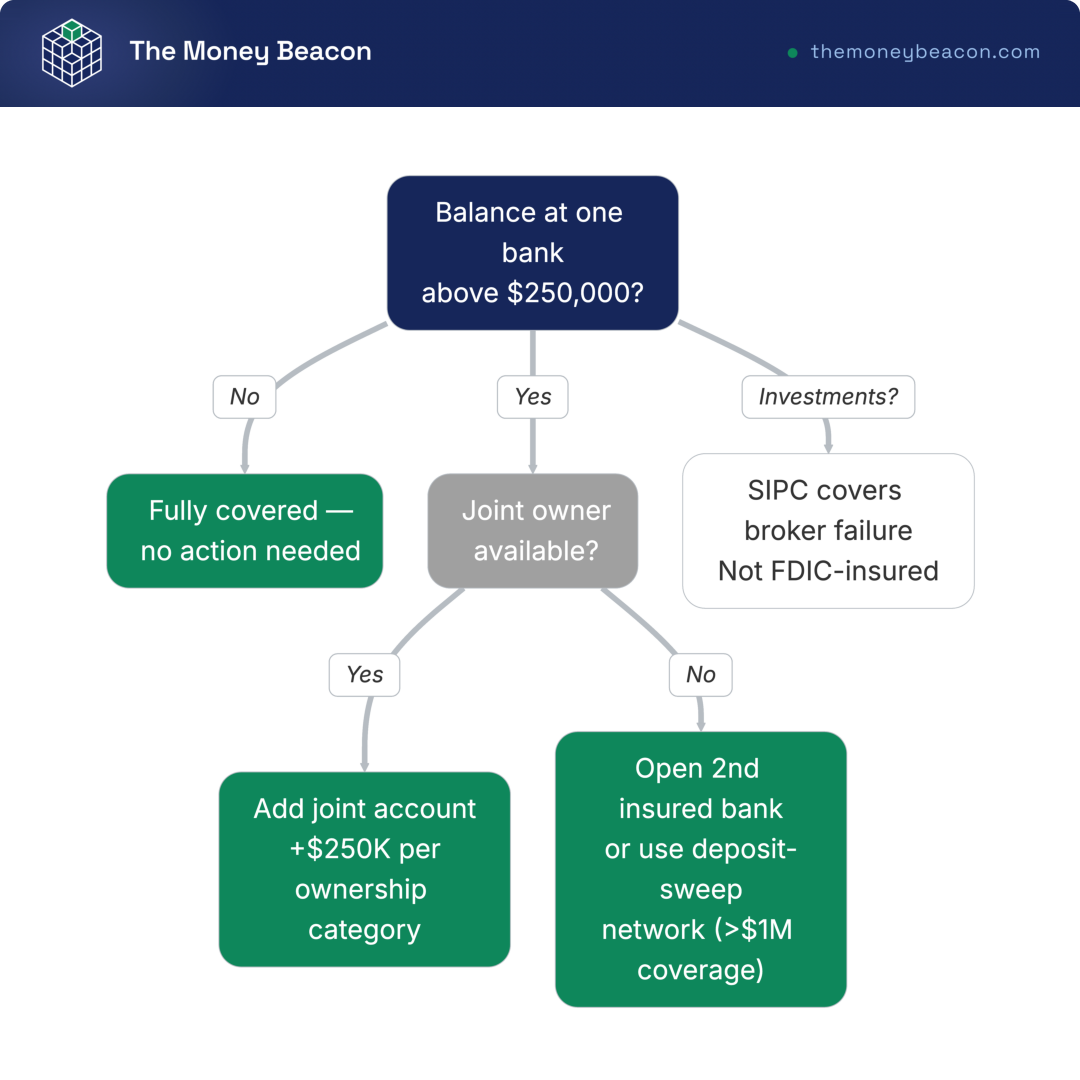
One caveat is worth knowing before you lean on a sweep network: the extra coverage comes from how the program is structured, not from a higher FDIC cap, so the protection is only as good as the current partner-bank list. Check that list before you rely on it, and if you want a free second opinion on your own accounts, the FDIC’s EDIE estimator walks you through exactly how much of your balance is covered.
4.3 Liquidity and access rules at a glance
Protection tells you the money is safe; it says nothing about how fast you can actually touch it. That is a separate axis, and it is where the trade-off for every extra basis point of yield shows up.
| Vehicle | Lock-up | Penalty for early access | Typical access time |
|---|---|---|---|
| HYSA / MMA | None | None | 1-3 business days (ACH) |
| CD | Full term | 60-365 days’ interest (~3-12 months) | At maturity; penalty otherwise |
| No-penalty CD | ~7 days then free | None after 7 days | 1-3 days |
| I bond | 1 year minimum | None yr 1 (cannot redeem); 3 months’ interest if < 5 yrs | 1-2 business days after yr 1 |
| T-bill | Until maturity (or sell) | Price risk if sold early | At maturity / secondary market |
| Index fund/ETF | None | Market risk | 1-3 days to settle |
Data current as of June 2026.
The pattern is a clean ladder from free to frozen. A HYSA or MMA is fully liquid, with money in your hands in one to three business days and no penalty for moving it. A CD trades that flexibility for a fixed rate, and breaking it early costs you anywhere from 60 to 365 days of interest. An I bond is stricter still: you cannot redeem it at all in the first year, then you forfeit three months’ interest until you cross the five-year mark. Index funds settle in a day or two, but the catch there is market risk rather than a penalty. This is exactly why any money you might need within six months belongs in a fully liquid account, not locked in a CD where a single surprise bill forces you to hand back months of interest.
4.4 How the interest is taxed
Safety and access are only two of the three hidden axes. The third is tax, and it is the one savers skip most often, even though it can quietly flip which vehicle actually pays you more. The starting rule is simple, so let’s build from there.
Interest on cash is taxed as ordinary income at your federal bracket, anywhere from 10% to 37%, and your bank reports it on Form 1099-INT once you earn $10 or more. That covers your HYSA, your MMA, and your CD interest the same way. One wrinkle on CDs catches people off guard: the interest is taxed each year as it accrues, even on a multi-year CD you have not cashed out yet, so you owe tax on money you cannot spend.
| Vehicle | Federal tax | State/local tax | When taxed |
|---|---|---|---|
| HYSA / MMA / CD interest | Ordinary income | Taxable | Year earned (CD: annually, even before maturity) |
| Treasury bills / notes interest | Ordinary income | Exempt (31 U.S.C. 3124) | Year earned |
| I / EE bond interest | Ordinary income (federal) | Exempt | Deferred until redemption/maturity; possible education exclusion |
| Government MMF dividends | Ordinary income; portion may be state-exempt | Partial state exemption (gov’t portion) | Year earned |
| Index fund (taxable) | Qualified dividends + LTCG (0/15/20%) | Taxable (varies) | On distributions and on sale |
Data current as of June 2026.
Now the part that actually changes decisions. Treasury interest, including T-bills and both I and EE bonds, is exempt from state and local income tax under federal law, while your HYSA and CD interest is fully state-taxable. In a high-tax state that exemption is a real edge: at a 9% state rate, a 4.00% T-bill can keep more in your pocket than a 4.15% CD once the state takes its cut of the CD. I bonds layer on a second advantage, since their federal tax is deferred until you redeem rather than billed every year. The edge has limits, though. In a no-income-tax state like Texas, Florida, Washington, or Nevada there is nothing for the exemption to dodge, so a higher-APY CD or HYSA simply wins on the headline rate. Want the full picture on how distributions and sales are taxed once money leaves cash? That lives in our guide to capital gains and qualified dividends.
4.5 When the NIIT and your bracket change the answer (high earners)
For most households, the rules above are the whole story. But cross a certain income line and a second tax layer switches on, one that quietly tilts the after-tax race toward the Treasury-backed vehicles. If your income is anywhere near six figures and rising, read this part closely.
The net investment income tax (NIIT) adds 3.8% on net investment income, including interest, once your modified adjusted gross income clears $200,000 single or $250,000 married filing jointly. The single most common mistake here is reading it as a flat 3.8% rate. It is not; the NIIT sits on top of your ordinary or capital-gains rate, never instead of it, so a high earner’s top long-term capital gains rate becomes 20% plus 3.8%, or 23.8%, not 3.8% alone. The same 3.8% rides on the interest from a CD or a HYSA once you are over the threshold.
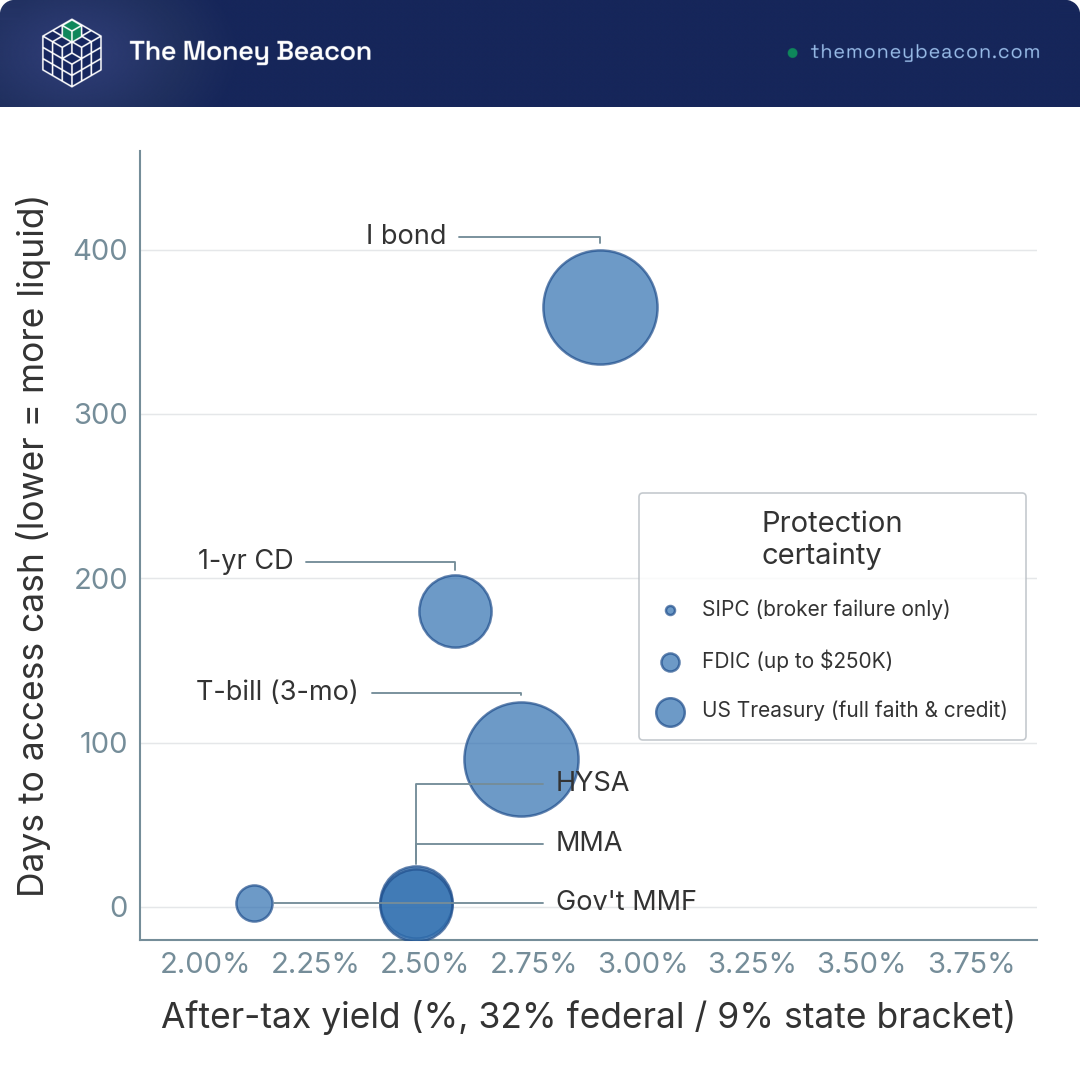
Here is why that matters for where your dollars land. Because the NIIT and the state tax both bite hardest on fully taxable interest, state-tax-exempt Treasurys and I bonds keep relatively more of their yield for a high earner, and the I bond’s federal deferral stretches the advantage further. The practical upshot is that a CD with a higher sticker rate can lose to a Treasury or I bond once you run the after-tax number, the reverse of the headline ranking.
Tom’s take
I’ve shopped most of the big private banks, and the lesson carries straight down to a simple savings decision: never sign before you compare the after-tax number. A CD that looks like it beats a Treasury on the banner can lose once the NIIT and a high state rate come out, and the only way to know is to actually run both nets, not the headlines.
If your income is high enough to trigger the NIIT, the broader move is to shrink the taxable income that feeds it in the first place, which we cover in our guide to lowering your taxable income. Run the after-tax yields side by side before you commit a single dollar; that comparison is the whole game once you are in NIIT territory.
5. Match Every Dollar to Its Time Horizon
You can now compare any two vehicles on the three things that decide a winner: who protects the money, how fast you can reach it, and what you keep after tax. So let’s put that to work and route each bucket. We take the three horizons in turn, name the default winner for each, and lay out the trade-off behind the choice.
5.1 Money needed within a year
Start with the money you might touch this month or this quarter, because the rule for it is the strictest. The emergency fund and any known near-term bill, a tax payment, a tuition check, an insurance premium, belongs in a HYSA or MMA: insured, liquid, and paying around 4%. Nothing about this bucket should ever be locked.
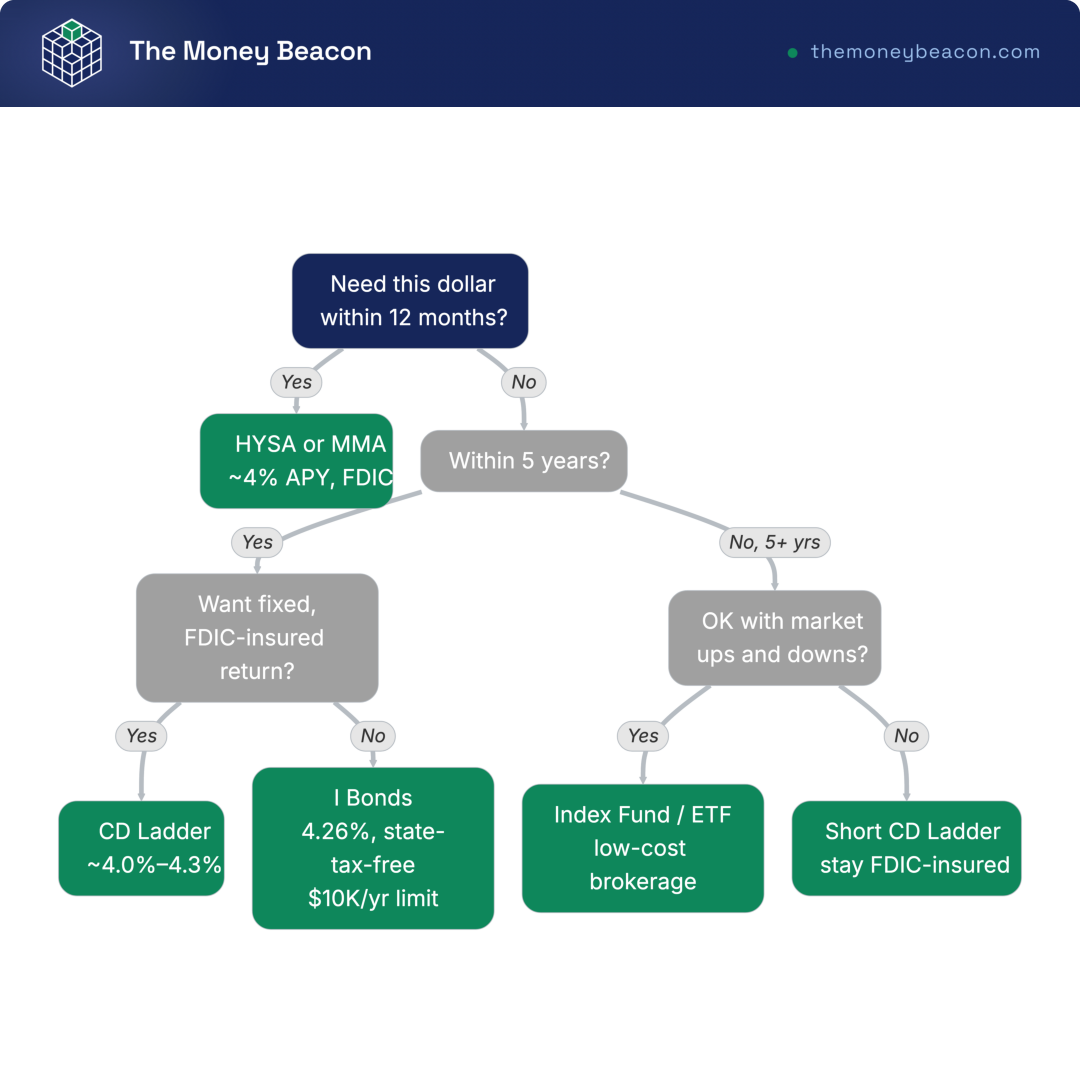
There is one refinement for the very shortest, state-tax-sensitive money. If you live in a high-tax state and have cash earmarked three to twelve months out, a T-bill or a government money market fund can edge out a HYSA after tax, since the Treasury interest dodges your state’s cut. For everything you might need inside six months, though, keep it fully liquid and skip the lock entirely; the few extra basis points a CD might offer are not worth a penalty the day an emergency lands.
5.2 One-to-five-year goals: CD ladder vs I bonds
Now the money with a date on it but more than a year away: a car, a down payment, a wedding. This is the bucket where the two Treasury-and-bank workhorses go head to head, and the right answer depends on what you value more, certainty or an inflation hedge.
| Factor | CD ladder | I bonds |
|---|---|---|
| Backing | FDIC ($250k) | US Treasury (no cap) |
| Rate | Fixed per rung (~4.0%-4.3% now) | Composite, resets semiannually (4.26% now) |
| Liquidity | Penalty if early | Locked 1 yr; 3-mo penalty < 5 yr |
| Annual limit | None | $10,000/person electronic + $5,000 paper |
| State tax | Taxable | Exempt |
| Best when | You want certainty and no annual cap | You want inflation hedge and tax deferral |
Data current as of June 2026.
If you want a known, fixed, fully FDIC-insured return you can match to the exact date, the CD ladder wins, and it carries no annual cap so it scales to any goal size. If what you want is inflation protection plus state-tax-free, federally deferred interest, I bonds win, with the catch that you are capped at $10,000 per person each year and locked in for the first twelve months. Plenty of households simply use both: I bonds up to the annual limit, the rest of the goal in a CD ladder. And this is exactly where the after-tax math from earlier comes back, because in a high-tax state the I bond’s exemption can tip a close call its way even when the CD shows a slightly higher sticker rate. When you are ready to size the rungs against live offers, you can compare the best CD rates available now across banks.
5.3 Five years and beyond: a low-cost brokerage account
The last bucket is the money you will not touch for five years or more, and here the rule flips. Leave it in cash and inflation slowly grinds it down; the right move is to accept market risk on purpose. A diversified, low-cost index fund or ETF, a total-market stock fund or a stock-and-bond blend, in a taxable brokerage is the default home, and flagship versions run expense ratios of roughly 0.03% to 0.04%, a rounding error against the long-run return. This is not insured, and that is the point: you are being paid to carry volatility you would never want anywhere near short-horizon cash. Past performance does not guarantee future results, so treat the historical 7% to 10% long-run nominal range as a reasonable expectation, not a promise.
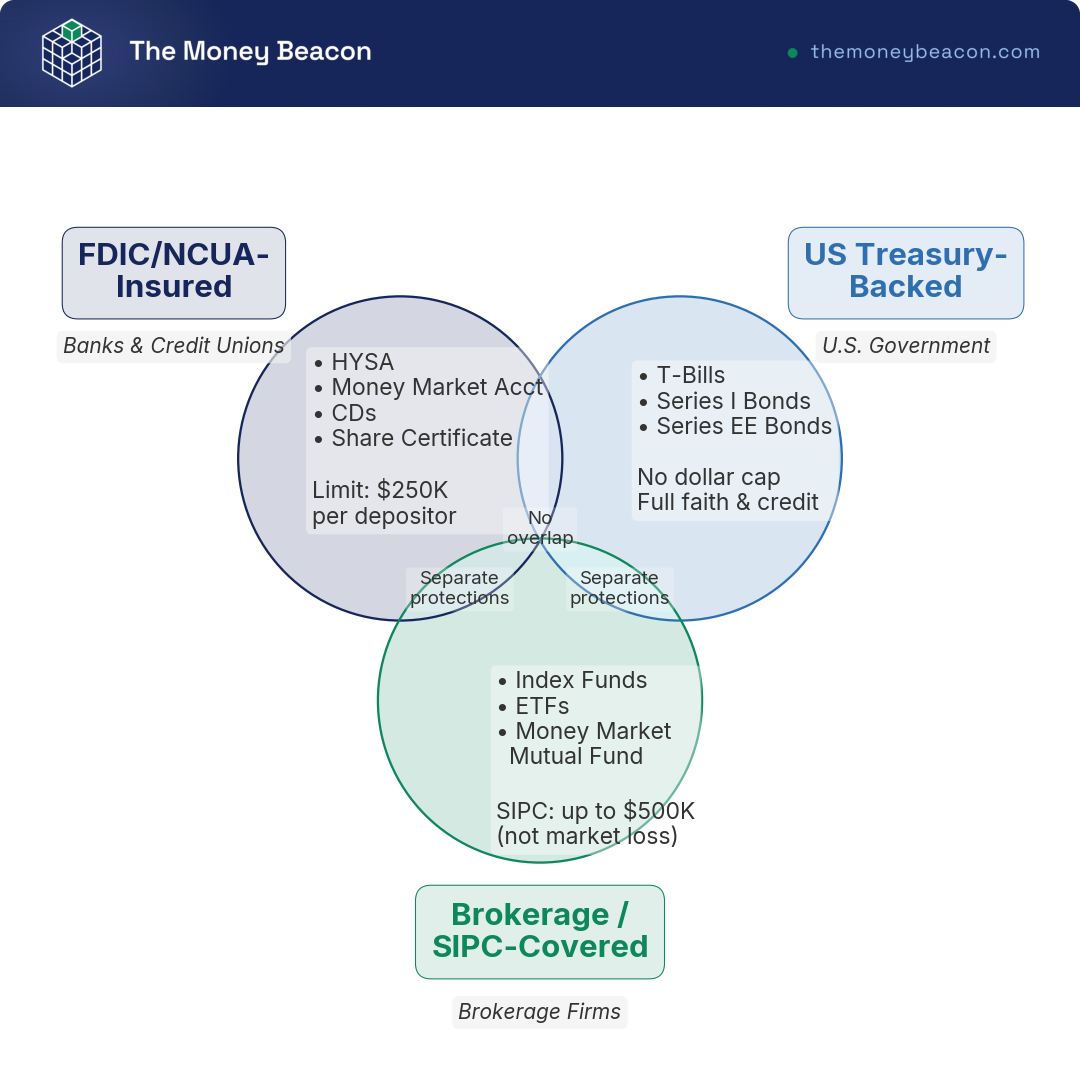
With all three horizons placed, the safety nets line up cleanly. Your now bucket sits behind FDIC insurance in a HYSA or MMA; your soon bucket splits between FDIC on the CD ladder and Treasury backing on the I bonds; your later bucket lives in a brokerage where SIPC guards only against the firm failing, never against the market falling. Each dollar now has both a home and the right protection behind it. You have picked the CD ladder for the mid-term bucket, so the obvious next move is to actually build one, rung by rung, which is where we go next. And if you want a head start on choosing where the long-term bucket lives, our walkthrough on starting with low-cost index funds covers the brokerage side in full.
6. Build and Maintain a CD Ladder
You have picked the CD ladder for the mid-term bucket, so the obvious next move is to actually build one, rung by rung. The mechanics are simpler than the name suggests: we lay out a concrete five-rung ladder from real APYs, turn the upkeep into a routine you repeat once a year, then settle the question every saver asks at this point, whether to lock your rate now or stay liquid against today’s rate backdrop.
6.1 A $25,000 five-rung ladder, step by step
The trick a ladder pulls off is having it both ways: the higher rates of longer terms, plus a chunk of cash freeing up every single year. You get there by splitting one sum across several CDs that mature in staggered steps rather than dumping it all into one term.
Take $25,000 and split it into five equal $5,000 rungs, opened on the same day, with terms of one, two, three, four, and five years. Using the representative APYs from the CD table earlier, each rung carries its own locked rate.
| Rung | Initial term | APY | At maturity, roll into |
|---|---|---|---|
| 1 | 1-year | 4.15% | New 5-year |
| 2 | 2-year | 4.10% | New 5-year |
| 3 | 3-year | 4.15% | New 5-year |
| 4 | 4-year | ~4.20% | New 5-year |
| 5 | 5-year | 4.30% | New 5-year |
Data current as of June 2026.
Blend those five rates across the five equal rungs and the first-year yield works out to about 4.18%, a touch above the one-year CD on its own and within a hair of the five-year rate, but without locking the whole $25,000 for five years. That is the payoff: you capture nearly the long-term rate while keeping a fifth of the money coming due every twelve months. Because the CD curve is roughly flat right now, the gap between the shortest and longest rungs is small, so stretching for the five-year rate buys you only a little extra yield in exchange for a lot less flexibility. The ladder splits the difference for you instead of forcing an all-or-nothing call.
6.2 What to do each time a rung matures
A ladder is only as good as the habit that keeps it running, and that habit is short. Each time a rung comes due, you make one decision, then repeat it a year later.
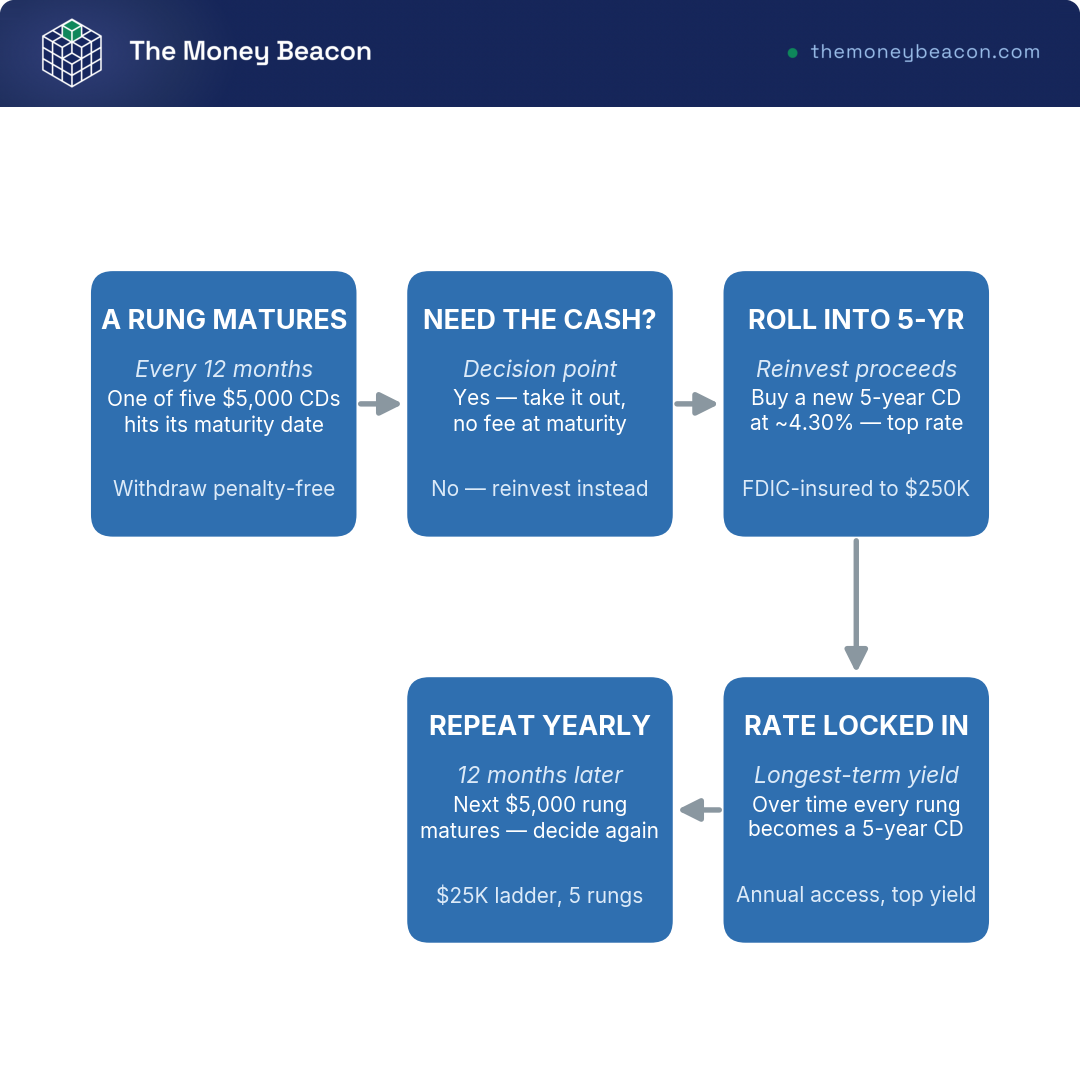
When the one-year rung matures, ask yourself a single question: do you need the cash now? If a goal has arrived, withdraw it, penalty-free, because the CD reached its term. If you do not need it, roll the full balance into a new five-year CD, which captures the longest-term rate, around 4.30% at June 2026 levels. Twelve months later the original two-year rung matures and you make the same call, and so on down the line. By the end of year five, every rung has rolled into a five-year CD, yet one still matures every twelve months. You end up holding long-term rates with a near-term exit always twelve months away, which is the whole reason to build a ladder instead of one big CD you cannot touch.
6.3 Lock your rate now or stay liquid?
The ladder answers most of the timing question on its own, but one judgment call remains: how much should you lock at all? The honest answer depends on where rates are headed, so let’s frame it against the actual backdrop rather than a guess.
Locking a multi-year CD, or the fixed component of an I bond, makes the most sense when you expect rates to fall. You capture today’s rate before it drifts lower, while a HYSA’s variable rate would follow the market down month by month. The reverse holds too: if rates look set to rise, you would rather stay liquid and re-price upward. So the lock-versus-liquid call is really a small bet on the direction of rates over your horizon.
Here is the backdrop as of June 2026. The Fed funds target range sits at 3.50% to 3.75%, down from its prior peak and roughly steady, with no imminent cut signaled in the latest FOMC materials and the median 2026 projection near 3.8%. So the case for locking now does not rest on a cut anyone has announced; it rests on a flat-to-slightly-lower outlook, which is a milder reason to lock than a clear easing cycle would be. The CD curve reflects exactly that, sitting roughly flat across terms.
Hank’s take
I read “no imminent cut” as exactly that, not as a hidden promise of one. With the curve this flat, I would not pay much in liquidity to reach for the five-year rate; the ladder already locks most of it while keeping a rung free every year, which is the part that actually protects you if the outlook is wrong.
The trade-off, as always, is liquidity, and the ladder is the compromise that softens it by keeping a near-term rung. If you want a rate lock with even less of a liquidity sacrifice, a no-penalty CD lets you walk away with full interest after the first week, and a bump-up CD lets you raise your rate once if the bank’s rates climb, both at a slightly lower starting APY. None of these forces an all-or-nothing choice, which is the point: you can lock the part of the goal you are sure about and leave the rest liquid.
7. Put It Together: Your Diversified Savings Plan
All the cards are now on the table: the buckets, the accounts, the safety and tax comparison, and the ladder mechanics. What is left is to assemble them into one plan you can actually run. We walk the sequence end to end, follow a real $60,000 household from an idle account to a matched plan, flag the quiet mistakes that drain a few hundred dollars a year, and close with a single table that holds the whole answer at a glance.
7.1 The plan, end to end
Run the steps in order, because each one clears the ground for the next. First, park one month of expenses in checking so daily bills never bounce you into selling something. Second, build the three-to-six-month emergency fund in a HYSA, stretching toward the longer end if your income is variable. Third, for one-to-five-year goals, build a CD ladder and buy I bonds up to the annual limit. Fourth, for money you will not touch for five years or more, invest in a low-cost index fund or ETF in a brokerage. Fifth, verify your insurance, keeping each bank balance under $250,000 per ownership category. Sixth, compare after-tax yields before choosing a CD over a Treasury or I bond, which matters most in a high-tax state or once you are in NIIT territory.
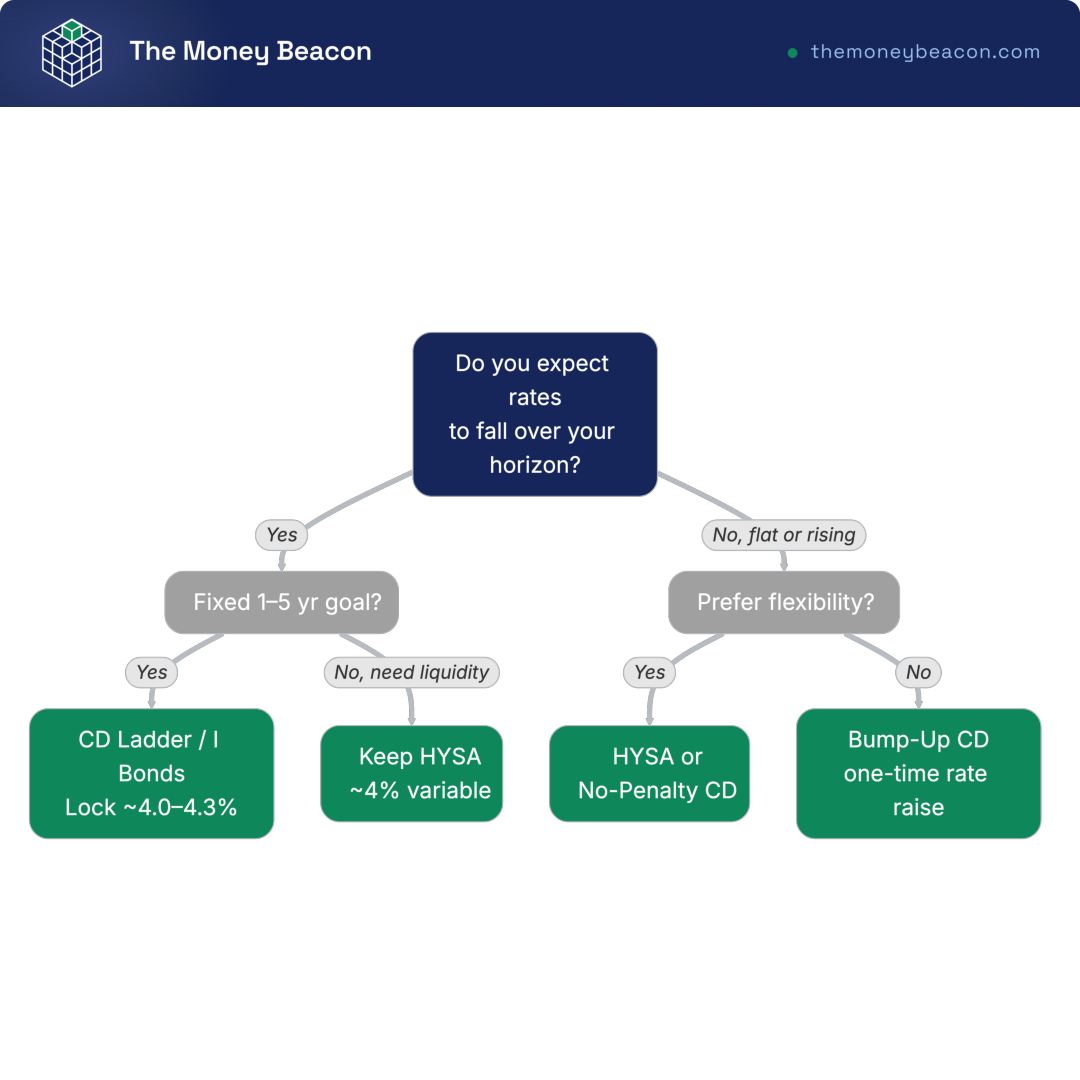
The only live judgment in that list sits at the mid-term step, where you fold in the lock-or-stay-liquid call from the last section against the current rate environment. Everything else runs on autopilot once the buckets are sized. When you reach the five-year-plus step and need a home for the long-term money, you can line up the platforms side by side in our guide to picking a low-cost brokerage account.
7.2 A worked household example: $60,000 from idle to matched
Here is a household running the plan. A dual-income couple has $60,000 sitting idle in a 0.01% megabank savings account, and their essential expenses run $5,000 a month. Watch what happens when each dollar finds its horizon.
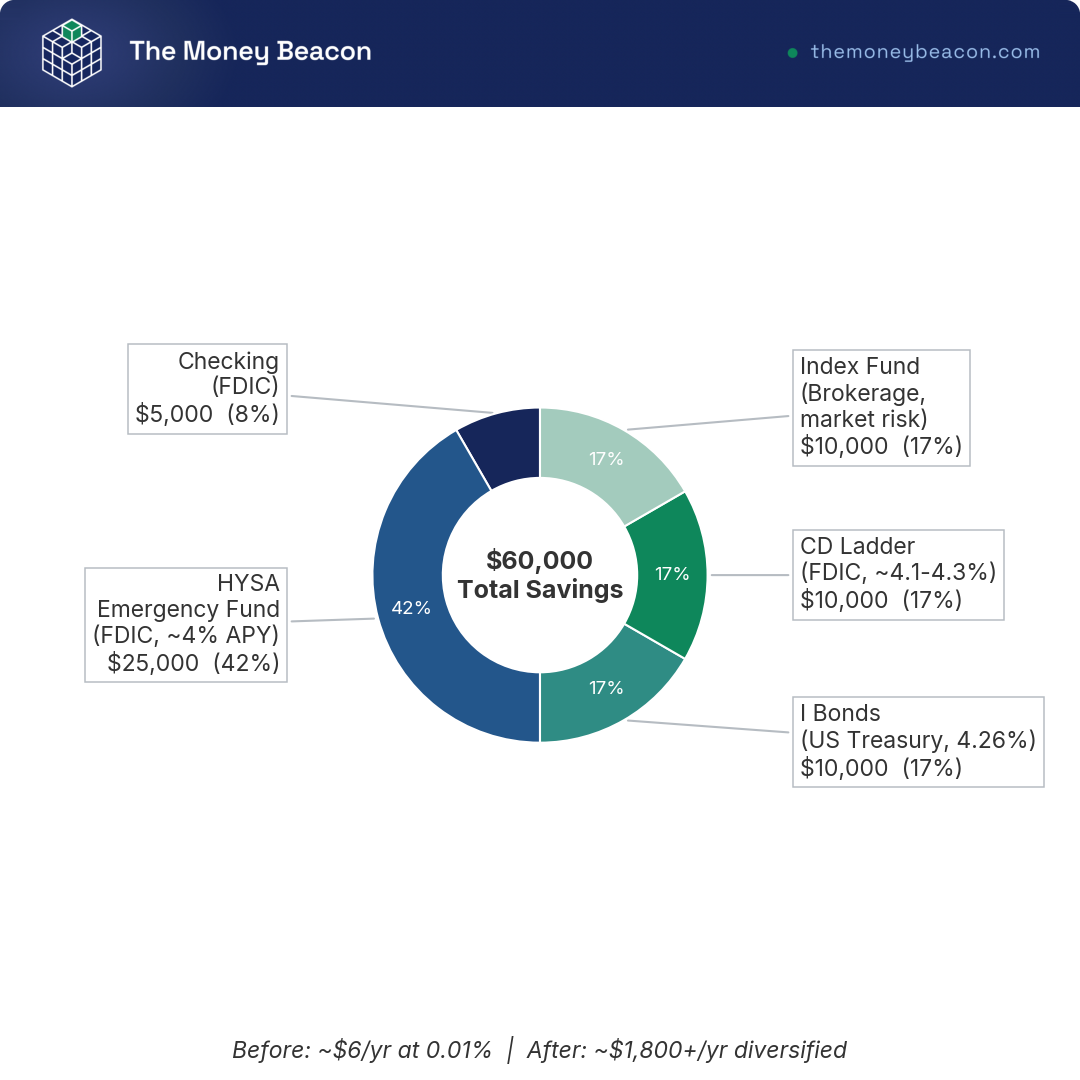
They keep $5,000 in checking, one month of expenses, for daily cash. They move $25,000, five months of expenses, into a HYSA at 4.00%, which earns about $1,000 in the first year against the roughly $3 it was earning before. For a down payment they expect to make in three years, they split $20,000 in half: $10,000 into I bonds at the 4.26% composite rate, state-tax-free, and $10,000 into a three-rung CD ladder running roughly 4.1% to 4.3%. The last $10,000, earmarked seven-plus years out, goes into a total-market index fund with a 0.03% to 0.04% expense ratio. Add it up and net first-year interest jumps from about $6 to roughly $1,800 or more, with every dollar matched to its horizon and the right protection behind it. The household took on no new risk on the cash it needs soon; it simply put the idle money to work.
7.3 Common mistakes that quietly cost money
The plan above is sturdy, but a handful of small slips can quietly chip away at it. Each one pairs a correct move with the pitfall it avoids.
| To do | To avoid | Common mistake |
|---|---|---|
| Move idle cash to a ~4% HYSA | Leaving it at 0.01% | “It’s only a few dollars” (it’s hundreds to thousands a year) |
| Keep the emergency fund insured and liquid | Putting it in stocks | Forced to sell in a downturn |
| Compare after-tax yields | Comparing headline APYs only | Ignoring state tax on CDs versus Treasurys |
| Track the I bond 1-year lock and 5-year mark | Redeeming an I bond in month 13 carelessly | Forfeiting 3 months’ interest needlessly |
| Read the CD penalty before locking | Locking cash you may need | Paying 3-12 months’ interest to break a CD |
| Stay under $250k per category | Exceeding the FDIC limit at one bank | Uninsured cash if the bank fails |
| Know SIPC is not deposit insurance | Calling a brokerage fund “FDIC-insured” | Misjudging the real protection |
Data current as of June 2026.
The thread running through every row is that the costly mistakes are quiet ones, a few dollars here, a forfeited quarter of interest there, none dramatic enough to notice on a single statement but real over a year. The fixes cost nothing but a few minutes of attention. If your idle cash is still the first row of that table, the fastest fix is moving it into a competitive high-yield savings account today and crossing the most expensive mistake off your list.
7.4 The complete answer at a glance
Everything in this guide collapses into one idea: match each dollar to when you need it and how much protection it requires, then pick the account that fits. Here is that whole answer in a single table, with every row already covered above.
| Horizon / purpose | Best vehicle | Backing | Yield (June 2026) | Liquidity / penalty | Tax |
|---|---|---|---|---|---|
| Daily cash (1 mo) | Checking | FDIC | ~0% | Instant | Ordinary |
| Emergency fund (3-6 mo) | HYSA / MMA | FDIC | ~3.0%-4.3% | 1-3 days, none | Ordinary, state-taxable |
| Short-term, state-tax-sensitive | T-bill / gov’t MMF | Treasury / none | ~3.3%-4.2% | At maturity / 1-3 days | Ordinary fed, state-exempt (T-bill) |
| 1-5 yr fixed goal | CD ladder | FDIC | ~4.0%-4.3% | Penalty 60-365 days interest | Ordinary, state-taxable |
| 1-5 yr, inflation hedge | I bonds | US Treasury | 4.26% | 1-yr lock; 3-mo penalty < 5 yr | Fed deferred, state-exempt |
| 5+ yr wealth | Index fund/ETF | None (SIPC on broker) | market (~7%-10% long-run) | 1-3 days + market risk | LTCG/qualified div (0/15/20%) |
Data current as of June 2026.
Read the table top to bottom and you can watch the logic settle into place: the closer a dollar is to being spent, the more it leans on insurance and instant access, and the further out it sits, the more it can trade liquidity for yield. Every dollar you own now has a home, a protection, and a reason for being there. That is the entire job of diversifying your savings, and you now have the map to do it.
Conclusion
Diversifying your savings comes down to one move repeated across every dollar: match the money to when you will actually need it. That rule is the whole game, and it is simpler than the product names make it sound. Cash you might touch this month belongs in a high-yield savings account or money market account, earning close to 4% instead of the 0.01% a big-bank account quietly pays. Money earmarked for a goal one to five years out fits a CD ladder or Series I bonds, both protected and both paying a known rate. And money you will not touch for a decade can take on market risk in a low-cost brokerage account, where sitting in cash would just let inflation eat away at it.
The single most valuable thing you can do is build a real emergency fund in a HYSA first, before any of the rest. This is the bucket that has to exist before a single dollar goes into a CD or an index fund, because it is what keeps you from selling investments at the worst possible moment. Everything after that is just sorting, and the payoff is concrete: the idle $20,000 that earns about $2 a year at 0.01% earns roughly $800 once it sits in a 4% account, with no extra risk and the same FDIC protection.
One point we want to stress, because savers find it out too late, is that a headline rate tells you almost nothing on its own. What insures the money, how fast you can reach it, and how the IRS and your state tax it can flip the ranking entirely, which is why a state-tax-free Treasury or I bond can beat a higher CD after tax in a high-tax state. Keep every dollar under the FDIC limit of $250,000 per depositor, per bank, per ownership category, and you stay fully covered while it works.
So here is the next step: this week, move the idle cash from a 0.01% account into a no-fee HYSA and turn on an automatic transfer each payday. Once that is done, you can dig deeper. We compare the leading providers in our guide to the best high-yield savings accounts, lay out terms and penalties in our comparison of current CD rates, and walk the long-horizon money into index funds in our guide to investing in the stock market. Read them in that order and you will have every bucket placed.
FAQ: Diversifying Your Savings
How many savings accounts should I have?
There is no magic number, so match accounts to horizons rather than to a count. Most households need at least three homes for cash: a checking account for about a month of spending, a high-yield savings account (HYSA) for the emergency fund and near-term money, and then horizon-specific homes for goals, meaning a CD ladder or I bonds for one-to-five-year goals and a brokerage for five-plus years. The point is matching each dollar to when you need it and how protected it must be, not collecting accounts.
Is it safe to keep more than $250,000 in one bank?
Only the first $250,000 per depositor, per insured bank, per ownership category is FDIC-insured. To stay fully covered above that, use different ownership categories (single, joint, and certain trust or POD accounts each get their own $250,000), spread deposits across several banks, or use a deposit-sweep network that distributes the balance across member banks, with some programs advertising total coverage above $1 million. The extra coverage comes from the program structure, not a higher FDIC cap, so check the network’s current bank list and run the FDIC’s free EDIE estimator to confirm your number.
What is the difference between a high-yield savings account and a money market account?
Both are FDIC-insured bank deposit accounts paying a variable rate in a similar range, so the gap is practical, not protective. A money market account often adds check-writing and a debit card or ATM access and may use tiered rates with a higher minimum, while a high-yield savings account stays leaner, usually with no or low minimums and no checks. Watch the wording, because a money market account at a bank is insured, but a money market mutual fund at a brokerage is not. Our comparison of money market accounts walks the top APYs side by side.
Are CDs or I bonds better for a three-year goal?
It depends on what you value. A CD gives a fixed, FDIC-insured return you can match exactly to the date, with no annual purchase cap, but the interest is state-taxable and breaking early costs roughly 3 to 12 months of interest. An I bond gives inflation protection and state-tax-free, federally deferred interest at a 4.26% composite rate, but it is capped at $10,000 per person per year, locked for the first year, and forfeits three months’ interest if redeemed before five years. Many savers use both: I bonds up to the limit, the rest in a CD ladder.
Do I pay state taxes on interest from a high-yield savings account?
Yes. Interest from a HYSA, a money market account, or a CD is ordinary income for both federal and state purposes in states that levy an income tax. Treasury interest and I and EE bond interest, by contrast, are exempt from state and local income tax under 31 U.S.C. 3124. In a high-tax state that exemption can flip the ranking, letting a slightly lower Treasury or I bond yield beat a higher CD yield after tax. The edge disappears for residents of no-income-tax states such as Texas, Florida, Washington, and Nevada, a point we unpack in our guide to investment taxes.
What happens if I withdraw from a CD or cash an I bond early?
Breaking a CD before maturity triggers an early-withdrawal penalty, typically about three months’ interest on terms of a year or less and up to nine to twelve months’ interest on longer terms, which can eat into your principal if the CD is still young. An I bond cannot be redeemed at all in the first 12 months. Redeem it between year one and year five and you forfeit the last three months of interest; after five years there is no penalty at all.
Should I lock money in a CD when the Fed is about to cut rates?
If you have a fixed one-to-five-year goal and you expect rates to drift lower over your horizon, locking a CD or the I bond fixed rate now captures today’s rate before it falls, whereas a HYSA’s variable rate would follow rates down. As of June 2026 the Fed funds target range is 3.50% to 3.75%, down from its peak and roughly steady, with no imminent cut signaled, so the case for locking rests on a flat-to-lower outlook, not an announced move. The cost is liquidity, and a CD ladder is the compromise, always keeping a near-term rung you can reach.
How much of my savings should stay in cash versus a brokerage account?
Match it to time horizon, not to a fixed percentage. Money you may need within five years, meaning the emergency fund plus your one-to-five-year goals, belongs in insured or Treasury-backed cash vehicles such as a high-yield savings account, a CD ladder, I bonds, or T-bills. Money you will not touch for five years or more can go into a low-cost brokerage index fund, where you accept market risk in exchange for higher expected return; past performance does not guarantee future results. The emergency fund comes first, and only money beyond it, with a genuinely long horizon, belongs in the brokerage.




Comments
Questions and corrections welcome. We read everything.