


Every broker advertises $0 commissions now, so that number tells you nothing. You still can’t answer the question that matters: what does a Robinhood account cost you over a year? The cost is real, the app just never totals it for you. It’s the $0.50 per contract on index options. It’s the crypto fee band running as high as 0.95%, embedded in the price instead of shown as a commission: up to $47.50 on a $5,000 buy. And it’s the $100 Robinhood charges the day you move your account somewhere else.
Then there’s Gold, at $5 a month or $50 a year, a subscription worth something or nothing depending on how much cash you hold and how you trade. Pay for a year of features you never use and you’re out $60. Skip it while you’re holding $10,000 in cash and you’re passing on the 3.35% annual percentage yield (APY) that only Gold members get, which is $335.
One thing changed the stakes this year. On June 4, 2026, the Financial Industry Regulatory Authority (FINRA) eliminated the pattern day trader rule and the $25,000 minimum equity requirement that came with it. The replacement is an intraday margin standard that firms have until October 20, 2027 to adopt.
So I worked through Robinhood’s own fee schedule, disclosures and support pages instead of its landing page. I take a side at the end, and it isn’t the same side for everyone.
1. What a Robinhood brokerage account actually is, and what it can hold
Open the app and you see one balance. Different companies hold different pieces of it under different rules, and only some are insured at all.
1.1 Five entities behind one app, and three different levels of protection
I’d start this Robinhood review with the companies behind the app.
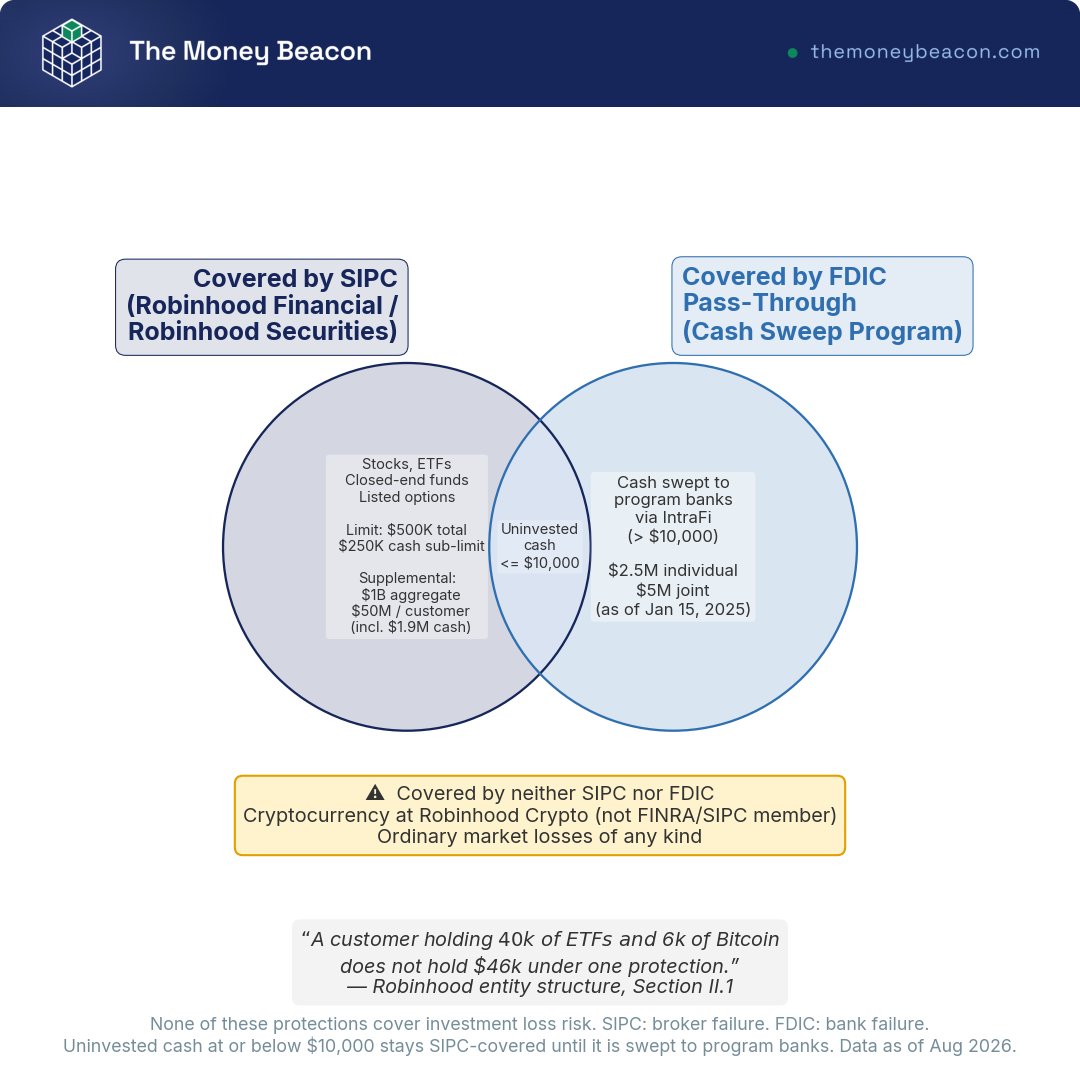
Robinhood Financial LLC (CRD 165998) holds your securities account, and Robinhood Securities, LLC (CRD 287900) clears it. Both are Securities and Exchange Commission (SEC) registered and FINRA members. Stocks, exchange-traded funds (ETFs) and listed options get Securities Investor Protection Corporation (SIPC) coverage to $500,000, including $250,000 for cash, plus supplemental coverage to an aggregate $1 billion.
Cash changes regime at $10,000. Below that line it stays at the broker-dealer under SIPC. Above it, Robinhood sweeps it to partner banks through the IntraFi Network Deposit Sweep Service, where Federal Deposit Insurance Corporation (FDIC) pass-through coverage runs to $2.5 million individual and $5 million joint (as of January 15, 2025), and SIPC no longer applies.
Crypto is the third pot. Robinhood Crypto, LLC, licensed under the Nationwide Multistate Licensing System (NMLS 1702840), is a member of neither FINRA nor SIPC.
There’s a trap in that FDIC figure. Coverage runs per depositor, per bank, per ownership category, across 15 program banks including Goldman Sachs Bank USA, Wells Fargo Bank N.A. and Citibank N.A. So money you already keep at one of them shrinks what the sweep covers.
None of the three covers the risk that the investment goes down. So when you ask is Robinhood safe, ask back: safe against which failure, in which pot? $40,000 of ETFs plus $6,000 of Bitcoin is not $46,000 under one umbrella.
1.2 What the account can hold, and the two things it will never hold
It’s deep at the exchange-listed end, a dead stop at the fund end.
Table: What you can and cannot hold in a Robinhood account
| Level: asset class or instrument | Available in a Robinhood brokerage account? | Note |
|---|---|---|
| US exchange-listed stocks | Yes | Fractional shares supported, $1 minimum order |
| Exchange-traded funds (ETFs) | Yes | The route to bond and index exposure |
| Closed-end funds (CEFs) | Yes | Listed, traded like stocks |
| Listed options on the above | Yes | Separate approval required |
| American depositary receipts (ADRs) | Yes | Pass-through custody fee applies |
| Certain OTC equities | Yes | $0 commission; not eligible for fractional orders |
| Mutual funds | No | Robinhood does not offer mutual funds; they appear on its own unsupported list |
| Individual bonds and fixed-income trading | No | Bond exposure only through ETFs |
| Foreign-domiciled stocks, limited partnerships | No | Not supported |
| Cryptocurrency | Yes, at Robinhood Crypto | Outside SIPC |
Data current as of August 2026.
It’s a self-directed brokerage account, and the fractional shares minimum covers national-exchange stocks, not over-the-counter (OTC) ones.
Robinhood doesn’t offer mutual funds, and the fee schedule has no mutual fund line. It sponsors no index funds, so there’s no expense ratio to publish. Its one recurring asset-based charge is the Robinhood Strategies advisory fee, 0.25% a year, paid by Gold members on the first $100,000 of assets.
That first absence costs money. Unsupported also blocks mutual funds from coming in through the Automated Customer Account Transfer Service (ACATS), so consolidating a household that holds any means selling first. In a taxable account, that’s a realization event, not a paperwork exercise.
Bond exposure here means exchange-traded funds only. That ETF route is fine for an accumulator and useless to anyone who needs specific maturity dates. If your equity side is funds anyway, look at how those ETFs stack up against the alternatives first.
The marketing doesn’t say what it costs to use.
2. What commission-free actually costs
The interesting part is where the $0 stops.
2.1 The $0 is real, and a $10,000 sale still costs about $0.25
The commission is genuinely zero. What’s left are regulator-set charges every US broker passes through identically.
Table: The $0 headline and where it stops
| Trading item | Robinhood published price |
|---|---|
| US listed equities, ETFs, CEFs, commission | $0 |
| Options on the above, base commission | $0 |
| Options on the above, per contract (Robinhood’s own fee) | $0 |
| OTC securities, commission | $0 |
| Index options, per contract, Gold | $0.35 |
| Index options, per contract, non-Gold | $0.50 |
| Futures, per contract, Gold | $0.50 |
| Futures, per contract per side, non-Gold | $0.75 |
| Crypto, total fee band | 0.00% to 0.95% by 30-day volume |
| Account opening and maintenance | $0 |
Data current as of August 2026.
The regulator-set charges, as published: SEC regulatory transaction fee $20.60 per $1 million of principal on sell orders (as of April 4, 2026), exempt below $500 of notional; FINRA trading activity fee $0.000195 a share on equity sells and $0.00329 a contract on options sells (as of January 1, 2026), capped at $9.79 per trade; options regulatory and exchange fee $0.04 a contract.
Sell 200 shares at $50 and that $10,000 sale costs $0.00 of commission, $0.21 of SEC fee and $0.04 of trading activity fee. Total $0.25, a quarter of one basis point.
So is Robinhood free? On a stock trade, near enough: anyone telling you Robinhood fees are hidden there is describing something the fee schedule doesn’t contain, though seven brokers score very differently on the same lines. The per-contract lines are where that changes.
2.2 Options at $0 a contract, index options at $0.35, and the $25,000 rule that no longer exists
On equity options, the per-contract fee is the whole argument.
The Robinhood options contract fee on US listed equities, ETFs and closed-end funds is $0. Fidelity and Charles Schwab each publish $0.65 a contract; Webull publishes $0. Trade 20 contracts a month, 240 a year, and that’s $0 at Robinhood against $156 at Fidelity or Schwab.
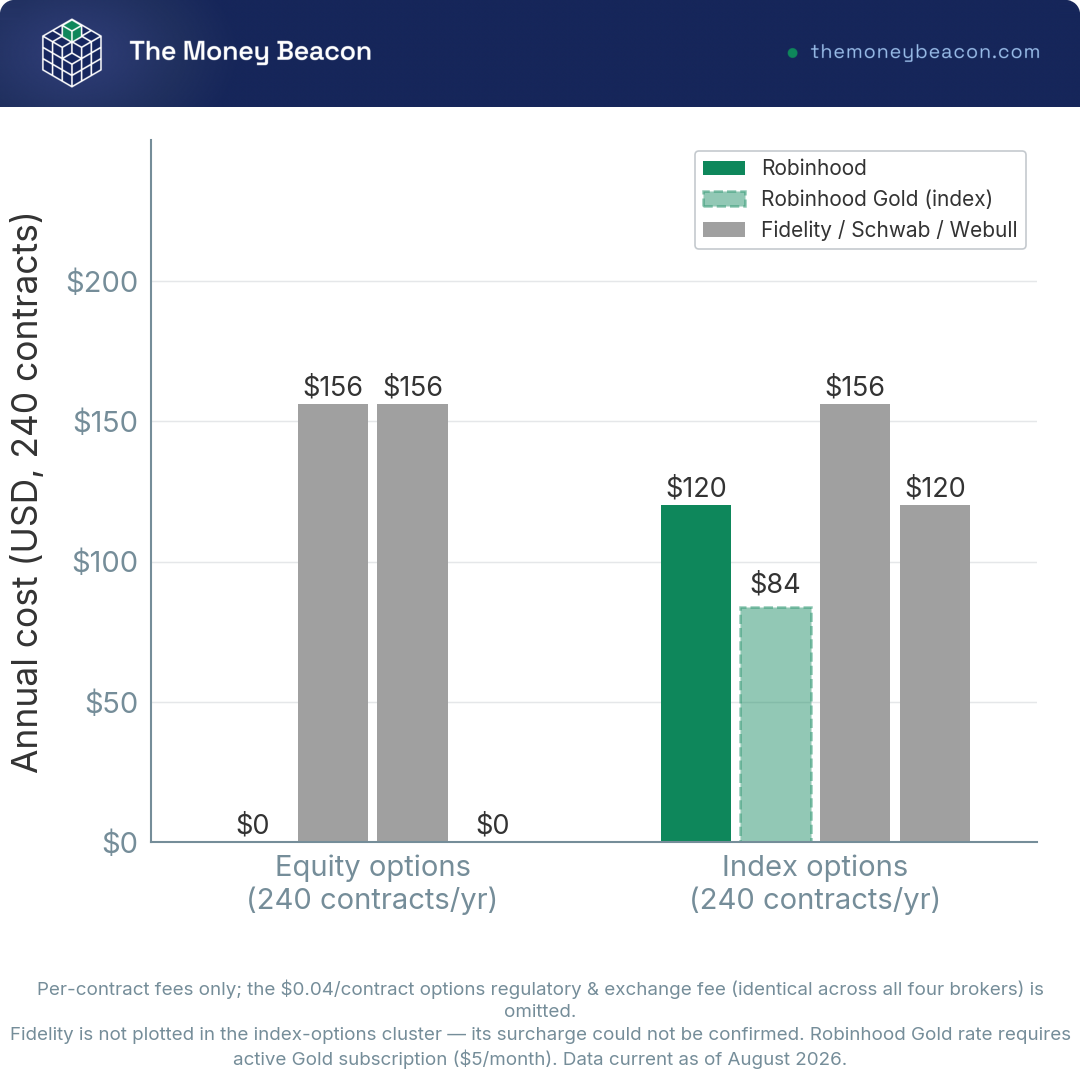
This isn’t a rave. Index options are charged, $0.50 a contract without Gold and $0.35 with it, so 240 of those cost $120 or $84 rather than nothing, plus $9.60 of pass-through either way. Call Robinhood the cheapest broker for options and you have to say which options you mean.
The $25,000 figure people attach to active options trading was never an options minimum. It was FINRA’s pattern day trader minimum equity requirement, eliminated along with the designation and the day-trade count test under amended Rule 4210, effective June 4, 2026.
Approval by option level is still required, and Robinhood may sell an expiring at-risk contract in the final 30 minutes if the account can’t cover exercising it. A careful beginner’s path into active trading beats an approval form.
2.3 The costs that never look like a commission: the crypto band and the $100 door
Not one of the remaining costs shows up as a commission.
Start with Robinhood crypto fees. Robinhood Crypto charges no stated commission and publishes a total fee band of 0.00% to 0.95%, with the market-maker rebate inside the spread. At the top of that band a $5,000 crypto buy costs about $47.50, while the same $5,000 as a stock sale costs about a dime.
Then there are the account-level charges, where Robinhood withdrawal fees stop being cheap.
Table: Account-level charges: transfers, wires, paper and instant access
| Service | Robinhood |
|---|---|
| ACATS transfer out, partial or full | $100 |
| Outgoing domestic wire | $25 |
| Incoming wire | $0 |
| Instant bank transfer (withdrawal) | Up to 1.75%, minimum $1, maximum $150 |
| Domestic overnight check delivery | $20 |
| Paper statements, monthly | $2 |
Data current as of August 2026.
At $100 to leave, moving a single position out costs more than two years of the annual Gold subscription. Fractional shares and crypto are liquidated rather than transferred, so a tax event comes with it. Schwab charges $50 for a full transfer out, Fidelity $0.
And a deposit by automated clearing house (ACH) has to wait five business days after settlement before you can withdraw it. If crypto is part of why you’re here, settle how big a crypto position should be inside a portfolio first.
The best number Robinhood publishes isn’t a commission. It’s an interest rate, behind a $5 subscription.
3. Robinhood Gold, priced against what it actually buys
Gold is a bundle, which makes it hard to judge. Let’s price the levers one at a time.
3.1 3.35% is the Gold rate, and it is never Robinhood’s default
Gold costs $5 monthly or $50 annually, and the first 30 days are free. The High-Yield Cash Program pays 3.35% APY to Gold members (as of February 11, 2026). It’s optional and you switch it on; cash left outside it doesn’t earn the program rate. For a Gold member both buckets pay the same 3.35%, so the $10,000 line changes your insurance, not your yield.
Against Schwab’s rate, the difference is wide.
Table: The Gold sweep yield worked in dollars (vs. Schwab)
| Uninvested cash balance | Robinhood Gold at 3.35% | Schwab brokerage cash at 0.01% | Annual difference | Less $50 Gold | Net |
|---|---|---|---|---|---|
| $5,000 | $167.50 | $0.50 | $167.00 | -$50 | +$117.00 |
| $10,000 | $335.00 | $1.00 | $334.00 | -$50 | +$284.00 |
| $25,000 | $837.50 | $2.50 | $835.00 | -$50 | +$785.00 |
| $100,000 | $3,350.00 | $10.00 | $3,340.00 | -$50 | +$3,290.00 |
Data current as of August 2026. Robinhood APY as of February 11, 2026; Schwab rates as published on schwab.com/cash-investments.
Now the caveat. 3.35% is roughly what a competitive US cash product paid in early 2026, and it floats with short-term rates, so the table measures a weak default at Charles Schwab, not a Robinhood miracle. Without a brokerage subscription, the fair alternative is a standalone savings account: seven no-fee, FDIC-insured accounts now pay up to 3.65% APY.
What you’re buying is Robinhood interest on uninvested cash accruing beside your portfolio, not at another institution: convenience, priced.
3.2 The 3% IRA match is a retention payment, not a gift
The match is real money with a five-year string on it.
Gold members get a 3% boost on annual individual retirement account (IRA) contributions, worth up to $225 for 2026, on traditional and Roth IRAs alike. That’s exactly 3% of $7,500, the standard 2026 limit, and the cap is per customer, not per account, so a second IRA doesn’t double it. It matters once you know the 2026 contribution limit and income phase-outs.
Now the strings. Matched funds come with a five-year holding period, and a distribution or transfer out inside that window can trigger an IRA match clawback. Gold has to run for one continuous year after the first eligible deposit.
So $225 on a $7,500 contribution is 3% paid once for a five-year commitment. That belongs in the retention-payment column, not the free-money column.
Hank’s take

a match with a five-year hold on it is a behavioral product, not a yield product. What the research keeps showing is that money stays put because moving it carries a penalty, not because the return was good, and $225 today buys a lot of not moving.
One part is genuinely good: a match paid into an IRA is inside the wrapper, so it isn’t taxable income the year you receive it and compounds like the rest of the account.
3.3 Four break-evens, and the margin ladder behind one of them
The real test isn’t one break-even but several, and clearing any one puts you ahead.
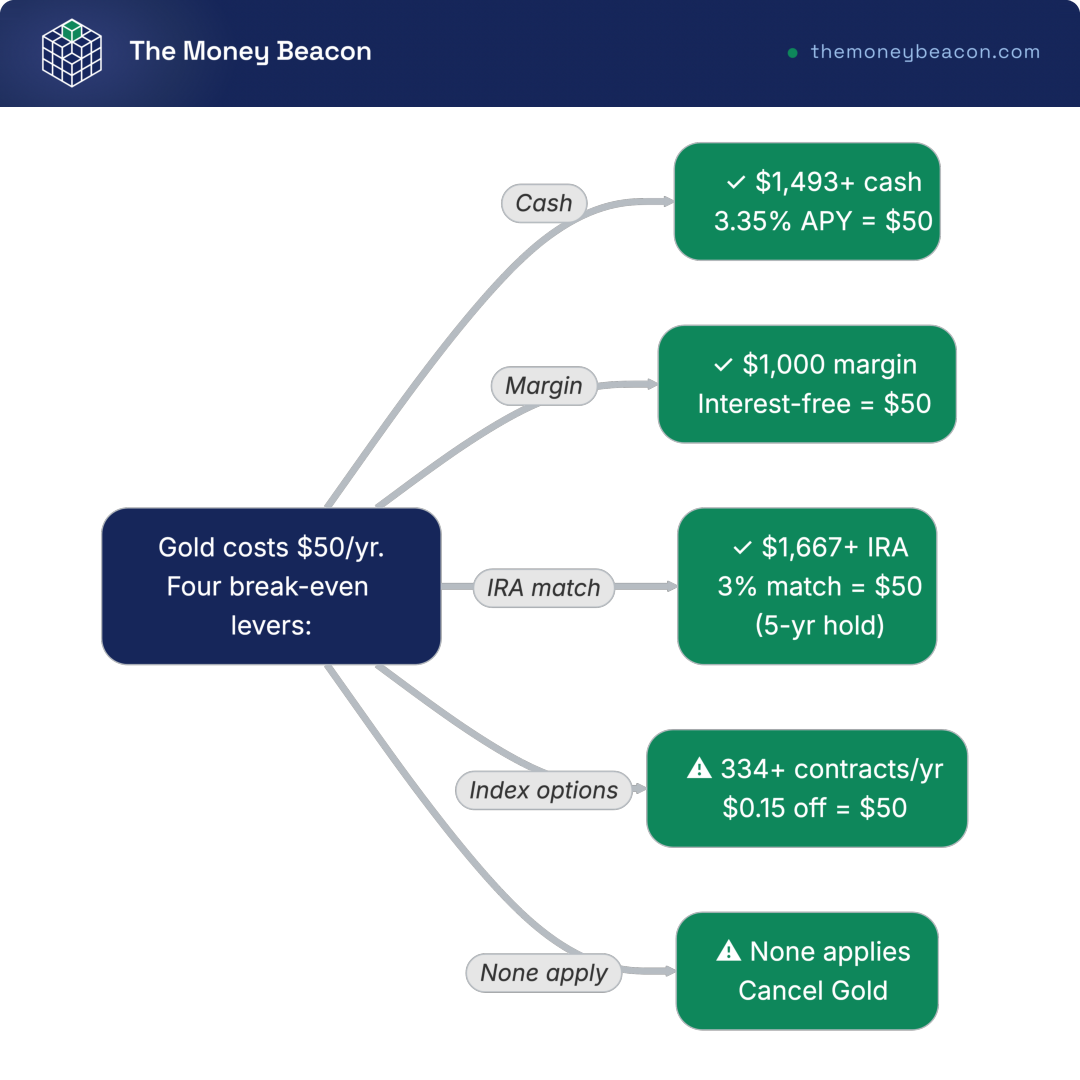
At the $50 annual price, cash clears at about $1,493 held a full year ($50 divided by 0.0335). Margin clears at about $1,000 of debit carried all year: Gold covers the first $1,000 of margin investing, and $1,000 at 5% is exactly $50. The match clears at about $1,667 contributed, index options at 334 contracts a year on the $0.15 Gold discount, futures at 200 on the $0.25 per side discount.
Behind the second branch are the Robinhood margin rates, published as of December 11, 2025: 5% on settled balances up to $50,000, 4.8% to $100,000, 4.5% to $1 million, 4.25% to $10 million, 4.2% to $50 million and 3.95% above that. Retail borrowers pay the top rung, so it’s competitive rather than cheap.
The index-options lever is the weakest of the four, because 334 contracts a year is 28 a month, sustained for twelve months, purely to recover a subscription. The Gold research bundle of Morningstar reports and Nasdaq Level II data works the same way, real money to a trader, close to nothing to an accumulator.
So is Robinhood Gold worth it? On cash, it clears easily. Everything else depends on habits you can measure in advance: with $300 of cash, no margin and no IRA, you’re paying $50 for instant deposits and a card benefit, a subscription looking for a use.
That leaves the part a review can’t price.
4. What the price does not cover: support and a five-year enforcement record
Cheap gets paid for somewhere. Two places, and neither shows up on a fee schedule.
4.1 App-first support, no published response time, and the ladder above it
You raise a request in the app, and phone contact comes back as a callback, not a switchboard.
Robinhood says in-app phone support runs 24/7, then publishes investing support hours of 7:00 a.m. to 9:00 p.m. Eastern, Monday to Friday.
What I went looking for and didn’t find is a service commitment. Robinhood publishes no response or resolution time, so the only leverage with a deadline is outside the app.
Save that ladder now. Broker-dealer conduct goes to the FINRA Investor Complaint Center, securities law and disclosure issues to the SEC through Investor.gov, and card and payments issues to the Consumer Financial Protection Bureau (CFPB) database. The binding step, written into the customer agreement, is FINRA arbitration.
The CFPB database was built for consumer products such as cards and deposits, so brokerage disputes go to FINRA and the SEC instead. Comparing a broker’s complaint count with a bank’s compares two collection systems, not two service levels.
4.2 Four settled actions in five years, and how much weight they deserve
Support is what happens on an ordinary day. The record is what happened when regulators looked.
Four settled actions in five years. The SEC settled on December 17, 2020 over statements about execution quality and payment for order flow, a $65 million civil penalty in an order describing about $34.1 million of aggregate customer harm. FINRA acted on June 30, 2021 over misleading margin and options communications and systems outages, $57 million in fines plus about $12.6 million of restitution. The SEC settled again on January 13, 2025 over recordkeeping and reporting failures at two Robinhood broker-dealers, $45 million in combined penalties. FINRA followed on March 6, 2025 over supervisory and compliance failures, $26 million in fines plus $3.75 million of restitution.
The Robinhood outage history is part of that second action, the March 2 and 3, 2020 platform failure FINRA’s own settlement describes as almost two days.
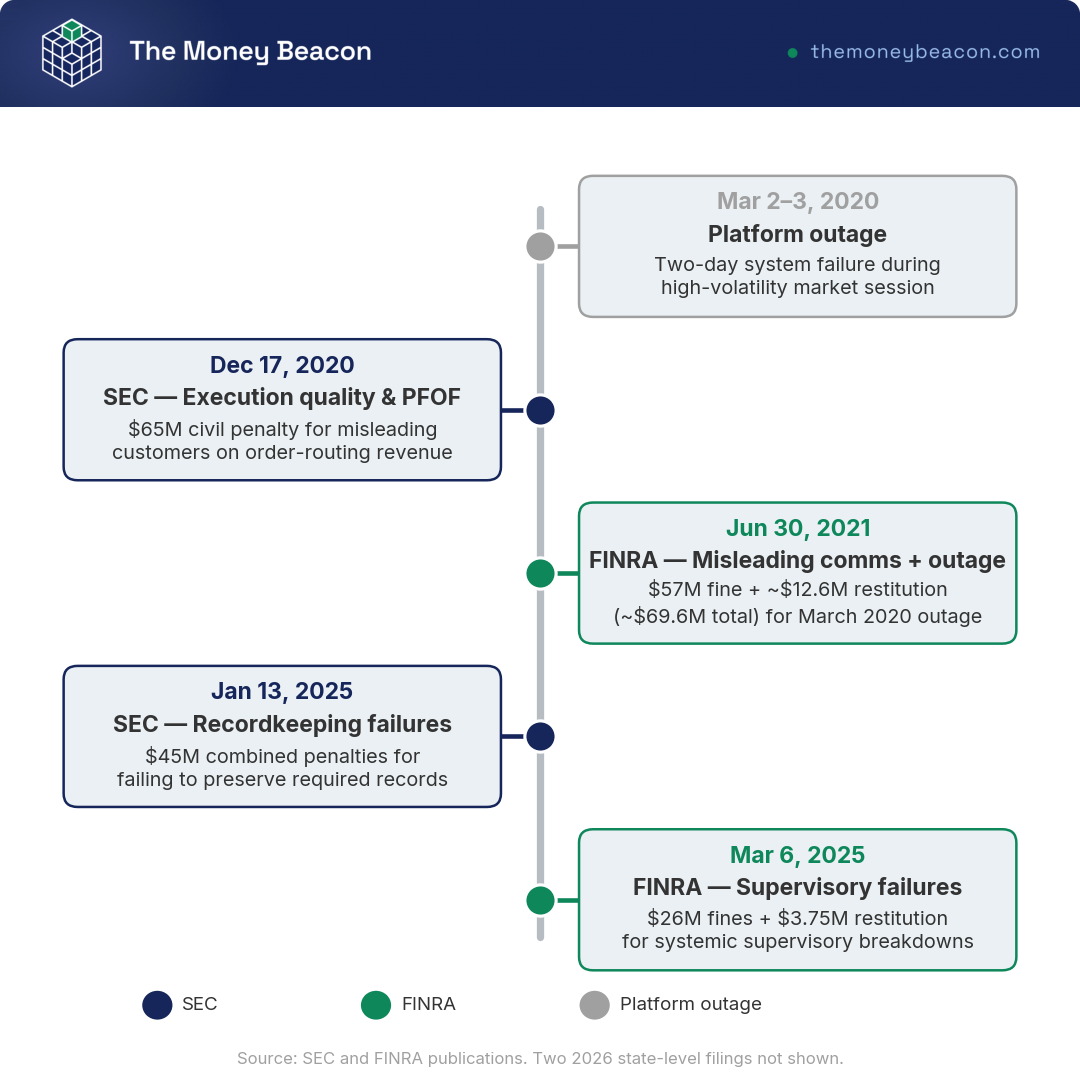
The 2020 and 2021 actions concern how the platform was presented to customers; the 2025 actions concern how the firm supervised and recorded itself, a less customer-facing failure mode.
Now the counterweight. None of it touched custody, and SIPC membership, the clearing structure and the supplemental insurance are unchanged. So this is a governance signal, not a custody warning.
5. The verdict: who Robinhood is for, and who should stay away
Time to rule.
5.1 Robinhood beside Fidelity, Schwab and Webull, on the lines that decide it
On the lines that still separate these four brokers, Robinhood wins the per-contract fight and loses the exit fight.
Table: Competitive positioning: pricing and fees
| Published line | Robinhood | Fidelity | Charles Schwab | Webull |
|---|---|---|---|---|
| Stock and ETF commission | $0 | $0 | $0 | $0 |
| Equity options, per contract | $0 | $0.65 | $0.65 | $0 |
| Index options, per contract | $0.35 with Gold, $0.50 without | $0.65, no index surcharge stated | $0.50 | |
| ACATS transfer out | $100, partial or full | $0 | $50, full transfer | |
| Mutual funds | Not available | $0 minimum | $0, OneSource | |
| Uninvested brokerage cash | 3.35% APY with Gold | 0.01% APY |
Data current as of August 2026, from each provider’s own pricing pages; Robinhood APY as of February 11, 2026. Blank cells are lines I could not confirm.
Row two is worth $156 a year at 20 contracts a month. And one row does the real work when moving a brokerage account to another broker stops being hypothetical. At $100 to leave, Robinhood is the worst of the four.
5.2 The ruling: a clean split, and four readers who should open something else
Four readers should open something else.
Start with the long-horizon investor consolidating a household holding mutual funds. Those funds are neither offered nor accepted by ACATS, so consolidating means selling first, a taxable liquidation. Building a long-term position in low-cost index funds works through ETFs, but the existing funds can’t come with you.
Next, the 1099 contractor or small-business owner, and the parent saving for college. There’s no SEP IRA, SIMPLE IRA or solo 401(k). There’s no 529 plan and no HSA either.
Then the retiree building a maturity ladder, because there are no individual bonds, only bond ETFs. And the crypto-first user who wants insured custody, since Robinhood Crypto belongs to neither FINRA nor SIPC, which makes a crypto-first exchange reviewed on custody and security the fairer comparison.
So what is the downside of Robinhood? Not the pricing. The perimeter.
Now who should open it. The active equity options trader is the best fit, on $0 a contract against $0.65 at Fidelity and Schwab. The investor holding an idle four or five-figure cash balance is next, on 3.35% with Gold against Schwab’s 0.01%, worth $785 a year net of the subscription on $25,000. Two more come out favorably: joint and custodial account users, and a single-earner accumulator with a taxable account and one IRA.
The ruling, both ways in one line: genuinely one of the cheapest US brokerage accounts to trade in, and genuinely one of the narrowest to hold a whole financial life in.
Take the lever, not the score, from this Robinhood brokerage account review. Turn the High-Yield Cash Program on and run the four Gold break-evens during the 30 free days, before you move a dollar you’d pay $100 to move back.
Conclusion
I went in expecting the fight to be about commissions. It isn’t. Reading Robinhood’s own fee schedule line by line, I couldn’t find the hidden trading charge people keep warning about on a stock order. The expensive part is one layer up, in what the account is allowed to hold and what it charges you to walk out with it.
You judge a broker on the day you open it, when the only number on the screen is $0, and you pay for that judgment on the day you leave. A $100 exit door isn’t really a fee, not on a platform that liquidates fractional shares and crypto on the way out. It’s a decision about how easy leaving should be.
So the ruling stands. If you trade equity options, or you’re sitting on an idle four or five-figure cash balance, Robinhood is priced better than the household names. I’d use it for that. If your financial life needs a solo 401(k), a 529, real bond maturities, or a mutual fund position you’d rather not liquidate, no subscription patches that hole.
One thing to do today: write down what you already hold and what you actually trade in a typical month. That list, not the $0, tells you whether to fund this account.
Further reading: if mutual funds are the sticking point, start with my Vanguard brokerage account review. If it’s the cash, weigh the Gold sweep against money market accounts you don’t pay a subscription to use. And before selling anything to move it, read how capital gains and dividends are taxed in 2026.
Frequently asked questions
Is my money safe at Robinhood, and what does SIPC cover?
Robinhood’s protection splits into three buckets, not one blanket policy. Securities and cash at the broker-dealer carry SIPC coverage up to $500,000, including a $250,000 cash limit. Cash above $10,000 gets swept to partner banks through the IntraFi Network Deposit Sweep Service, where FDIC pass-through coverage runs up to $2.5 million individual and $5 million joint, and SIPC no longer applies once it’s swept. Crypto sits outside both systems: Robinhood Crypto belongs to neither FINRA nor SIPC. None of this covers a loss on the investment itself, only a broker failure.
Does Robinhood charge a fee for options, and do I need $25,000 to trade them?
No fee of its own, and no, you don’t need $25,000. On options tied to US listed equities, ETFs and closed-end funds, Robinhood charges no commission and no per-contract fee, where Fidelity and Schwab each publish $0.65 a contract, a $156 difference at 20 contracts a month. Index options are $0.35 a contract with Gold, $0.50 without. The $25,000 figure was never an options minimum; it was FINRA’s pattern day trader equity requirement, eliminated effective June 4, 2026. Options approval is still its own application, with no published turnaround.
What is the $100 fee on Robinhood?
It’s the ACATS transfer-out fee, and I’d want to know about it before funding the account, not after. Robinhood charges $100 whether you move one position or the whole account, more than two years of the annual Gold subscription. Schwab charges $50 for a full transfer out; Fidelity charges nothing. A second cost rides along: fractional shares and crypto can’t move in kind, so Robinhood sells them and sends cash instead, and in a taxable account that sale is a realization event on a timeline you didn’t pick.
Is Robinhood Gold worth it for uninvested cash?
On cash alone, Gold clears its own price easily. It costs $50 a year, and the High-Yield Cash Program pays Gold members 3.35% APY, so the subscription pays for itself at around $1,493 held for a full year. Keep $25,000 in cash and Gold’s rate produces $837.50 a year against $2.50 at the 0.01% Schwab publishes for uninvested brokerage cash, a net gain of $785 after the fee. Remember that 3.35% is Gold-only, has to be switched on, and floats with short-term rates rather than staying fixed. If you’d rather weigh it against dedicated cash accounts, compare it on the rate you keep after the $50 subscription.
What happens to the IRA match if I leave?
You can lose it. Gold members get a 3% match on annual IRA contributions, worth up to $225 in 2026 on the $7,500 standard limit, paid into the IRA so it isn’t taxable income the year you get it. The catch is the five-year holding period on matched funds: a distribution or transfer out inside that window can trigger a clawback, and Gold has to stay active for one continuous year after your first eligible deposit. I’d call this a retention payment more than a gift.
Is Robinhood still trustworthy after the regulatory actions?
I’d rather hand you the record than an opinion. The SEC settled with Robinhood for $65 million in December 2020 over its statements on execution quality and payment for order flow. FINRA followed in June 2021 with $57 million in fines plus about $12.6 million in restitution, over misleading margin and options communications and the nearly two-day outage of March 2 and 3, 2020. Two more settlements landed in 2025: $45 million from the SEC in January over recordkeeping failures, and $26 million from FINRA in March plus $3.75 million in restitution. None of it touched custody: SIPC membership and the clearing structure stayed intact.




Comments
Questions and corrections welcome. We read everything.