


Your renewal notice shows up with a bigger premium on it, so you do the sensible thing and go looking for a better price. There isn’t one to find. Auto insurance is the only product in personal finance with no shelf price. Every premium is priced one driver at a time. Your ZIP code matters, your driving record matters, and in most states a credit-based insurance score counts too. Change one input and the quote changes. Open three carrier sites in three tabs and you get three numbers you can’t compare, because each one quietly assumed a different deductible.
So the ads hand you a number that belongs to somebody else’s ZIP code and somebody else’s driving record. Progressive advertises $946 in average savings for drivers who switch. State Farm advertises $740. Both figures are real, and neither one is a price. Each one comes from the people who switched and saved, which leaves out everybody who shopped and stayed put. You can’t buy an average. You can only get quoted. And guessing wrong costs you more than money, because it’s how drivers end up at state minimum liability limits that leave them exposed after one serious injury claim.
That still leaves plenty you can compare before you type your ZIP code into anything. Each carrier publishes a discount list and the rules of its safe-driving app, and those are differences you can actually check. One of them matters more than the rest: five of the six telematics programs in this comparison can raise your rate, not just lower it. Where an increase is blocked, that’s state law doing it, not the carrier being generous. So enrolling that app is a trade at almost every carrier, not a free discount. If you drive 6,000 miles a year, the trade can still pay off. If your commute runs past midnight, it can go the other way.
1. How we compared the six biggest auto insurers, and why none of them will show you a price
If price is off the table, something else has to take its place.
1.1 The criteria we applied to all six carriers
Nine dimensions, applied identically to every carrier in this car insurance comparison 2026: positioning and how the company sells, coverages actually written, published discounts, the telematics program and what it can do to a rate in both directions, disclosed fees, eligibility, claims and service access, financial strength, and who the carrier suits.
Two limits before we start. This comparison can’t tell you which carrier is cheapest for you, since not one of them publishes a premium. And a national discount list isn’t what you’ll be offered. State Farm names thirteen discounts on its national page and six on its Texas page. Same company, same year, half the list.
1.2 Why no auto insurer publishes a price
A premium is assembled from your ZIP code, your age, your record, your annual mileage, the vehicle, the limits and deductibles you pick, and in most states a credit-based insurance score. That last input is where it gets strange. Credit-based insurance scoring plays no part in auto rating in California, Hawaii, Massachusetts or Michigan. Michigan goes furthest of all: its 2019 reform also bars sex, marital status, home ownership, education, occupation and ZIP code from rate setting. So a Michigan quote can’t be lined up against one from anywhere else. A middle tier including Maryland, Nevada, Oregon and Utah restricts credit rather than banning it. In most of them, credit can’t be the sole reason for a cancellation or a declination.
| Rating input | Direction of effect | Driver control | Where it is decided |
|---|---|---|---|
| ZIP code (garaging address) | Large; territory factors drive base rates | Low, short of moving | State rate filing |
| Driving record (violations, at-fault accidents) | Large; typically rateable 3 to 5 years | Medium, over time | Carrier underwriting rules |
| Credit-based insurance score | Large in most states, banned in several | Medium, over months | State law plus the FCRA |
| Annual mileage | Moderate; the basis of low-mileage and pay-per-mile programs | High | Quote inputs and telematics |
| Vehicle make, model, year, safety and theft record | Moderate | High, at purchase | Carrier symbol tables |
| Liability limits chosen | Moderate; higher limits cost less per dollar of protection | High | The reader |
| Collision and comprehensive deductible | Moderate | High | The reader |
| Prior continuous coverage | Moderate; a lapse is expensive | High | The reader |
| Discount eligibility (bundle, multi-car, student, payment method) | Small to moderate each, cumulative | High | The reader |
| Telematics score | Up to roughly 30% down, or up, depending on state | High, once enrolled | Carrier program plus state law |
Data current as of August 2026.
1.3 What each carrier tells you before you ask for a quote
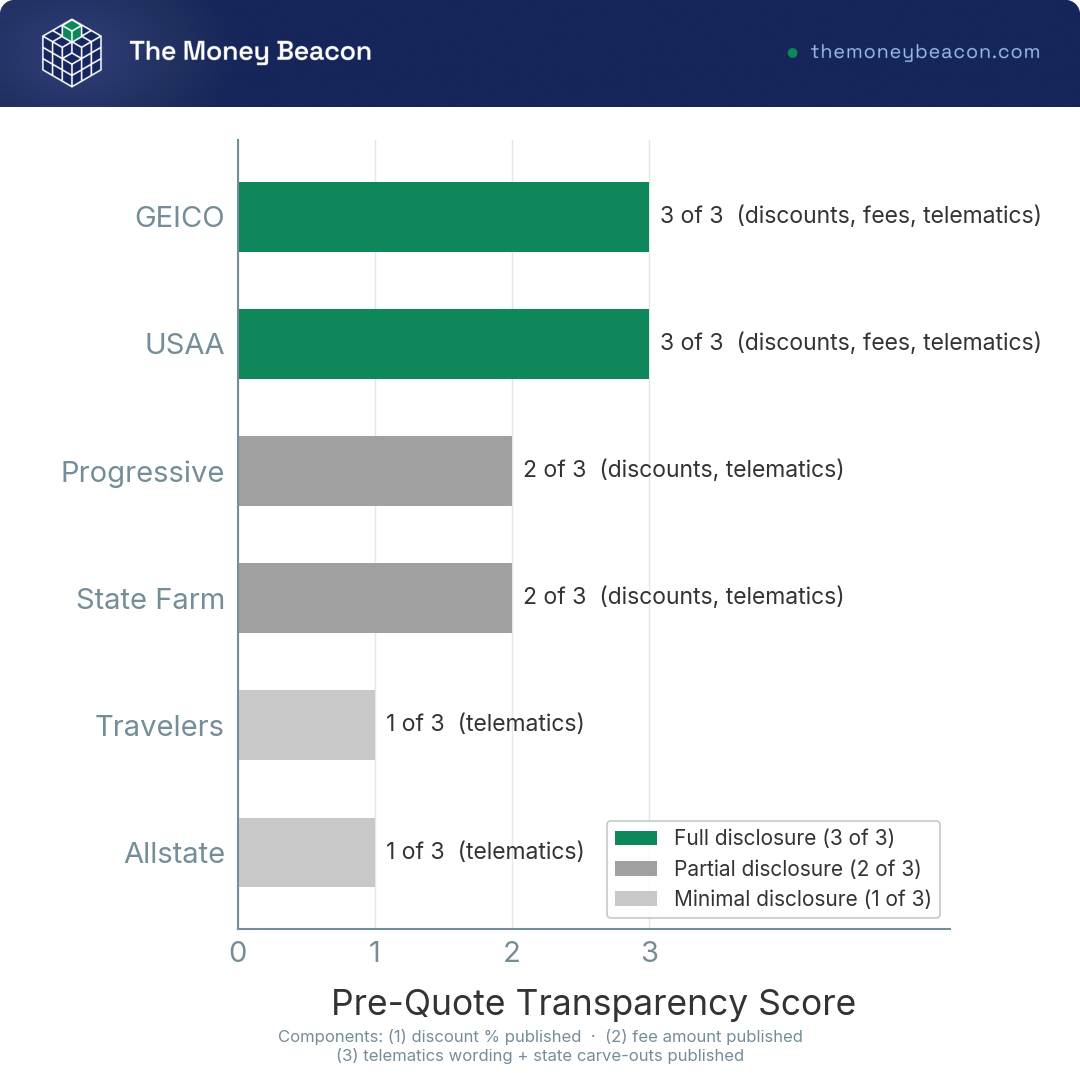
So the next best signal is disclosure. How much will a carrier tell you before it has your name, your ZIP code and your permission to pull a report? On that measure the six aren’t close.
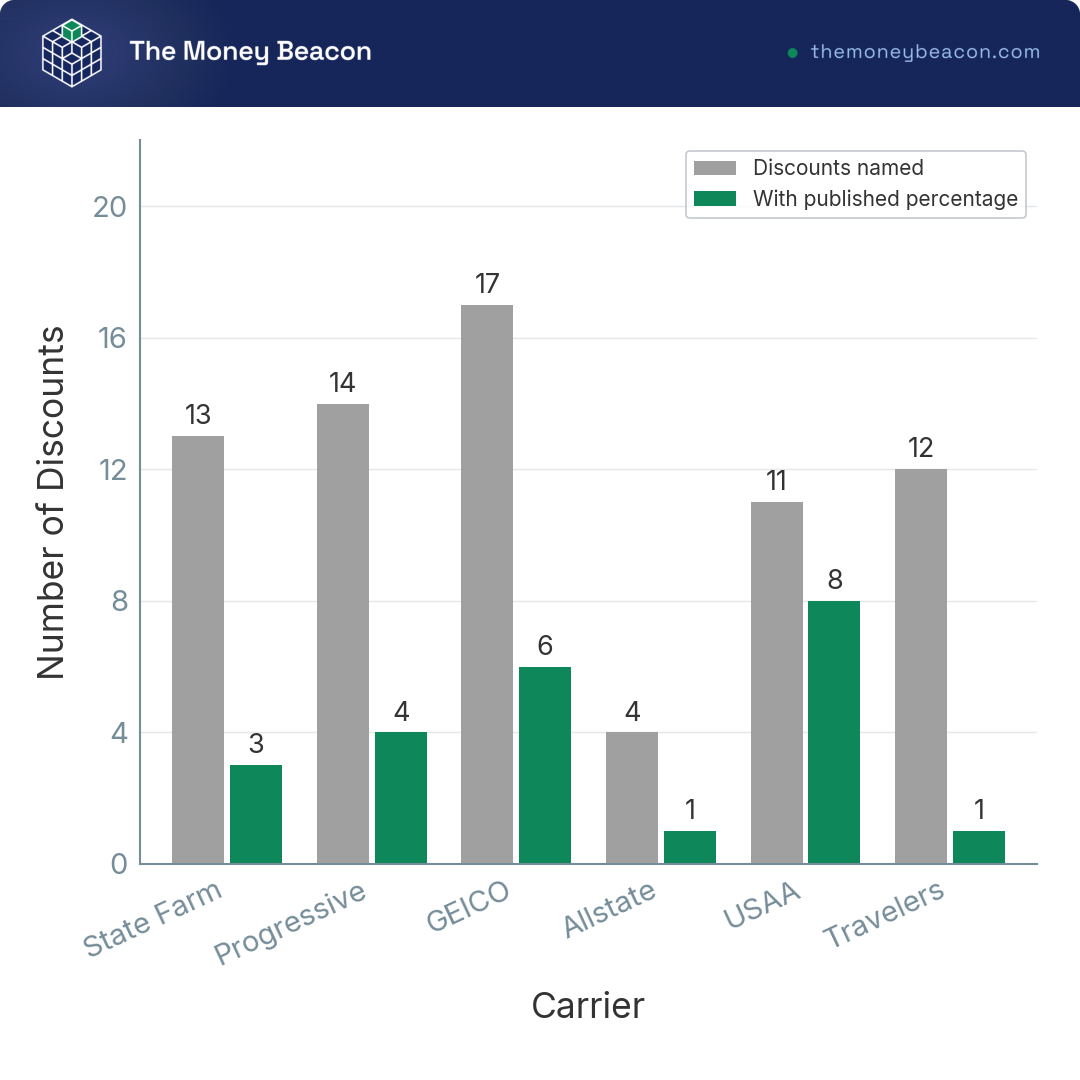
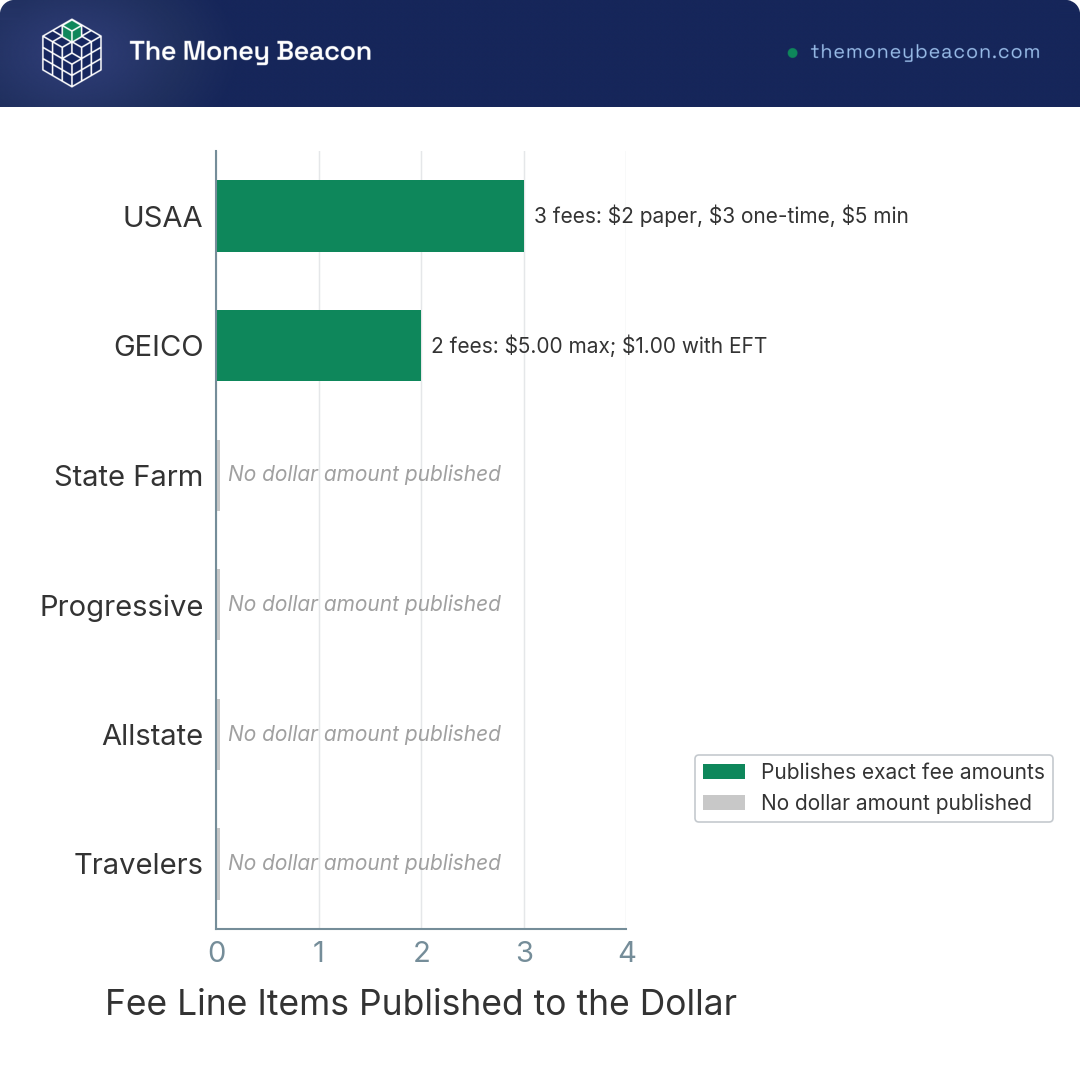
GEICO publishes real percentage ceilings across almost its whole car insurance discounts list. USAA publishes ceilings on most of its. Travelers names twelve discounts and attaches a percentage to none of them. Allstate names only four on its discounts page and publishes no percentage at all.
Read the chart below as a transparency ranking and nothing more. A carrier that publishes more is easier to compare, and easier to compare isn’t the same thing as cheaper.
1.4 State minimums, full coverage and the deductible trade-off
Every state sets a floor, and the floor is low. Look at the numbers below: one serious injury claim exceeds them, and you personally owe the difference.
Full coverage isn’t a product anyone sells. It’s shorthand for liability plus collision plus comprehensive. Collision pays for your car when you hit something; comprehensive pays for theft, fire, weather and the deer. Uninsured and underinsured motorist coverage, or UM/UIM, pays your injuries when the at-fault driver has no insurance or not enough of it.
Then the deductible. Raising a car insurance deductible from $500 to $1,000 might cut an illustrative $1,600 premium to $1,450. That’s $150 a year saved against $500 more owed at claim time, so it only pays if you go more than about 3.3 years between physical-damage claims. The precondition matters more than the math: if that extra $500 isn’t already in your checking account, take the lower deductible.
None of the six publishes its list of deductible options, so this comparison carries no deductible row.
| State | BI per person | BI per accident | Property damage | Additional mandates |
|---|---|---|---|---|
| California | $30,000 | $60,000 | $15,000 | Increased limits effective January 1, 2025 |
| Texas | $30,000 | $60,000 | $25,000 | PIP and UM/UIM must be offered; a signed form is required to reject or lower them |
| Florida | Not required for most drivers | Not required for most drivers | $10,000 | $10,000 PIP required; 10/20/10 bodily injury liability is triggered only by certain at-fault crashes and convictions under the Financial Responsibility Law |
| New York | $25,000 | $50,000 | $10,000 | No-fault PIP of $50,000 and UM/UIM of $25,000 / $50,000 required; supplementary UM can be raised to match BI limits |
| Michigan | $50,000 | $100,000 | $10,000 in-state | PIP choice levels: unlimited, $500,000, $250,000, $250,000 with persons excluded under qualified health coverage, $50,000 for Medicaid enrollees, or a Medicare opt-out |
Data current as of August 2026.
1.5 The telematics catch: the app that can also raise your bill
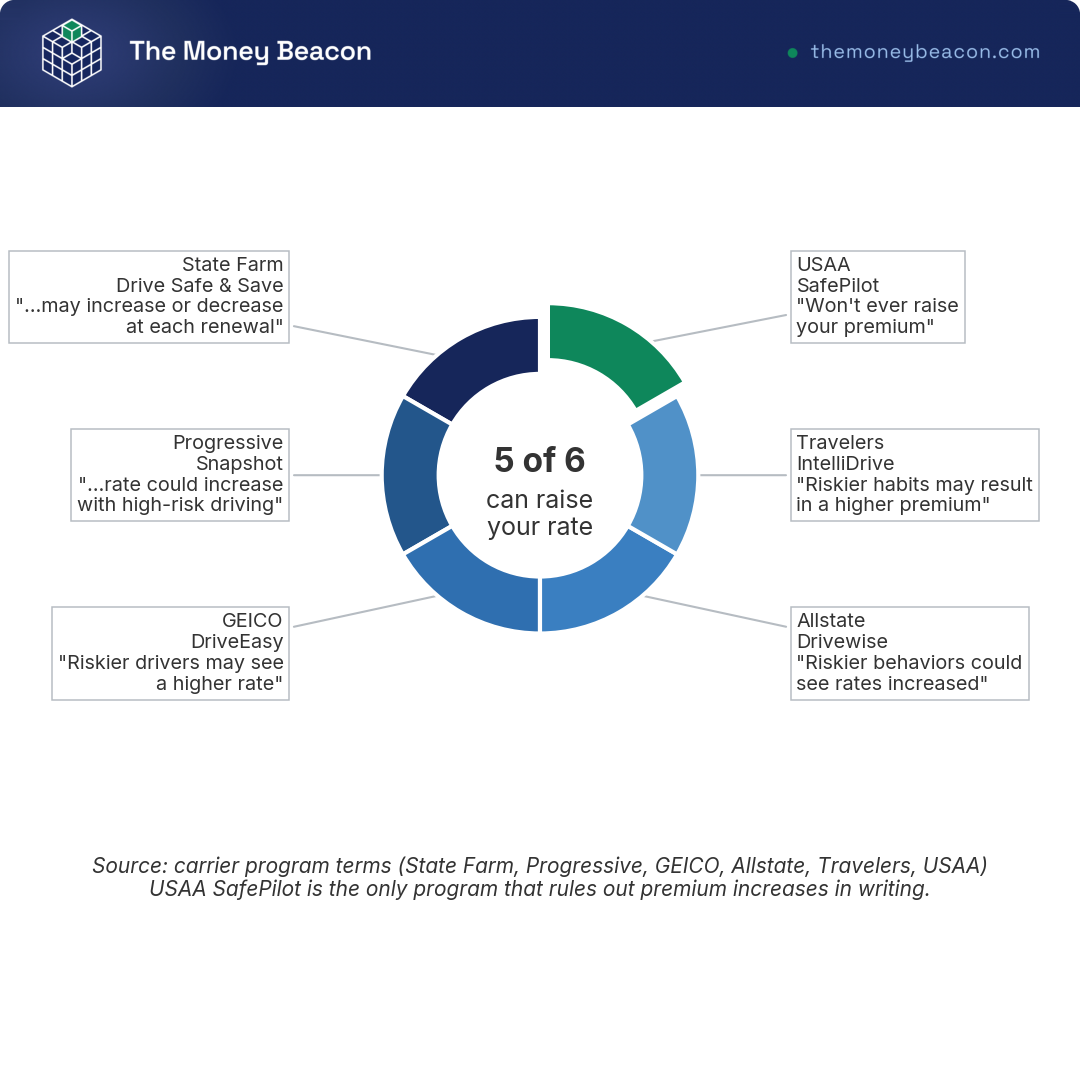
All six sell a telematics or usage-based program, and all six market it as savings. So does telematics raise your rate? At five of the six, it can.
State Farm’s Drive Safe & Save adjustment “may increase or decrease at each renewal”, in State Farm’s own words. Progressive says a rate could increase with high-risk driving, then quantifies it honestly, at about 2 out of 10 drivers. GEICO says riskier drivers may see a higher rate depending on the state. Allstate’s Drivewise and Travelers’ IntelliDrive can both raise a premium too.
USAA is the exception, and it makes the commitment in writing rather than leaving it to a state carve-out. Participation in SafePilot won’t ever raise a premium.
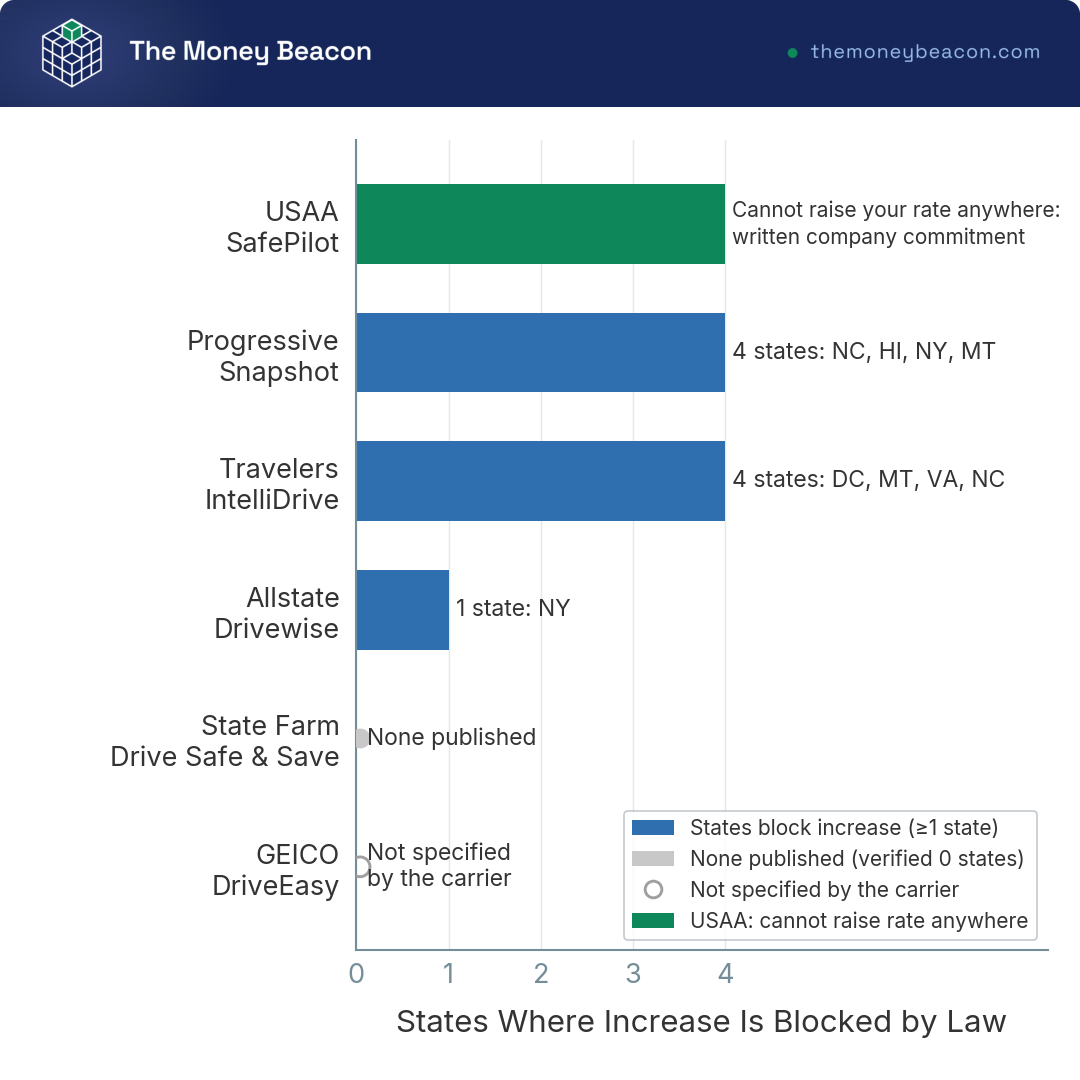
1.6 Where state law, not the carrier, blocks a telematics increase
The carve-outs come from state regulators, which means the same app behaves differently across a state line. Progressive’s Snapshot can’t raise a rate in North Carolina, Hawaii, New York or Montana, and isn’t offered in California at all. Allstate’s Drivewise can’t increase in New York. Travelers’ IntelliDrive can’t in DC, Montana, Virginia or North Carolina. GEICO’s DriveEasy isn’t offered in California, Hawaii or Vermont. State Farm’s discount is unavailable in California, Massachusetts and Rhode Island, and capped at 30% in New York.
Not one of those protections is a carrier deciding to be generous. Check your own state before you enroll, because the same app is a one-way discount in one state and a two-way rate adjustment next door.
1.7 When these rules actually bite: the renewal calendar
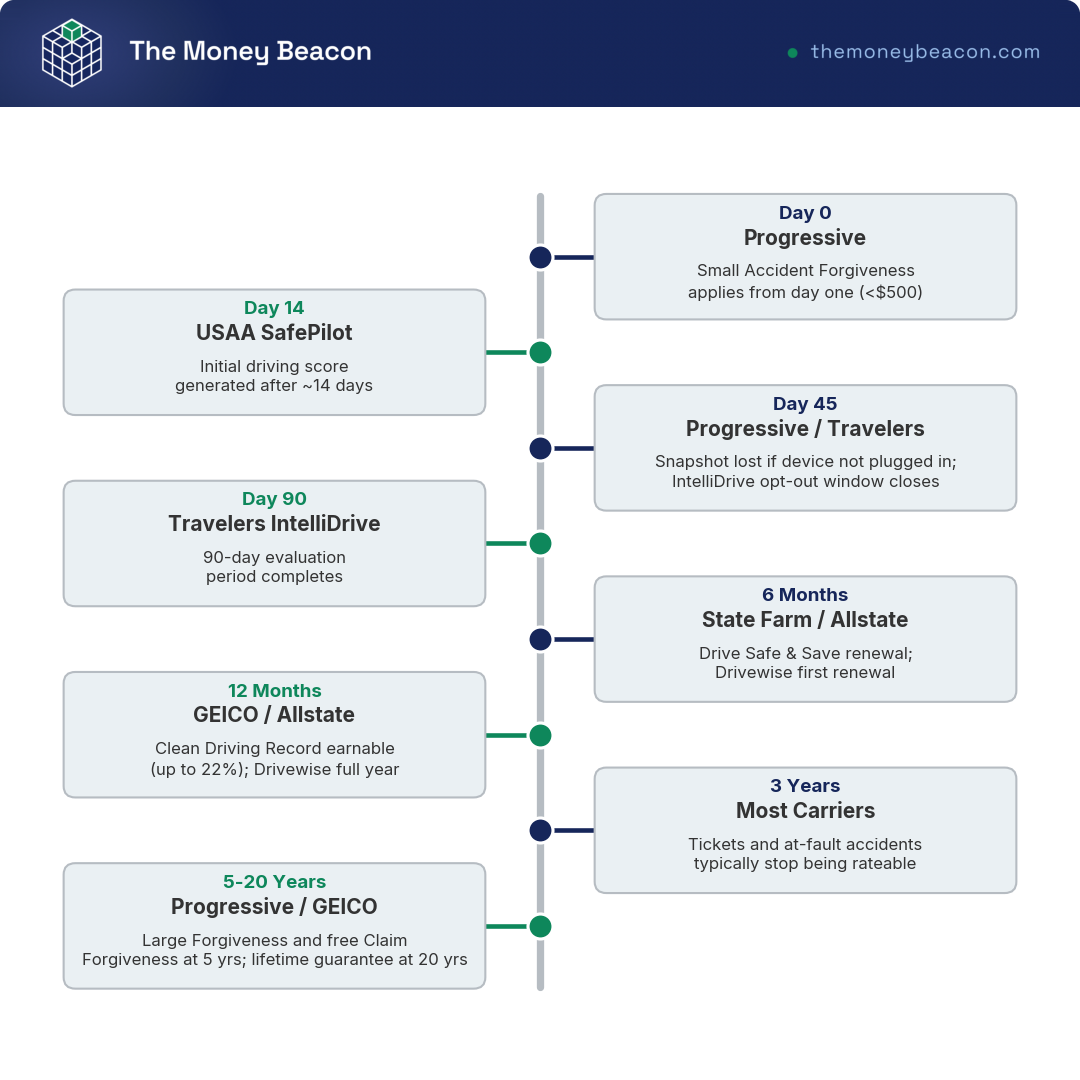
Telematics scores, forgiveness eligibility and violation lookbacks all run on a clock. And the reasons behind a car insurance renewal increase are usually just that clock running out.
USAA generates a first SafePilot score after about 14 days of trips. Progressive sets a 45-day plug-in deadline for the Snapshot device. Tickets and at-fault accidents typically stop being rateable at around three years, while major violations can follow you for five. And State Farm applies a Post-Program Premium Adjustment for at least a year to anyone who leaves Drive Safe & Save.
Almost none of that hits on the day you sign. It hits at renewal. So shop before the renewal notice arrives, not after.
1.8 Financial strength, and the entity that actually writes your policy
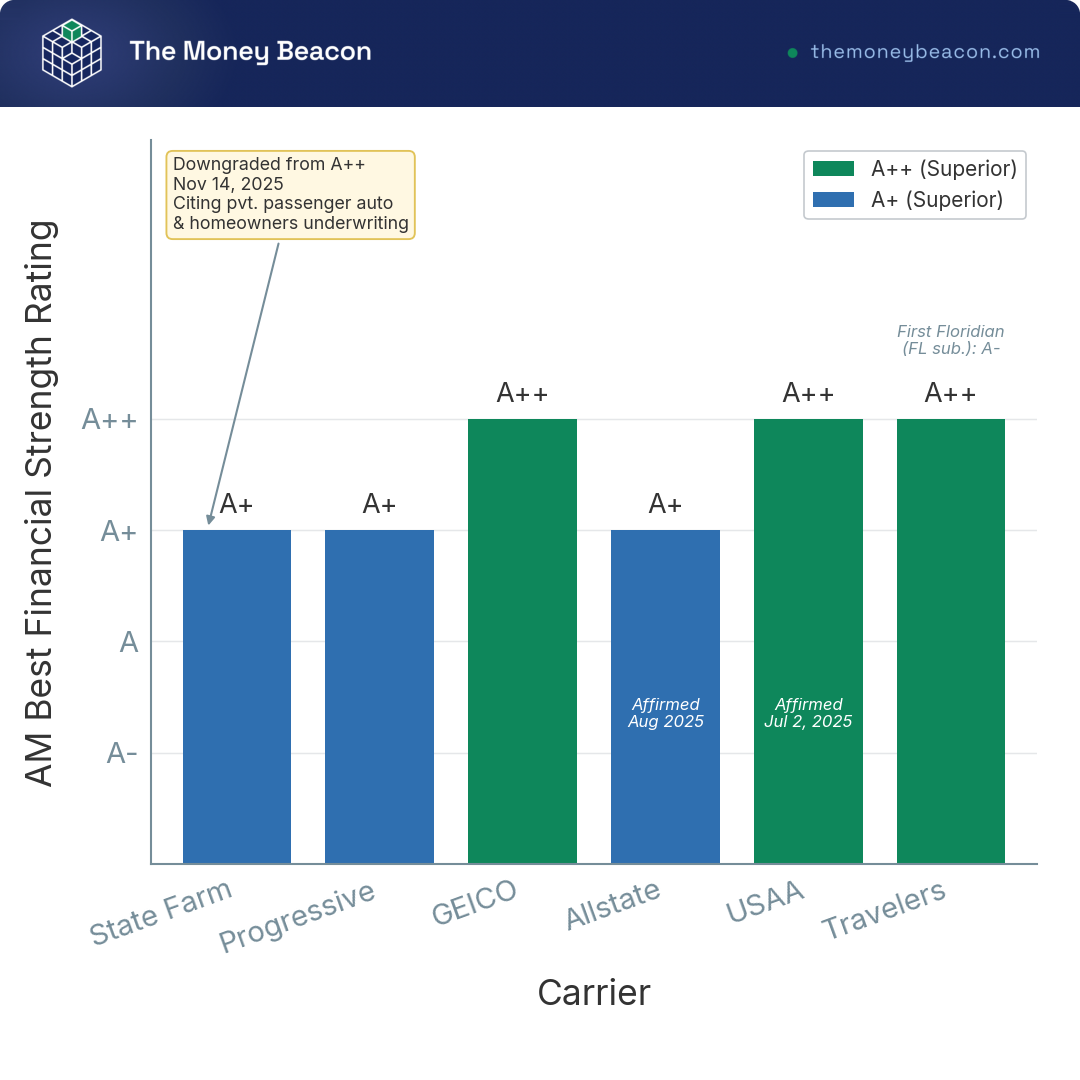
The AM Best rating auto insurance buyers look up belongs to a legal entity, not to a brand. Travelers proves it on one page. Its Reinsurance Pool carries A++, the top of the scale. Its single-state Florida subsidiary, First Floridian Auto and Home Insurance Co., carries A-, five notches lower. Same logo, very different paper.
The biggest development of the past year is State Farm’s. On November 14, 2025, AM Best downgraded State Farm Mutual Automobile Insurance Company to A+ (Superior) from A++. The cause it cited: adverse underwriting driven by elevated loss ratios in private passenger auto and homeowners.
Hank’s take

after years spent picking apart risk data, the first thing I read isn’t the letter grade, it’s what the agency says moved it. A downgrade pinned on private passenger auto tells you the losses landed in exactly the line you’re shopping for, and that kind of signal reaches next year’s rates long before it reaches the advertising.
The other number worth knowing is the NAIC Complaint Index. It divides a company’s share of closed consumer complaints by its share of premium, normalized so the national median is 1.00. And it’s published by writing entity, not by brand. No per-carrier value appears in this comparison, because the number that helps you is yours, not a national one.
1.9 The six carriers at a glance
The six carriers below are the ones any list of the best auto insurance companies 2026 starts from, compared on the criteria above.
| Carrier | Distribution | Eligibility | Telematics program | Can telematics raise your rate? | Publishes discount percentages? | Publishes any fee amount? |
|---|---|---|---|---|---|---|
| State Farm | Captive agents, over 19,000 auto agents | Open | Drive Safe & Save | Yes, “may increase or decrease at each renewal” | Partly: 30% / 20% / 40% ceilings on three discounts | No amount published (Not disclosed) |
| Progressive | Direct plus independent agents | Open | Snapshot | Yes, except NC, HI, NY and MT; not offered in CA | Partly, as averages: 12% / 10% / 7% / from 5% | No amount published (Not disclosed) |
| GEICO | Direct, online and phone | Open | DriveEasy | Yes, “depending on the state”; not offered in CA, HI, VT | Yes, most completely of the six | Yes: up to $5.00, reduced to $1.00 with EFT |
| Allstate | Captive agents | Open | Drivewise and Milewise | Yes, except NY | No (Not disclosed, proven), except Easy Pay up to 5% | No amount published (Not disclosed) |
| USAA | Direct, members only | Military service or a qualifying family relationship | SafePilot and SafePilot Miles | No. “Participation in the USAA SafePilot program won’t ever raise your premium” | Yes, on most of the list, up to 60% for a stored vehicle | Yes: $2 paper statement, $3 one-time payment, $0 autopay |
| Travelers | Independent agents plus direct | Open, but no online quote in AK, FL, HI, LA | IntelliDrive and IntelliDrive 365 | Yes, except DC, MT, VA and NC | No (Not disclosed, proven), except IntelliDrive | No dollar amount published; a service charge applies in most states on the monthly plan, referred to state-specific billing |
Data current as of August 2026.
The reviews run in order of market presence, largest first. Each one is self-contained and answers the same five questions in the same order. So jump straight to the two or three carriers you’re actually considering and skip the rest.
2. State Farm: the agent network, and the downgrade that changed its story
2.1 Overview
Any State Farm auto insurance review has to start with its size. It’s the largest personal auto writer in the country, with more than 19,000 auto agents and over 96 million policies and accounts in force. It’s also the most agent-heavy of the six by a wide margin, selling almost entirely through captive agents.
That’s not incidental. It’s the whole proposition. You get a named local person who handles the policy and, more to the point, handles the claim. The company advertises average savings of $740 for drivers who switch and up to $900 for bundling auto with renters. Both are State Farm’s own advertising claims, and neither is a price anyone can buy.
2.2 Strengths
The agent network is the real product, and it’s the largest of the six. If you want to walk into an office and talk to a human who knows your file, this is the shortest route to that.
Two programs stand out on the auto insurance discounts list. Drive Safe & Save starts with a guaranteed 10% decrease just for joining, costs nothing to run, and goes up to 30% from there. Steer Clear targets drivers under 25 with as much as 20%, one of the few young-driver programs published with a named ceiling. It asks for real work, though: five hours of driving across at least ten trips, plus five training modules with quizzes.
The passive restraint discount goes as high as 40% on medical-related coverages, and the national list has thirteen entries, the longest in this comparison.
2.3 Weaknesses
Three rate-protection features that competitors publish are simply missing. State Farm publishes no accident forgiveness for auto, no gap or new-car replacement coverage, and no vanishing or diminishing deductible feature. The closest thing on offer is the Good Driver discount. Have an at-fault accident and you lose it, instead of having the accident forgiven.
Drive Safe & Save also carries the harshest published exit term of the six. Quit the program and the discount comes off immediately, then a Post-Program Premium Adjustment applies for at least a year after you’ve left.
The discount is unavailable in California, Massachusetts and Rhode Island, and capped at 30% in New York. And that thirteen-discount headline shrinks to six on the Texas page, so the national list is advertising, not an offer.
2.4 Pricing and fees
State Farm confirms it charges a late payment fee and a returned payment fee, and publishes no amount for either. No installment or service fee schedule appears anywhere on the site. The terms are in a Billing and Payment Agreement mailed with your bill. AutoPay is free, with no discount stated for using it.
And driving more than your estimated mileage can push your rate up on its own, no matter how well you drive. AM Best rates the company A+ (Superior) after the November 14, 2025 downgrade from A++.
| Item | What State Farm publishes |
|---|---|
| Named discounts, national page | 13 nationally, 6 on the Texas page |
| Discounts carrying a published percentage | 3: Drive Safe & Save up to 30%, Steer Clear as much as 20%, passive restraint up to 40% on medical coverages |
| Telematics program | Drive Safe & Save, $0 to join, beacon plus app plus odometer readings |
| Published telematics discount range | 10% initial decrease, up to 30% thereafter |
| Can telematics raise your rate? | Yes, the adjustment “may increase or decrease at each renewal” |
| Telematics exit terms | Discount removed immediately, plus a Post-Program Premium Adjustment for at least a further year |
| Accident forgiveness | Not disclosed |
| Gap or loan/lease payoff coverage | Not disclosed |
| Diminishing deductible feature | Not disclosed |
| Deductible options published | Not disclosed |
| Policy or installment fee amount | Not disclosed |
| Other fees the carrier confirms | Late payment fee and returned payment fee, no amount published |
| Rideshare endorsement | Yes, generally adds about 15% to 20% to the premium |
| AM Best financial strength rating | A+ (Superior), cut from A++ on November 14, 2025 |
Data current as of August 2026.
2.5 Who it is for
State Farm is ideal for a family shopping car insurance for teen drivers, especially one that wants a named agent to call when the fender-bender happens. It suits anyone who values a local office over a lower price.
It’s not the right choice for a driver who wants accident forgiveness after a first at-fault accident, or for someone financing a new car who needs gap coverage from the same company. Neither is published.
3. Progressive: the carrier that will still quote a driver with a record
3.1 Overview
Progressive insures around 37 million drivers and sells three ways: direct online, by phone and through independent agents. That reach makes it hard to avoid, and any Progressive auto insurance review has to deal with the advertising first, because it’s the loudest of the six.
Progressive is the only carrier in this comparison that names rivals in its savings claims. It advertises $1,019 for drivers switching from Allstate, $759 from GEICO and $792 from State Farm, alongside $946 for switchers generally and $1,086 for new home-and-auto bundlers. Every one of those is Progressive’s own claim about the people who switched and saved. Not one is a quote.
3.2 Strengths
Progressive is the most willing of the six to quote a driver who has a violation or an at-fault accident on record. If two carriers have already declined you, this is the one still answering.
Its accident forgiveness comes with published terms instead of vague reassurance. From your first policy term, a claim under $500 won’t raise your rate. Stay five years as a customer without a claim or violation and Large Accident Forgiveness applies, covering a claim of any size. At twenty years you earn a lifetime renewal guarantee, meaning the policy renews regardless of what happens to your record.
The ancillary terms are unusually concrete too. Roadside towing covers a 15-mile radius, the Vehicle Protection plan has a $100 deductible, and pet injury covers up to $1,000 of vet bills free with collision. Progressive also writes rideshare insurance coverage, which it requires rather than merely offers if you drive for a rideshare company.
3.3 Weaknesses
Snapshot runs both ways. Progressive states plainly that a rate could increase with high-risk driving, then puts a number on it: about 2 out of 10 drivers actually get one. That’s honest disclosure, and it’s still a one-in-five chance of paying more for volunteering your data.
There’s a second penalty most readers won’t see coming. If Progressive doesn’t collect enough driving information, it applies a surcharge when the policy renews. Plug the device in later than 45 days and you lose the participation discount entirely. A half-finished Snapshot enrollment is worse than never enrolling.
The state map matters as much for Snapshot as anywhere. Snapshot increases are barred in North Carolina, Hawaii, New York and Montana, and Snapshot isn’t offered in California at all.
3.4 Pricing and fees
Progressive is the only carrier in this comparison that publishes anything resembling a price. Its FAQ states that a liability-only policy ranged from $72.64 to $217.04 a month as of 2025, depending on the state. Treat that as an internal average across Progressive’s own book for one thin coverage setup, not as a quote and not as something you can hold against another carrier’s figure.
Beyond that, the disclosure thins out. No policy or installment fee amount appears anywhere on the site, and no list of deductible options either.
| Item | What Progressive publishes |
|---|---|
| Named discounts, national page | 14 nationally, with state carve-outs published as footnotes |
| Discounts carrying a published percentage | 4, stated as averages: multi-car 12%, sign online 10%, online quote 7%, good student from 5% |
| Telematics program | Snapshot, by mobile app or plug-in device |
| Published telematics discount range | Not disclosed nationally; only Hawaii publishes a range, at 0% to 20% |
| Can telematics raise your rate? | Yes, except in NC, HI, NY and MT; not offered in CA |
| Telematics exit terms | Opt out at any time, but a surcharge applies at renewal if too little data was collected, and the participation discount is lost if the device is not plugged in within 45 days |
| Accident forgiveness | Yes: claims under $500 from day one, Large Accident Forgiveness after five years |
| Gap or loan/lease payoff coverage | Yes, loan/lease payoff up to 25% of actual cash value |
| Diminishing deductible feature | Yes, Deductible Savings Bank takes $50 off per claim-free and violation-free period, down to $0 |
| Deductible options published | Not disclosed |
| Policy or installment fee amount | Not disclosed |
| Other fees the carrier confirms | Snapshot data-shortfall surcharge, no amount published |
| Rideshare endorsement | Yes, and required for rideshare drivers |
| AM Best financial strength rating | A+ (Superior) |
Data current as of August 2026.
3.5 Who it is for
Progressive is the best choice in car insurance for high risk drivers, meaning anyone carrying a ticket or an at-fault accident on record. It’s also a strong option for anyone who’d rather read forgiveness terms in writing than be told not to worry.
It’s not the right choice for a low-mileage driver living in a state where Snapshot can raise the rate, since the program is the main way Progressive pays a careful driver back.
4. GEICO: the most transparent discount list, and two coverages it will not write
4.1 Overview
The distribution model is where any GEICO auto insurance review has to start, because everything else follows from it. GEICO sells straight to the customer, online or by phone, with no agent layer in between. Nobody local holds your file, and nobody local gets paid out of your premium either.
It advertises potential savings of up to 15%, plus a 97% customer satisfaction rating. The second comes from a study GEICO commissioned and published in 2024. Both are GEICO’s own claims, so treat them the way you’d treat any advertisement. What matters more is that GEICO expects you to self-serve, from the quote through the claim. It prices and publishes as if it knows that.
4.2 Strengths
GEICO publishes more real numbers than any other carrier in this comparison. That makes it the easiest of the six to evaluate before you spend a minute on a quote form. Its discount table is even dated: November 2025.
The ceilings are published across most of the car insurance discounts list: up to 22% for a clean driving record after one accident-free year, up to 25% for multiple vehicles or a deployed driver, and up to 15% for a full-time student with good grades. Run that clean-record ceiling against an illustrative $1,600 premium and it’s worth roughly $350 a year. The fine print says “most coverages,” though, not the whole bill.
Claim Forgiveness is free for eligible drivers accident-free for five years or more, and purchasable in most states. DriveEasy needs no hardware, just the phone in your pocket and about 105 MB of data a month.
4.3 Weaknesses
Two missing coverages are published outright, and each one is a dealbreaker for a specific kind of reader. GEICO writes no rideshare endorsement, so if you drive for a rideshare or delivery platform, GEICO can’t properly cover you. It also says outright that its auto insurance doesn’t include gap insurance. So a financed buyer has to buy that piece somewhere else.
DriveEasy has a downside too. Riskier drivers may see a higher rate depending on the state. The score re-adjusts at every renewal, and the program isn’t offered in California, Hawaii or Vermont. Claim Forgiveness has its own exclusions. It’s unavailable in California, Connecticut and Massachusetts, and the free version may skip drivers under 21.
And the direct model has a cost. When a claim gets complicated, there’s no named local person to argue with.
4.4 Pricing and fees
GEICO is the only carrier in this comparison that publishes any installment figure at all. And it publishes that figure as a ceiling, not a price. In most states the normal service fee can be up to $5.00, reduced to only $1.00 when you pay by electronic funds transfer. The exact per-installment charge isn’t published anywhere, because it appears on your billing statement and can change.
The 100/300/100 liability figures and the $250, $500 and $1,000 deductibles are worked illustrations of how limits and deductibles get written. They aren’t a published list of options you can pick from.
| Item | What GEICO publishes |
|---|---|
| Named discounts, national page | 17 nationally, plus discounts for over 800 member and employee groups |
| Discounts carrying a published percentage | 6: clean driving record up to 22%, multi-vehicle up to 25%, deployed driver up to 25%, good student up to 15%, DriveEasy typically 5% to 15%, anti-lock braking system 5% |
| Telematics program | DriveEasy, phone only with no device, about 105 MB of mobile data a month |
| Published telematics discount range | Typically 5% to 15% |
| Can telematics raise your rate? | Yes, “riskier drivers may see a higher rate depending on the state they live in”; not offered in CA, HI or VT |
| Telematics exit terms | No penalty period published, though unenrolling may itself change the premium |
| Accident forgiveness | Yes, Claim Forgiveness, free after five or more accident-free years and purchasable in most states; not available in CA, CT or MA, and the free version may not apply to drivers under 21 |
| Gap or loan/lease payoff coverage | No. GEICO publishes that its auto insurance offerings do not include gap insurance |
| Diminishing deductible feature | None appears among GEICO’s published coverages |
| Deductible options published | Not disclosed |
| Policy or installment fee amount | Service fee up to $5.00, reduced to $1.00 with electronic funds transfer. Exact per-installment amount: Not disclosed |
| Other fees the carrier confirms | An installment fee applies on any installment plan, with the amount shown on the billing statement and subject to change |
| Rideshare endorsement | Not disclosed. No rideshare endorsement appears among GEICO’s published auto coverages |
| AM Best financial strength rating | A++ (Superior) for members of Government Employees Insurance Company, no rating action date published |
Data current as of August 2026.
4.5 Who it is for
GEICO is ideal for a price-first driver who’s comfortable buying and servicing a policy online, and who wants to check published percentages before handing over any personal data. A deployed service member or an affiliated group member has a second reason to quote it.
It’s not the right choice for a rideshare driver. And it’s an awkward fit for car insurance for a financed vehicle. That’s because financing a new car leaves a gap between the loan balance and the car’s value. GEICO says outright it won’t cover that, so you’d buy the protection from the lender or the dealer instead.
5. Allstate: the bundling and agent play, with the thinnest disclosure of the six
5.1 Overview
An Allstate auto insurance review runs into an odd split almost immediately. Allstate sells through captive agents, and it’s been doing that for more than ninety years. Its central pitch is bundling home or renters with auto.
That agent model gives you a person and a long list of add-ons. Allstate offers the widest set of named rate-protection features in this comparison, the kind of add-ons that cap what a bad year costs you. It also publishes less about what any of them is worth than any of the others. So the reader who likes reading numbers before shopping and the reader who wants a person to call are two very different customers. Allstate is designed for the second one.
5.2 Strengths
The feature list is broad. Allstate Your Choice Auto, Accident Forgiveness, Deductible Rewards, Safe Driving Bonus and New Car Replacement are all named products. Allstate also writes a rideshare endorsement for a personal car used on a platform.
It also offers two telematics programs instead of one. Drivewise is the behavior-based version, free to add. It prices each renewal from your past 12 months of driving (6 months at the first renewal). Milewise is true pay per mile, a daily rate plus a per-mile rate. That gives a low-mileage driver an option a single-program carrier can’t offer.
And its roadside assistance insurance is a standalone membership with published prices, buyable without an Allstate policy. Roadside Assist is $78 a year with 15-mile tows. Roadside Advantage is $111 with 25-mile tows and tire and wheel reimbursement.
Tom’s take
the question I ask on any add-on like this is what the worst case actually costs me. A tow across town is a couple hundred dollars, so I carry that risk myself and skip the membership. I buy insurance for the losses I couldn’t write a check for, not the ones I’d rather not.
5.3 Weaknesses
Disclosure is the weak point, and it’s systematic rather than accidental. Allstate names only four discounts on its discounts page: anti-lock brake, anti-theft device, responsible payer and good student. It attaches a percentage to none of them. The one exception is the Easy Pay Plan, worth up to 5% on certain policy types where available. You can’t estimate what an Allstate discount is worth until you’ve already handed over your details, and that’s exactly backwards from how you’d want to shop.
Milewise is worse still. Allstate publishes the structure, set from driver age, vehicle type and history, but no dollar figures and no list of the states where Milewise is sold. And its rates “may fluctuate up or down” in certain states, so pay per mile isn’t a guaranteed one-way saving either.
Drivewise can raise a rate everywhere except New York. Deductible Rewards and the Safe Driving Bonus lost their product pages entirely. What survives is a legal footnote: Deductible Rewards applies to collision only, with the deductible floored at $100 in New York and Pennsylvania.
5.4 Pricing and fees
Allstate publishes no policy or installment fee amount anywhere on its consumer site. The billing FAQ mentions installment fees twice without ever naming a figure. It says only that the Easy Pay Plan brings lower ones. Fee amounts are state-filed, so the first place you’ll see yours is your own declarations page.
What Allstate does price openly is roadside, and it prices it to the dollar. Adding household members costs $45 or $50 a year each, up to five of them. Benefits start 72 hours after you enroll. Extended Vehicle Care starts at $19 a month.
| Item | What Allstate publishes |
|---|---|
| Named discounts, national page | 4 on the discounts page, plus bundling, the Easy Pay Plan discount, the Drivewise enrollment discount and a college-student discount published elsewhere. Allstate does not publish a complete list in one place |
| Discounts carrying a published percentage | 1: Easy Pay Plan up to 5% on certain policy types where available. Every other percentage value: Not disclosed |
| Telematics program | Two, Drivewise for driving behavior and Milewise for pay per mile |
| Published telematics discount range | Not disclosed. The Drivewise enrollment discount is published only as varying by state |
| Can telematics raise your rate? | Yes. Drivewise can raise a rate everywhere except New York, and Milewise rates “may fluctuate up or down” in certain states |
| Telematics exit terms | No exit penalty published. The Drivewise participation discount requires at least 50 logged trips before the renewal is processed |
| Accident forgiveness | Yes, sold as an optional add-on |
| Gap or loan/lease payoff coverage | New Car Replacement is published as an optional feature; no separate loan or lease payoff coverage is named |
| Diminishing deductible feature | Yes, Deductible Rewards, collision only, with the deductible floored at $100 in NY and PA. Dollar mechanics: Not disclosed |
| Deductible options published | No list of deductible options appears on Allstate’s coverage pages; the deductible is chosen inside the quote |
| Policy or installment fee amount | Not disclosed |
| Other fees the carrier confirms | Installment fees apply, lower on the Easy Pay Plan. Milewise adds a Mileage Assessment Charge of 40 miles a day when the device stops reporting |
| Rideshare endorsement | Yes, for a personal car used on a rideshare platform |
| AM Best financial strength rating | A+ (Superior), long-term issuer credit rating “aa-“, affirmed August 2025, outlook stable. The rating covers Allstate Insurance Group, so check which member entity your declarations page names |
Data current as of August 2026.
5.5 Who it is for
Allstate is ideal for a household bundling home or renters with auto through an agent, and for a driver who wants forgiveness and deductible features on the same policy. A low-mileage driver has a second reason to ask about Milewise.
It’s not the right choice for anyone who wants to know what a discount is worth before a quote. Almost none of those numbers exist.
6. USAA: the only telematics program that cannot raise your rate, if you qualify
6.1 Overview
A USAA auto insurance review is a strange thing to write, because for most readers the answer is decided before any of it matters. USAA is a members-only exchange serving the military community, and eligibility is the gate. Active-duty service members, National Guard and Reserve members, veterans who separated with honorable service, military spouses and the children of members can join. Everyone else can’t, at any price.
For the readers who can, it’s worth checking first rather than last. USAA sells direct, through its app and site. And it publishes exact figures where the rest of the market publishes ranges or nothing at all.
6.2 Strengths
USAA makes the one telematics commitment in this comparison that isn’t hedged by a state carve-out. Participation in the USAA SafePilot program won’t ever raise your premium, in USAA’s own words. That turns enrolling from a bet into a free option for anyone eligible.
The numbers behind it are published too. SafePilot pays up to 15% for enrolling and up to 30% at renewal. Your first score is generated after about 14 days of trips. SafePilot Miles serves drivers at 8,000 miles a year or under, adding a mileage discount of up to 20% on top.
The rest of the discount list has published ceilings too. One is unusually large: up to 60% for a stored vehicle, aimed at a member heading out on deployment. One quieter detail matters to any family with a teenager. USAA doesn’t charge the policy for a driver holding only a learner’s permit.
6.3 Weaknesses
Who qualifies for USAA is the hard limit, and no amount of clean driving gets you around it.
The SafePilot guarantee also doesn’t apply to every member. The program isn’t available in California, Delaware or New Jersey, nor in US territories or overseas. And the enrollment discount is separately excluded in a long list of states including New York, New Jersey, Pennsylvania, Maryland and Hawaii. So the main benefit is real, but it depends on your state.
Underwriting works the way it does anywhere else. Driving-related tickets and accidents can affect the policy for about three years. A major violation or major accident has a five-year lookback. And USAA states plainly that rates rise when claims costs rise. That’s an industry-wide pressure on the premium, and it’s a completely separate thing from the SafePilot promise. Don’t read the one as canceling the other.
6.4 Pricing and fees
USAA publishes its fees to the dollar, which almost nobody in this market does. Paper statement delivery costs $2, and a one-time payment costs $3. Online statements, automatic payments and Express Pay are all free. Pay each month by one-time payment and that’s $36 a year you could have avoided by turning on autopay. The minimum due to generate a bill is $5.
The restriction terms are published as well. Four or more returned payments in 12 months restricts payment by bank account or check. That restriction lifts only after 12 months with none returned. Refunds process in one to three days electronically, or seven to ten days by mailed check.
| Item | What USAA publishes |
|---|---|
| Named discounts, national page | 11, including SafePilot and SafePilot Miles |
| Discounts carrying a published percentage | Most of the list: vehicle storage up to 60%, SafePilot renewal up to 30%, SafePilot Miles up to 20%, garaging on base up to 15%, SafePilot enrollment up to 15%, bundling up to 10%, good student up to 10%, MyUSAA Legacy up to 10% |
| Telematics program | SafePilot, plus SafePilot Miles for drivers at 8,000 miles a year or under |
| Published telematics discount range | Up to 15% at enrollment and up to 30% at renewal; SafePilot Miles adds a mileage discount of up to 20% |
| Can telematics raise your rate? | No. “Participation in the USAA SafePilot program won’t ever raise your premium” |
| Telematics exit terms | Voluntary, cancellable at any time, with no exit penalty published |
| Accident forgiveness | No accident forgiveness product appears on USAA’s published auto coverage pages |
| Gap or loan/lease payoff coverage | Yes, car replacement assistance and total-loss protection covering the difference between actual cash value and the outstanding loan balance |
| Diminishing deductible feature | None on the auto side. A USAA credit card benefit reimburses up to $200 per covered auto claim |
| Deductible options published | No list of deductible options appears on USAA’s auto product pages; the deductible is set inside the quote |
| Policy or installment fee amount | No installment fee published. A one-time payment costs $3, and automatic payment and Express Pay are free |
| Other fees the carrier confirms | Paper statement delivery $2, online statement delivery free, $5 minimum due to generate a bill, and a bank-account and check restriction after 4 or more returned payments in 12 months |
| Rideshare endorsement | Yes, rideshare gap protection for drivers on a rideshare platform |
| AM Best financial strength rating | A++ (Superior), long-term issuer credit rating “aaa” (Exceptional), affirmed July 2, 2025, outlook stable. That is the top financial strength grade AM Best awards |
Data current as of August 2026.
6.5 Who it is for
USAA is the best car insurance for military members, veterans and qualifying family. It’s especially strong for a member adding a teen on a learner’s permit, storing a vehicle through a deployment, or driving low annual mileage.
It’s the one carrier where a safety-conscious driver can enroll in telematics with no risk of the rate moving up, as long as you’re not in California, Delaware or New Jersey. And it’s not an option at all without a qualifying service or family connection.
7. Travelers: twelve named discounts, none of them priced, and a rating that depends on your state
7.1 Overview
There’s an unusual question to settle before any Travelers auto insurance review can start: which company actually writes the policy? Travelers sells personal auto mostly through independent agents. So you shop it through a broker who can price several carriers in one conversation, not a salesperson who only sells one. That’s the appeal, and it’s most of the pitch.
The other half of it is that Travelers is mostly a commercial insurer. Personal auto is a small line next to a much larger business book, and the brand covers a whole family of separate legal entities. So the name printed on your declarations page matters more than the logo on the advertisement.
7.2 Strengths
Travelers names twelve discounts, one of the longest lists in this comparison: multi-policy, multi-car, home ownership (even if the home is insured somewhere else), safe driver, continuous insurance, hybrid or electric vehicle, new car, EFT, pay in full and good payer, early quote, good student, student away at school, and driver training. That’s the defensive driving course discount under a different name.
The endorsement list is where it gets specific. Premier New Car Replacement replaces a totaled new car with the same make and model for the first five years you own it. The Decreasing Deductible earns a $50 credit for every six-month policy you finish without an accident or a major violation, up to $500. Travelers also writes a limited ride sharing endorsement and a named non-owner policy for someone who drives but doesn’t own a car.
7.3 Weaknesses
Not one of those twelve discounts carries a published percentage. So the list stays a list. You can’t put a dollar value on any of it until a quote comes back. And by then it’s too late to shop on it. Several entries also vanish by state: nine are unavailable in California, and early quote, safe driver and good payer are out in New York.
IntelliDrive moves in both directions too. Riskier driving habits may result in a higher premium, in Travelers’ own words. The only places that increase is blocked are DC, Montana, Virginia and North Carolina.
Then there’s the rating. The A++ on the advertising belongs to the Travelers Reinsurance Pool, not to every company under the brand. First Floridian Auto and Home Insurance Co., the single-state Florida subsidiary, is rated A-, five notches lower. And Travelers won’t quote online at all for risks located in Alaska, Florida, Hawaii or Louisiana.
7.4 Pricing and fees
What Travelers does publish precisely is the telematics math. IntelliDrive pays up to 10% just for signing up, up to 5% in South Carolina and up to 8% in North Carolina. Then it pays up to 30% for safe driving once a fixed 90-day scoring period closes. That 30% becomes 40% in Nevada, and falls to 25% in North Carolina and New Jersey and 22% in Florida. It’s published as available in 39 states plus DC.
Fee disclosure is weaker. Travelers confirms that a service charge applies in most states on the monthly payment plan, then sends you to state-specific billing information for the amount. Ask your agent for that figure before you bind.
| Item | What Travelers publishes |
|---|---|
| Named discounts, national page | 12 named on the national discounts page, with a detailed state footnote; 9 are unavailable in CA and 3 in NY |
| Discounts carrying a published percentage | Not disclosed. None of the twelve carries a percentage. IntelliDrive is the only published rate-effect figure |
| Telematics program | IntelliDrive, a phone app scoring braking, acceleration, speed, time of day and distraction over a fixed 90-day period, with location explicitly excluded from pricing. IntelliDrive 365 additionally in AZ, IN, KY and UT |
| Published telematics discount range | Up to 10% for signing up (up to 5% in SC, up to 8% in NC), then up to 30% for safe driving, rising to 40% in NV and falling to 25% in NC and NJ and 22% in FL |
| Can telematics raise your rate? | Yes, “riskier driving habits may result in a higher premium”, except in DC, MT, VA and NC. Published as available in 39 states plus DC |
| Telematics exit terms | Opt out within 45 days and you lose only the enrollment discount. The window is 90 days in KS, and any time in MT |
| Accident forgiveness | Yes, under the Responsible Driver Plan, forgiving one accident within a specified period; not available in all states, including CA |
| Gap or loan/lease payoff coverage | Yes, loan/lease gap insurance, plus Premier New Car Replacement covering the first five years of ownership |
| Diminishing deductible feature | Yes, Decreasing Deductible: a $50 credit per six-month policy or $100 per twelve-month policy, up to a $500 maximum |
| Deductible options published | No list of deductible options appears on Travelers’ pages. The explainer pages describe how a deductible works, not which ones you can pick |
| Policy or installment fee amount | No amount published. A service charge applies in most states on the monthly plan, with the figure referred to state-specific billing information |
| Other fees the carrier confirms | That monthly-plan service charge is the only fee Travelers names. EFT, pay-in-full and good payer discounts are published with no values attached |
| Rideshare endorsement | Yes, a limited ride sharing endorsement, not available in all states, including CA |
| AM Best financial strength rating | A++ (Superior) for the Travelers Reinsurance Pool, led by The Travelers Indemnity Company. First Floridian Auto and Home Insurance Co. carries A-. No rating action date published |
Data current as of August 2026.
7.5 Who it is for
Travelers is ideal for a driver who already works with an independent agent and wants a long set of named endorsements to choose from. It’s also the best choice for someone buying a new car who wants a five-year replacement guarantee in writing. A hybrid or electric vehicle owner should ask for a quote too.
It’s not the right choice for a Florida driver. You can’t quote online, and the policy would come from the subsidiary rated five notches below the number in the advertising.
8. The verdict: which auto insurer belongs on your quote list
You can’t rank these six on price. So what follows ranks them on what they’ll commit to in writing.
8.1 The full comparison: all six carriers on every criterion
Here’s the whole table. Treat it as the source of truth for every comparison in this article.
| Criterion | State Farm | Progressive | GEICO | Allstate | USAA | Travelers |
|---|---|---|---|---|---|---|
| Distribution | Captive agents, over 19,000 | Direct plus independent agents | Direct, online and phone | Captive agents | Direct, members only | Independent agents plus direct |
| Eligibility | Open | Open | Open | Open | Military service or a qualifying family relationship | Open, but no online quote in AK, FL, HI or LA |
| Telematics program | Drive Safe & Save | Snapshot | DriveEasy | Drivewise and Milewise | SafePilot and SafePilot Miles | IntelliDrive |
| Can telematics raise your rate? | Yes, at each renewal | Yes, except NC, HI, NY, MT; not offered in CA | Yes, state-dependent; not offered in CA, HI, VT | Yes, except NY | No, published commitment | Yes, except DC, MT, VA, NC |
| Discounts named / carrying a percentage | 13 / 3 | 14 / 4, published as averages | 17 / 6 | 4 / 1 | 11 / 8 | 12 / 0; IntelliDrive is the only published percentage |
| Highest published percentage | Up to 40%, passive restraint, medical coverages only | 12% average, multi-car | Up to 25%, multi-vehicle and deployed driver | Up to 5%, Easy Pay Plan | Up to 60%, vehicle storage | Up to 40%, IntelliDrive in NV; 30% nationally |
| Published fee amounts | None. Late and returned-payment fees confirmed, no amount | None published | Up to $5.00, reduced to $1.00 with EFT | None published | $2 paper statement, $3 one-time payment, $0 autopay | None published; a monthly-plan service charge is confirmed |
| Accident forgiveness | None published | Yes, under $500 from day one, large claims at five years | Yes, free at five years accident-free; not in CA, CT, MA | Yes, optional add-on | None published on its auto coverage pages | Yes, Responsible Driver Plan; not in all states, including CA |
| Gap or new-car replacement | None published | Yes, loan/lease payoff up to 25% of actual cash value | No. Publishes that it does not offer gap insurance | New Car Replacement, optional | Yes, total-loss protection and car replacement assistance | Yes, gap plus five-year new car replacement |
| Diminishing deductible | None published | Yes, $50 per claim-free six-month term, down to $0 | None published | Yes, Deductible Rewards, collision only; dollar mechanics not published | None on the auto side | Yes, $50 per six-month policy, up to $500 |
| Rideshare endorsement | Yes, adds about 15% to 20% | Yes, and required | No | Yes | Yes, rideshare gap protection | Yes, limited, not in all states |
| AM Best, and the entity to look up | A+ (Superior), cut from A++ on November 14, 2025 | A+ (Superior) | A++ (Superior), Government Employees Insurance Company | A+ (Superior), affirmed August 2025 | A++ (Superior), affirmed July 2, 2025 | A++ for the Reinsurance Pool, A- for First Floridian Auto and Home |
Data current as of August 2026.
Three rows decide most choices. Telematics can raise your rate at five of the six. Only one program promises in writing that it won’t. Discount transparency splits the six into two groups, one you can evaluate before quoting and one you can’t. And the company AM Best rates is often not the company in the advertisement.
8.2 Discount lists: how many carry a published percentage
A long discount list is worth nothing if none of the entries carries a number.
Be clear about what a published ceiling is and isn’t. It’s not a promise that you’ll get that number, and almost nobody gets the ceiling. What it gives you is something to measure the quote against. When an agent tells you the multi-car discount is already in there, you can ask why it came back at 6% when the carrier’s own page says up to 25%. With the two carriers that publish nothing, you have no way to ask that question at all.
8.3 Telematics economics: what each program actually pays, and risks
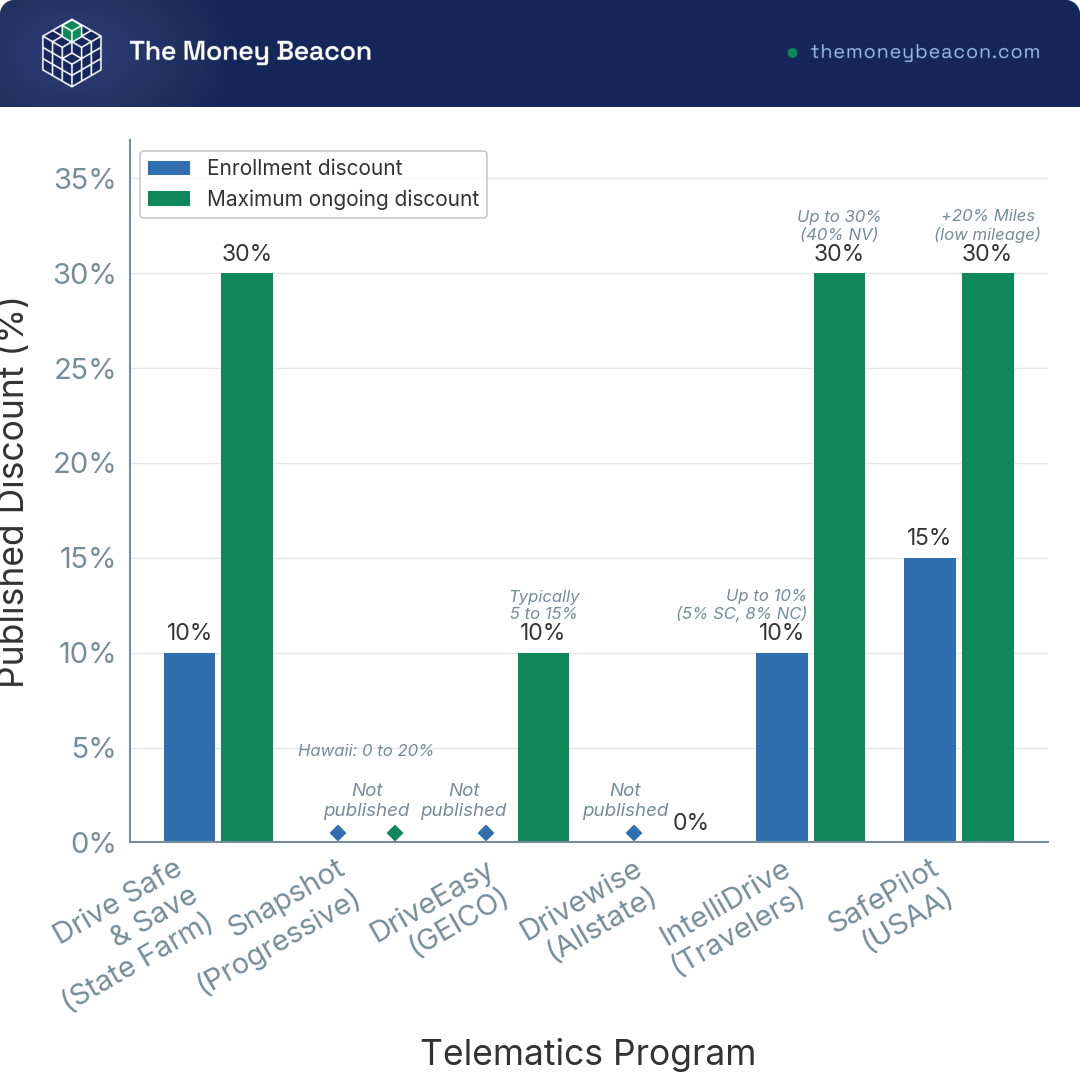
Line up the enrollment discount against the maximum ongoing discount, then ask whether the program can move your rate up.
USAA pays up to 15% to enroll and up to 30% at renewal, with nothing on the downside. State Farm and Travelers pay up to 30% too, but both can move a rate up. And Progressive is the only one that puts a number on the risk: about 2 out of 10 drivers get an increase.
So the telematics discount programs compared here aren’t really one product. For an eligible USAA member it’s a free option, and you’d take it. For everybody else outside a protected state it’s a bet on your own driving, priced by a scoring model you never get to see.
8.4 Rate-protection features: forgiveness, gap and diminishing deductibles
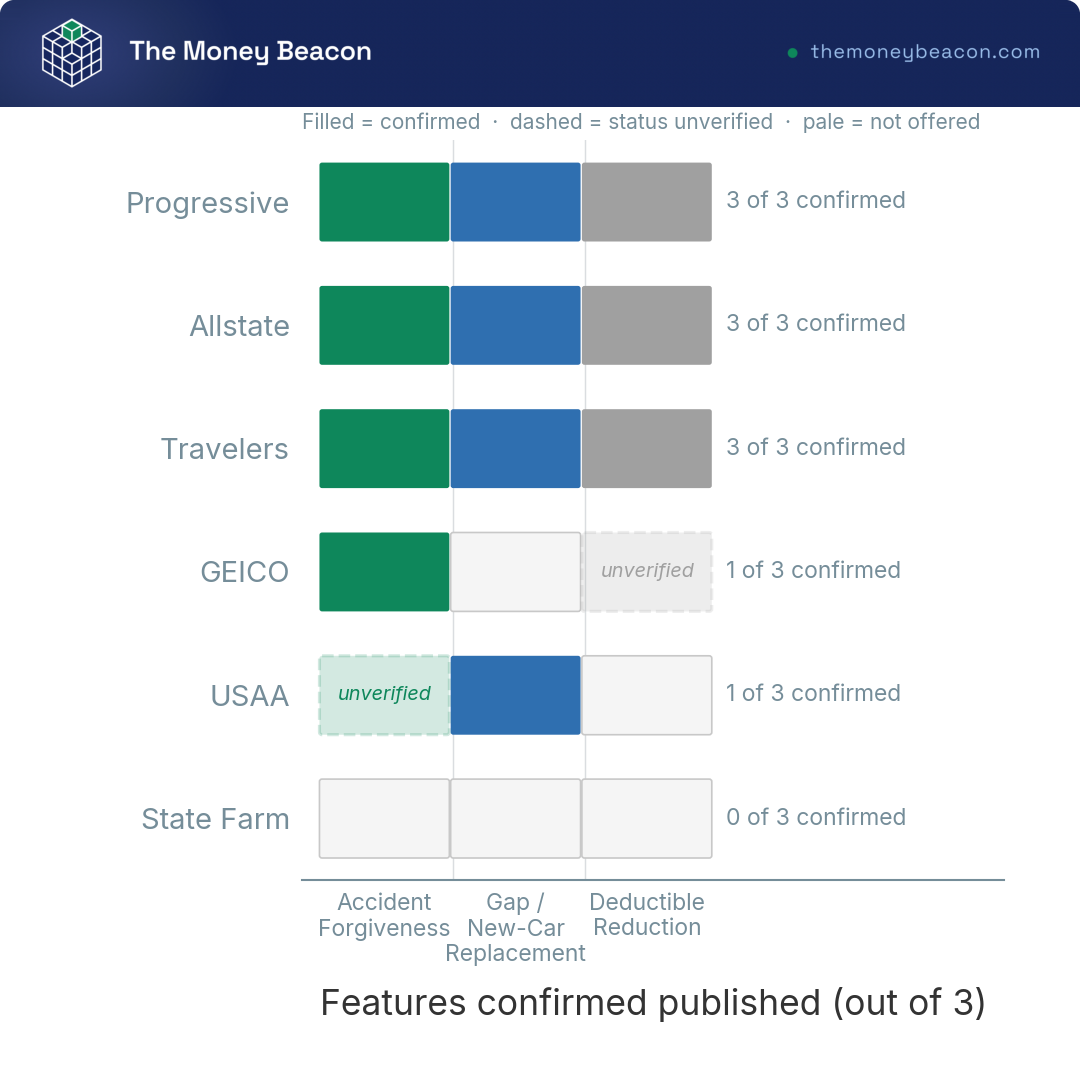
Accident forgiveness, gap or new-car replacement, and a diminishing deductible all do the same job. They cap what one bad year costs you. This is the part of a policy hardly anybody reads until the week they need it.
Progressive publishes the most complete set with real terms attached, and Travelers publishes dollar mechanics too. Allstate names the widest set of features but publishes no mechanics for Deductible Rewards or the Safe Driving Bonus. So you’re buying a name and finding out later what it’s worth. State Farm publishes none of the three.
Financing or leasing a car? Then gap coverage isn’t a nice-to-have, and two of these six won’t sell you one.
8.5 Fees: who publishes a dollar amount at all
Two of the six publish a fee figure. That’s it.
USAA publishes exact amounts. GEICO publishes a ceiling. State Farm confirms a late fee and a returned-payment fee exist and names no amount for either, and Progressive, Allstate and Travelers publish nothing at all. Allstate’s own billing FAQ manages to mention installment fees twice without printing a number.
So ask every carrier for the fee schedule in writing before you bind. The quote won’t contain it, and your declarations page shows up after you’ve already paid. Take GEICO’s published ceiling as the illustration: $5.00 a month is $60 a year. That’s enough to reorder two quotes that came in $50 apart.
8.6 The verdict, by reader profile
Five situations, five shortlists. None of them is a single name, because your own quote can always beat a feature list.
If you’re an eligible military member, veteran or qualifying family, USAA is the best choice.
If you have a ticket or an at-fault accident, Progressive is ideal: it’s the most willing of the six to quote you at all.
If you’re adding a teen driver, State Farm is the best choice, for Steer Clear and for the agent who picks up the phone after the fender-bender.
If you’re bundling home insurance or renters and you want a person to call, Allstate and Travelers are ideal. Go in knowing neither one prices its discounts.
And if you’re buying online near minimum coverage, GEICO is the best choice among the best car insurance companies: published percentages, a published fee, and nobody between you and the quote.
| Reader profile | Quote first | Also quote | Skip, and why |
|---|---|---|---|
| Military member, veteran or qualifying family | USAA (SafePilot cannot raise the rate; up to 60% on a stored vehicle) | GEICO (deployed driver up to 25%), State Farm | None, but confirm USAA eligibility before anything else |
| Driver with a ticket or at-fault accident | Progressive (forgiveness ladder from day one) | GEICO (Claim Forgiveness at five years), Travelers (Responsible Driver Plan) | State Farm, which publishes no forgiveness product |
| Family adding a teen driver | State Farm (Steer Clear), USAA if eligible (learner’s permit not charged) | GEICO and Progressive good student discounts | GEICO DriveEasy and app-based Snapshot, where the teen’s score prices the whole policy |
| Bundling home or renters with auto | Allstate, State Farm | Progressive (multi-policy), Travelers via an independent agent, USAA if eligible (bundling up to 10%) | GEICO if the home line is not competitive; bundling only counts if the discount lands on the declarations page |
| Price-first, minimum-limits buyer | GEICO (published discount ceilings, lowest published fee) | Progressive | Allstate and Travelers, which publish almost no percentages to compare |
Data current as of August 2026.
8.7 Which carrier to quote first
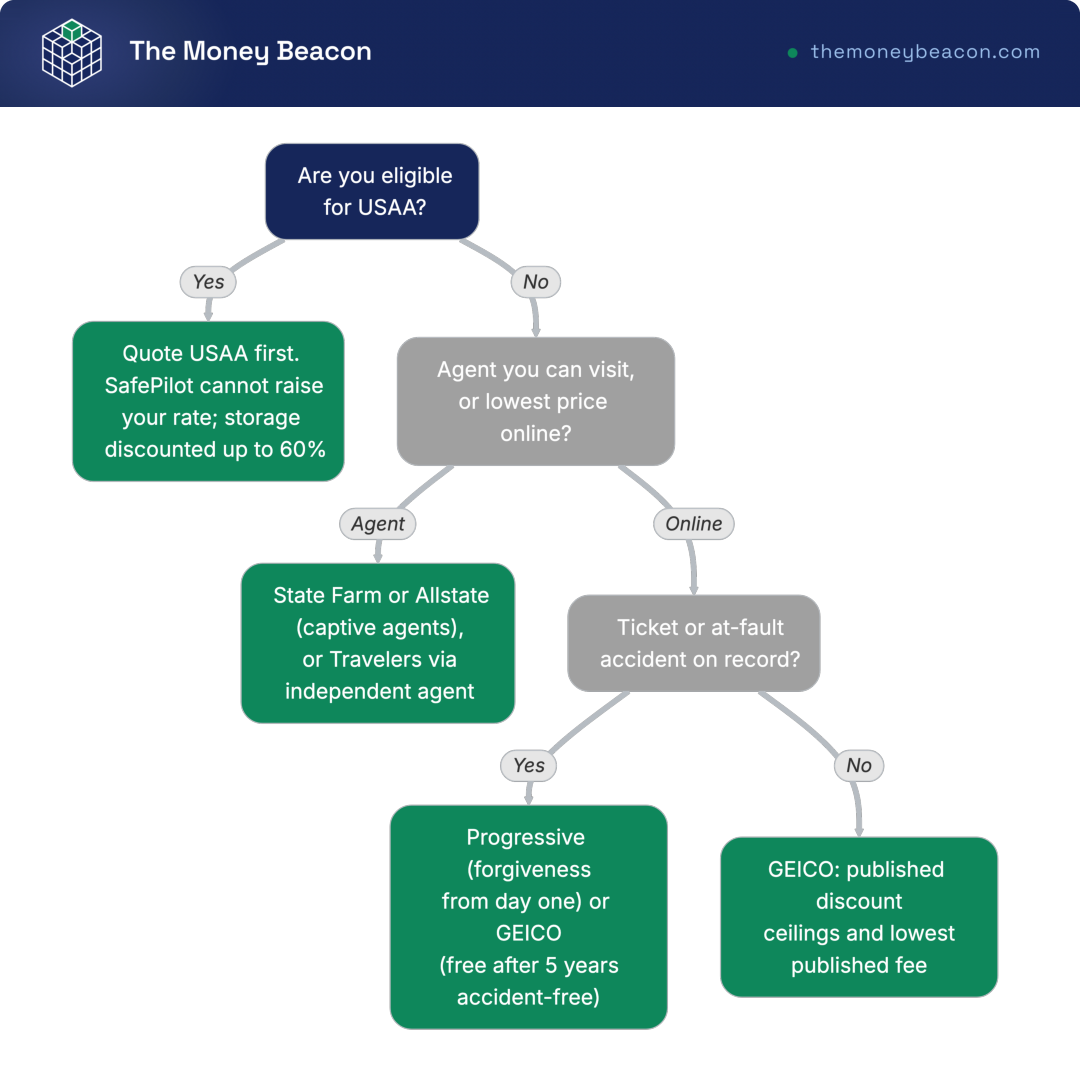
The order matters, because one question outranks all the others.
Start with USAA eligibility. If anyone in the household served, that’s candidate one and nothing else changes it. Next, look at your record. Car insurance after an accident or a moving violation is a different market, and Progressive is where it starts. Then ask whether a bundle is realistic, and whether you want an agent or you’re happy buying online. Last, and only last, think about telematics.
Work down that list and you end up with two or three names, never one. Only your own quotes tell you what you’ll actually pay.
8.8 How to run six quotes that can actually be compared
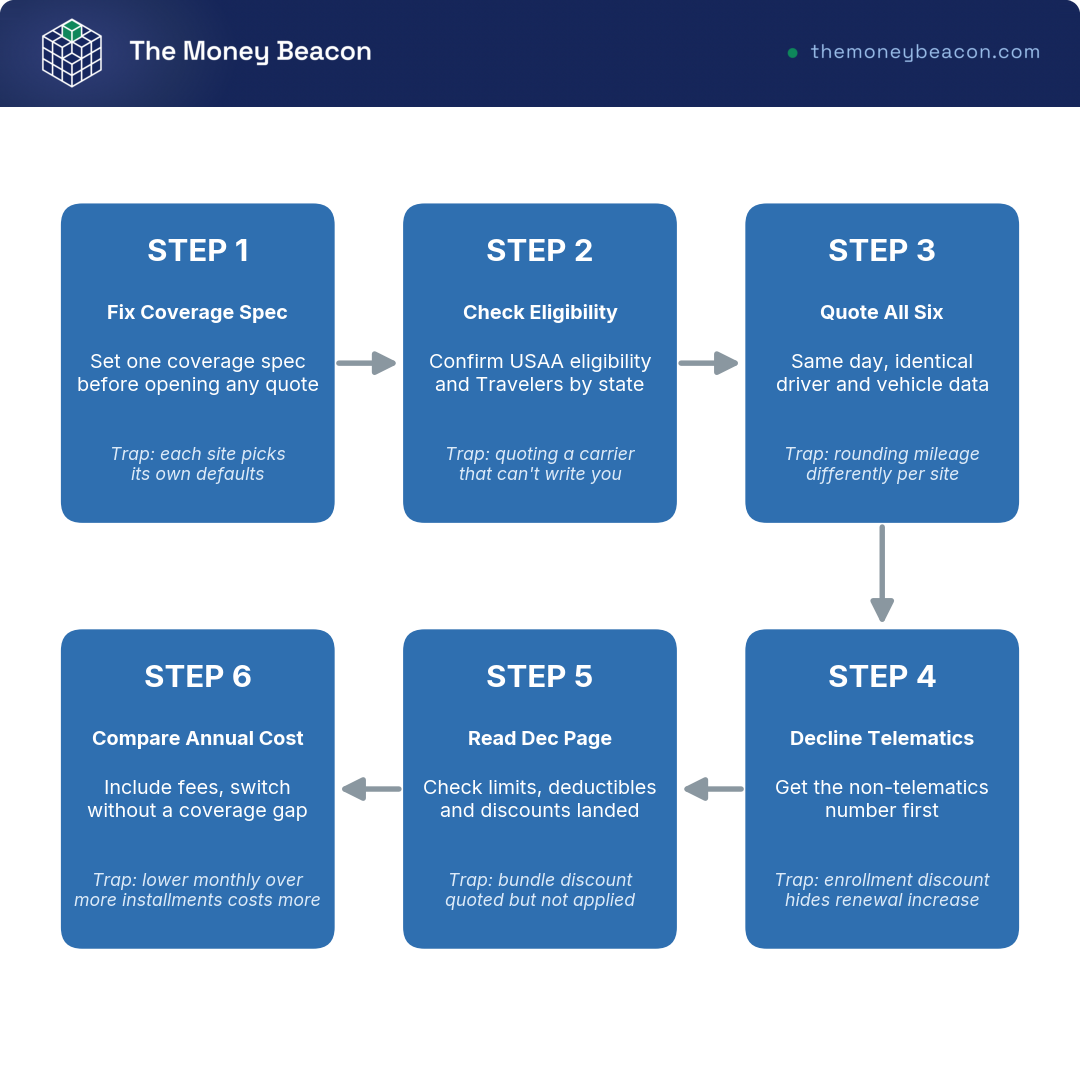
Quotes are only comparable if you hold everything else still.
Run them all on the same day. Use identical liability limits, identical deductibles and the same optional coverages on every one. Use the same annual mileage figure and the same garaging address, right down to the ZIP code.
Then there are four things no quote form will prompt you for. Ask each carrier for the fee schedule in writing. Confirm which legal entity writes the policy before you lean on any advertised AM Best rating. Check your own state’s rules before you enroll in telematics. And look up that writing entity’s NAIC Complaint Index for your state through the NAIC Consumer Information Source.
Change one of those inputs between quotes and you’re not comparing carriers anymore. You’re comparing your own typing.
Conclusion
You can’t look up what auto insurance will cost you, and that isn’t going to change. So the only number that means anything is the one quoted to you by name. Everything before the quote is fair game, though, and that’s the part you can actually compare. Look at how much each carrier publishes about its discounts, what its safe-driving app is allowed to do to your rate, which fees it will name in dollars, and which company actually stands behind the policy. Those are facts you can check in an afternoon, and almost nobody checks them.
The one finding worth remembering is the telematics one. Five of the six programs in this comparison can raise your rate, not only lower it, and where an increase is off the table it’s state law doing that, not the carrier being generous. USAA is the one exception that puts it in writing for SafePilot. So enrolling that app is a trade, not a free discount, and your own state’s rules decide which side of it you’re on.
The coverage question matters more than the carrier question anyway. State minimum liability limits are cheap right up until one serious injury claim exceeds them, and then the rest of what you own is exposed. So decide your limits and your deductible first, then shop. And confirm which legal entity writes your policy before you trust any advertised strength rating: Travelers alone ranges from A++ to A- across its own subsidiaries, so the logo on the ad tells you nothing.
If you do one thing this week, settle the USAA question. If anyone in your household has served, that one answer changes your whole shortlist before you type a ZIP code into anything.
Auto isn’t the only coverage priced one customer at a time, so the rest of your insurance is worth reading just as closely. Our comparison of life insurance companies works through the same trade. It covers term versus whole life, and how much coverage you genuinely need rather than what gets pitched to you. And our guide to health insurance explains deductibles, metal tiers and how an HSA fits.
Frequently Asked Questions
Which auto insurance company is cheapest in 2026?
I ran this comparison across State Farm, Progressive, GEICO, Allstate, USAA and Travelers, and I can tell you upfront: five of the six don’t publish a premium at all. Progressive comes closest with a single range: its liability-only policies range from $72.64 to $217.04 a month as of 2025. But that’s an average across Progressive’s entire book of business in one coverage configuration, not a quote you’d actually get. Your premium gets built from your ZIP code, your driving record, your vehicle, your mileage, the limits you pick and, in most states, a credit-based insurance score. So the “cheapest” carrier is whichever one hands you the lowest number when you run identical quotes at all six on the same day. Advertised numbers like “save $946 switching to Progressive” are survivorship figures pulled from people who already switched and saved, so treat them as marketing, not evidence.
Can a telematics program like Snapshot, Drivewise or IntelliDrive raise my rate?
Yes, and five of the six carriers I looked at say so themselves. State Farm’s Drive Safe & Save “may increase or decrease at each renewal.” Progressive’s Snapshot admits it plainly too: “only about 2 out of 10 drivers actually get an increase.” And it blocks that increase in North Carolina, Hawaii, New York and Montana. GEICO’s DriveEasy says riskier drivers may see a higher rate depending on the state they live in. Allstate’s Drivewise can raise your rate everywhere except New York, and Travelers’ IntelliDrive can raise it everywhere except DC, Montana, Virginia and North Carolina. Where an increase is blocked, that’s state law doing the blocking, not the carrier being generous. The one carrier that breaks the pattern is USAA.
Should I raise my deductible from $500 to $1,000?
Only if that extra $500 is already sitting in your emergency fund today, in cash you could actually spend on the day of a claim. The math is straightforward: divide the extra exposure by the annual saving. Say raising your deductible saves you $150 a year. Then the higher deductible only pays off if you go more than about three and a third years between covered claims. None of the six carriers publishes a deductible price ladder, so you have to measure the real saving yourself, by running the same quote twice, once at each deductible.
A few carriers do build savings programs around the deductible you already have. Progressive’s Deductible Savings Bank needs a minimum $500 deductible to start, Allstate’s Deductible Rewards floors the deductible at $100 in New York and Pennsylvania, and Travelers’ Decreasing Deductible pays you back $50 every six months, up to $500. If the extra $500 for a higher deductible isn’t sitting in a high-yield savings account insured by the Federal Deposit Insurance Corporation (FDIC) you can tap the same day, keep the lower deductible regardless of what the math says.
Who qualifies for USAA auto insurance?
Active-duty service members, National Guard and Reserve members, veterans who separated with honorable service, eligible officer and warrant officer candidates, military spouses, and children of USAA members. USAA also lets an existing member extend membership out to a spouse, children and grandchildren. I’d check this before doing any other comparison work. It decides whether your shortlist has five carriers on it or six. And the one genuinely unique feature in this comparison, SafePilot’s no-increase guarantee, is only available through that membership. No amount of comparing quotes opens the door if you don’t have a qualifying service or family connection.
What is the NAIC Complaint Index and how do I read it?
It’s the ratio of a company’s share of closed consumer complaints to its share of premium in a given line of business, scaled so the national median is 1.00. A number below 1.00 means the company draws fewer complaints than its size would predict, and above 1.00 means more. To look one up, start with the company name printed on your own declarations page, not the brand name in the ad. Then open the NAIC Consumer Information Source at content.naic.org, search that company for private passenger auto in your state, and read the result against 1.00.
Two things to keep in mind. It’s published by the legal entity that actually writes the policy, not by the brand. And it measures complaints filed with regulators, not overall happiness, so treat it as a floor-quality check, not a satisfaction ranking.
Does the AM Best rating on the ads apply to the company that writes my policy?
Not necessarily, and Travelers is the clearest example I found. Travelers publishes A++ for its Reinsurance Pool, led by The Travelers Indemnity Company, and on that very same page it publishes A- for First Floridian Auto and Home Insurance Co., its single-state Florida subsidiary. Same brand, five rating notches apart. Ratings move, too: AM Best downgraded State Farm Mutual Automobile Insurance Company from A++ to A+ on November 14, 2025, citing weaker underwriting results in private passenger auto and homeowners. So read the entity name off your own declarations page and look that specific company up yourself.



Comments
Questions and corrections welcome. We read everything.