


Your balance barely moves. You send $300 a month, and most of it disappears into interest instead of principal. Meanwhile one issuer advertises 21 months at 0% and another advertises 15. The fee that buys those months is buried in the fine print. So you’re left guessing which offer actually costs you less.
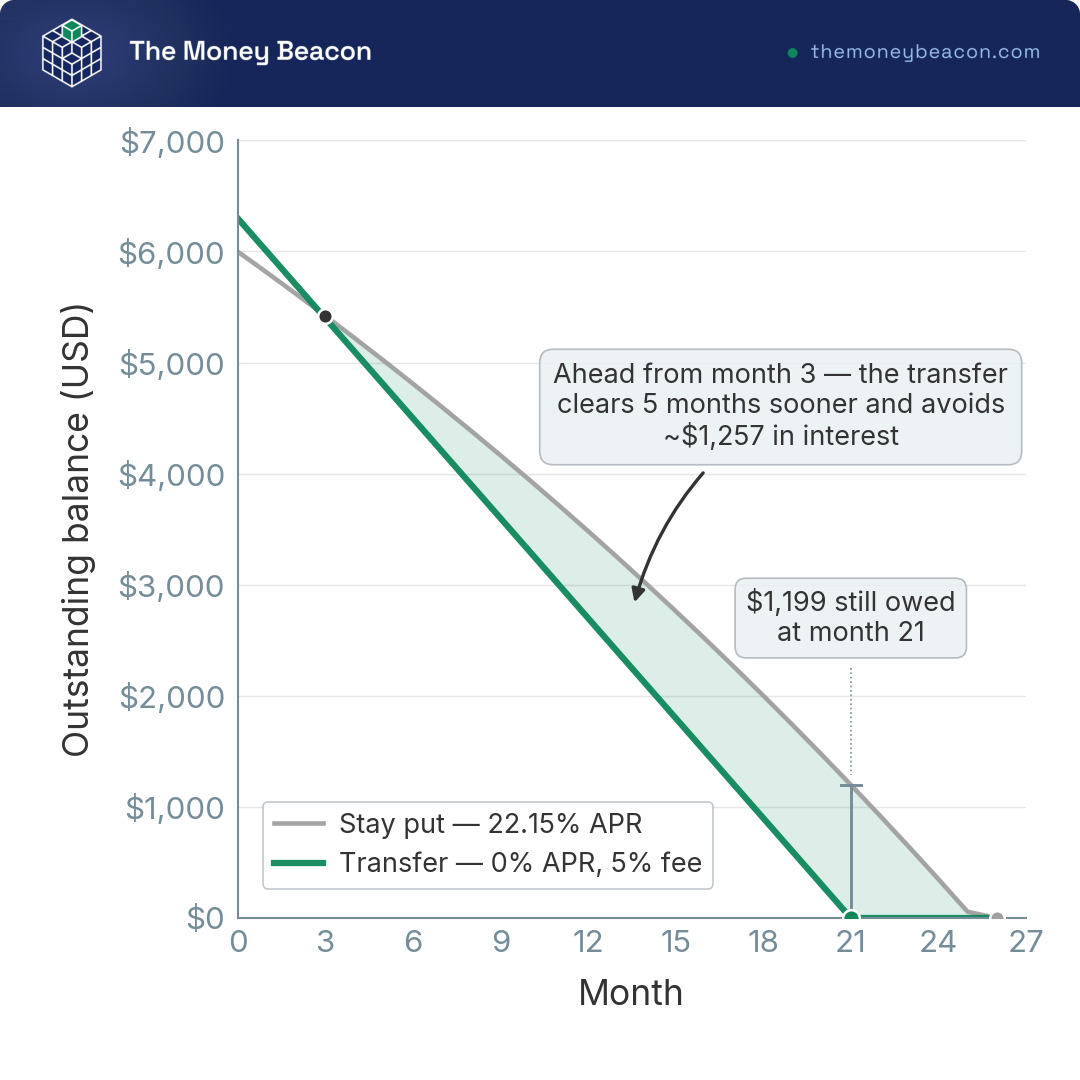
Here’s what standing still costs you. The Federal Reserve’s G.19 release puts the average annual percentage rate (APR) on card accounts charged interest at 22.15%. On a $6,000 balance, that’s $110.75 of interest in the first month alone. Keep paying $300 a month at that rate and you’ll be at it for 26 months. That’s $1,557.21 of interest along the way.
Move that same $6,000 to a 21-month 0% card with a 5% transfer fee and the math changes. You pay $300 up front. You clear the balance in 21 months and save roughly $1,257. So the fee isn’t the enemy. It isn’t a discount either. A balance transfer card doesn’t make your debt cheaper: what it sells you is a fixed number of interest-free months at a percentage price.
Nothing gets forgiven. The balance just moves to a new card, larger by the fee on day one. And the clock starts when the account opens, not when your transfer posts. Every card in this comparison prices those months differently.
Before I rank a single one of these 0% APR balance transfer cards, I’ll show you the exact method I use to compare them. After that I walk through all six and end with a clear pick for your situation.
1. How we compared the six balance transfer cards of 2026
Five numbers decide whether a transfer clears your balance or just relocates it.
1.1 What a balance transfer really buys, and what standing still costs
The new card pays off the old one. Your debt then moves under its terms, bigger by the fee. So what you’re buying is time, and standing still has its own price.
One thing 0% APR balance transfer cards are not: deferred-interest promotions. Those bill back every month of accrued interest if a balance remains, and none of these six price debt that way.
Every figure below assumes $6,000, no new purchases, and a payment of balance plus fee divided by the promotional months. The go-to rate, the APR that takes over once the 0% window ends, comes as a range set at approval and floating with the 6.75% prime rate. And a transfer isn’t your only way out, so the choice turns on what each route actually costs you. Here are the two paths.
1.2 The five criteria that decide the payoff, and their weight
Five things move the answer, and they don’t move it equally.
| Criterion | Weight | Why it decides the outcome |
|---|---|---|
| Months of 0% on transfers | Highest | Sets your payment and your ceiling |
| Balance transfer fee | High | The cash price of the runway |
| Transfer deadline after opening | High | Miss it and you forfeit the rate |
| Go-to variable APR | Medium | Prices whatever is left |
| Purchase and penalty treatment | Medium | Decides if the card is usable after |
Rewards and network perks barely count. A transferred balance earns nothing on any of these six, so a card chosen for what it earns is a different exercise.
What binds you is the Regulation Z Schumer box in the agreement, not the marketing page. Anything you pay above the minimum goes to the highest-APR balance first. One gate comes earlier: same-issuer transfers get refused at the transfer stage, so check who issues your current card.
1.3 Why the transfer fee is prepaid interest, not a loss
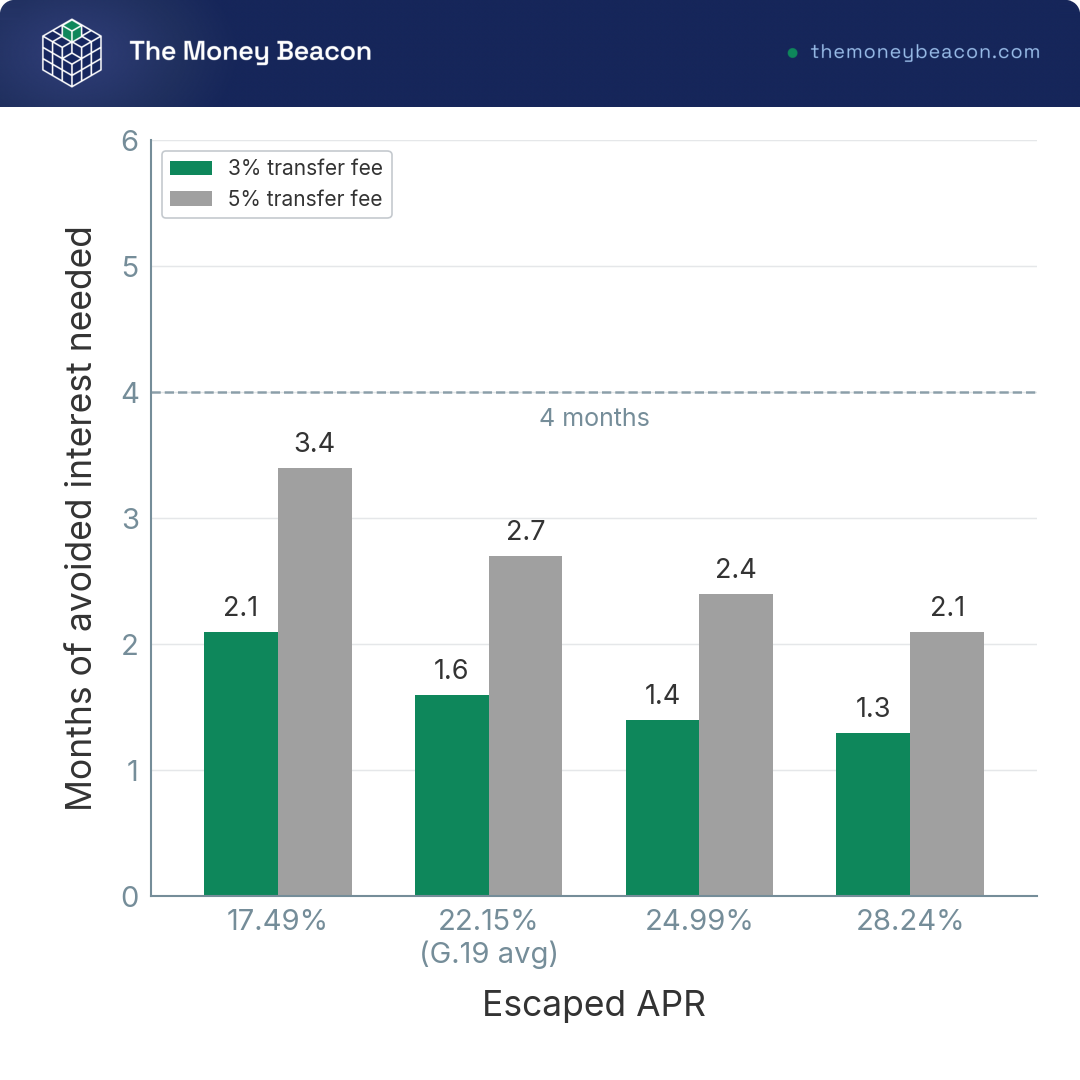
It’s prepaid interest at a discount, and one line prices it: breakeven months equals the fee percentage divided by the monthly APR.
You don’t need a balance transfer fee calculator for that. At 22.15%, a 3% fee is recovered by about 1.6 months of avoided interest and a 5% fee by about 2.7.
So carry the balance more than about four months and even a 5% fee pays for itself. In dollars, 3% of $6,000 is $180, under two months of interest. One catch: on four of the six cards the cheap tier has its own deadline.
Hank’s take

the bank prime rate has come down to 6.75%, and the average card APR hasn’t followed. Follow the data long enough and you stop expecting card pricing to track policy rates. That spread widened rather than narrowed, which is why paying 3% to escape 22.15% is such lopsided arithmetic.
Here’s how that breakeven looks, tier by tier.
1.4 The clock starts at account opening, not at the transfer
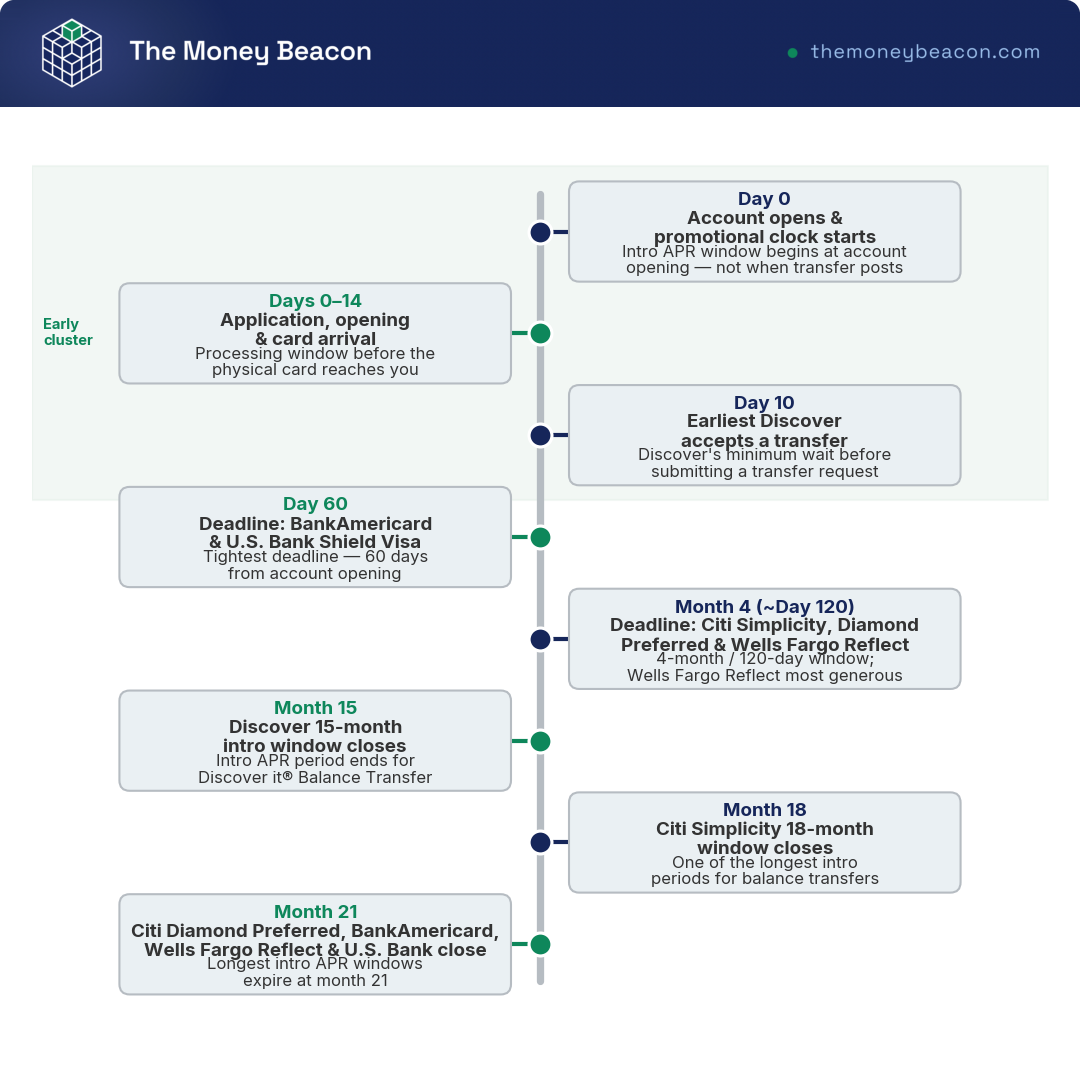
The introductory APR clock runs from account opening, not from the day your balance arrives. So every day between approval and the day the transfer posts is promotional time you spend on nothing.
The deadlines range from 60 days at the tightest to 120 days at the most generous. Discover it Balance Transfer publishes none at all and takes requests from day 10.
Request the transfer inside the application whenever the issuer allows it, because posting takes four days to three weeks. Keep paying the old card’s minimum until it reads zero. Miss the deadline and the transfer processes at the standard APR and fee. Here’s every deadline on one axis.
1.5 How long each 0% window actually runs
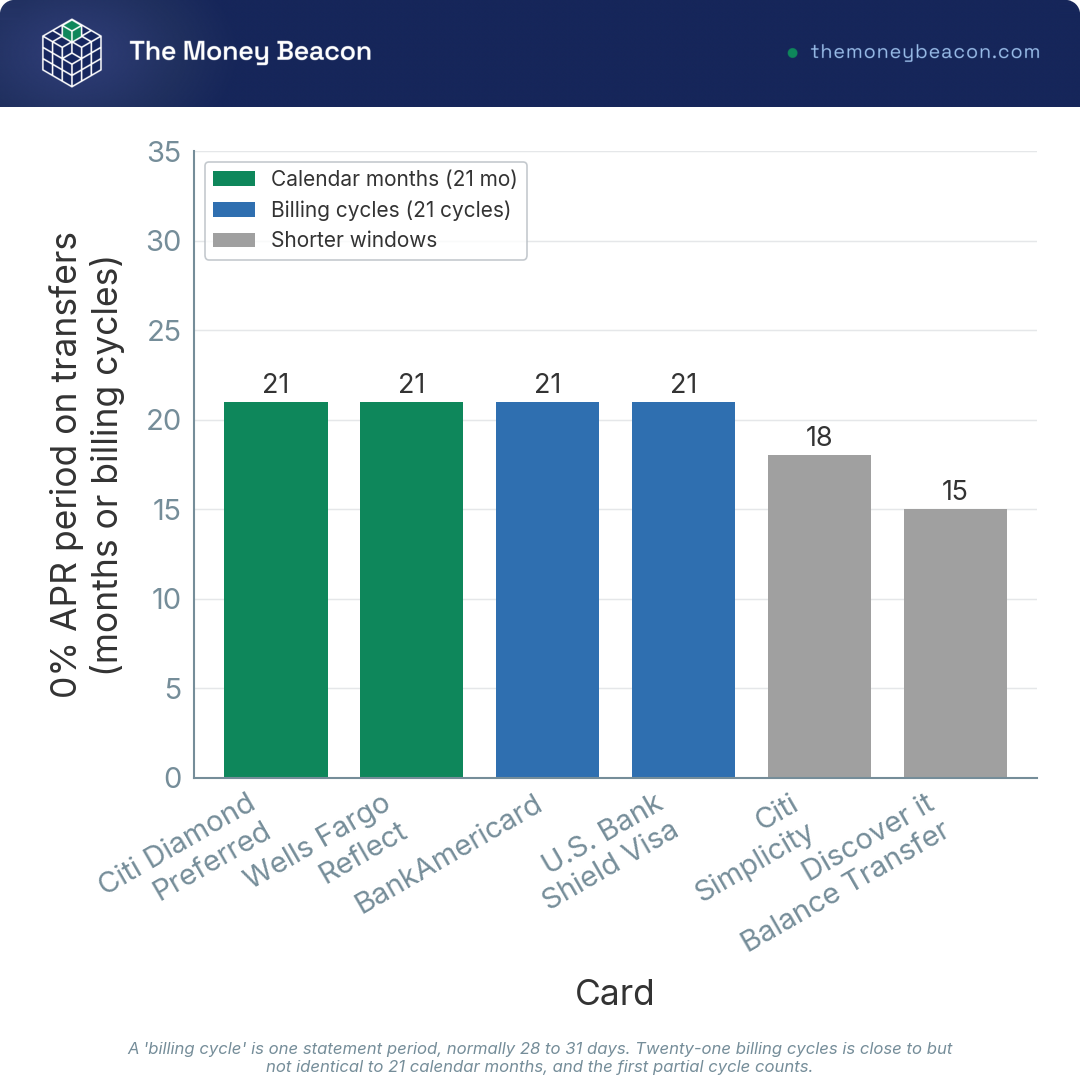
On transferred balances the windows range from 21 months down to 15. Two of the six count billing cycles rather than calendar months.
A 21 month balance transfer isn’t the same thing as 21 billing cycles. A cycle is one statement period of 28 to 31 days, and the first partial one counts.
Length is the divisor in your payment. On $6,000, three extra months separate $343.33 a month from $300.00. The chart below ranks all six.
1.6 Fee against runway: where the six cards sit
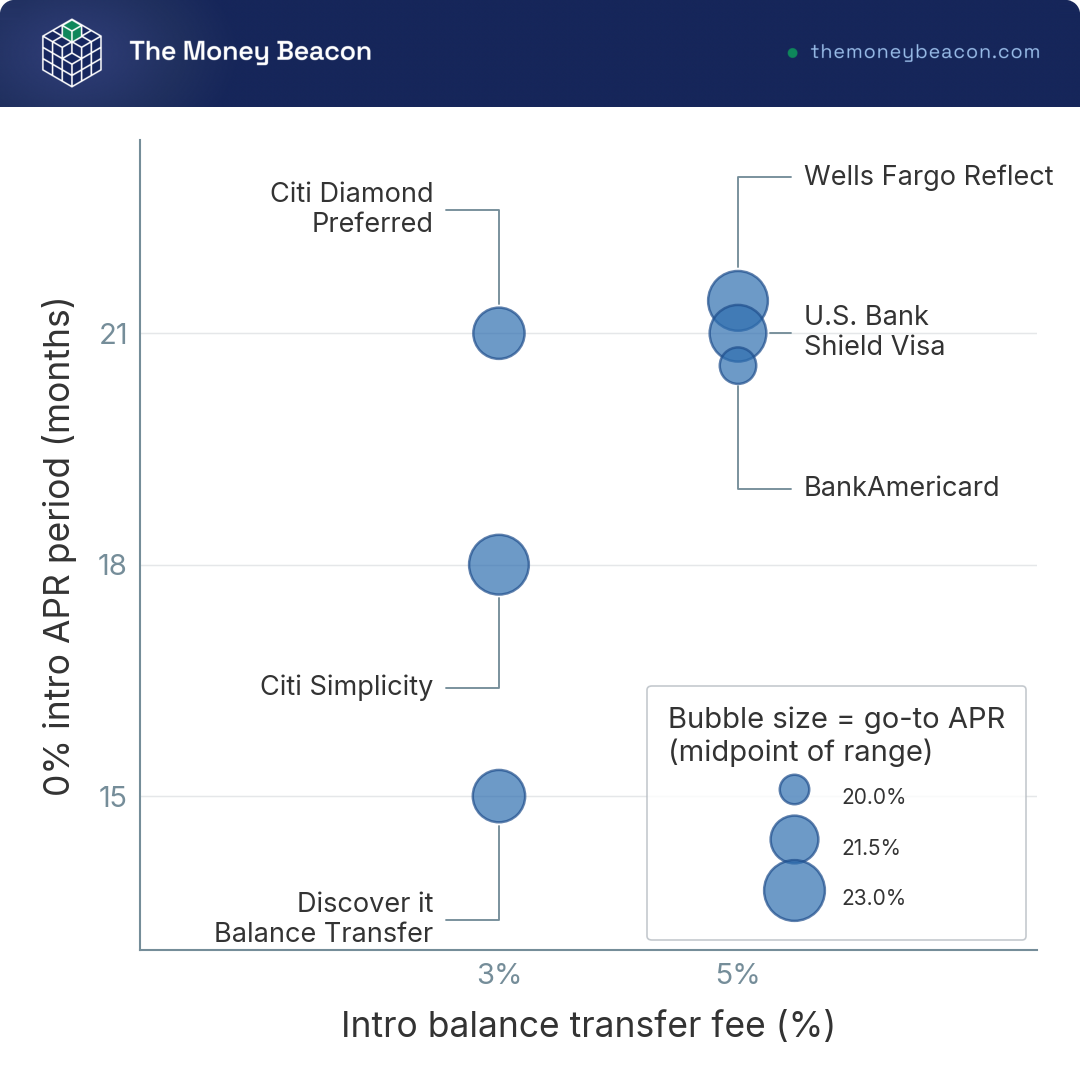
Two axes explain most of this comparison: the transfer fee, and the months of 0% you get for it.
Citi Diamond Preferred is long and cheap. BankAmericard is the awkward one, the expensive way into a long window, though it does have the lowest go-to range at 14.99% to 25.99%. Here’s that trade-off in one chart.
1.7 The six cards at a glance
Six consumer cards, all at $0 a year, from six different issuers.
| Card | 0% on transfers | 0% on purchases | Transfer fee | Transfer deadline |
|---|---|---|---|---|
| Citi Simplicity | 18 months | 18 months | 3% intro ($5 min), then 5% | 4 months |
| Citi Diamond Preferred | 21 months | 12 months | 3% intro ($5 min), then 5% | 4 months |
| Wells Fargo Reflect | 21 months | 21 months | 5% | 120 days |
| BankAmericard | 21 billing cycles | 21 billing cycles | 5% of each transaction | 60 days |
| U.S. Bank Shield Visa | 21 billing cycles | 21 billing cycles | 5% of each transfer, $5 min | 60 days |
| Discover it Balance Transfer | 15 months | 15 months | 3% on balances posting in 15 months | None published, requests from day 10 |
Data current as of August 2026.
2. Citi Simplicity: 18 months at the cheapest fee, with no late fee and no penalty APR
2.1 Overview
Citi designed this one for a borrower who wants a long window with no fee surprises. The Citi Simplicity balance transfer offer is 0% for 18 months, and purchases get 0% for the same 18 months on the same clock.
The intro transfer fee is 3% of each transfer ($5 minimum) on transfers completed in the first 4 months, then 5%. The go-to variable APR is 17.49% to 28.24%, assigned at approval. There’s a $0 annual fee and no rewards program. On $6,000, that 3% fee is $180.
2.2 Strengths
The window covers both sides equally, so a planned purchase doesn’t fall outside the promotion. The 3% intro fee is the cheapest entry cost Citi publishes, $180 rather than $300 at 5%. And the 4-month deadline is roomier than the tightest in this category.
Two absences matter. Citi publishes no late payment fee and no penalty APR on this card in 2026, which removes an entire failure mode from a payoff plan. The 17.49% go-to floor is also well below the 22.15% average you’re escaping.
2.3 Weaknesses
18 months is three months shorter than the longest offers published in 2026, and that raises the payment on the same balance by roughly 17%. The go-to range reaches 28.24%, the joint-highest ceiling in this comparison. The 3% fee is a tier rather than a price, because transfers completed later cost 5%.
Same-issuer transfers are refused, and that’s checked at the transfer stage rather than at approval, so you can be approved and still not move the balance.
There are no rewards, so the card earns you nothing once you’re clear. Cash advances are excluded from the promotion at $10 or 5% whichever is greater, at 29.74% variable with no grace period. Citi publishes no minimum score, but this one is underwritten for good to excellent credit.
2.4 Pricing & fees
The two cells to read first are the ones that say none.
| Item | Citi Simplicity |
|---|---|
| Annual fee | $0 |
| Intro APR, transfers and purchases | 0% for 18 months |
| Go-to variable APR | 17.49% to 28.24% |
| Intro balance transfer fee | 3% of each transfer, $5 minimum |
| Standard balance transfer fee | 5% of each transfer, $5 minimum |
| Cash advance fee and APR | $10 or 5%, whichever is greater, at 29.74% variable |
| Late payment fee | None |
| Penalty APR | None |
| Foreign transaction fee | 3% |
| Minimum interest charge | $0.50 |
Data current as of August 2026.
The number you’ll live with is the payment: $6,180 divided by 18 months is $343.33 a month.
2.5 Who it’s for
Citi Simplicity is ideal for a borrower who can commit to the higher payment and wants the cheaper 3% entry cost. It’s also the best choice if you want those failure modes gone.
It’s not the right choice for a balance you can’t clear inside 18 months, or for a balance already at Citi.
3. Citi Diamond Preferred: 21 months on transfers at the cheapest fee tier
3.1 Overview
This is Citi’s longest runway, designed for a pure payoff plan rather than for spending. The longest balance transfer offer Citi publishes gives you 0% for 21 months on transfers, but only 12 months on purchases. That asymmetry is the easiest thing to miss in a headline.
The go-to variable APR is 16.49% to 27.24% on both. The transfer fee is 3% of each transfer ($5 minimum) during the intro period and 5% after. Transfers must complete within 4 months of account opening. There’s a $0 annual fee and no rewards program.
On $6,000 that fee is $180. The resulting $294.29 a month is the smallest required payment of any card in this comparison.
3.2 Strengths
Twenty-one months of 0% paired with the 3% intro fee tier is the cheapest combination of runway and entry cost Citi publishes. The 16.49% go-to floor is the lowest in this comparison.
The payment is the real strength. $294.29 a month on $6,000 is less than the $300 you may already be paying at 22.15%, and it finishes five months sooner.
The 4-month deadline covers an application that goes to review, and the pre-qualification check is a soft inquiry.
3.3 Weaknesses
The purchase window ends nine months before the transfer window. Put a purchase on this card in month 13 and it accrues at up to 27.24% while the transferred balance is still at 0%. Under CARD Act allocation, everything above the minimum goes to that expensive purchase balance first.
Then there’s the penalty rate, up to 29.99% variable, triggered by a late or returned payment. Under 60 days late it applies to new transactions only. Once the minimum is 60 days past due it can reach existing balances, including the promotional one. Late and returned payment fees are $30 each.
Same-issuer transfers are refused at the transfer stage. There are no rewards after payoff, and cash advances are excluded from the promotion at 29.74% variable with no grace period.
3.4 Pricing & fees
Two rows in the table do all the work: the 12-month purchase line and the 29.99% penalty line.
| Item | Citi Diamond Preferred |
|---|---|
| Annual fee | $0 |
| Intro APR on balance transfers | 0% for 21 months |
| Intro APR on purchases | 0% for 12 months |
| Go-to variable APR | 16.49% to 27.24% |
| Intro balance transfer fee | 3% of each transfer, $5 minimum |
| Standard balance transfer fee | 5% of each transfer, $5 minimum |
| Cash advance fee and APR | $10 or 5%, whichever is greater, at 29.74% variable |
| Late payment fee | $30 |
| Returned payment fee | $30 |
| Penalty APR | Up to 29.99% variable |
| Foreign transaction fee | 3% |
| Minimum interest charge | $0.50 |
Data current as of August 2026.
$6,180 divided by 21 months is $294.29 a month.
3.5 Who it’s for
Citi Diamond Preferred is ideal for a disciplined borrower moving a large balance who’ll use it strictly to pay that balance off. If the monthly payment is your binding constraint, $294.29 on $6,000 is the lowest commitment in this comparison.
It’s not the right choice if you need 0% on new purchases beyond the first year. Skip it too if you expect to be late, since the penalty APR can reach the promotional balance after a 60-day delinquency.
4. Wells Fargo Reflect: 21 months covering transfers and purchases on one clock
4.1 Overview
Reflect is the symmetrical one. A single 21-month 0% window from account opening covers purchases and qualifying balance transfers alike, which suits you if a near-term expense is coming. Transfers have to be made within 120 days of opening to qualify.
The go-to APR comes as three discrete tiers, 17.49%, 23.99%, or 28.24%, assigned at approval. Easier to anticipate, coarser than a range. The transfer fee is a flat 5% with no cheaper in-window tier. There’s a $0 annual fee and no rewards program, and on $6,000 that fee is $300.
4.2 Strengths
The main strength is the symmetry. Twenty-one months at 0% covers purchases and transfers on one clock. So a near-term expense on this card stays inside the promotion instead of accruing interest outside it. The 120-day transfer deadline is the most generous in this comparison, and it forgives a slow application in a way a 60-day window doesn’t.
Cell phone protection is a genuine perk on a card type that usually has none. You get up to $600 per claim, a $25 deductible, and two paid claims per 12-month period. You just have to pay the monthly cell bill with the card.
Three published tiers also beat an opaque range. And there’s no penalty APR, so one slip can’t move you above your tier.
4.3 Weaknesses
The flat 5% has no cheaper tier: $300 on a $6,000 balance, $120 more than a 3% fee on the same amount.
Two eligibility lockouts do more damage than the fee, though. A past Reflect holder can be approved and still get no intro APR. Wells Fargo says you may not be eligible for introductory rates, fees or bonus offers if you opened this product within the last 48 months. A separate rule says you may not qualify for an additional Wells Fargo consumer card if you opened one in the last 4 months.
There’s no rewards program, and the late payment fee is in the rates and terms disclosure rather than on the marketing page. On the credit score for balance transfer approval, Wells Fargo publishes no cutoff and says only that it runs a credit check. And the top tier is 28.24%, expensive if the window closes with a balance.
4.4 Pricing & fees
The row that changes the arithmetic is the flat 5%. The row that changes the plan is the 120 days.
| Item | Wells Fargo Reflect |
|---|---|
| Annual fee | $0 |
| Intro APR, purchases and qualifying transfers | 0% for 21 months |
| Go-to variable APR | 17.49%, 23.99%, or 28.24% |
| Balance transfer fee | 5% |
| Transfer deadline | 120 days from account opening |
| Penalty APR | None published |
| Foreign currency conversion fee | 3% |
| Cell phone protection | $600 per claim, $25 deductible, two claims per 12 months |
Data current as of August 2026.
$6,000 plus a $300 fee is $6,300, and across 21 months that’s $300.00 a month. The late payment, returned payment and cash advance figures are in the rates and terms disclosure, not on the product page.
4.5 Who it’s for
Wells Fargo Reflect is ideal for a borrower who needs 0% on new purchases as well as on the transfer, since both run on one 21-month clock. It’s also the best choice when your application timing is uncertain, because 120 days is the longest runway to get a transfer completed.
It’s not the right choice if you’re optimizing purely on entry cost, given the flat 5%. A past Reflect holder inside the 48-month lockout should skip it too.
5. BankAmericard: the lowest go-to APR, behind the tightest deadline
5.1 Overview
Bank of America built this one for a single job. You get 0% for 21 billing cycles on purchases and on transfers made within 60 days of opening. Twenty-one cycles is just short of 21 calendar months.
The go-to variable APR is 14.99% to 25.99%. The transfer fee is a flat 5% with no cheaper tier. No annual fee, no rewards, issued by Bank of America, N.A. On $6,000 that fee is $300.
5.2 Strengths
14.99% to 25.99% is the lowest floor and the lowest ceiling in this comparison, so anything left over costs less than on any other card. The agreement also states “Penalty APR and When it Applies: None”, so a late payment costs a fee without repricing the card. Purchases run on the same 21 cycles.
5.3 Weaknesses
The 5% is flat and permanent. Entry costs you $300 on $6,000 rather than $180, the most expensive of the six.
The 60-day deadline is the tightest published here, and it runs from account opening, not from the day the card reaches your mailbox. Existing Bank of America balances can’t move here either, and that refusal comes at the transfer stage.
5.4 Pricing & fees
Read this table bottom up, because that none in the penalty row is a big part of what the 5% buys.
| Item | BankAmericard |
|---|---|
| Annual fee | $0 |
| Intro APR, purchases and transfers | 0% for 21 billing cycles |
| Go-to variable APR | 14.99% to 25.99% |
| Balance transfer fee | 5% of each transaction |
| Transfer deadline | 60 days from account opening |
| Late payment fee | $30 first, up to $41 within six cycles |
| Cash advance fee and APR | 5%; 28.99% direct deposit and check, 29.24% bank |
| Penalty APR | None |
| Foreign transaction fee | 3% |
Data current as of August 2026.
$6,300 across 21 billing cycles is $300.00 a month.
5.5 Who it’s for
BankAmericard is ideal if you apply with the transfer request already prepared and you’d rather have a low residual rate than a low entry cost.
It’s not the right choice if you’re optimizing entry cost, or if you can’t request the transfer inside 60 days.
6. U.S. Bank Shield Visa: a 21-cycle window with a small rewards component attached
6.1 Overview
This one replaces the U.S. Bank Visa Platinum, no longer offered. Its page redirects here, and the legacy benefits apply only to applications made before April 14, 2025.
The Shield Visa gives you 0% on purchases and transfers for 21 billing cycles, on transfers made within 60 days of opening. The go-to variable APR is 16.99% to 27.99%, and the fee is 5% of each transfer, $5 minimum. No annual fee, issued by U.S. Bank National Association. Unusually for a 0 introductory APR credit card, this one comes with rewards. On $6,000 that fee is $300.
6.2 Strengths
Twenty-one billing cycles cover purchases and transfers alike, and the 16.99% floor is low for this category. Then the rare part: 4% cash back on prepaid air, hotel and car booked through the U.S. Bank Rewards Center, plus a $20 annual credit for purchases in 11 consecutive months.
6.3 Weaknesses
The 5% has no cheaper tier, so moving $6,000 costs $300 rather than $180. And the 60-day deadline leaves little room if the application goes to review.
The rewards also look better than they are. The 4% covers one booking channel, and a transferred balance earns nothing on any of it. The $20 credit needs 11 consecutive months of purchases, awkward if you park the card.
6.4 Pricing & fees
There’s one rewards line in this table, and it does the least for a transferred balance.
| Item | U.S. Bank Shield Visa |
|---|---|
| Annual fee | $0 |
| Intro APR, purchases and transfers | 0% for 21 billing cycles |
| Go-to variable APR | 16.99% to 27.99% |
| Balance transfer fee | 5% of each transfer, $5 minimum |
| Transfer deadline | 60 days from account opening |
| Penalty APR | None published |
| Rewards | 4% on prepaid air, hotel and car via the Rewards Center; $20 annual credit after 11 consecutive months |
Data current as of August 2026.
$6,300 across 21 cycles is $300.00 a month. The late, returned payment, cash advance and foreign transaction fees are in the pricing and terms disclosure that comes with the application.
6.5 Who it’s for
U.S. Bank Shield Visa is ideal if you want the long window and you’ll keep the card afterward for travel booked through the Rewards Center.
It’s not the right choice if you’re optimizing entry cost, or if you’ll park the card after payoff. Where earning is the goal, cards built around travel rewards do better.
7. Discover it Balance Transfer: the cheapest entry, with no deadline to miss
7.1 Overview
Discover has the shortest window of the six, offset by the cheapest entry and the most forgiving timing. The discover 0 balance transfer offer gives you 0% for 15 months on purchases and transfers, one clock.
The go-to APR comes as four tiers, 17.49%, 21.49%, 24.49% or 26.49%, assigned on creditworthiness. The fee is 3% of each transferred balance posting in the first 15 months. No completion deadline is published, and you can request a transfer from day 10.
No annual fee, issued by Discover Bank. Since the Capital One acquisition the disclosures are headed “Discover by Capital One”, so that’s the document to read. On $6,000 that fee is $180.
7.2 Strengths
3% is the cheapest entry cost of the six, and it applies to every balance posting inside the 15-month window, not to a short tier after opening. There’s no separate fee deadline to miss, and no completion deadline either, so a slow application costs you time rather than terms.
The rewards are worth having: 5% cash back on rotating quarterly categories, up to $1,500 a quarter once activated, 1% elsewhere, plus a first-year Cashback Match.
7.3 Weaknesses
15 months is the shortest runway of the six, six months short of the longest offers published in 2026. That raises the payment by roughly 40%, to $412.00 rather than $294.29.
The fee and the APR tiers appear only in the application disclosure, which a headline comparison won’t show. International coverage is narrower than Visa or Mastercard too, and rewards never apply to a transferred balance, Cashback Match included.
7.4 Pricing & fees
The discover balance transfer fee is tied to a posting window rather than a deadline, so being slow can’t cost you anything here.
| Item | Discover it Balance Transfer |
|---|---|
| Annual fee | No annual fee |
| Intro APR, purchases and transfers | 0% for 15 months |
| Go-to variable APR | 17.49%, 21.49%, 24.49% or 26.49% |
| Intro transfer fee | 3% of each balance posting in first 15 months |
| Transfer fee after intro | 5% at a later promo APR, none at purchase APR |
| Cash advance fee | $10 or 5% of each advance, whichever is greater |
| Late payment fee | None first time, then up to $41 |
| Returned payment fee | Up to $30 |
| Penalty APR | None |
| Foreign transaction fee | None |
| Rewards | 5% rotating on up to $1,500 a quarter, 1% base, first-year Match |
Data current as of August 2026.
$6,180 across 15 months is $412.00 a month. A balance moved at the purchase APR after month 15 has no fee, but no 0% either.
7.5 Who it’s for
Discover it Balance Transfer is ideal for a balance that clears inside 15 months, at the cheapest fee of the six. It’s also the best choice if you want a card worth keeping afterward, given the rotating 5% categories.
It’s not the right choice above 15 months, because the payment it demands is the highest of the six.
8. Comparison recap and verdict by reader profile
8.1 The full comparison table: six cards on every criterion
Here are all six cards on every criterion, in review order.
| Criterion | Citi Simplicity | Citi Diamond Preferred | Wells Fargo Reflect | BankAmericard | U.S. Bank Shield Visa | Discover it Balance Transfer |
|---|---|---|---|---|---|---|
| 0% on transfers | 18 months | 21 months | 21 months | 21 cycles | 21 cycles | 15 months |
| 0% on purchases | 18 months | 12 months | 21 months | 21 cycles | 21 cycles | 15 months |
| Intro transfer fee | 3%, $5 min | 3%, $5 min | 5% | 5% | 5%, $5 min | 3% in first 15 months |
| Standard transfer fee | 5%, $5 min | 5%, $5 min | 5% | 5% | 5%, $5 min | 5% later promo, none at purchase APR |
| Transfer deadline | 4 months | 4 months | 120 days | 60 days | 60 days | None, requests from day 10 |
| Go-to variable APR | 17.49% to 28.24% | 16.49% to 27.24% | 17.49%, 23.99% or 28.24% | 14.99% to 25.99% | 16.99% to 27.99% | 17.49%, 21.49%, 24.49% or 26.49% |
| Annual fee | $0 | $0 | $0 | $0 | $0 | $0 |
| Penalty APR | None | Up to 29.99% | None published | None | None published | None |
| Late payment fee | None | $30 | Per disclosure | $30, then $41 | Per disclosure | None first, then $41 |
| Rewards | None | None | None | None | 4% prepaid travel, $20 annual credit | 5% rotating, 1% base, first-year match |
Data current as of August 2026.
Three facts don’t fit a cell. Same-issuer transfers are refused everywhere. Regulation Z ability-to-pay means the approved line may be smaller than your balance, leaving a remainder at the old APR. And cash advance and foreign transaction terms are outside the promotion.
8.2 What each card demands per month on a $6,000 balance
The spread is wider than the advertised offers suggest.
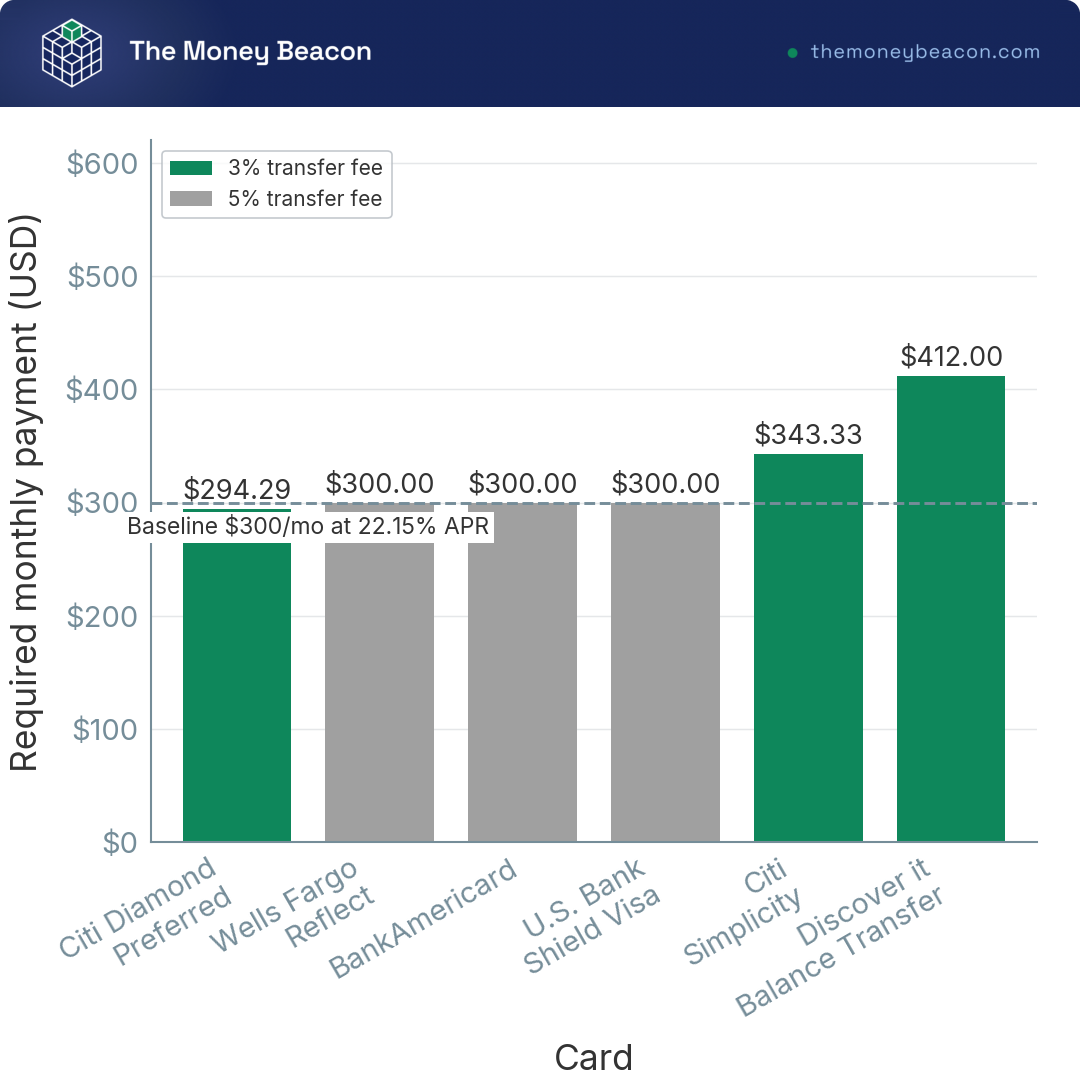
$294.29 to $412.00 on the same balance is a $117.71 difference, all of it window length and fee. That’s all a balance transfer calculator would tell you. Set the figure, rounded up, as autopay the day the transfer posts.
Tom’s take
size the payment to a bad month, not an average one. Running a company teaches you that fast: every fixed commitment gets sized against the worst quarter you can imagine, not the one in the plan. Pick the window whose payment you’d still make then.
8.3 What the whole payoff costs, against standing still
The fee is the entire cost of a plan that finishes on time.
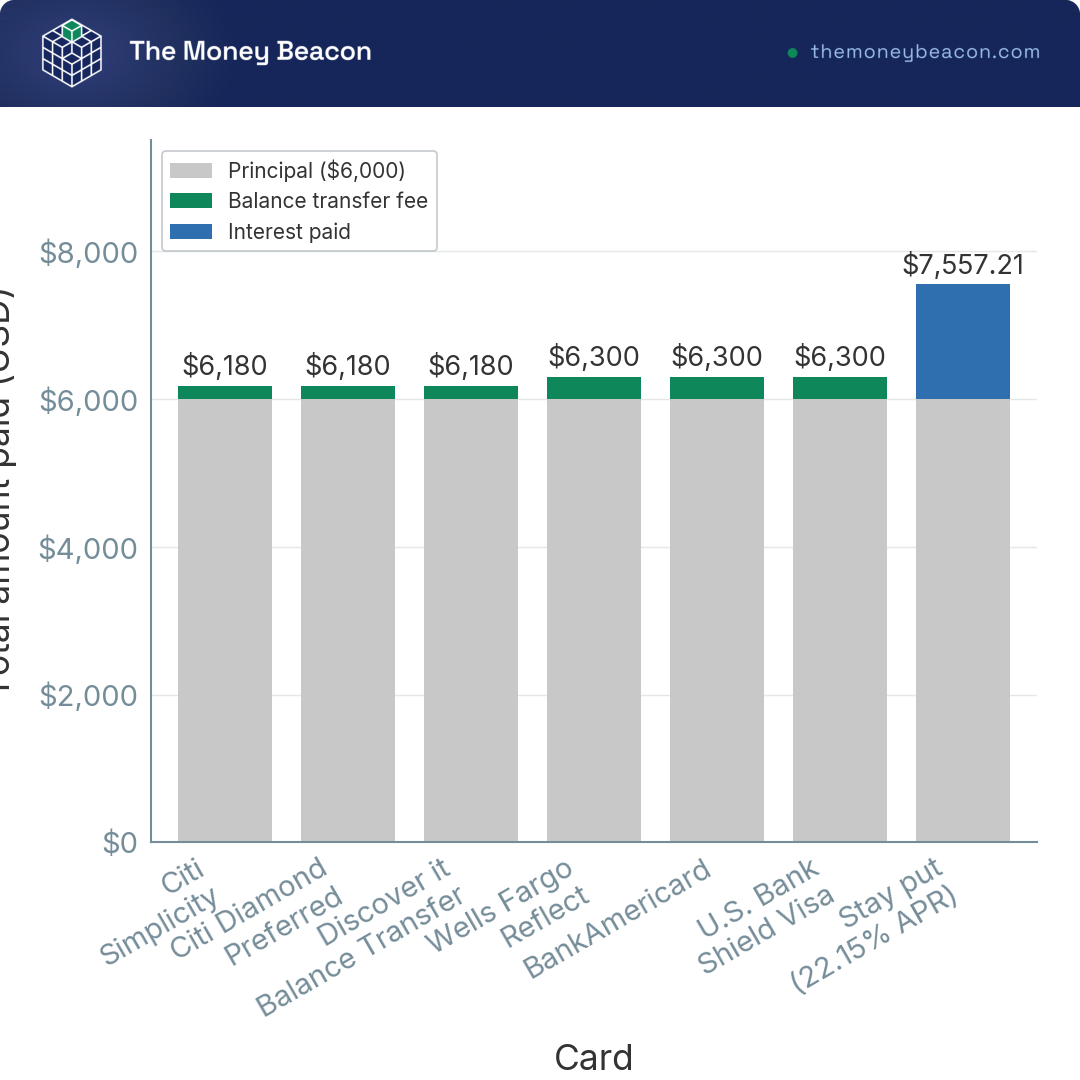
$6,180 clears the balance on the three 3% cards and $6,300 on the three at 5%. Standing still costs $7,557.21, at 22.15% and $300 a month for 26 months. Pay $343 reliably and Citi Simplicity is $120 cheaper. If $343 is a stretch, that $120 buys a $43 cushion and the longer card wins.
8.4 The largest balance your payment can actually clear
Run the arithmetic backwards and every window has a ceiling.
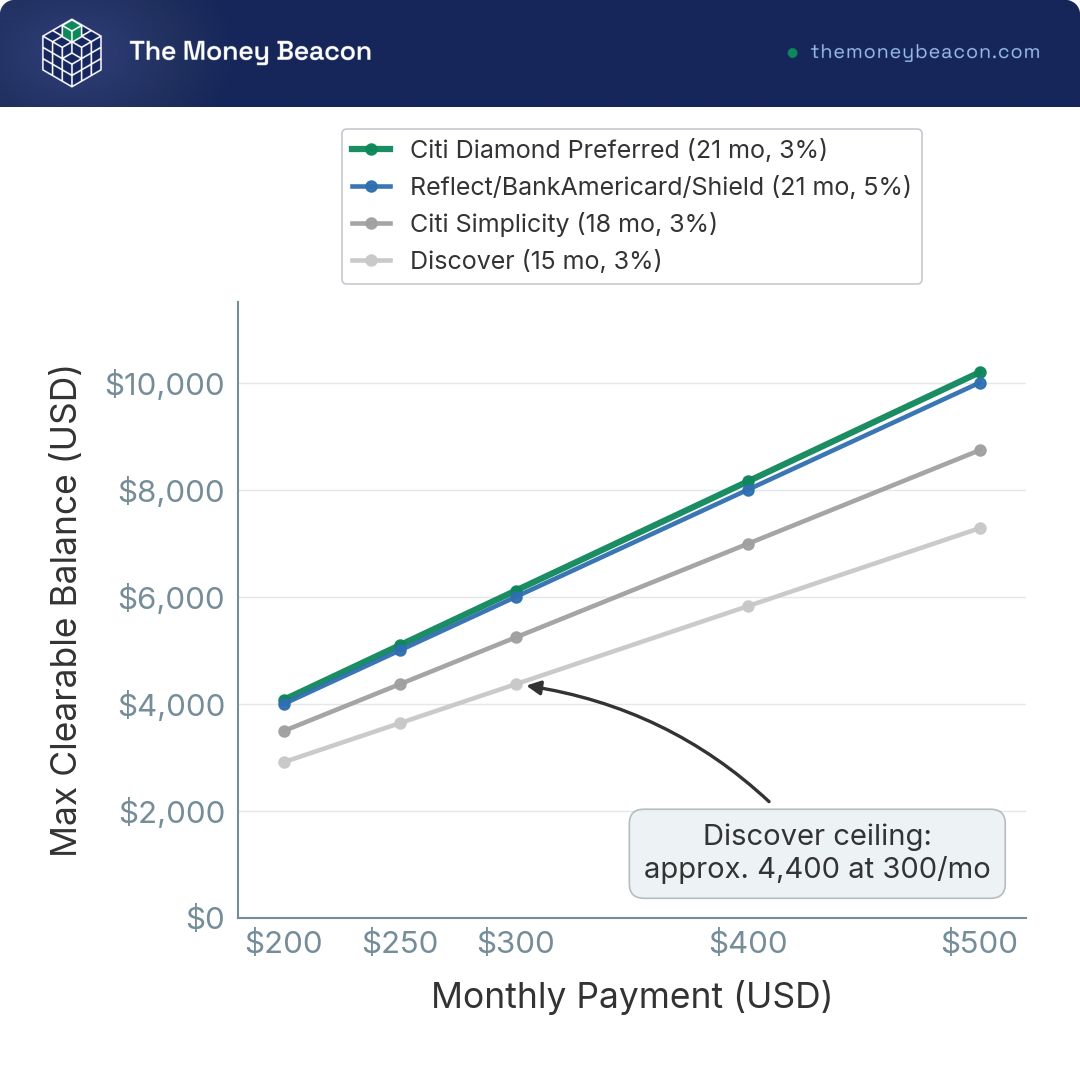
At a $300 payment, Citi Diamond Preferred clears $6,117, the largest of the six. Discover clears about $4,369. So under roughly $4,400, 15 months is enough.
8.5 The rate waiting at the end of the window
Every one of these promotions ends, and the go-to APR is what’s waiting.
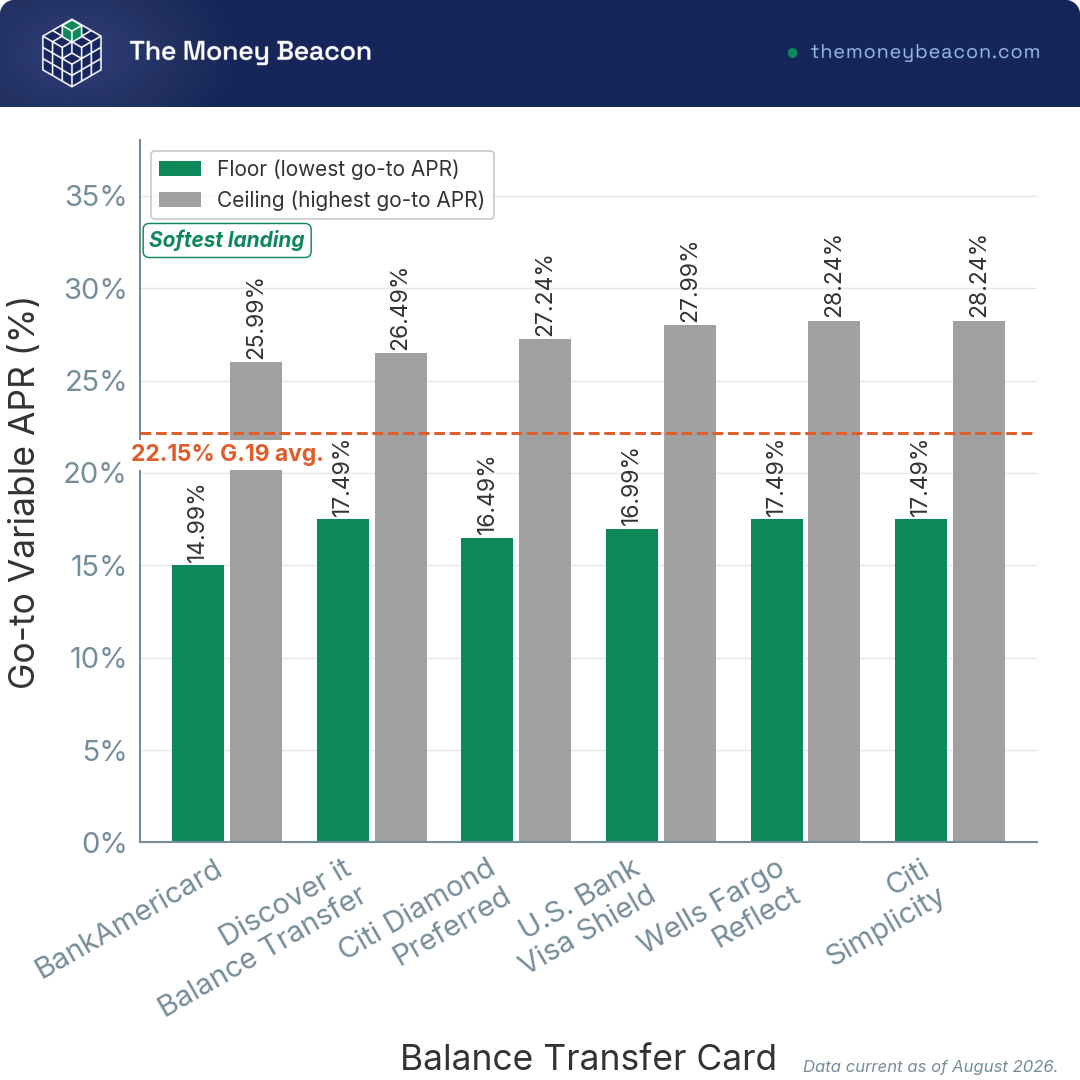
BankAmericard has the lowest floor and the lowest ceiling, 14.99% to 25.99%, and Citi Simplicity’s 28.24% is the highest. Several floors are below the 22.15% average you’re escaping, several ceilings well above it. Only Citi Diamond Preferred publishes a penalty APR, up to 29.99%. So set an alert a month before your window closes.
8.6 Which of these cards you can still spend on
Five of the six put purchases on the same clock as transfers. Citi Diamond Preferred gives 12 months on purchases against 21 on transfers.
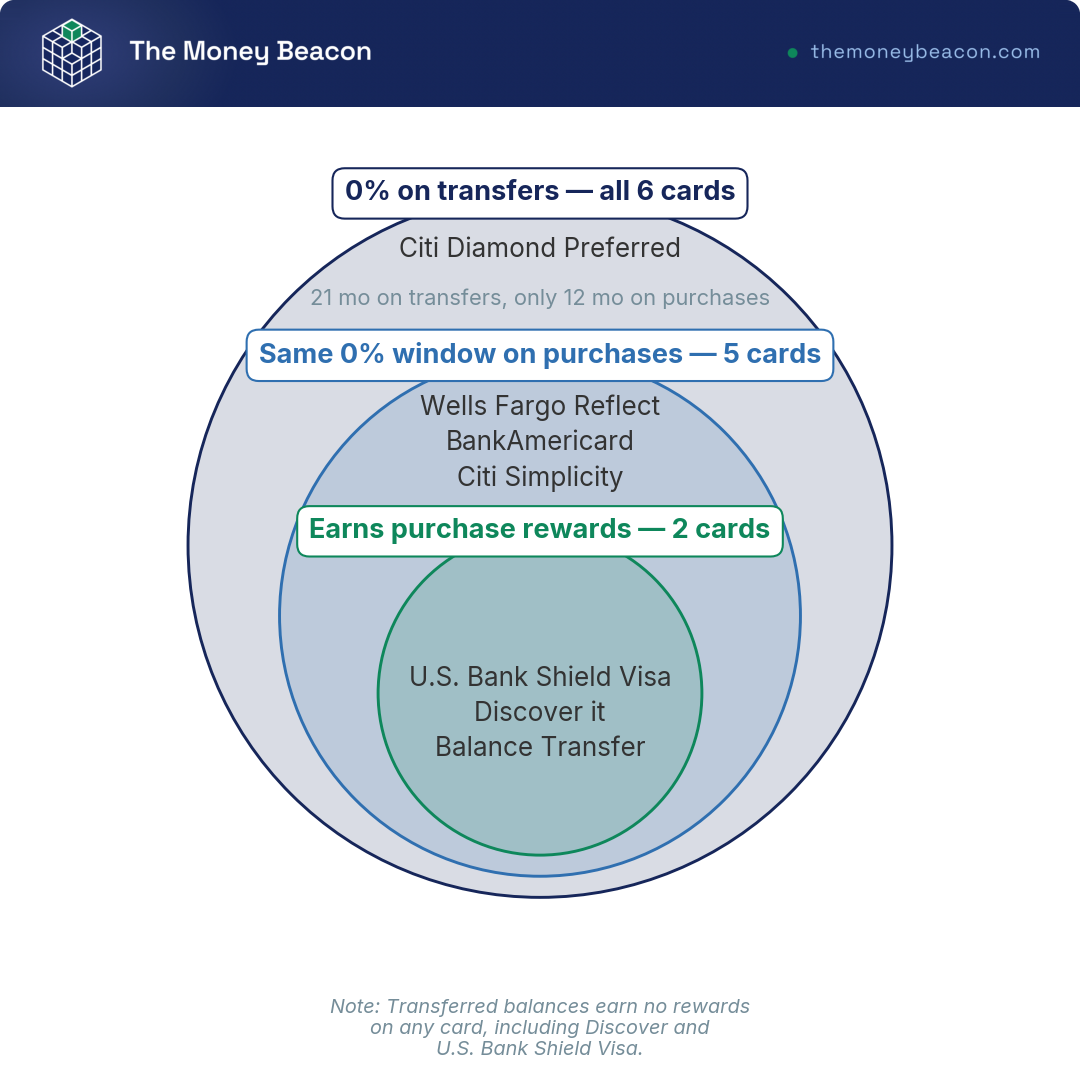
A purchase made there in month 13 accrues at up to 27.24% while the transferred balance stays at 0%. Only U.S. Bank Shield Visa and Discover earn anything, neither on a transferred balance. So if a near-term expense can’t wait, the purchase window decides.
8.7 Verdict by reader profile
Five situations, and they don’t all point at the same card.
| Your situation | Best fit | Why | Runner-up |
|---|---|---|---|
| Longest runway, large balance | Citi Diamond Preferred | Cheapest month per dollar, $294.29 a month, $6,117 clearable at $300 | BankAmericard |
| Small balance, cheapest entry cost | Discover it Balance Transfer | 3% on every posting in the first 15 months, no deadline, $4,369 clearable at $300 | Citi Simplicity |
| Needs 0% on new purchases too | Wells Fargo Reflect | 21 months on purchases and transfers, one clock, 120-day deadline | U.S. Bank Shield Visa |
| Wants a card worth keeping | Discover it Balance Transfer | 5% rotating, 1% base, first-year Match, no annual or foreign fee | Citi Simplicity |
| Worried about not finishing in time | BankAmericard | Lowest go-to range, 14.99% to 25.99%, and no penalty APR | Citi Diamond Preferred |
Data current as of August 2026.
Every pick has a cost. Citi Diamond Preferred stops purchases at 12 months and needs the transfer inside 4 months. Citi Simplicity buys you 18 months at $343.33 when 15 isn’t enough. Reflect’s parity costs $300 not $180, and BankAmericard has the tightest deadline.
8.8 Matching your binding constraint to one card
Walk it in the weighted order: the payment you can commit to for 15 to 21 months, the size of the balance, whether purchases need 0% too.
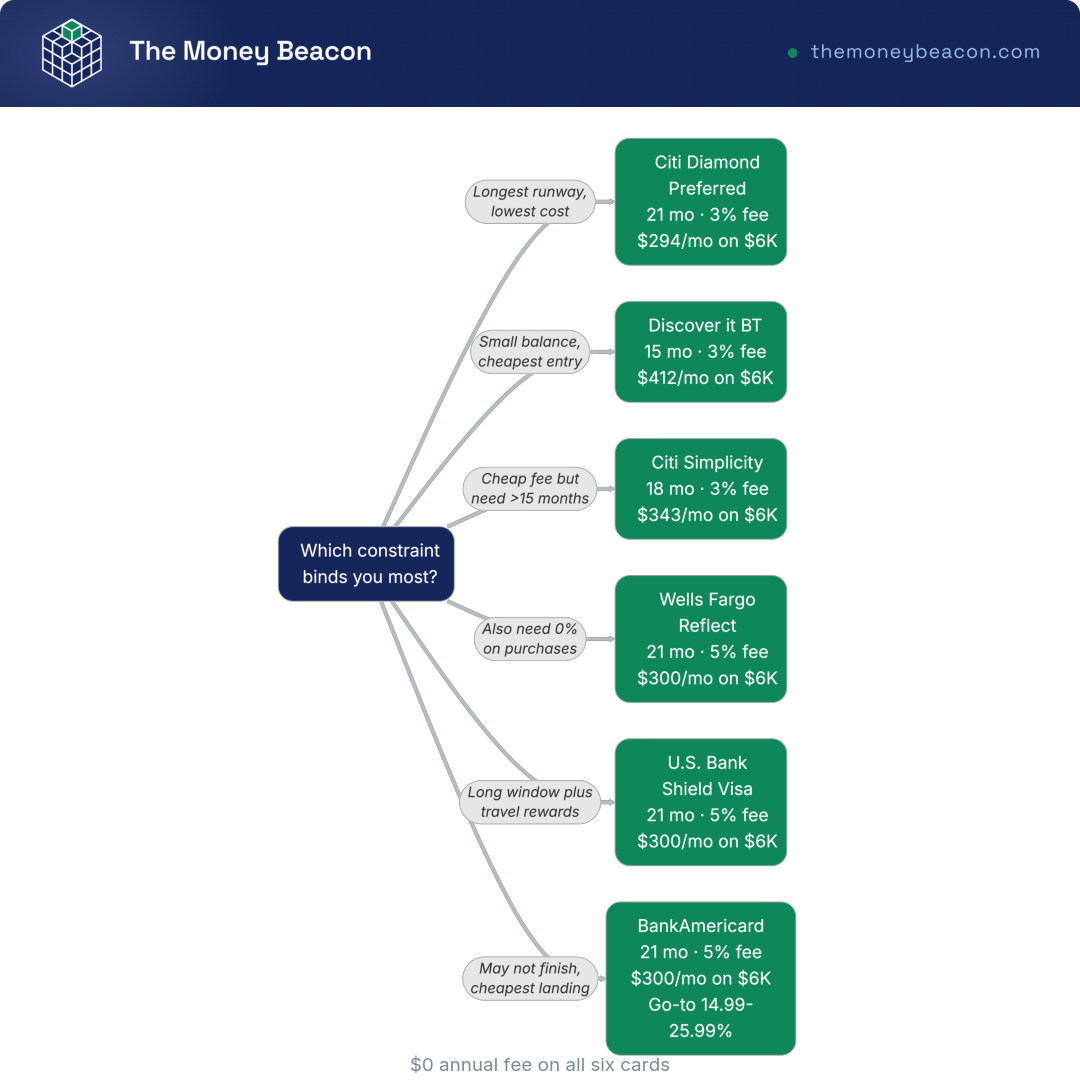
Ask the prior question first, though. If the balance can’t clear in 21 months at a payment you can sustain, a transfer card won’t do the job. Price an unsecured personal loan against it. The G.19 average is 11.86%, and it comes with a fixed end date, though your old cards stay open. There’s also a home equity line of credit, cheaper still, but it turns unsecured debt into debt secured by your house. A nonprofit counseling plan trades concessionary rates for a monthly fee and closed accounts; check it’s a 501(c)(3).
Every card in this comparison needs good to excellent credit, roughly 670 and up. Below that, the credit card debt consolidation routes are a secured card, a credit union loan, or a debt management plan. And on variable income, take the longer window.
Conclusion
A balance transfer card doesn’t make your debt cheaper. It sells you a fixed number of interest-free months. The transfer fee is the price of those months, prepaid interest you hand over on day one instead of paying 22.15% by the month. On $6,000, $180 buys you the 21 months at Citi Diamond Preferred and $300 buys the same runway at BankAmericard. Either price beats the $1,557.21 of interest that standing still costs you.
By now two details decide how many of those months you keep. The clock starts the day the account opens, not the day your balance arrives, so request the transfer inside the application whenever the issuer allows it. And no issuer moves a balance onto its own card. Check who issues your current one first.
The months only work if you use all of them. Leave a balance when the window closes and it goes back to a go-to rate between 14.99% and 28.24%. That’s where most transfers go wrong. So work out the payment before you pick the card. Divide your balance plus the fee by the months on offer, then ask whether you’d still make that payment in a bad month. Pick the window that fits your answer. The payment chooses the card, not the other way around.
Once the balance is gone, keep sending that same amount somewhere it earns. Our comparison of the best high-yield savings accounts shows where to park it, and matching each dollar to a time horizon covers what comes after the cushion. If another loan is charging you more than it should, current auto loan rates are worth checking too.
FAQ
How many interest-free months can you actually get on a balance transfer in 2026?
Up to 21 months on transfers, but only two cards. Citi Diamond Preferred and Wells Fargo Reflect both run 21 months; BankAmericard and U.S. Bank Shield Visa count 21 billing cycles, close but not identical. Citi Simplicity offers 18 months, Discover it Balance Transfer 15. What matters most is the months left once the transfer posts, since the clock starts at account opening.
Is a 3% balance transfer fee worth paying to escape a 22% APR?
Yes, and it’s not close. A 3% fee on $6,000 is $180, while that balance adds $110.75 of interest in one month at the 22.15% G.19 average. Even a 5% fee, $300, pays for itself in about 2.7 months. The only exception is a balance you’d have cleared within a quarter anyway. Pay the fee, then actually pay down the balance.
How long do you have to make the transfer after opening the account?
It depends on the card. BankAmericard and U.S. Bank Shield Visa give 60 days, both Citi cards give 4 months, and Wells Fargo Reflect gives 120 days. Discover it Balance Transfer publishes no deadline; its 3% fee covers any balance posting within the 15-month window, and requests open on day 10. Miss the deadline elsewhere and you typically lose the promotional rate.
Do new purchases get the same 0% window as the transferred balance?
Mostly, with one exception. Citi Simplicity, Wells Fargo Reflect, BankAmericard, U.S. Bank Shield Visa, and Discover it Balance Transfer apply the same 0% window to purchases and transfers. Citi Diamond Preferred doesn’t: 21 months on the transfer, only 12 on purchases, so a charge in month 13 accrues at up to 27.24% while the transfer stays at 0%.
Can you transfer a balance between two cards from the same issuer?
No. Every issuer here refuses transfers from its own accounts, so a Citi balance can’t move to either Citi card, and a Bank of America balance can’t move to BankAmericard. The refusal happens at the transfer stage, not at approval, so you can be approved and only then find out the balance won’t move. Check who issues your current card first.
What happens to the 0% rate if you make a late payment?
It depends on how late you are. Under the CARD Act, an issuer can’t raise your rate in year one unless a payment runs past 60 days late. Citi Diamond Preferred is the only card here with a published penalty APR, up to 29.99%, reaching the promotional balance past that point. Citi Simplicity charges no late fee; Discover waives the first one. No card makes lateness safe.
Does a balance transfer hurt your credit score?
Briefly, and usually not for long. The application triggers a hard inquiry worth a few points that fades within a year, and slightly lowers account age. On the other side, the new line raises your available credit, and your old card’s balance drops to zero, cutting utilization sharply. Most people see a net improvement within months. What hurts you is closing the old card afterward.
What credit score do you need to qualify for a 0% balance transfer card?
None of these six issuers publishes a minimum, and Discover says no specific score is required to apply. In practice, these offers go to good to excellent credit, roughly 670 and up. Score isn’t the whole story: income and debt matter too, and Wells Fargo adds a 48-month lockout for past Reflect holders. Citi and Discover both offer a soft-pull pre-qualification check.



Comments
Questions and corrections welcome. We read everything.