


You’re carrying a rate higher than what’s advertised today, and a refinance looks like a simple swap. Trade the high rate for the low one, watch the payment drop, done. It isn’t that simple. And the payment is the wrong number to judge it on.
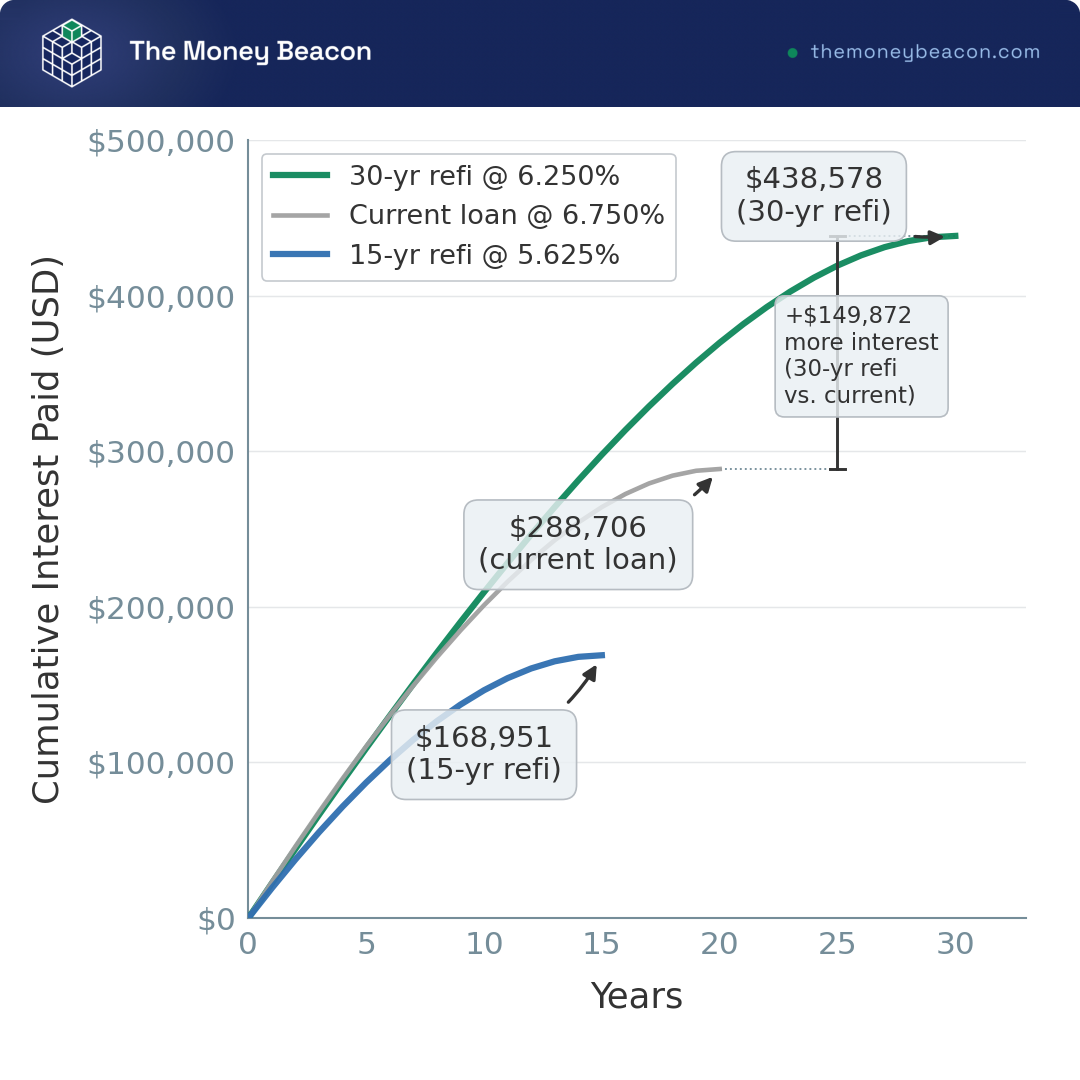
Every refinance restarts the amortization clock at year one. So on a $350,000 balance, a fresh 30-year loan can cut your payment by $441.61 a month and still add about $149,872 to the interest you pay. The payment fell. The cost went up.
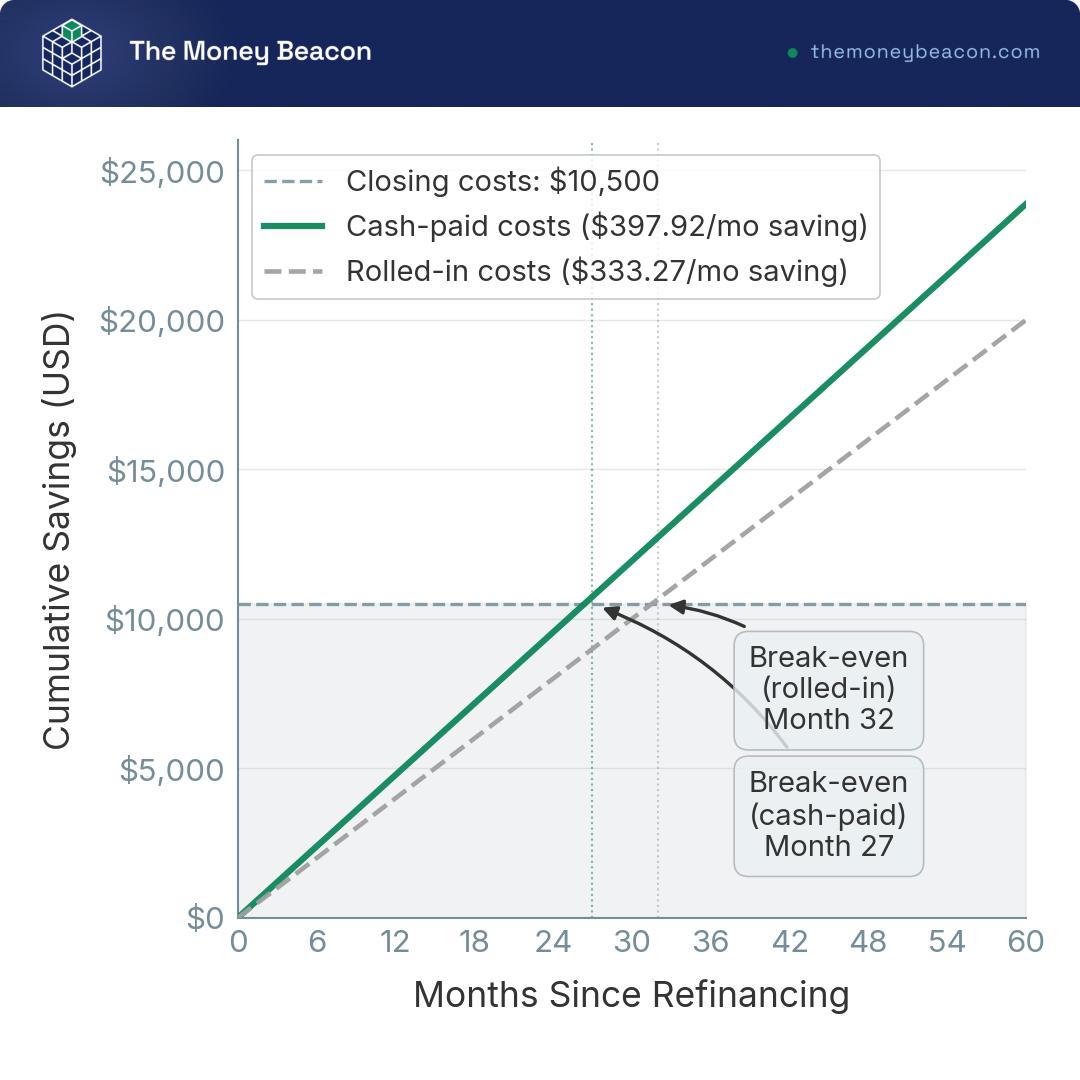
And you pay the closing costs before any of that happens. They’re 2% to 6% of the loan amount, and you get none of it back until your monthly savings have covered the bill. Divide the costs by those savings and you have your refinance break-even point. On that same $350,000 balance, $10,500 of costs against $397.92 a month puts you at month 27. Sell or refinance again before then and the deal cost you money instead of saving it.
Rates have ticked down two weeks running. Freddie Mac’s weekly survey put the 30-year fixed at 6.65% on August 20, 2026, so a refinance is worth pricing again. Just don’t read an advertised rate as an offer. It’s a price quoted for one scenario: a borrower with a specific credit score and a specific amount of equity. The rates published in this comparison already include between 0.5 and 2.45 discount points, and you pay for those at closing.
Before I rank a single lender, I’ll lay out the method and the break-even math you can run on your own balance.
1. How we compared the 2026 refinance lenders, and the math that decides whether to refinance at all
1.1 What we measured, where every number came from, and the six lenders at a glance
Every lender gets the same nine criteria, in the same order: products written, eligibility, rate, annual percentage rate (APR), points, fees, credit and loan-to-value limits, lock and float-down, timeline. Every figure comes off the lender’s own page or a US regulator.
Table: The 2026 refinance lineup at a glance
| Lender | Type | Headline 30-yr conv. refi rate / APR | Origination fee | Standout |
|---|---|---|---|---|
| Rocket Mortgage | Nonbank lender | 6.250% / 6.557% (2 pts) | Not disclosed | Deepest published rate grid; no prepayment penalties; 20-day average close |
| Better | All-digital nonbank | 6.490% / 6.730% (2.02 pts) | Median $1,378 lender-paid origination on purchase loans; no commissions | Published closing-cost range of $1,500 to $5,500 |
| loanDepot | Nonbank lender | Not disclosed | Not disclosed | Lifetime Guarantee: lender fees waived on a future refinance |
| PennyMac | Nonbank lender and servicer | 7.000% / 7.188% (0.832 pts) | Not disclosed | Broadest government lineup; VA IRRRL at $0 out of pocket |
| U.S. Bank | National bank (FDIC) | 6.750% / 6.933% (0.987 pts) | Not disclosed | Branch network; 2% to 5% closing-cost range; 0.25% autopay client credit up to $750 |
| Navy Federal | Credit union (NCUA) | 6.250% / 6.406% | 1%, waivable for +0.25% on the rate | Best published VA pricing; only published lock length and float-down in the lineup |
Data current as of August 22, 2026, except U.S. Bank as of August 21, 2026.
Only one of the six publishes its origination fee. So when you compare refinance lenders, part of the price only shows up on a Loan Estimate.
1.2 The break-even month: the one number that decides a rate-and-term refinance
Here’s the break-even point formula: closing costs divided by your monthly payment saving.
Say you owe $350,000 at 7.500% with 312 payments left, so principal and interest are $2,552.93 a month. A new 30-year at 6.250% costs $2,155.01, giving you back $397.92. Divide $10,500 of closing costs by that and break-even is month 27.
And if you expect to stay at least twice as long as the break-even, the refinance is worth doing.
1.3 The term trap: a $441 lower payment that adds about $149,872 of interest
Here’s how a lower payment produces higher total interest. You have $350,000 left, 20 years to run at 6.750%. The payment is $2,661.27, with $288,706 of interest still to come. Refinance into a fresh 30-year at 6.250% with costs rolled in ($360,500) and the payment falls $441.61. But total interest goes up to about $438,578, roughly $149,872 more. A new 15-year at 5.625% does the opposite: the payment rises $221.79 and interest drops to about $168,951.
Both get sold to you as a lower rate. They do opposite things. If you’re after wealth, compare total remaining interest, not payments.
Hank’s take

the behavioral research is clear here. You feel the payment monthly, so you anchor on it. Nobody opens the interest column.
1.4 What closing costs really run, and what a ’no-closing-cost’ refinance actually costs
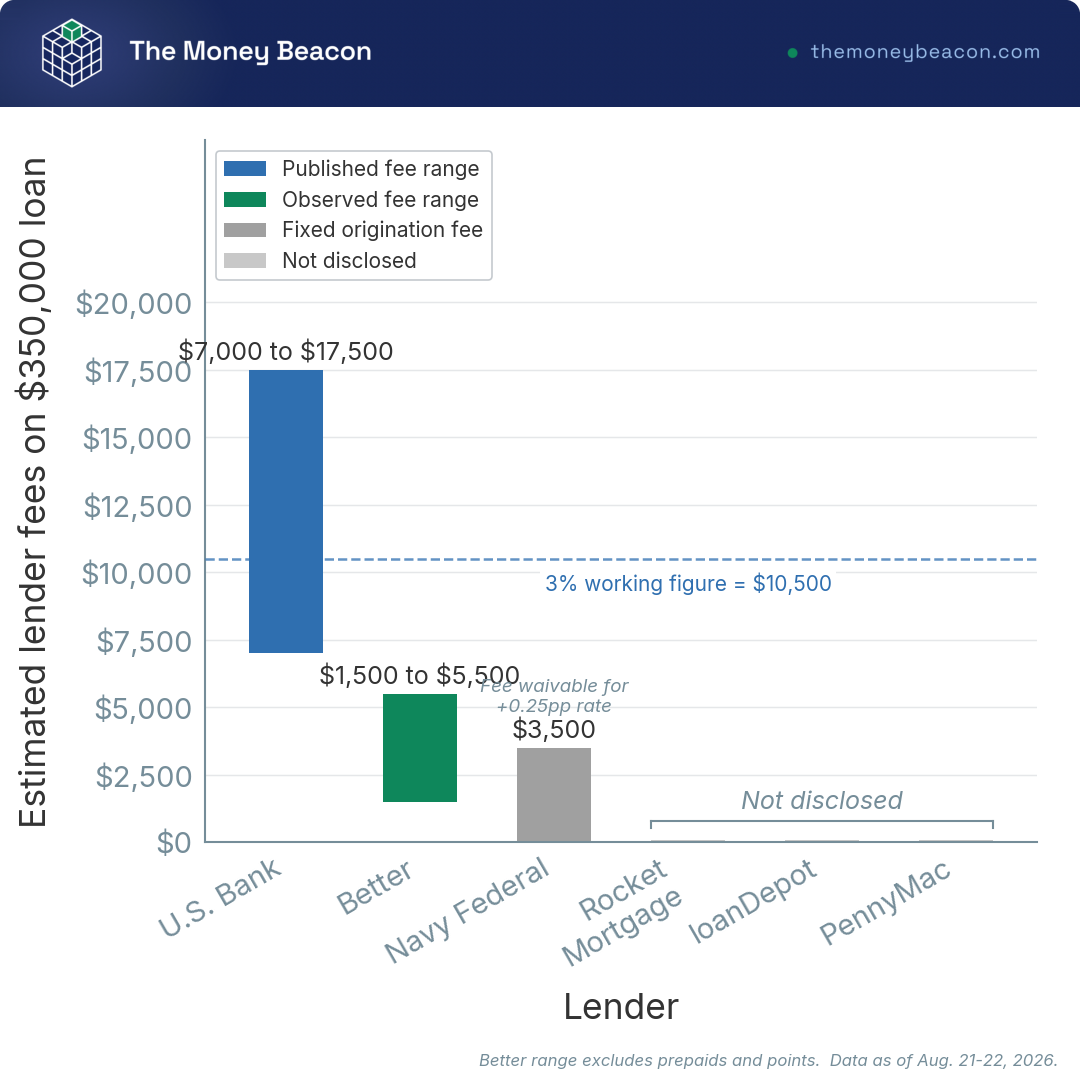
U.S. Bank publishes 2% to 5% of the loan amount. Better publishes $1,500 to $5,500 for most of its loans. On $350,000 that’s $7,000 at 2% and $17,500 at 5%, and I’ll work with 3%, or $10,500. Only origination, underwriting and processing are lender-set. Appraisal, title and settlement are third-party, so two lenders at the same rate can differ by thousands.
Table: Three ways to pay for a refinance, $350,000 at a 6.250% base
| Structure | Out of pocket | Monthly payment | What it really costs |
|---|---|---|---|
| Pay costs in cash | $10,500 | $2,155.01 | The $10,500, plus its opportunity cost |
| Roll costs into the balance | $0 | $2,219.66 | $64.65/month for 360 months = $23,274 |
| Take a lender credit at a higher rate (+0.375 pp, 6.625%) | $0 | $2,241.09 | $86.08/month; the credit pays for itself only if you leave before month 122 |
Data current as of August 2026.
Rolling closing costs into a refinance is the worst of the three if you carry the loan to term.
1.5 Equity, LTV, and the 80% cash-out wall
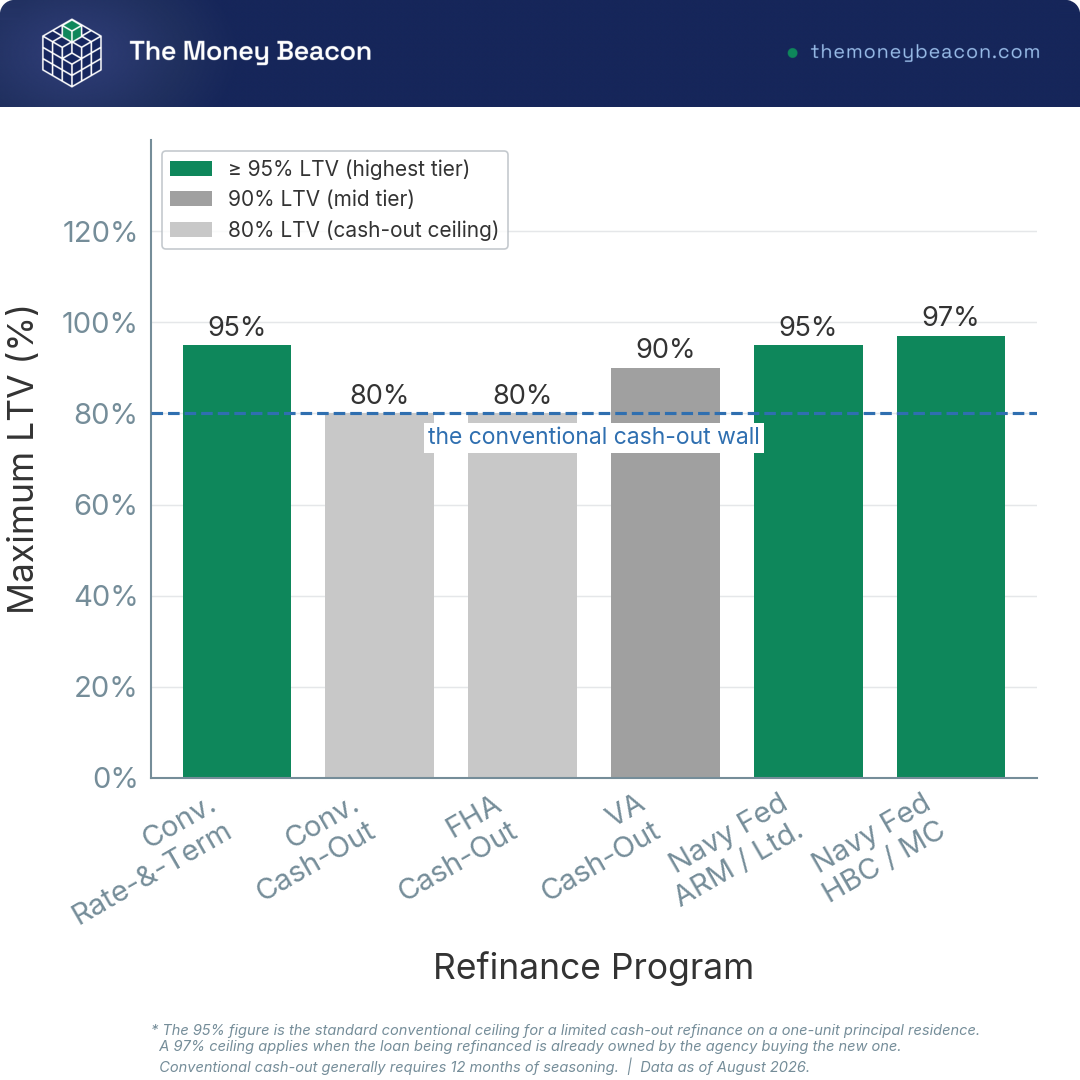
Loan-to-value (LTV) is your balance divided by the appraised value. A conventional rate-and-term refinance generally reaches 95% LTV, and 97% when the agency already owns the old loan. Conventional and Federal Housing Administration (FHA) cash-out both stop at 80%. That cash-out refinance LTV cap is set by Fannie Mae and Freddie Mac, not by any lender.
Department of Veterans Affairs (VA) cash-out goes higher: PennyMac publishes 90%, and Navy Federal 97% on its Choice refinances. And conventional cash-out needs 12 months of seasoning, meaning you have to have held the loan that long first.
1.6 From home value to cash in hand: the cash-out arithmetic on a $500,000 home
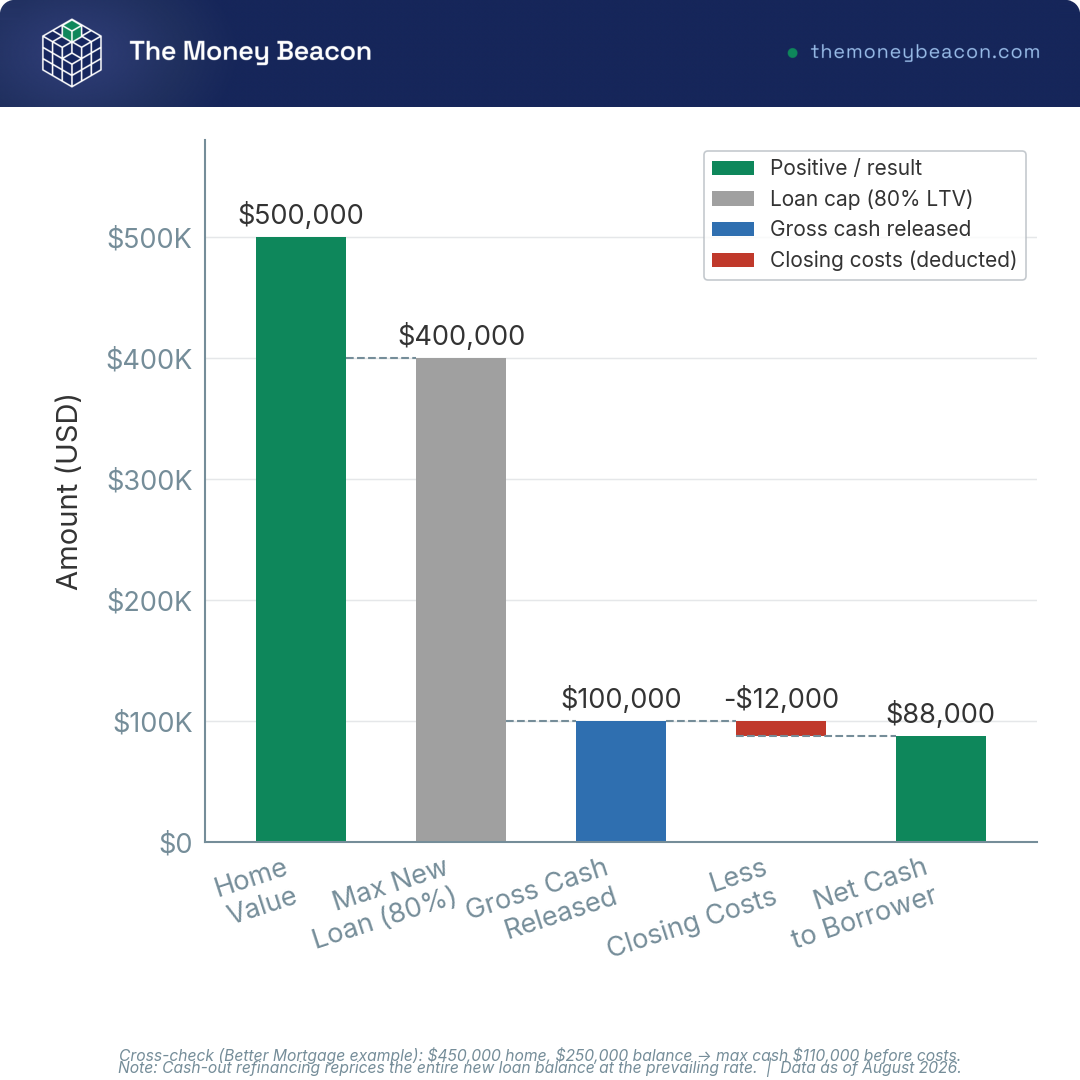
Say your home is worth $500,000, you owe $300,000, and you take a conventional cash-out at the 80% cap. The maximum new loan is $400,000. The payoff leaves $100,000 gross, and 3% closing costs mean about $88,000 reaches your account. Taking that $88,000 at 7.250% against a 3.25% legacy note means paying 7.250% on all $400,000, not just the new money.
The cash-out refinance tax rules catch debt consolidators hardest. Under the Tax Cuts and Jobs Act buy, build, or substantially improve test, interest on proceeds you spend on credit cards, tuition or a car isn’t deductible.
1.7 The two government shortcuts: FHA Streamline and VA IRRRL
Hold an FHA or a VA loan and two programs cut most of the underwriting out of a refinance: the FHA Streamline and the VA Interest Rate Reduction Refinance Loan (IRRRL). Both mean reduced documentation, no appraisal, no cash out.
Table: FHA Streamline versus VA IRRRL
| Dimension | FHA Streamline | VA IRRRL |
|---|---|---|
| Who qualifies | Existing FHA loan only | Existing VA-guaranteed loan only |
| Income and employment docs | Waived on the non-credit-qualifying version | Typically waived |
| Appraisal | Typically not required | Typically not required |
| Cash back to borrower | Max $500 incidental (PennyMac published) | None |
| Benefit test | Net tangible benefit; payment must fall (loanDepot published) | Rate must be lower unless refinancing out of an ARM (loanDepot published) |
| Fee | UFMIP 1.75% plus annual MIP of 0.50% to 0.55% on a 30-year loan | Funding fee 0.5% (PennyMac published), exemptions apply |
| Seasoning | 210 days from the closing date of the existing loan, six consecutive monthly payments made, and six full months since the first payment due date | 210 days from the first payment due date and six consecutive payments |
| Cost recoupment rule | Net tangible benefit standard | Fees must be recouped within 36 months |
Data current as of August 2026.
FHA Streamline seasoning is a three-part test you satisfy all at once, so a borrower who paid quickly can still fail the 210-day part. And the 0.50% to 0.55% annual premium comes from HUD Mortgagee Letter 2023-05, so any page quoting 0.80% to 1.05% is using the pre-2023 schedule.
On a government-program rule, the agency outranks the lender.
1.8 Refinance, second lien, or recast: choosing the instrument before choosing the lender
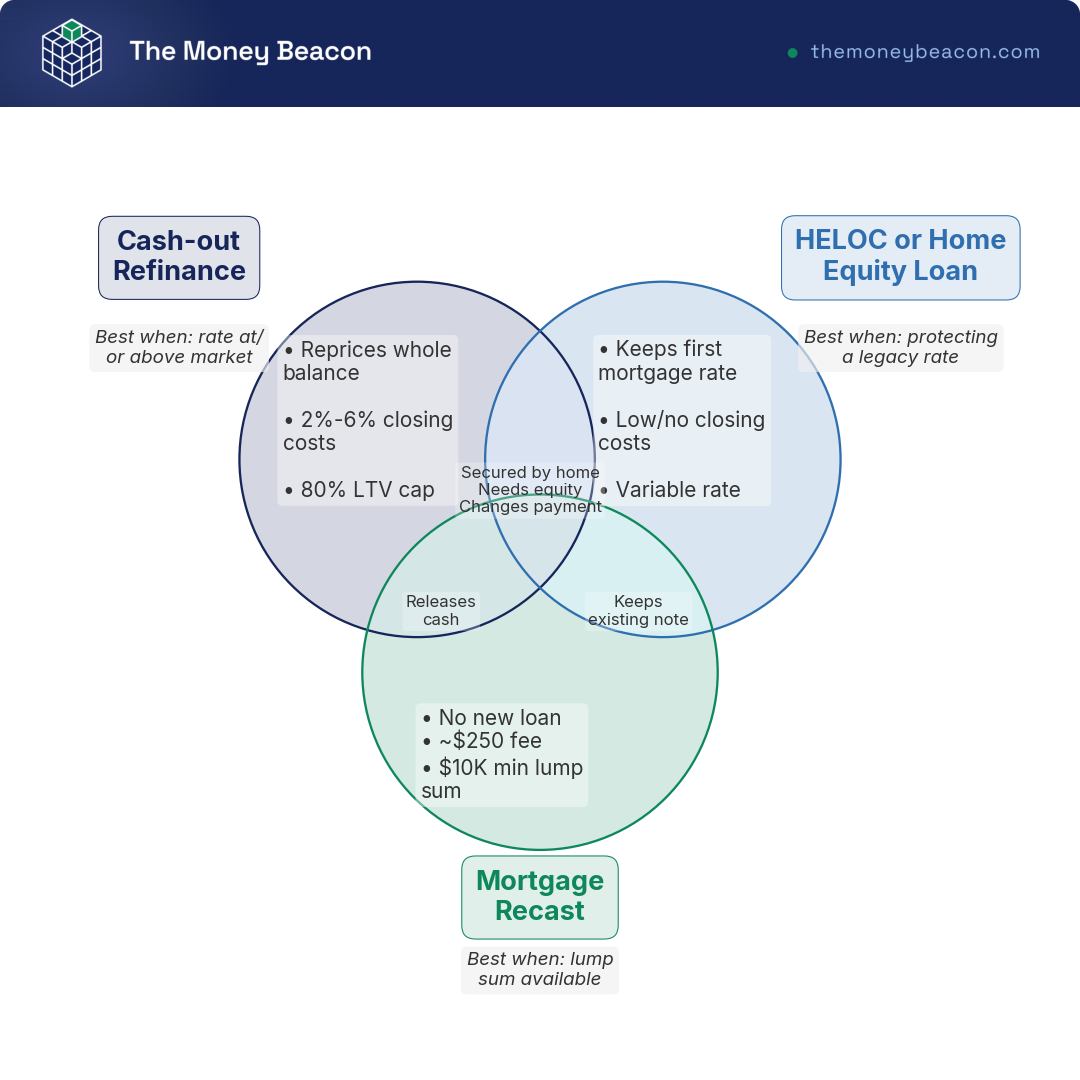
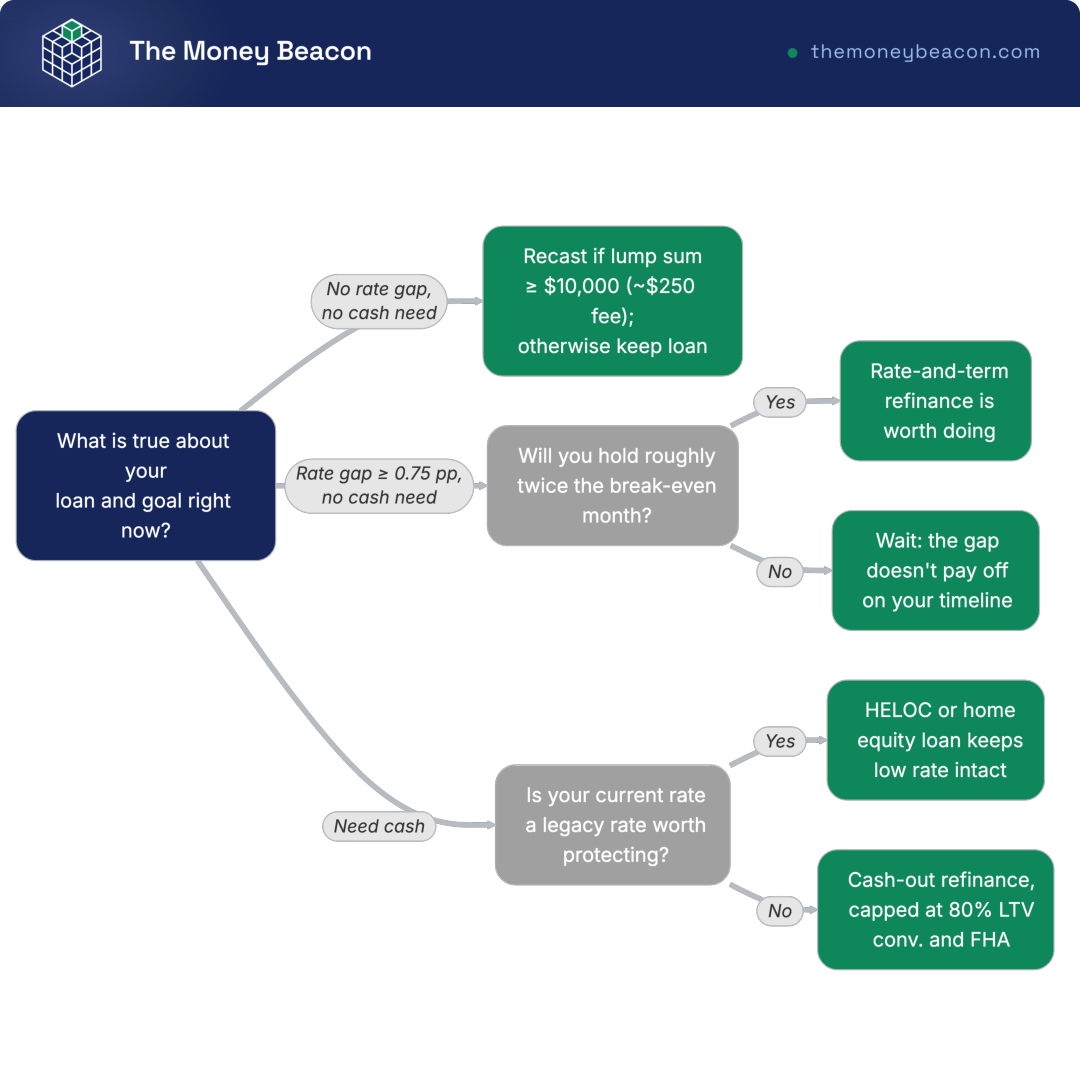
A cash-out refinance reprices your whole balance: 2% to 6% of the new loan, a restarted clock and an 80% LTV ceiling. A home equity line of credit (HELOC) or home equity loan is a second lien, so your current rate is untouched. A mortgage recast keeps the same note, rate and payoff date, then re-amortizes after a lump sum. That costs about $250 on a minimum $10,000 reduction (PennyMac’s servicing FAQ).
Two things settle the mortgage recast vs refinance question: a recast is generally unavailable on FHA, VA and USDA loans, and servicers rarely mention it.
The reviews start with the deepest published rate grid of the six.
2. Rocket Mortgage: the deepest published rate grid and the fastest documented close
2.1 Overview
Rocket Mortgage is the highest-volume retail nonbank in this comparison, built around a guided digital application. It publishes the deepest Rocket Mortgage refinance rate grid of the six. It writes conventional rate-and-term at 30 and 15 years, plus FHA, VA and jumbo. Cash-out is offered but isn’t priced. It holds Nationwide Multistate Licensing System (NMLS) #3030 and is licensed in all 50 states and the District of Columbia.
2.2 Strengths
- The most granular published rate grid of the six, with its pricing assumptions beside it.
- Competitive short-term pricing: the 15-year fixed at 5.625%, and the lowest published 15-year VA jumbo rate in this comparison, 5.250% / 5.916% APR.
- No prepayment penalties, stated explicitly on the page.
- The fastest mortgage refinance closing published in this comparison, about 20 days.
- A full program lineup including jumbo, in every state.
2.3 Weaknesses
- Heavy discount points inside the advertised rates, 1.625 to 2.000, so the rate understates your cash cost.
- Origination fee: not disclosed. Rocket’s fee page says it varies, then quotes market-wide figures.
- Rate-lock length and float-down: not disclosed; Rate Drop Advantage ended on March 31, 2025.
- Maximum LTV, minimum credit score and loan-amount limits: not disclosed, so you can’t check whether you qualify before you open a file.
- The jumbo threshold on the rate page, $766,550, is the 2024 baseline; Rocket’s own pages and the Federal Housing Finance Agency show $832,750.
2.4 Pricing & fees
This grid prices a borrower, not a product.
Table: Rocket Mortgage published refinance rates
| Product | Rate | APR | Points (cost) |
|---|---|---|---|
| 30-year fixed | 6.250% | 6.557% | 2.000 ($5,500) |
| 30-year FHA | 6.125% | 6.983% | 1.750 ($4,813) |
| 30-year VA | 6.125% | 6.621% | 1.750 ($4,813) |
| 30-year jumbo fixed | 6.125% | 6.326% | 1.625 ($17,875) |
| 15-year fixed | 5.625% | 6.101% | 1.875 ($5,157) |
| 15-year FHA | 5.625% | 6.603% | 2.000 ($5,500) |
| 15-year VA | 5.625% | 6.456% | 1.875 ($5,157) |
| 15-year VA jumbo | 5.250% | 5.916% | 1.625 ($17,875) |
Data current as of August 22, 2026.
Rocket prices those for a $275,000 loan ($1,100,000 on jumbo) at 60.00% LTV (70.00% on jumbo), a 740 credit score, a debt-to-income ratio under 43%, and a single-family primary residence. None of those is a minimum you have to clear.
2.5 Who it’s for
Rocket Mortgage is ideal for a borrower with strong credit and substantial equity who wants the fastest documented close in this comparison. It’s also the natural first call on a jumbo balance. It’s not the right choice if you need the lender fee in writing.
3. Navy Federal Credit Union: the best published VA pricing, and the only lender that shows its fee
3.1 Overview
Navy Federal is the only credit union in this comparison, and the most transparent on price. It publishes its full rate grid, origination fee, lock length and float-down terms, the option to move to a lower rate if the market drops before you close.
It writes VA rate-and-term, VA cash-out and VA Streamline, conventional fixed at 15 and 30 years plus jumbo, conforming adjustable-rate mortgages (ARMs), and two no-down-payment products, Homebuyers Choice and Military Choice.
Membership is the gate. It’s open to Active Duty, Veterans, immediate family and Department of Defense civilians, for a $5 minimum share deposit. The National Credit Union Administration (NCUA) supervises it under charter number 5536. It publishes a Navy Federal refinance timeline of 30 to 45 days.
3.2 Strengths
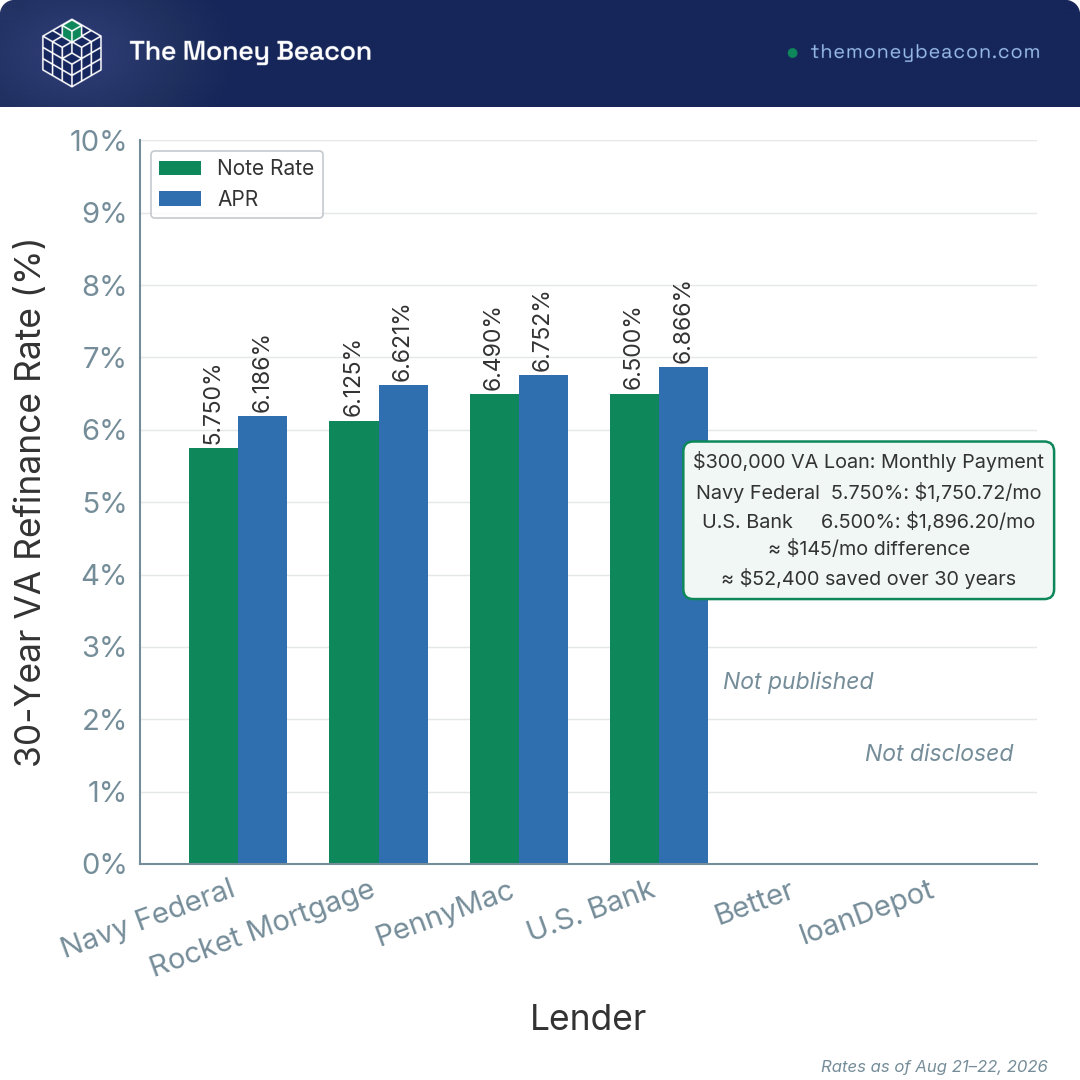
- The best published VA refinance pricing in this comparison: 5.375% / 6.068% APR on the 15-year, 5.750% / 6.186% APR on the 30-year.
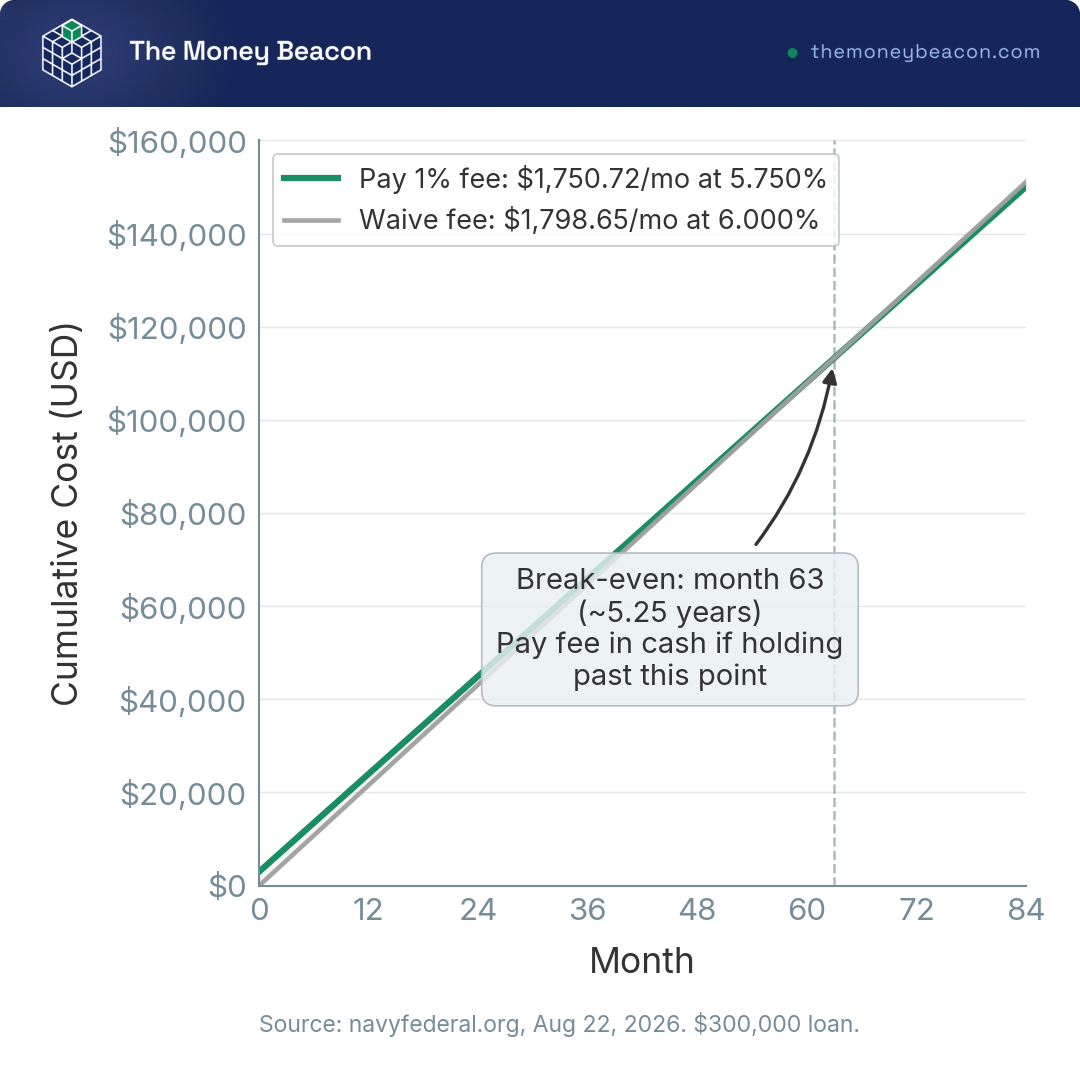
- The only published origination fee in this comparison, 1% of the loan, and the cost of waiving it, 0.25 percentage points.
- The only published lock length and float-down: 60 days standard, a 90-day extension for a fee, and two No-Cost Freedom Lock float-downs capped at 0.25 percentage points.
- High published LTV allowances: 95% on conventional fixed, 97% on the Choice refinances.
On a $300,000 loan that fee is $3,000 in cash, and waiving it costs $47.93 a month. Pay it and you’re ahead from about month 63 onward. Credit union refinance rates rarely come with that arithmetic.
3.3 Weaknesses
- Navy Federal membership eligibility is restricted to the military community, disqualifying most US homeowners.
- Discount points are published only on the two VA rows, so the rate-to-APR difference elsewhere can’t be split into points and fees.
- Homebuyers Choice and Military Choice are expensive at 7.000% to 7.500%, with a funding fee of 1.75%.
- The claim that a member can borrow up to 100% of the home’s value is product-conditional, not a universal cash-out cap.
- Minimum credit score and loan-amount limits: not disclosed; the 720 and 780 FICO credit-score figures are rate assumptions.
3.4 Pricing & fees
Start with the fee, because it’s published rather than quoted on request. It’s 1% of the loan amount, waivable for a 0.25 percentage-point increase in the rate, and the Choice products add a 1.75% funding fee.
Table: Navy Federal published refinance rates
| Product | Rate | APR | Points |
|---|---|---|---|
| 15-year VA | 5.375% | 6.068% | 0.500 |
| 30-year VA | 5.750% | 6.186% | 0.625 |
| 15-year conventional fixed | 5.625% | 5.820% | Not published |
| 30-year conventional fixed | 6.250% | 6.406% | Not published |
| 15-year jumbo conventional | 6.125% | 6.323% | Not published |
| 30-year jumbo conventional | 6.500% | 6.658% | Not published |
| 30-year Homebuyers Choice | 7.125% | 7.458% | Not published |
| 30-year jumbo Homebuyers Choice | 7.500% | Not published | Not published |
| 30-year Military Choice | 7.000% | 7.331% | Not published |
| 30-year jumbo Military Choice | 7.375% | Not published | Not published |
| 3/5 conforming ARM | 5.375% | 6.248% | Not published |
| 5/5 conforming ARM | 5.625% | 6.207% | Not published |
Data current as of August 22, 2026.
Those “as low as” rates are the pricing floor, not your quote. The 15-year products assume a 720 FICO at 80% LTV, and the conforming 30-year assumes a 780 FICO at 75% LTV.
3.5 Who it’s for
Navy Federal is the ideal choice for a VA-eligible borrower in the military community, especially for an IRRRL. It’s also strong for a member who needs an LTV above the conventional 80% cash-out ceiling. It isn’t an option outside that community.
4. U.S. Bank: the lightest points load and the only published closing-cost credit
4.1 Overview
U.S. Bank is the only Federal Deposit Insurance Corporation (FDIC) insured national bank in this comparison. It’s also the only lender offering a branch instead of a fully remote process. That’s the real online mortgage lender vs bank difference.
It writes conventional rate-and-term at four terms from 10 to 30 years, conventional cash-out, FHA and VA refinances, jumbo fixed, plus conforming and jumbo ARMs.
U.S. Bank National Association holds FDIC certificate #6548 and answers to the Office of the Comptroller of the Currency. Deposit insurance doesn’t cover a mortgage, but bank status brings that supervision and a desk you can sit at. The published closing window is 30 to 45 days.
4.2 Strengths
- The lightest points load in this comparison, 0.676 to 0.987, so the advertised rate is close to the real cash price. The 30-year conventional rate-to-APR difference is just 18.3 basis points, and a basis point is one hundredth of a percentage point.
- The broadest set of terms of the six, 10 to 30 years, plus ARMs.
- A published closing-cost range of 2% to 5%, on both the rate-and-term and cash-out pages.
- Borrower-paid finance charges of 0.862% of the base loan amount, about $3,491 on the $405,000 loan assumed.
- The only relationship discount mortgage bank offer in this comparison: 0.25% off closing costs, capped at $750, if you turn on autopay from a U.S. Bank checking account. It costs you nothing beyond opening the account.
4.3 Weaknesses
- The published 30-year conventional rate of 6.750% is high for a conventional specialist in this comparison.
- Origination fee, minimum credit score, rate-lock length and float-down are all not disclosed. The 740+ FICO (680+ on FHA) is the score assumed in the advertised rates, not a bar to clear.
- There’s no no-closing-cost refinance product on the site. The Smart Refinance page returns a 404.
- The advertised conventional rates assume at least 25% equity, a demanding scenario.
- Two limits couldn’t be pinned down. There’s no published maximum LTV on rate-and-term, and conflicting answers on the loan-amount range.
- The 10/6 and 7/6 month ARM rows print an APR below the note rate, an artifact of the hybrid-ARM APR projection.
4.4 Pricing & fees
Read the points column first, because that’s where the case gets made.
Table: U.S. Bank published refinance rates
| Product | Rate | APR | Points |
|---|---|---|---|
| 30-year conventional fixed | 6.750% | 6.933% | 0.987 |
| 20-year conventional fixed | 6.490% | 6.703% | 0.803 |
| 15-year conventional fixed | 5.990% | 6.250% | 0.785 |
| 10-year conventional fixed | 6.125% | 6.510% | 0.856 |
| 30-year FHA | 6.625% | 7.504% | 0.676 |
| 30-year VA | 6.500% | 6.866% | 0.732 |
| 30-year jumbo fixed | 7.000% | 7.151% | Not published |
| 20-year jumbo fixed | 6.875% | 7.094% | Not published |
| 15-year jumbo fixed | 6.625% | 6.914% | Not published |
| 10/6mo ARM | 7.125% | 7.065% | Not published |
| 7/6mo ARM | 7.125% | 6.956% | Not published |
| 10/1yr jumbo ARM | 6.500% | 6.763% | Not published |
| 7/1yr jumbo ARM | 6.250% | 6.649% | Not published |
| 5/1yr jumbo ARM | 6.125% | 6.647% | Not published |
Data current as of August 21, 2026.
Those prices assume a 740 FICO (680 on FHA), at least 25% equity, and a $405,000 conventional loan.
Now for the refinance closing costs breakdown. One point on a $250,000 loan costs $2,500, so 0.987 points on that $405,000 balance is about $3,997 in cash. Two points would be roughly $8,100, and that difference can outweigh a quarter point on the rate.
Origination fee: not disclosed. The 0.25% autopay credit reaches its $750 cap exactly on a $300,000 refinance.
4.5 Who it’s for
U.S. Bank refinance pricing is ideal for a borrower with substantial equity who wants a bank relationship and a rate quoted with barely a point on it. That goes double if you already bank there, since the autopay credit applies. It’s not the right choice with less than 20% equity, or if you need a no-closing-cost structure.
5. Better: the only lender publishing a dollar closing-cost range, and a full cash-out grid
5.1 Overview
Better mortgage refinance comes from an all-digital nonbank whose pitch is speed and fee transparency. It’s the only lender in this comparison publishing hard dollar data about its own fee outcomes.
It writes conventional rate-and-term from 10 to 30 years, FHA refinance, three ARMs, plus a separately priced conventional cash-out lineup that almost no lender publishes.
It’s a nonbank lender, NMLS #330511. It publishes a licensing disclosure page but not a full state list, so check your state on the licensing register. The published average close is about 32 days, self-reported rather than audited.
5.2 Strengths
- The only lender in this comparison publishing an observed dollar closing-cost outcome: most of its loans over the past year closed between $1,500 and $5,500, excluding prepaids and points.
- A full cash-out grid published beside the rate-and-term grid, so you can price both before you apply.
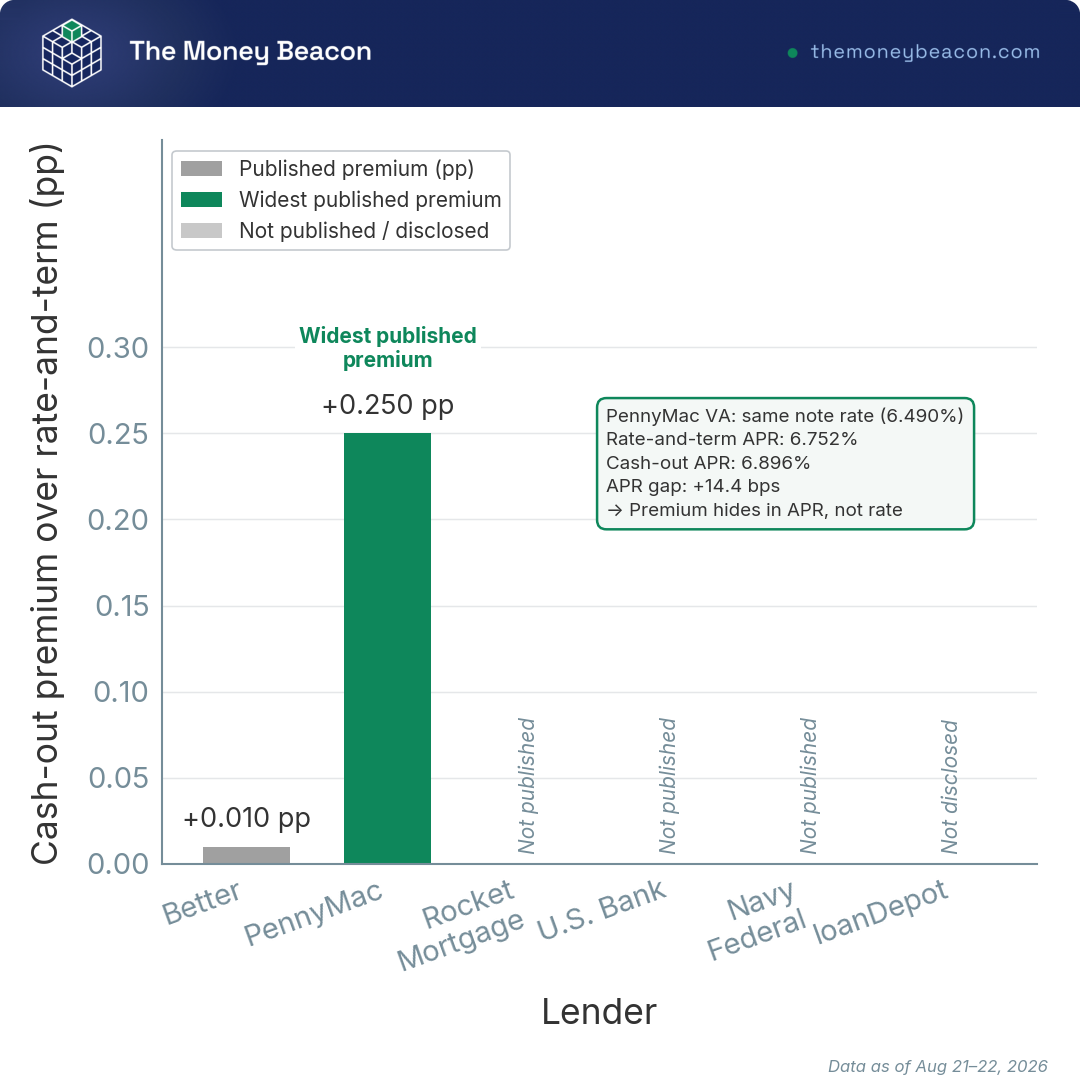
- The smallest 30-year cash-out premium in this comparison, one hundredth of a percentage point, 6.490% against 6.500%.
- A rate locked in as little as 30 minutes, on a genuinely all-digital mortgage application.
- A published statement that you may be eligible to pay little to no upfront closing costs, which is the lender-credit or roll-in structure priced earlier.
5.3 Weaknesses
Start with the correction, because it’s the most repeated error about Better. Better doesn’t charge zero lender fees. Its claims page publishes median lender-paid origination charges of $1,378 on purchase loans, plus a claim that customers pay $2,464 less in lender fees. Better never claimed a no lender fee mortgage; its rates page says “no commissions.” And that $1,378 is a purchase figure with no refinance equivalent published, so don’t carry it across.
- The advertised rates come with the heaviest points in this comparison, 2.02 to 2.45, so that rate is expensive in cash.
- No maximum LTV, no minimum credit score and no loan-amount limits are published, so you can’t self-screen.
- Rate-lock duration and float-down are both not disclosed.
- The rate assumptions describe a narrow borrower profile: 760 or higher, a debt-to-income ratio below 35%, and 20% down.
- The cash-out premium is tiny on the 30-year and much larger down the curve, half a percentage point on the 15-year.
5.4 Pricing & fees
Rate-and-term and cash-out share every row in the table below. The grid is ZIP-gated, so you have to enter a ZIP code before any of it renders.
Table: Better published refinance rates
| Product | Rate-and-term rate / APR | Cash-out rate / APR | Points (cost) on rate-and-term |
|---|---|---|---|
| 30-year fixed | 6.490% / 6.730% | 6.500% / 6.738% | 2.02 ($7,081) |
| 30-year FHA | 6.000% / 7.058% | Not offered on the cash-out grid | 2.22 ($7,783) |
| 20-year fixed | 6.000% / 6.365% | 6.375% / 6.681% | 2.45 ($8,565) |
| 15-year fixed | 5.625% / 6.016% | 6.125% / 6.492% | 2.06 ($7,209) |
| 10-year fixed | 5.750% / 6.317% | 6.250% / 6.802% | 2.10 ($7,368) |
| 10/6m ARM | 6.375% / 6.621% | Not published | 2.10 ($7,347) |
| 7/6m ARM | 6.375% / 6.736% | 6.990% / 7.032% | 2.04 ($7,133) |
| 5/6m ARM | 6.125% / 6.526% | 7.375% / 7.161% | 2.17 ($7,585) |
Data current as of August 22, 2026.
Those prices assume closing costs paid out of pocket. The cash-out page adds an 80% maximum LTV, 20% minimum equity, and an example where a $450,000 home with a $250,000 balance releases $110,000 at most.
One row looks like a typo and isn’t. The 5/6 month ARM cash-out prints a 7.161% APR under its 7.375% note rate. It’s the same hybrid-ARM projection artifact, so ask for the APR worksheet if you’re quoted it.
5.5 Who it’s for
Better is ideal for a documentable W-2 borrower with strong credit and at least 20% equity. It’s the best choice if you want a fast, fully online refinance and a published dollar range for closing costs. It’s not the right choice for a self-employed mortgage refinance, or if you need a human underwriter reading the file.
6. PennyMac: the broadest government lineup and the most explicit published eligibility floors
6.1 Overview
One warning belongs at the top. PennyMac’s public rate page opens on the Purchase tab, whose conventional 30-year reads 6.750% against the refinance pane’s 7.000%. Read a purchase rate as a refinance rate and you understate the price by 25 basis points.
A PennyMac refinance comes from a nonbank lender that’s also one of the largest US mortgage servicers. It publishes the broadest government lineup in this comparison, and the most explicit eligibility numbers.
It writes conventional rate-and-term and cash-out at 30, 20 and 15 years, FHA and FHA Streamline, VA and VA IRRRL, plus jumbo financing up to $3 million. It holds NMLS ID #35953, is state-licensed, and closes in 30 to 45 days.
6.2 Strengths
- The broadest published government lineup in this comparison, with FHA, FHA Streamline, VA, VA IRRRL and VA cash-out each priced, not just listed.
- The most explicit refinance credit score requirements of the six: a 580 minimum on FHA cash-out, and displayed tiers of above 720 for excellent, 680 to 719 for good.
- Ceilings you can check before applying: a 90% VA cash-out limit, a 70% to 80% maximum LTV band on conventional and FHA cash-out, and conventional refinancing on 3% to 5% equity.
- The lowest published jumbo refinance rate in this comparison at 5.750% / 5.966%, financing to $3 million.
- A VA IRRRL at a 0.5% funding fee that typically closes with $0 out of pocket, and an FHA Streamline capped at $500 of incidental cash back.
- A $250 recast fee on a $10,000 minimum principal reduction, which almost no servicer publishes.
6.3 Weaknesses
- The least competitive published conventional 30-year in this comparison at 7.000% / 7.188%, a poor fit for a strong-credit rate-and-term file.
- The widest published conventional cash-out premium in this comparison, a quarter of a percentage point, 7.250% against 7.000%. It applies to the whole balance, not to the cash you release.
- Origination fee: not disclosed.
- Rate-lock length and float-down are also not disclosed, deliberately: the rate widget’s assumptions modal contains a rate-lock-period item commented out in the page source.
- Points are published on the fixed-rate rows but not on the cash-out or FHA Streamline rows, so you can’t break down those rate-to-APR differences.
6.4 Pricing & fees
Everything below comes from the refinance pane, not the purchase tab that loads by default.
Table: PennyMac published refinance rates
| Product | Rate | APR | Points |
|---|---|---|---|
| Conventional 30-year fixed | 7.000% | 7.188% | 0.832 |
| Conventional 20-year fixed | 7.125% | 7.352% | 0.679 |
| Conventional 15-year fixed | 6.750% | 7.053% | 0.841 |
| FHA 30-year fixed | 6.490% | 7.126% | 0.544 |
| FHA 15-year fixed | 6.625% | 7.500% | 2.192 |
| FHA Streamline 20-year fixed | 6.490% | 7.280% | Not published |
| VA 30-year fixed | 6.490% | 6.752% | 0.949 |
| VA 20-year fixed | 6.490% | 6.835% | 0.949 |
| VA 15-year fixed | 6.625% | 7.194% | 1.761 |
| Jumbo 30-year fixed | 5.750% | 5.966% | 1.905 |
| Cash-out, conventional 30-year | 7.250% | 7.406% | Not published |
| Cash-out, VA 30-year | 6.490% | 6.896% | Not published |
| Cash-out, FHA 30-year | 6.625% | 7.349% | Not published |
Data current as of August 22, 2026.
Those prices assume a $275,000 loan at 70% LTV with a 740 FICO.
The VA line is the cleanest illustration in this article of why APR is the field you compare on. Cash-out and rate-and-term both have a 6.490% note rate, so the payment is identical. The cash-out still costs more, 6.896% APR against 6.752%. That difference is pure fee load, and only the APR column shows it.
Origination fee: not disclosed. The one published fee is the VA IRRRL funding fee of 0.5%.
6.5 Who it’s for
PennyMac is ideal for an FHA or VA borrower, especially one after an IRRRL or a VA cash-out above the 80% conventional ceiling. It also fits a thin credit file that needs a published floor, or a jumbo balance. It’s not the right choice for a strong-credit conventional rate-and-term file.
7. loanDepot: no published rates, and a Lifetime Guarantee aimed at your second refinance
7.1 Overview
loanDepot sells a repeat-customer guarantee instead of a published price. It’s the only lender in this comparison with no rate table anywhere on its domain, and that rate isn’t published anywhere, not just hard to find.
It writes conventional, FHA and VA refinances including both streamline programs, jumbo cash-out and a HELOC. Nonbank, NMLS #174457. As for how long does a refinance take, it’s the slowest in this comparison at 45 to 60 days.
7.2 Strengths
- The Lifetime Guarantee, unmatched in this comparison: lender fees waived on a qualifying future refinance.
- Checkable government-program guidelines: an FHA Streamline needs an existing FHA loan, current payments and a falling payment, and a VA IRRRL needs a lower rate on an existing VA loan.
- Published no-cost structures on both, plus a HELOC variant that waives half a point of closing costs.
- An APR ceiling of 3 points, so you know the outer bound of what a quote can hide.
7.3 Weaknesses
- No published rate or APR anywhere, so you can’t price-screen loanDepot before a phone call.
- And it isn’t for lack of looking.
- Lender fee, minimum credit score, cash-out LTV cap, loan-amount range, lock length and float-down: all not disclosed.
- The Lifetime Guarantee is worth exactly a lender fee loanDepot doesn’t publish, and it’s blocked for 12 months.
- The slowest published timeline in this comparison, and no lock length either.
7.4 Pricing & fees
This table looks nothing like the other five, and that’s really the review.
Table: loanDepot published refinance pricing
| Metric | Published value |
|---|---|
| Rate and APR grid by loan type | Not disclosed |
| Lender or origination fee on a first refinance | Not disclosed |
| Cost of one discount point | 1% of the new loan amount |
| Points embedded in the APR | Up to 3 points, including any origination, discount and lender fees |
| Rate assumption, loan-to-value | 80% or less |
| Rate assumption, debt-to-income | 35% or lower |
| Fee categories charged | Credit report, title, escrow, notary, recording, appraisal, processing, underwriting |
| Documented refinance timeline | Up to 45 to 60 days, closing about 3 days after signed documents are received |
| Lifetime Guarantee | No lender fee on a qualifying future refinance; not redeemable within 12 calendar months of the date issued |
| Lifetime Guarantee, HELOC variant | Up to a half point waiver of closing costs |
Data current as of August 22, 2026.
That 80%-or-less figure is the assumption behind rates you never see, not a cap. And the only lender fee it puts a number on applies to your second refinance.
7.5 Who it’s for
A loanDepot refinance is ideal for a borrower who expects to refinance twice and is fine working by phone. It’s not the right choice if you want published prices before you call.
8. The full comparison and the verdict for your profile
8.1 Every published rate and APR, all six lenders on one page
This table settles the comparisons the individual reviews left alone.
Table: Published refinance rate and APR by loan type
| Loan type | Rocket | Better | loanDepot | PennyMac | U.S. Bank | Navy Federal |
|---|---|---|---|---|---|---|
| 30-yr conventional | 6.250% / 6.557% | 6.490% / 6.730% | Not disclosed | 7.000% / 7.188% | 6.750% / 6.933% | 6.250% / 6.406% |
| 15-yr conventional | 5.625% / 6.101% | 5.625% / 6.016% | Not disclosed | 6.750% / 7.053% | 5.990% / 6.250% | 5.625% / 5.820% |
| 30-yr FHA | 6.125% / 6.983% | 6.000% / 7.058% | Not disclosed | 6.490% / 7.126% | 6.625% / 7.504% | Not published |
| 30-yr VA loan | 6.125% / 6.621% | Not published | Not disclosed | 6.490% / 6.752% | 6.500% / 6.866% | 5.750% / 6.186% |
| 30-yr jumbo | 6.125% / 6.326% | Not published | Not disclosed | 5.750% / 5.966% | 7.000% / 7.151% | 6.500% / 6.658% |
| 30-yr conventional cash-out | Not published | 6.500% / 6.738% | Not disclosed | 7.250% / 7.406% | Not published | Not published |
Rates as of August 22, 2026, except U.S. Bank, August 21, 2026. “Not published” means priced elsewhere but not on this row; “Not disclosed” means no grid at all.
The lowest refinance rate on the 30-year conventional is a tie at 6.250%, and on APR Navy Federal beats Rocket.
8.2 Whose headline rate is closest to what you would actually pay
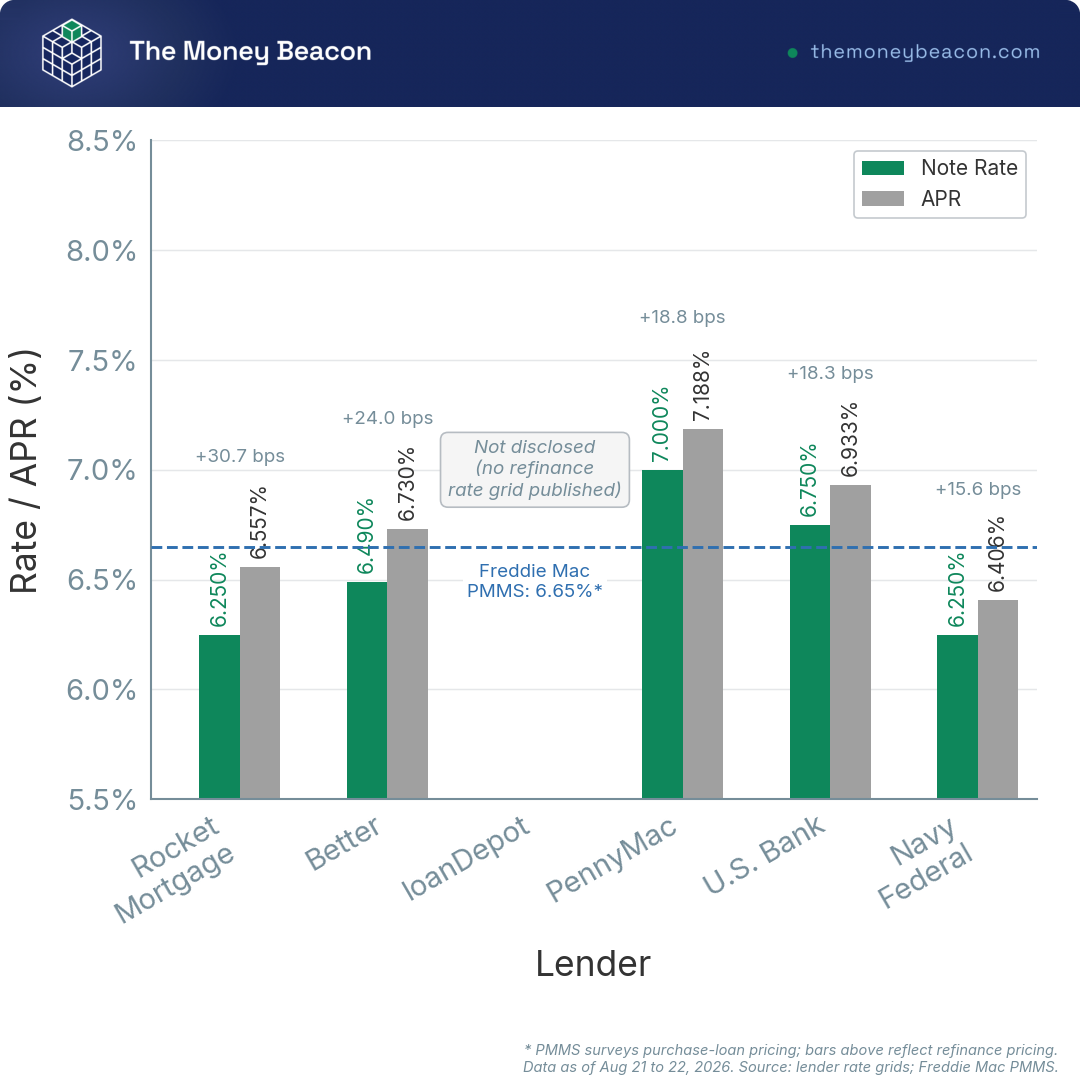
The distance between the rate and the APR shows you the fee load. On the 30-year conventional: Rocket 30.7 basis points, Better 24.0, PennyMac 18.8, U.S. Bank 18.3, Navy Federal 15.6.
A joint-lowest advertised rate doesn’t produce the lowest all-in price. So mortgage refinance APR is the number to compare.
The Freddie Mac Primary Mortgage Market Survey read 6.65% on the 30-year fixed on August 20, 2026. That’s purchase pricing, which our comparison of rates for a home purchase covers. And it’s one reason refinance grids price above it.
8.3 Fees, points, and the four lenders that will not name their origination charge
Four of the six decline to publish an origination fee at all.
Table: Fees and published closing-cost data
| Item | Rocket | Better | loanDepot | PennyMac | U.S. Bank | Navy Federal |
|---|---|---|---|---|---|---|
| Origination / lender fee | Not disclosed | Median $1,378 lender-paid (purchase loans only); “no commissions” | Not disclosed | Not disclosed | Not disclosed | 1% of loan, waivable for +0.25% rate |
| Published closing-cost range | Not published | $1,500 to $5,500 | Not published | Not published | 2% to 5% of loan amount | Not published |
| Quantified finance charge | Not published | Not published | Not published | Not published | 0.862% of base loan amount | Not published |
| Cost of one point | Not published | Published per row | 1% of the new loan amount | Published per row | $2,500 on a $250,000 loan | Published on VA rows |
| Program funding fee | Not published | Not published | Not published | VA IRRRL 0.5% | Not published | Choice products 1.75% |
| Relationship / autopay credit | Not published | Not published | Not published | Not published | 0.25% of loan, capped at $750 | Not published |
| No-cost structure | Not published | “Little to no upfront closing costs” | “No cost” FHA Streamline; VA no money out of pocket | VA IRRRL $0 out of pocket | No such product on site | Not published |
| Prepayment penalty | None (published) | Not published | Not published | Not published | Not published | Not published |
| Repeat-refinance benefit | Not published | Not published | Lifetime Guarantee, blocked 12 months | Not published | Not published | No-Refi Rate Drop, $250 |
Data current as of August 2026.
Each blank held across the lender’s own site, so the absence is itself the finding.
8.4 What the fee sheet looks like on a $350,000 loan
On that balance, Navy Federal’s 1% fee is $3,500, or nothing if you take the quarter point instead.
Rocket, PennyMac and loanDepot publish nothing at all, which is why this comparison ends with a process instead of a single winner.
8.5 Lock, timeline, eligibility, and the risk five of six lenders leave you holding
Published timelines differ by a factor of three, and just one lender in six tells you how long it holds your rate.
Table: Lock, timeline, eligibility, safety
| Item | Rocket | Better | loanDepot | PennyMac | U.S. Bank | Navy Federal |
|---|---|---|---|---|---|---|
| Rate-lock length | Not disclosed | Not disclosed | Not disclosed | Not disclosed (commented out in page source) | Not disclosed | 60 days standard; 90-day extended for a fee; Lock and Shop to 120 days |
| Float-down | Not disclosed (window closed 03/31/2025) | Not disclosed | Not disclosed | Not disclosed | Not disclosed | No-Cost Freedom Lock: 2 float-downs, capped at 0.25 pp |
| Lock speed claim | Not published | “As little as 30 minutes” | Not published | Not published | Not published | Not published |
| Avg. closing timeline | About 20 days | About 32 days | Up to 45 to 60 days | 30 to 45 days | 30 to 45 days | 30 to 45 days |
| Eligibility gate | Open | Open | Open | Open | Open | Military community ($5 share deposit) |
| Entity type / regulator | Nonbank, NMLS #3030 | Nonbank, NMLS #330511 | Nonbank, NMLS #174457 | Nonbank servicer, NMLS #35953 | National bank, FDIC #6548, OCC | Credit union, NCUA charter 5536 |
| Channel | Digital plus loan officers | All-digital | Phone and loan officers | Digital plus phone | Digital plus branches | Digital plus branches |
Data current as of August 2026.
A lender that quotes 45 to 60 days and won’t say how long the lock runs is asking you to carry the expiry risk blind. And a rate lock extension fee can wipe out the whole saving.
8.6 Verdict: the strong-credit homeowner doing a rate-and-term refinance
Strong credit, substantial equity, no cash needed. Your decision turns on the break-even month, month 27 on the worked example.
Strip the points out of the advertised rate first. Rocket’s two points cost $5,500 on its assumed balance, and U.S. Bank’s 0.987 points cost about $3,997 on its own.
Two routes. Rocket and Navy Federal tie at 6.250%, though only the military community gets into Navy Federal. Or take light points and speed: U.S. Bank at 0.987 points, Rocket at about 20 days.
And the winner only shows up on three same-day Loan Estimates.
8.7 Verdict: the homeowner pulling cash out to consolidate debt or fund a renovation
The 80% wall is Fannie Mae’s and Freddie Mac’s. FHA cash-out stops there too, and private mortgage insurance isn’t available above it.
Every lender adds a cash-out premium, from a hundredth of a point at Better up to a quarter point at PennyMac. And it applies to the whole balance, not just the cash you release.
The best cash-out refinance lender for most of this profile is Better: smallest 30-year premium, a full published grid, 80% maximum LTV. U.S. Bank publishes 80%, up to 90% in some cases, and PennyMac 90% on VA cash-out.
If the goal is clearing card balances, price a personal loan or a balance transfer first, because interest on consolidation proceeds isn’t deductible and the house now secures it.
8.8 Verdict: the VA-eligible borrower, and especially the IRRRL candidate
If you’re VA-eligible and in the military community, get a Navy Federal quote first. Its 5.750% / 6.186% on the 30-year VA undercuts Rocket, PennyMac and U.S. Bank. On $300,000 that’s about $145 a month, roughly $52,400 over thirty years, and getting in costs a $5 share deposit.
An IRRRL strips the file down: no appraisal, no income documentation, a 0.5% funding fee, typically $0 out of pocket.
Veterans receiving compensation for a service-connected disability owe no VA funding fee, so confirm the exemption in writing before closing. The exemption is worth $1,500 on a $300,000 IRRRL.
If your entitlement is exhausted, Choice refinances reach 97% LTV at a 1.75% funding fee.
8.9 Verdict: the thin-equity or thin-credit-file homeowner, including existing FHA borrowers
Every advertised grid in this comparison assumes a 740 to 780 credit score and 20% to 25% equity. Those are pricing scenarios, not minimums, so you aren’t disqualified from borrowing, you’re disqualified from the advertised price.
The only published floors belong to PennyMac: a 580 minimum on FHA cash-out, and conventional refinancing on as little as 3% to 5% equity.
Existing FHA borrowers also pay mortgage insurance that nobody else does, offset by the Streamline shortcut.
Two risks apply to this profile alone. A low appraisal turns the file into a higher-LTV, higher-priced loan, and no lender publishes appraisal-waiver criteria. And underwriting built around W-2 paperwork makes 1099 income refinance documentation harder to place.
8.10 Verdict: the homeowner who should not refinance at all
The numbers settle this one. You owe $300,000 at 3.25% and need $80,000. A cash-out at 7.250% reprices all $380,000: the payment goes from $1,305.62 to $2,592.27, and first-year interest from $9,661 to $27,429.
So $17,768 of extra first-year interest buys $80,000 of cash, an effective first-year cost of 22.2%. A second lien would have to price above roughly 22% before the cash-out caught up, and no legitimate home-equity product does.
Which makes the home equity loan vs refinance question easy. A HELOC or a home equity loan is a second lien behind the 3.25% first mortgage, and it leaves that loan alone. A recast costs about $250 on a $10,000 minimum, against roughly $10,500 for a refinance, and servicers rarely bring it up. So ask in writing.
Tom’s take
I carry mortgage debt on rental property on purpose, and I’ve borrowed against those positions more than once. The rule: don’t retire cheap debt to raise cash, borrow behind it.
8.11 How to run the comparison yourself: three Loan Estimates and the deadlines that protect you
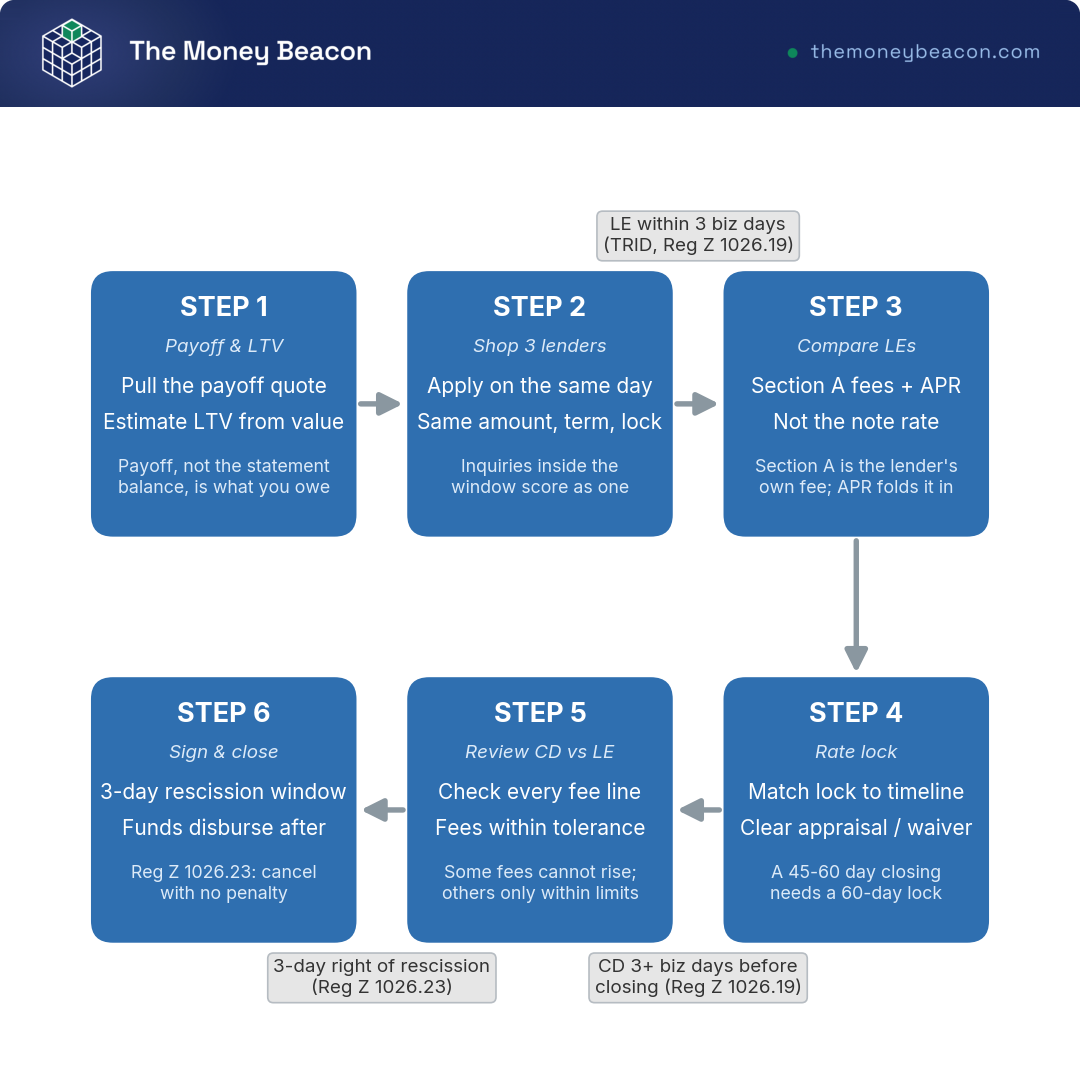
Four of six lenders withhold the origination fee, and five of six the lock length. So you pick the winner on paper: three Loan Estimates, same day, same amount, term and lock, compared on APR and Section A, the lender’s own fees.
Start by pulling a payoff quote from your mortgage servicer, because the payoff and not the statement balance is what the new loan must cover. Estimate your LTV against the 80% wall, then apply to three lenders in one day.
Cluster every credit pull inside the rate-shopping window, 45 days on recent FICO models and 14 on older ones. Two weeks makes the distinction moot.
Match the lock to the lender’s published timeline. Read the Closing Disclosure against the Loan Estimate during the three business days before you sign. And treat the rescission window after closing as a real review period, since the money hasn’t moved yet.
Three requests pay for themselves: a zero-point quote beside the featured rate, the same loan priced with a lender credit, and the lock length and average close together.
Conclusion
Six lenders, nine criteria. And picking the lender turns out to be the smaller part of this decision. A refinance only pays off once your monthly saving has covered the closing costs. On a $350,000 balance that’s $10,500 against a $397.92 saving, so you break even in month 27. And if you might sell or refinance again before then, the rate barely matters, because you’d be paying $10,500 for a discount you never collect.
The term matters just as much. In the worked example, a fresh 30-year loan cut the payment by $441.61 and added about $149,872 of interest. So compare remaining interest, not monthly payments.
Then treat every advertised rate as what it really is, a scenario price. The rates in this comparison come with between 0.5 and 2.45 discount points, and you pay for those in cash at closing. So no rate table can tell you who’s cheapest for you. Only three Loan Estimates can: pulled the same day, on the same amount and term, compared on Section A and APR.
So here’s the step you can take today. Call your servicer and ask for a payoff quote, not your statement balance. It’s free, it takes about ten minutes, and you measure every quote you collect afterward against it.
If you want to dig deeper, our step-by-step guide for first-time buyers breaks the same closing-cost bill down line by line. When the cash matters more than the rate, our comparison of personal loan rates is often a cheaper way to raise it than repricing a whole mortgage. And if the break-even math tells you to stay put, our comparison of homeowners insurance covers one line of your monthly payment you can still lower without paying a dollar of closing costs.
FAQ
How much does it cost to refinance a mortgage in 2026?
Usually 2% to 6% of your new loan amount. U.S. Bank publishes 2% to 5% on its refinance pages, and Better reports that most of its loans closed with costs between $1,500 and $5,500. On a $300,000 refinance, that’s $6,000 to $18,000. Origination and underwriting are the lender’s own fees, in Section A of your Loan Estimate. Appraisal, title, and recording are third-party and vary by state. Navy Federal is the only lender in this comparison that discloses its fee outright, 1% of the loan.
How do I calculate the break-even point on a refinance?
Divide your total closing costs by the monthly payment saving. Refinance a $350,000 balance from 7.500% to 6.250% and the payment drops from $2,552.93 to $2,155.01, a $397.92 saving. Divide $10,500 of closing costs by that saving and you get 26.4 months, so you break even in month 27. Compare principal and interest only. Escrow is a cash-flow shuffle, not a saving. Sell or refinance again before that month and you lose money, however good the rate looked.
Is a “no-closing-cost” refinance really free?
No. It’s one of three financing structures, and each has a price. On a $350,000 loan at 6.250%, paying cash costs $10,500 up front. Rolling the costs into your balance costs $64.65 a month, or $23,274 over the loan’s life. Taking a lender credit for a higher rate costs about $86 a month at 6.625%. The credit route is actually cheapest if you won’t keep the loan long: it only passes paying cash after about 122 months.
What credit score and LTV do I need to refinance, and how much higher are the requirements for a cash-out?
Almost none of them publish a true minimum. Five of the six state no floor at all. The scores on their rate pages (740 at Rocket Mortgage and PennyMac, 760 at Better, 720 to 780 at Navy Federal) describe the profile behind the advertised price, not a cutoff. PennyMac is the exception, with a published 580 minimum for an FHA cash-out. LTV is what’s actually enforced. A conventional rate-and-term refinance can reach 95%, or 97% if an agency already owns your loan. A cash-out, conventional or FHA, caps out at 80%.
How much cash can I actually take out with a cash-out refinance?
Take 80% of a realistic appraised value, subtract what you still owe, then subtract closing costs. On a $500,000 home with a $300,000 balance, the maximum new loan is $400,000, gross cash is $100,000, and after 3% closing costs you net about $88,000. Two costs are easy to miss. A cash-out reprices your entire balance, not just the money you take, so a low legacy rate disappears on all of it. And cash-out pricing is higher than rate-and-term. PennyMac’s own conventional 30-year cash-out is 7.250% against 7.000%.
What is a VA IRRRL, and how is it different from a regular VA refinance?
A VA IRRRL is a streamlined refinance available only if you already hold a VA-guaranteed loan. It typically skips income and employment paperwork and usually the appraisal, allows no cash out, and requires a lower rate unless you’re leaving an adjustable-rate loan. The funding fee is just 0.5%, versus 2.15% on a first-use cash-out, and PennyMac notes an IRRRL often closes with $0 out of pocket. You need 210 days of seasoning with six consecutive payments made. Navy Federal publishes the best VA pricing in this comparison, 5.750% and 6.186% APR on a 30-year.
Does refinancing hurt my credit score, and how many lenders can I apply to?
Applying triggers a hard inquiry, which typically costs a few points and fades within a year. Credit models bundle multiple mortgage inquiries made in a short window into a single hit, precisely so shopping around doesn’t cost extra: recent FICO models use a 45-day window, older models and VantageScore use 14. Apply to three lenders on the same day. That holds the rate environment steady, which matters more than the scoring effect anyway. The bigger hit comes after closing, when a new account replaces an old one.
Should I refinance, take a HELOC, or ask for a mortgage recast?
It depends on the rate you’re already holding. If your current rate is at or above today’s market and you need cash, a cash-out refinance makes sense. If you’re sitting on a low legacy rate, it almost never does: taking $80,000 out against a $300,000 balance at 3.25% through a 7.250% cash-out reprices the whole $380,000, at an effective first-year cost above 22%. If you just want a lower payment on money you already have, ask your servicer about a recast instead: PennyMac charges $250 on a $10,000 minimum.



Comments
Questions and corrections welcome. We read everything.