


You open a money market account for one reason. You want a savings account you can actually spend from, with checks, a debit card, and an ATM you can walk up to when the water heater dies on a Sunday night.
Then you read the account disclosure. Vio Bank pays 3.45% on its Cornerstone Money Market Savings account. But its own terms say a debit or ATM card, wallet checks, and Bill Pay aren’t available on it. Quontic Bank pays 3.80% and gives you a free debit card and check writing.
Same three words on the sign, two very different products. That’s the problem with this category in 2026: the name tells you nothing about the access, and not much about the rate either.
Across the six accounts in this comparison, money market rates range from 2.00% to 3.80%. Leave $25,000 alone for twelve months and the top of that range pays $950.00 while the bottom pays $500.00. That’s a $450 difference inside a single product category, at banks that are federally insured either way.
Then there’s the part most savers don’t price out: at some banks, the spending tools come out of your yield. Synchrony pays 2.00% on its money market account against 3.30% on its own savings. So the checks and the optional ATM card cost you 1.30 percentage points a year. At Ally that same access is free, because its money market and savings accounts both pay 3.00%.
So there are two questions, not one. What rate are you actually getting, and what can you do with the money once it’s in the account? I rated all six on both, and the ranking flips depending on which of the two matters more to you.
1. How we compared these six money market accounts
Two questions, one scorecard. And a single word that separates this product from something carrying no federal insurance at all.
1.1 What a money market account gives you that a savings account doesn’t
A money market deposit account is a deposit account at a bank. Your cash is insured by the Federal Deposit Insurance Corporation (FDIC) up to the standard limit, and the bank pays a variable annual percentage yield (APY) it can reprice whenever it likes. You also get spending tools a plain savings account doesn’t have: check writing, a debit or ATM card, sometimes an ATM fee refund.
A money market fund is a different animal: a mutual fund of short-term debt, bought through a brokerage account and governed by Securities and Exchange Commission (SEC) rules. It carries no FDIC insurance and its value can fall.
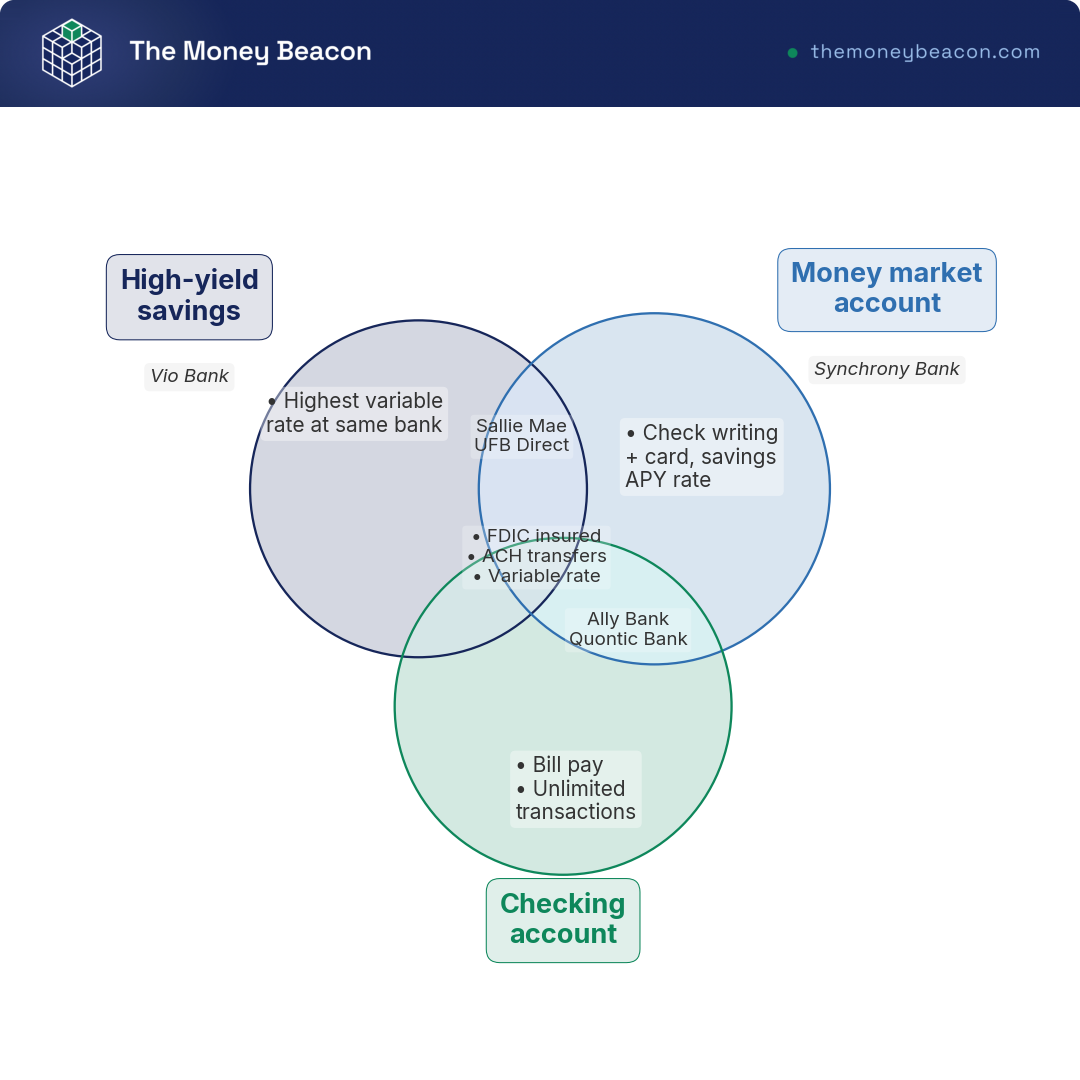
Here’s the part the name hides. The money market label tells you nothing about whether you can spend from the account. Spending access is four separate features, and you check them one at a time.
1.2 The seven criteria, and how each number was checked
Here’s the scorecard I used to rank the best money market accounts 2026 has on offer, in the order the criteria decide.
Table: Comparison criteria, weighting, and how each was measured
| Rank | Criterion | Why it is weighted here | How it was measured |
|---|---|---|---|
| 1 | APY and its tier structure | Drives the dollar outcome on every balance | Issuer’s own rate page or rate table, with the issuer’s own as-of date |
| 2 | Spending access | The only reason to prefer this product over a savings account | Check writing, debit or ATM card, ATM network, ATM fee reimbursement |
| 3 | Fee exposure at the reader’s balance | A fee can exceed the interest below a threshold | Monthly fee, waiver condition, excess-transaction fee, statement fee |
| 4 | Access conditions | Determines whether the account is openable and usable | Minimum opening deposit, minimum balance for the rate, funding cap |
| 5 | Transfer and withdrawal limits | Governs how fast a large sum can actually leave | Per-cycle counts and per-transfer or per-month dollar caps |
| 6 | Safety and legal entity | Determines the real insurance ceiling | FDIC status, legal entity behind the brand |
| 7 | Digital experience and service | Tie-breaker, not a decider | Issuer documentation; app ratings deferred to verification |
One row deserves a note: fee exposure gets judged at your balance, and it catches exactly one account in this comparison.
Left out on purpose: promotional bonuses tied to a direct deposit or a partner relationship, business and trust variants, and any figure from a rate aggregator.
1.3 Every rate here is variable, so check the date on it
Money market rates aren’t promises. They’re variable, repriced without notice, and only as good as the date attached to them.
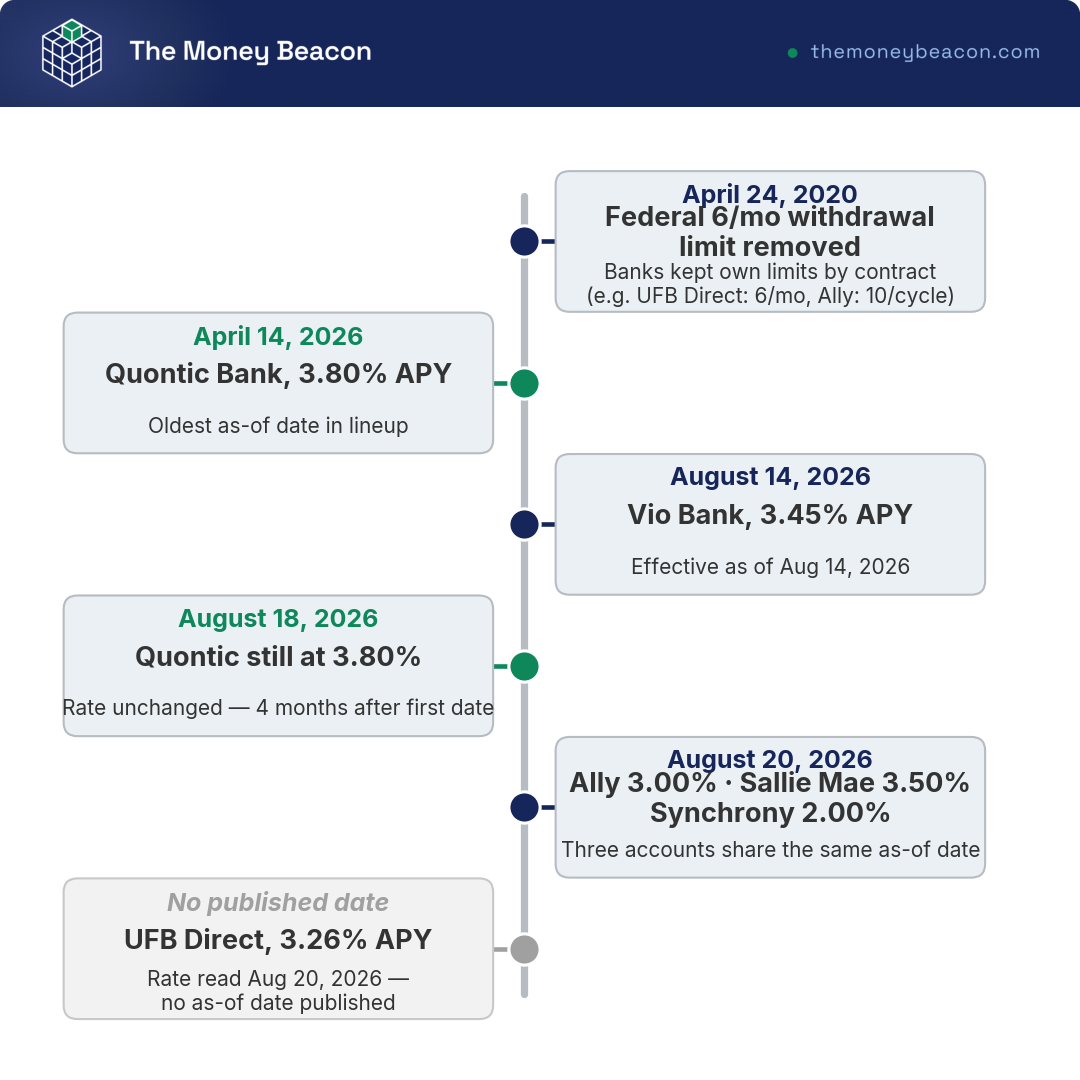
Four of these six banks publish a date within a week of the reading. Quontic’s page is four months older, dated April 14, 2026, though its own rate sheet still showed 3.80% on August 18, 2026. UFB Direct publishes no effective date at all, so its 3.26% is dated to the day it was read.
1.4 The six accounts side by side
Table: The six accounts at a glance
| Account | APY | Rate as of | Min. to open | Monthly fee | Checks | Debit or ATM card |
|---|---|---|---|---|---|---|
| Quontic Bank | 3.80% | April 14, 2026 | $100 | $0 | Yes | Yes, free debit card |
| Sallie Mae Bank | 3.50% | 08/20/2026 | $0 | $0 | Yes | No card offered |
| Vio Bank | 3.45% | 08/14/2026 | $100 | $0 | No | No |
| UFB Direct | 3.26% | No date published | $0 | $10.00 below $5,000.00 | Yes | Not listed for this product |
| Ally Bank | 3.00% | 08/20/2026 | $0 | $0 | Yes | Yes, debit card |
| Synchrony Bank | 2.00% | 8/20/2026 | $0 | $0 | Yes, on request | Optional ATM card |
Data current as of August 2026.
Read the last two columns against the first, and you’ll see that the high yield money market accounts in this comparison don’t reliably come with the best spending tools.
1.5 Yield on one axis, spending access on the other
Access here is scored out of three, one point each for check writing, a card, and a published ATM fee reimbursement.
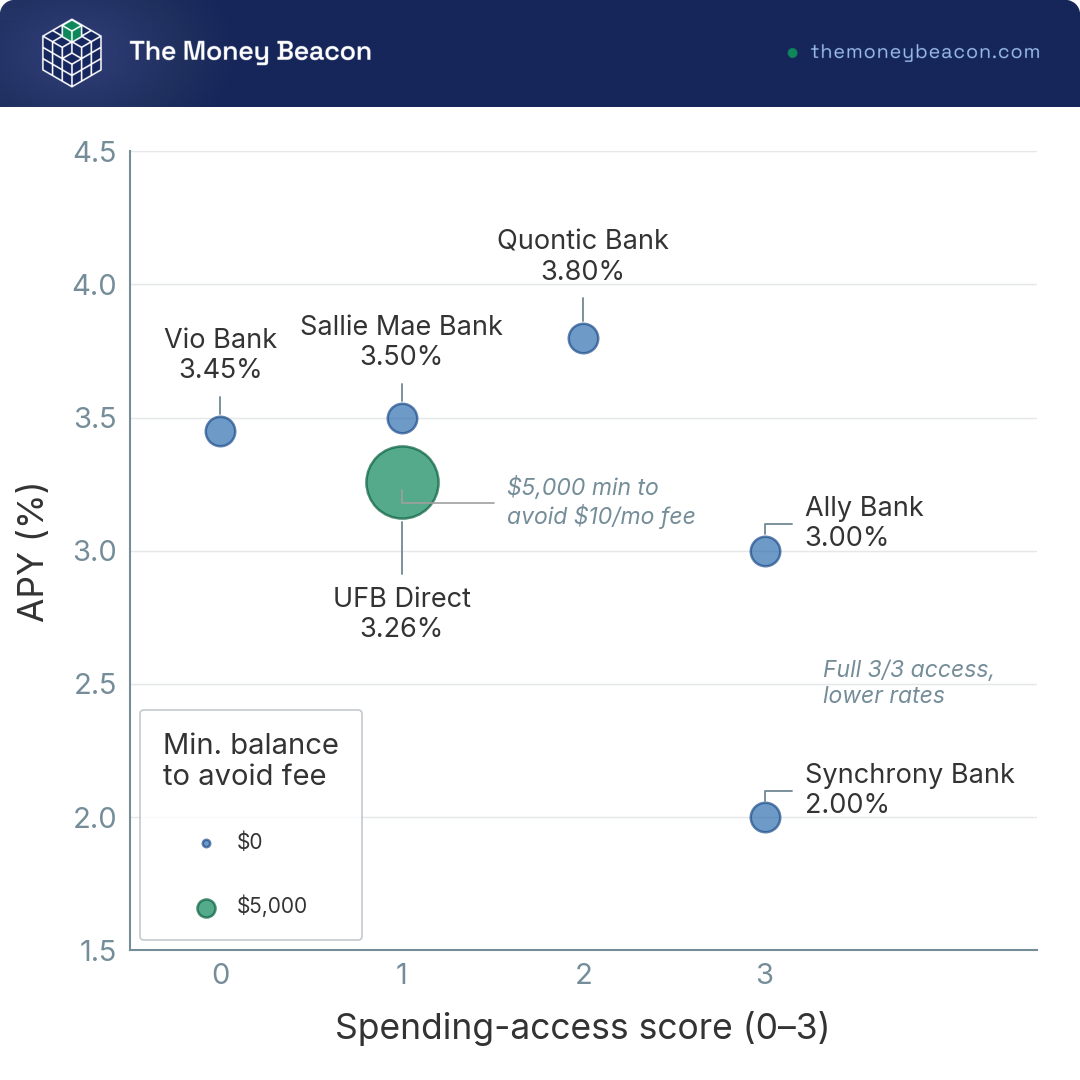
Quontic tops the rate axis but scores two of three, with no domestic ATM fee reimbursement. Vio scores zero: a money market account with none of the money market access. Ally and Synchrony score three, at the bottom of the rate axis.
No diagonal line on that chart, so you can’t infer access from rate, or rate from access. Sort by rate alone and you’ll pick the wrong money market checking account.
1.6 What the same $25,000 earns in each account
Money market account rates only mean something once you convert them into dollars. On a static $25,000 held for twelve months, Quontic pays $950.00, Sallie Mae $875.00, Vio $862.50, UFB Direct $815.00, Ally $750.00, and Synchrony $500.00, all before tax and before fees.
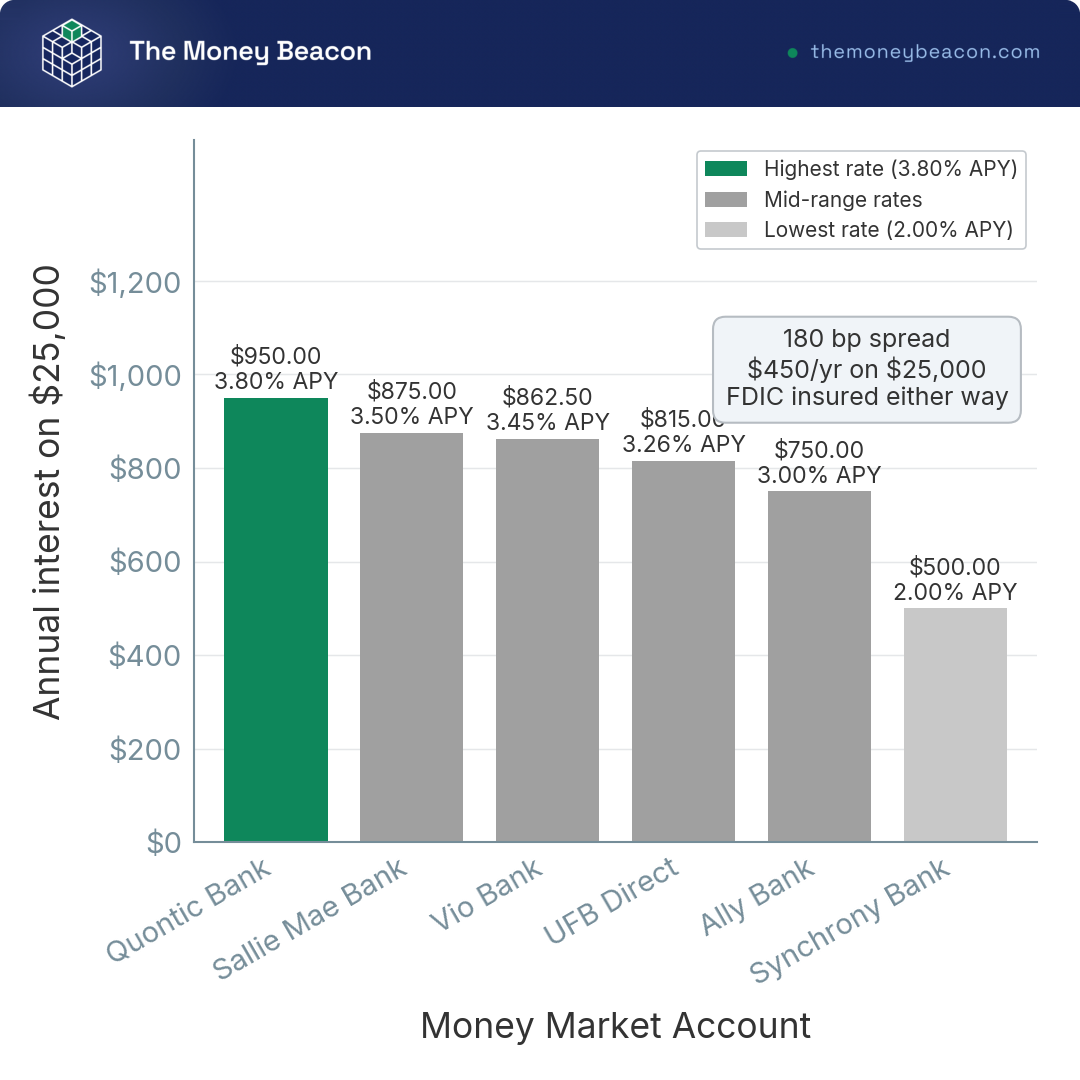
So what does that $450 a year actually buy? At some banks a debit card and an ATM network, at one nothing at all. I’ll start at the top, where the highest rate also comes with both a debit card and checks.
2. Quontic Bank: the highest rate here, with a debit card and checks attached
2.1 Quontic Bank overview
Quontic is a digital bank and a certified Community Development Financial Institution (CDFI), a US Treasury designation it has held since 2015. That’s positioning more than a consumer benefit, so treat it as context.
The Quontic Bank money market account pays 3.80% APY, with the product page dated April 14, 2026. It’s a tiered variable account, and the same 3.80% applies to every tier: $0.01 to $4,999.99, $5,000.00 to $149,999.99, and balances over $149,999.99. The minimum opening deposit is $100, and no minimum balance is published for earning the rate.
2.2 Quontic Bank strengths
Most high interest rate money market accounts ask you to give something up somewhere. Here’s what this one does well:
- 3.80% APY on every balance tier, not just the top one, so your first dollar earns the full rate.
- A free debit card and check-writing privileges, the complete spending set.
- A stated 90,000 surcharge-free ATMs across the country.
- No monthly fee, no overdraft fee and no foreign collection fee, on a $100 entry price.
- Quontic’s own High Yield Savings Account pays 3.20% APY, 60 basis points below this money market account. A basis point is one hundredth of a percentage point, so that’s 0.60% a year, about $150 more on $25,000.
So at this bank, the account with the checks and the card is also the account with the higher rate, which is the opposite of the usual trade-off.
2.3 Quontic Bank weaknesses
The list is shorter, and one line on it can decide your whole choice.
- External transfer limits of $2,000 daily and $10,000 monthly. A $25,000 balance can’t be moved out electronically inside a single month, and moving it all out takes three statement cycles.
- The rate information on the product page is dated April 14, 2026, though the bank’s own rate sheet still showed 3.80% on August 18, 2026.
- The schedule of fees carries a 5/22/25 effective date, so several fee lines can’t be confirmed as current.
- No domestic out-of-network ATM fee reimbursement is published, and a $2.75 standard fee applies at non-Quontic ATMs outside the United States.
- It’s a small institution, and several of these access facts are documented only on the product page.
That transfer cap isn’t a footnote. On this account it’s the line that decides.
2.4 Quontic Bank pricing and fees
Read this schedule for what it doesn’t charge you.
Table: Quontic Bank money market account fee schedule
| Item | Quontic Bank money market account |
|---|---|
| Monthly maintenance fee | $0 |
| Overdraft fee | $0 |
| Foreign collection fee | $0 |
| Outgoing domestic wire | $25 |
| Outgoing international wire | $35 |
| Stop payment | $20 |
| Excess transaction fee | $0.00 |
| Non-Quontic ATM outside the United States | $2.75 |
| Minimum opening deposit | $100 |
| External transfer limit | $2,000 daily, $10,000 monthly |
| Debit card | Free |
| Schedule of fees effective date | 5/22/25 |
Data current as of August 2026.
The excess transaction fee is $0.00. On this account the constraint is the value of your transfers, not the count.
2.5 Who Quontic Bank is for
Quontic is ideal for the saver who wants a money market account with checks and a free debit card without trading down on yield, at any balance, since the same 3.80% applies to every tier.
It’s not the right choice if you might need the full balance at another bank quickly: the $10,000 monthly cap decides that.
3. Sallie Mae Bank: checks, zero minimums, and a $500,000 transfer ceiling
3.1 Sallie Mae Bank overview
Sallie Mae Bank is an education lender first, and its deposit lineup is deliberately narrow: high-yield savings, this money market account, certificates of deposit (CDs), and SmartyPig. The deposit side is run without gimmicks.
The Sallie Mae money market account pays 3.50% APY, accurate as of 08/20/2026, with no balance tiers. There’s no minimum deposit to open and no minimum balance to maintain, so once the account is funded there’s nothing left to monitor. The Automated Clearing House (ACH) transfer limit is $500,000 per transaction.
3.2 Sallie Mae Bank strengths
What you get here is mostly the absence of things, which is easy to undervalue:
- 3.50% APY with no minimums anywhere, no opening deposit and no balance floor, so the money market account minimum balance question doesn’t apply.
- Check writing, with the first check order free at account opening.
- A $500,000 ACH transfer limit per transaction, which means a full emergency fund can leave in one move.
- A dated, published rate table rather than a marketing number, so you can audit the 3.50% yourself.
- FDIC coverage stated on the bank’s own page at $250,000 per depositor, and $250,000 per co-owner on a joint account.
That transfer ceiling is the feature an emergency-fund saver usually discovers too late, on the afternoon they need the money somewhere else.
3.3 Sallie Mae Bank weaknesses
Three of these are small. The first one isn’t.
- No debit or ATM card at all. The deposit terms list check, electronic funds transfer and wire as the only permitted withdrawal methods, so there’s no way to withdraw cash at a machine.
- The bank’s own High-Yield Savings Account pays 3.75% APY as of 08/20/2026, 25 basis points more than this account.
- A $5 charge on any check reorder placed after opening, with expedited delivery a further $10.
- Phone support runs Monday through Friday, 9 a.m. to 6 p.m. ET, and closes daily from 1 to 2 p.m. ET.
So inside this bank the money market vs high yield savings comparison doesn’t favor the money market account: the check privilege costs 25 basis points, or $62.50 a year on $25,000.
3.4 Sallie Mae Bank pricing and fees
Table: Sallie Mae Bank money market account fee schedule
| Item | Sallie Mae Bank money market account |
|---|---|
| Monthly maintenance fee | $0 |
| Minimum opening deposit | $0 |
| Minimum balance | $0 |
| Check order at account opening | Free |
| Check order after account opening | $5 |
| Expedited check order delivery | $10 additional |
| Outgoing wire transfer | $20 |
| ACH transfer limit | $500,000 per transaction |
Data current as of August 2026.
The $5 reorder is avoidable: order your checks when you open the account. The $20 wire is the only other charge.
3.5 Who Sallie Mae Bank is for
Sallie Mae Bank is ideal for the emergency-fund saver who writes the occasional large check rather than needing daily cash, and for a beginner, since there’s no opening deposit and no balance floor.
It’s not the right choice if you want to tap the balance at an ATM. No card of any kind is offered on this account.
4. Vio Bank: a high rate on an account that has no checks and no card
4.1 Vio Bank overview
The brand is younger than the bank behind it. Vio Bank launched in 2018 as the national online division of MidFirst Bank, which holds roughly $15 billion in assets.
The Vio Bank money market account, sold as Cornerstone Money Market Savings, is deliberately minimal. It pays 3.45% APY on all balances, effective as of 08/14/2026. There are no tiers and no minimum balance to earn that rate. $100 opens it, and initial funding is capped at $250,000, which matches the standard FDIC coverage limit.
4.2 Vio Bank strengths
Money market savings account rates this high usually come attached to a longer feature list. This one is short on purpose, because the account does one thing.
- 3.45% APY on all balances, with no tiers, no minimum balance and no monthly fee, so there’s no threshold to manage.
- A rate effective date of 08/14/2026 printed on the product page, recent enough to trust.
- A $100 entry price, low enough to open with a starter balance.
4.3 Vio Bank weaknesses
One line on this list decides the whole account, and it’s the first one. The other four are worth knowing, but you can work around every one of them once you’ve read them.
- Vio’s own disclosure states that a debit or ATM card, wallet checks, Bill Pay and outgoing international wires are not available on this account.
- Vio has no FDIC certificate of its own. It’s a division of MidFirst Bank, so Vio and MidFirst deposits in the same ownership category share one $250,000 limit under MidFirst Bank, Certificate #4063.
- Initial funding is capped at $250,000, so a larger cash position needs a second bank from day one.
- A $5 monthly fee if you want paper statements.
- No per-statement-cycle withdrawal count is published for this account.
4.4 Vio Bank pricing and fees
Table: Vio Bank Cornerstone Money Market Savings fee schedule
| Item | Vio Bank Cornerstone Money Market Savings |
|---|---|
| Monthly maintenance fee | $0 |
| Monthly service charge (disclosure) | $0 |
| Paper statement fee | $5 per month |
| Outgoing domestic wire | $30 |
| Stop payment | $30 |
| Excess transaction fee | None published for this account |
| Outgoing international wire | Not available on this account |
| Minimum deposit to open | $100 |
| Maximum initial funding | $250,000 |
| Checks | Not available on this account |
| Debit or ATM card | Not available on this account |
Data current as of August 2026.
Five dollars a month is $60 a year. On a $2,000 balance earning 3.45%, that’s about 87% of your interest gone to paper you didn’t need. Switch to electronic statements on day one and it never applies.
4.5 Who Vio Bank is for
Vio is ideal for the saver who only wants yield and is happy moving money by ACH transfer or domestic wire.
It’s not the right choice for anyone who wants check or card access, and if you already bank with MidFirst, count both balances against one $250,000 limit.
5. UFB Direct: check writing above $5,000, and a monthly fee below it
5.1 UFB Direct overview
One number governs this account, and it isn’t the rate.
UFB Direct is a brand of Axos Bank. The Portfolio Money Market account is sold on a savings-style rate plus check-writing privileges. It pays 3.26% APY on a 3.21% interest rate. All five balance tiers, from $0 to $9,999.99 up through $100,000 or greater, currently pay that same 3.26%.
No minimum balance is required to open, per the Axos personal deposit account agreement. The number that decides the UFB Direct money market account is the $5,000.00 average daily ledger balance that waives the monthly fee.
5.2 UFB Direct strengths
Money market checking account rates usually reward a big balance and short-change a small one. This tier table doesn’t.
- 3.26% APY paid on every tier, including your first dollar.
- Check-writing privileges advertised on the product page, on a rate in the upper half of this comparison.
- No minimum balance required to open, per the deposit account agreement.
- The FDIC certificate number, #35546, printed right on the product page. It belongs to Axos Bank, so UFB and Axos deposits share one insured-institution limit.
5.3 UFB Direct weaknesses
Now for the condition, and it’s a real one.
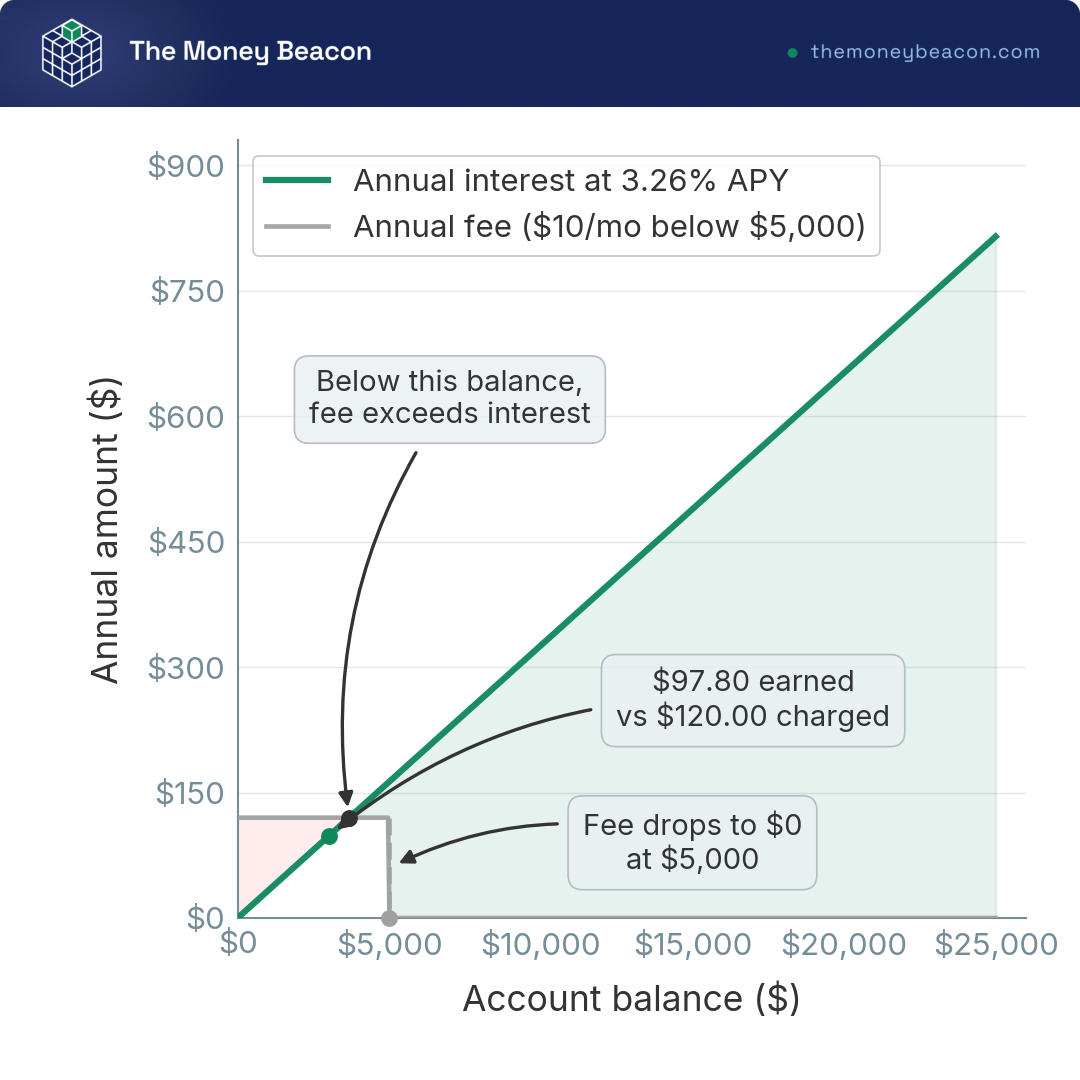
- A $10.00 monthly maintenance fee whenever the average daily ledger balance drops below $5,000.00. That’s $120.00 a year.
- At a $3,000 balance you earn about $97.80 at 3.26% and pay $120.00 in fees, so you’re down about $22.20 on the year. The account only starts paying you above roughly $3,700.
- Six withdrawals or transfers per month or statement cycle combined, with a $10.00 fee on each one beyond that.
- No published rate effective date anywhere on the product page or the tier table, so you can’t tell how fresh the 3.26% is.
- The card question stays open. The account’s own feature list in the deposit agreement records no debit card and no ATM fee reimbursement, while another account at the same bank documents both. The bank doesn’t list either one on this product, so I won’t assert it either way.
Here’s that same arithmetic as one chart.
5.4 UFB Direct pricing and fees
Most of this table is one condition, restated four ways.
Table: UFB Direct Portfolio Money Market fee schedule
| Item | UFB Direct Portfolio Money Market |
|---|---|
| Monthly maintenance fee | $10.00 if the average daily ledger balance falls below $5,000.00 |
| Fee waiver condition | Maintain a $5,000.00 balance |
| Minimum balance required to open | None |
| Withdrawal and transfer limit | Six per month or statement cycle |
| Excess transaction or withdrawal fee | $10.00 per withdrawal |
| Boosted savings rate with Freedom Checking | 0.20% APY |
| Freedom Checking balances APY | 2.00% APY |
Data current as of August 2026.
The last two rows aren’t fees. Pair this with a Freedom Checking account and those balances earn 2.00% APY, while the savings rate gains 0.20% APY.
5.5 Who UFB Direct is for
UFB Direct is ideal for the saver who will hold well above $5,000 permanently and wants a mid-3% rate with check access.
It’s not the right choice for a first account or a small balance. Treat the $5,000 line as a condition of ownership, not a target you’ll reach later.
6. Ally Bank: the full access set, at no cost in yield
6.1 Ally Bank overview
No branches anywhere, and that’s the point. This money market account is one product in a lineup that also includes a Spending account, savings, CDs, and investing, aimed at the saver who wants one online bank for everything.
The Ally money market account pays 3.00% APY on all balance tiers, accurate as of 08/20/2026. There are three, under $5,000, $5,000 to $24,999.99, and $25,000 or more, and all pay the same rate. There’s no minimum balance to earn it and no minimum opening deposit.
6.2 Ally Bank strengths
This is the access set the product category is supposed to come with.
- A debit card and checks, plus more than 75,000 Allpoint and MoneyPass ATMs where withdrawals are free and unlimited.
- Up to $10 per statement cycle reimbursed for fees at other banks’ machines, which is $120 a year of cover.
- $0 on almost every fee line, including overdraft items and excess transactions.
- Ten withdrawals per statement cycle, with ATM withdrawals excluded from that count.
- A dated rate disclosure, 08/20/2026, and customer care published as available 24/7.
And here’s the number that decides this account. Ally’s own Online Savings Account pays the same 3.00% APY, so the checks, the card and the ATM reimbursement cost you nothing in yield.
6.3 Ally Bank weaknesses
Three drawbacks, and only one of them is structural.
- At 3.00% APY the rate is in the lower half of this comparison, giving up $200 a year on $25,000 against the top rate.
- There’s no free online bill pay on this account. Bill pay comes with the Ally Spending Account instead.
- Outgoing domestic wires cost $20, against $0 for incoming.
So the checking vs savings account question doesn’t fully go away. You can write a check and tap a card, but you can’t pay a utility bill from this account, so a one-account household will still need a separate checking account.
6.4 Ally Bank pricing and fees
Table: Ally Bank money market account fee schedule
| Item | Ally Bank money market account |
|---|---|
| Monthly maintenance fee | $0 |
| Minimum opening deposit | $0 |
| Overdraft item fee | $0 |
| Excessive transactions fee | $0 |
| Standard or expedited ACH transfer | $0 |
| Incoming wire, domestic and international | $0 |
| Official or cashier’s check | $0 |
| Outgoing domestic wire | $20 |
| Expedited delivery | $15 |
| Out-of-network ATM fee reimbursement | Up to $10 per statement cycle |
Data current as of August 2026.
Two charges, and you have to go looking for both. Up to $10 a cycle in ATM refunds is worth real money if you withdraw cash regularly, and nothing at all if you don’t.
6.5 Who Ally Bank is for
Ally is ideal for the saver who wants one online bank for the emergency fund and the occasional purchase, and who genuinely withdraws cash. Its savings and money market accounts pay the same rate, so that access costs nothing in yield.
It’s not the right choice for a saver optimizing purely for yield, and it can’t be your only account, because bill pay requires the separate Spending account.
7. Synchrony Bank: an ATM card that works overseas, on the lowest rate here
7.1 Synchrony Bank overview
Synchrony’s deposit business grew out of consumer credit, and it’s built around high-yield savings and CDs. This account is the side product.
The Synchrony money market account pays 2.00% APY, accurate as of 8/20/2026, with no published tiers and no minimum balance. There’s no minimum deposit and no monthly fee. Mobile deposits are capped at $2,000.00 per account per day.
7.2 Synchrony Bank strengths
The access set is the whole case for this account. At 2.00% the rate isn’t the reason to open it, so everything worth having here is about what you can do with the money.
- Checks on request and an optional ATM card, with no minimum of any kind.
- The card works at machines displaying the Plus or Accel logos, in the US or overseas.
- Domestic ATM fees from other financial institutions are refunded up to $5.00 per statement cycle, or $60 over a year.
- A rewards program whose top tier, Diamond, needs a $250,000 relationship balance or five years of tenure. Its marketed unlimited ATM refund isn’t in the program terms, so $5.00 per cycle is the only refund figure I’ll treat as established.
7.3 Synchrony Bank weaknesses
Run the money market account vs high yield savings account comparison inside this one bank and the case gets hard to make.
- 2.00% APY pays $500.00 of gross interest a year on $25,000.
- Synchrony’s own High Yield Savings pays 130 basis points more than this account. That’s 3.30% APY as of 8/20/2026, worth $325.00 a year on $25,000, and it offers an optional ATM card too.
- A $25.00 outgoing wire transfer fee.
- A $2,000.00 daily mobile deposit cap, which slows the funding of a large balance.
7.4 Synchrony Bank pricing and fees
Nothing about opening or holding this account costs anything.
Table: Synchrony Bank money market account fee schedule
| Item | Synchrony Bank money market account |
|---|---|
| Monthly maintenance fee | $0 |
| Minimum opening deposit | $0 |
| Minimum balance | $0 |
| Outgoing wire transfer | $25.00 |
| Domestic ATM fee refund | Up to $5.00 per statement cycle |
| Mobile deposit limit | $2,000.00 per account per day |
Data current as of August 2026.
The mobile deposit line isn’t a fee, but it limits how fast money gets in.
7.5 Who Synchrony Bank is for
Synchrony is ideal for an existing customer who needs cash at an ATM abroad and keeps only a working balance in this account.
It’s not the right choice as a primary yield account, since the bank’s own savings pays 130 basis points more and issues the card anyway.
8. The full comparison, and which account fits you
8.1 Every account on every criterion
Every comparative claim in this article comes out of this table.
Table: Full comparison: every target on every criterion
| Criterion | Quontic Bank | Sallie Mae Bank | Vio Bank | UFB Direct | Ally Bank | Synchrony Bank |
|---|---|---|---|---|---|---|
| APY | 3.80% | 3.50% | 3.45% | 3.26% | 3.00% | 2.00% |
| Rate as of | April 14, 2026 on the product page; the same 3.80% still on the rate sheet 08/18/2026 | 08/20/2026 | 08/14/2026 | No published date | 08/20/2026 | 8/20/2026 |
| Same bank’s own savings APY | 3.20% | 3.75% | Not confirmed first-party | Not returned by verification | 3.00% | 3.30% |
| Flat or tiered | Tiered, one rate on all tiers | Flat | Flat, all balances | Tiered, one rate on all tiers | Tiered, one rate on all tiers | Flat |
| Minimum to open | $100 | $0 | $100 | None required | $0 | $0 |
| Minimum balance for the rate | None published | $0 | $0 | None; rate is uniform | No minimum to earn APY | $0 |
| Monthly maintenance fee | $0 | $0 | $0 | $10.00 below $5,000.00 | $0 | $0 |
| Fee waiver | Not applicable | Not applicable | Not applicable | $5,000.00 average daily ledger balance | Not applicable | Not applicable |
| Check writing | Yes | Yes | No | Yes | Yes | Yes, on request |
| Debit or ATM card | Yes, free debit card | No | No | Not listed for this product | Yes, debit card | Optional ATM card |
| ATM network | 90,000 surcharge-free | Not applicable | Not applicable | Not listed for this product | 75,000+ Allpoint and MoneyPass | Plus and Accel, US and overseas |
| ATM fee reimbursement | None domestically; $2.75 fee at non-Quontic ATMs outside the US | Not applicable | Not applicable | Not listed for this product | Up to $10 per statement cycle | Up to $5.00 per statement cycle |
| Withdrawal or transfer limit | $2,000 daily, $10,000 monthly external | $500,000 per ACH transaction | No numeric limit published | Six per month or cycle | 10 per statement cycle, ATM unlimited | Mobile deposit $2,000.00 per day |
| Excess transaction fee | $0.00 | Not published | None published for this account | $10.00 per withdrawal | $0 | Not published |
| Outgoing wire fee | $25 domestic, $35 international | $20 | $30 | Not published | $20 | $25.00 |
| Other fee | $20 stop payment | $5 check reorder after opening | $5 per month for paper statements, $30 stop payment | None beyond the above | $15 expedited delivery | None published |
| FDIC insurance | Yes | Yes, $250,000 per depositor | Yes, $250,000 | Yes, Certificate #35546 | Yes | Yes, $250,000.00 per ownership category |
| Insured institution (FDIC certificate) | Quontic Bank, #57807 | Sallie Mae Bank, #58177 | MidFirst Bank, #4063 | Axos Bank, #35546 | Ally Bank, #57803 | Synchrony Bank, #27314 |
| Interest on $25,000 per year | $950.00 | $875.00 | $862.50 | $815.00 | $750.00 | $500.00 |
Data current as of August 2026.
Two rows decide most cases. $500,000 per ACH transaction against $10,000 a month is the difference between moving an emergency fund in one transaction and moving it over three statement cycles. And an FDIC insured money market account is covered by legal entity, not by brand: Vio shares MidFirst’s limit, UFB Direct shares Axos’s.
8.2 What the access premium actually costs at each bank
Set each bank’s money market APY against its own savings APY, and the bank money market rates in this comparison stop looking like one category.
Synchrony charges about 130 basis points for that access, $325.00 a year on $25,000. Sallie Mae charges about 25 basis points, $62.50 a year. Ally charges nothing. Quontic does the opposite, paying about 60 basis points more than its own savings, roughly $150 a year in your favor.
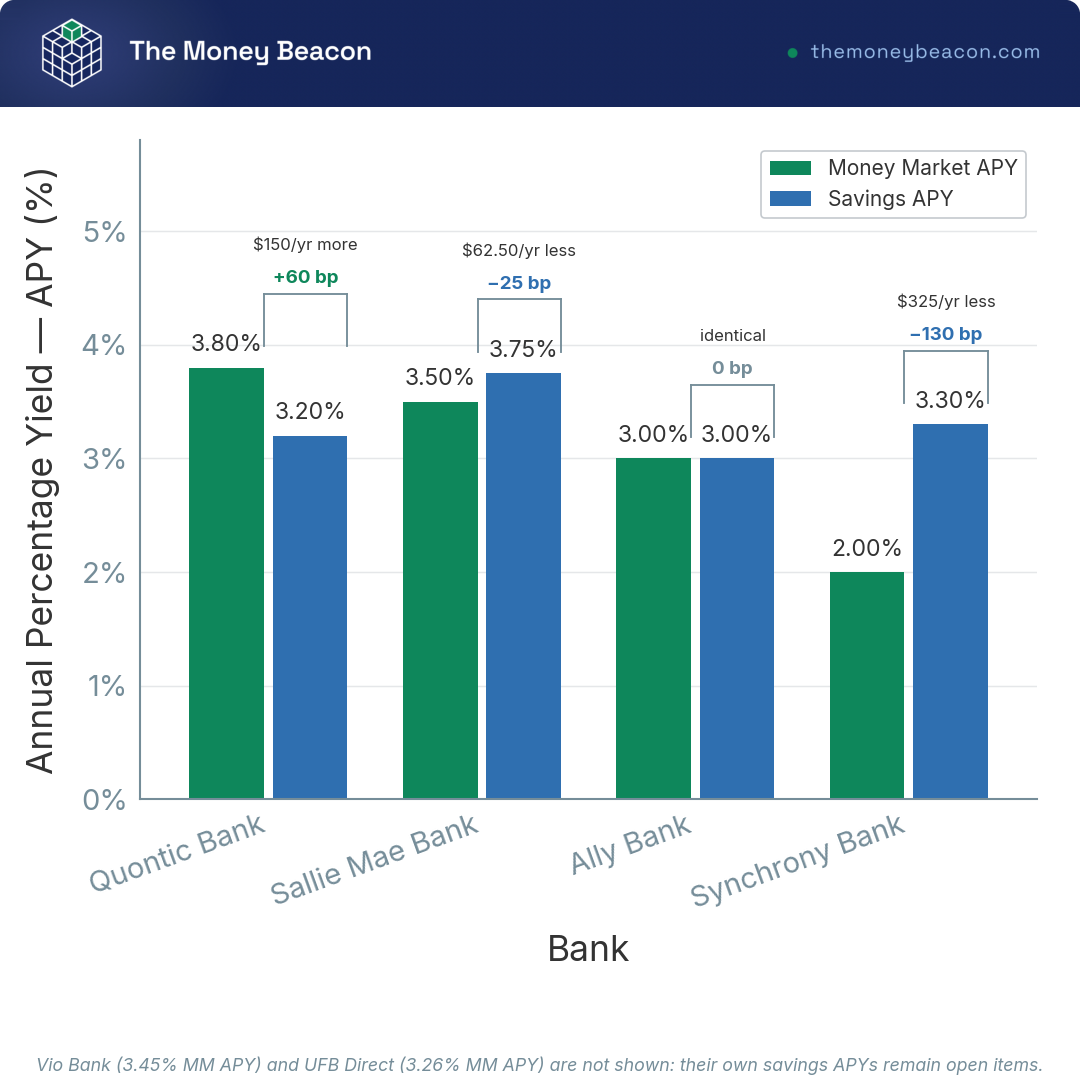
Vio and UFB Direct are off that chart because neither bank’s own savings APY could be confirmed first-party. For the four that report both, if the yearly rate difference beats what the access saves you, that access is a luxury.
Tom’s take

I’ve shopped a lot of banks for cash. Not one of them prints its own savings rate next to its money market rate, because that’s the number that hurts them.
8.3 Five years of the same gap
An emergency fund isn’t a one-year holding. Park $25,000 at rates that don’t move, and five years of interest comes to about $4,750 at 3.80%, $4,312 at 3.45%, $3,750 at 3.00%, and $2,500 at 2.00%. Top to bottom, that’s roughly $2,250.
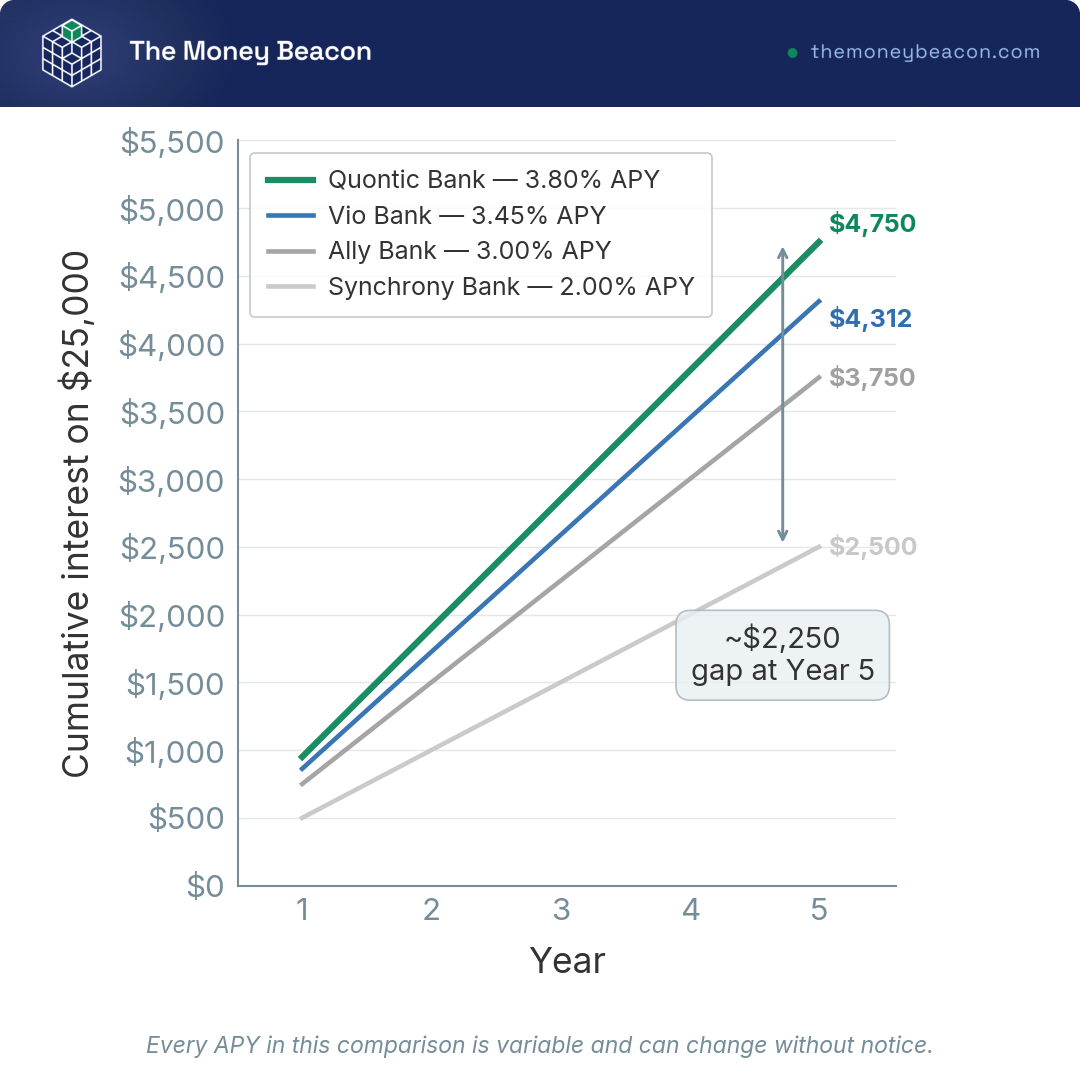
Every rate is variable, so that’s today’s spread, not a forecast. With a certificate of deposit the rate is locked for a set term, while a high yield money market savings account can be repriced any week. So re-read the ranking once a year.
8.4 When the monthly fee outruns the interest
Five of these six accounts charge $0 a month at every balance. UFB Direct charges $10.00 a month below a $5,000.00 average daily ledger balance, and on $3,000 that ends the year about $22.20 in the red.
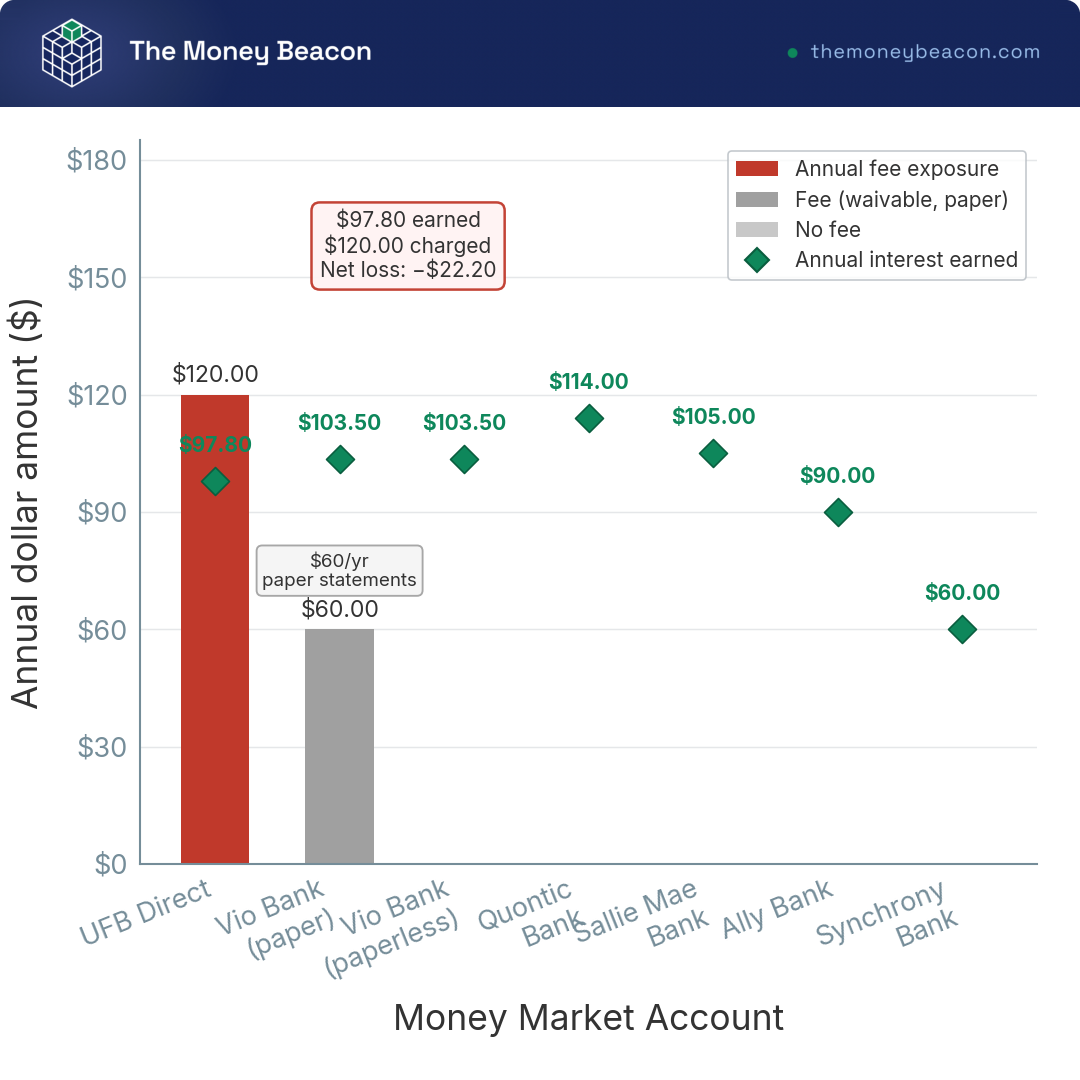
Above $5,000 the fee disappears. So on a small balance, a balance-conditioned fee turns a rate comparison into a threshold comparison.
8.5 What you actually keep after tax
Every money market account interest rate in this comparison pays ordinary income, reported on Form 1099-INT and taxed at your marginal federal rate. It gets none of the preferential treatment that long-term gains and qualified dividends do.
On $25,000 at a 24% federal rate, the $950.00 that 3.80% pays becomes about $722.00, and the $500.00 that 2.00% pays becomes $380.00.
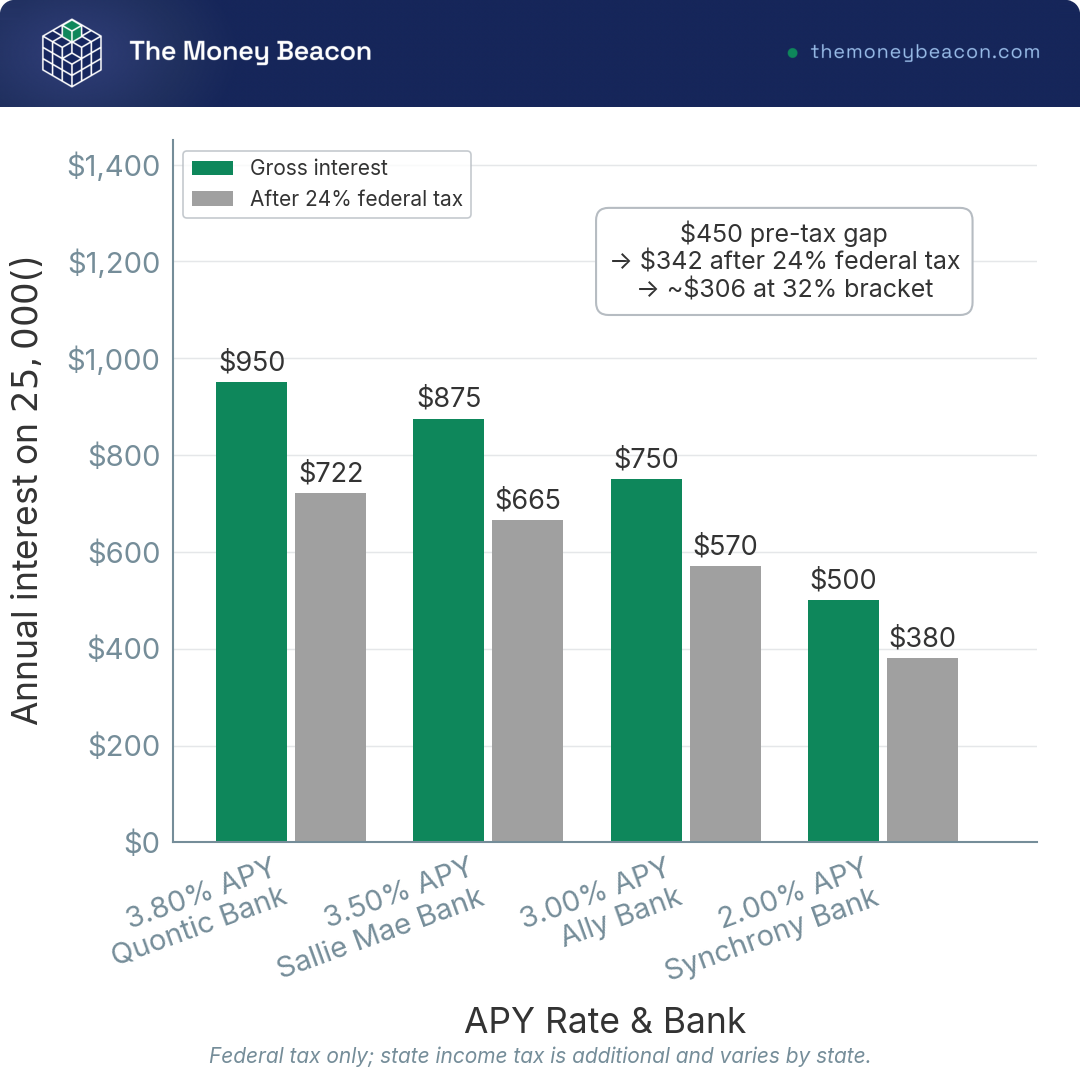
So $342 a year still separates the top and bottom accounts after federal tax alone. State income tax is additional and varies.
Hank’s take
most savers price a cash account gross and stop there. Take out the marginal rate, then inflation, and what’s left of a 2.00% account is the number I’d want to see before opening it.
8.6 Verdict by reader profile
Five readers, five answers.
Table: Verdict by reader profile
| Reader profile | Winner | Runner-up | Why |
|---|---|---|---|
| Emergency-fund saver who writes the occasional large check | Sallie Mae Bank, 3.50% | Quontic Bank, 3.80% | Checks, no minimums, no fees, and a $500,000 ACH transfer ceiling that lets the whole fund move in one transaction |
| High-balance saver chasing the top rate | Quontic Bank, 3.80% | Vio Bank, 3.45% | The highest APY in the set, applied to every tier rather than to a top tier, with no fee at any balance |
| One account to park cash and pay bills | Ally Bank, 3.00% | Synchrony Bank, 2.00% | The only account with a debit card, checks, a 75,000+ ATM network, and an out-of-network reimbursement, and the only one whose access costs nothing, since Ally’s own savings account pays the same 3.00%; online bill pay still requires the separate Spending account |
| Beginner who wants no minimums and no fees | Sallie Mae Bank, 3.50% | Ally Bank, 3.00% | Zero opening deposit, zero minimum balance, zero monthly fee, and a rate near the top of the set |
| Saver who only wants yield and moves money by transfer | Quontic Bank, 3.80% | Vio Bank, 3.45% | Quontic wins on rate; Vio wins if the saver may need to move more than $10,000 in a month |
Data current as of August 2026.
Sallie Mae is the best choice for a money market account for emergency fund duty.
Two warnings go with all five verdicts. Re-read Quontic’s rate the day you apply, and below $5,000 UFB Direct isn’t the right choice for anyone.
8.7 Which of the six fits you
Four questions get you from six accounts to one, and the chart below runs them in order. Do you need a debit or ATM card? Will your balance always stay above $5,000? Will you ever move more than $10,000 out in a single month? Then, rate or access? Rate means Quontic, access means Ally.
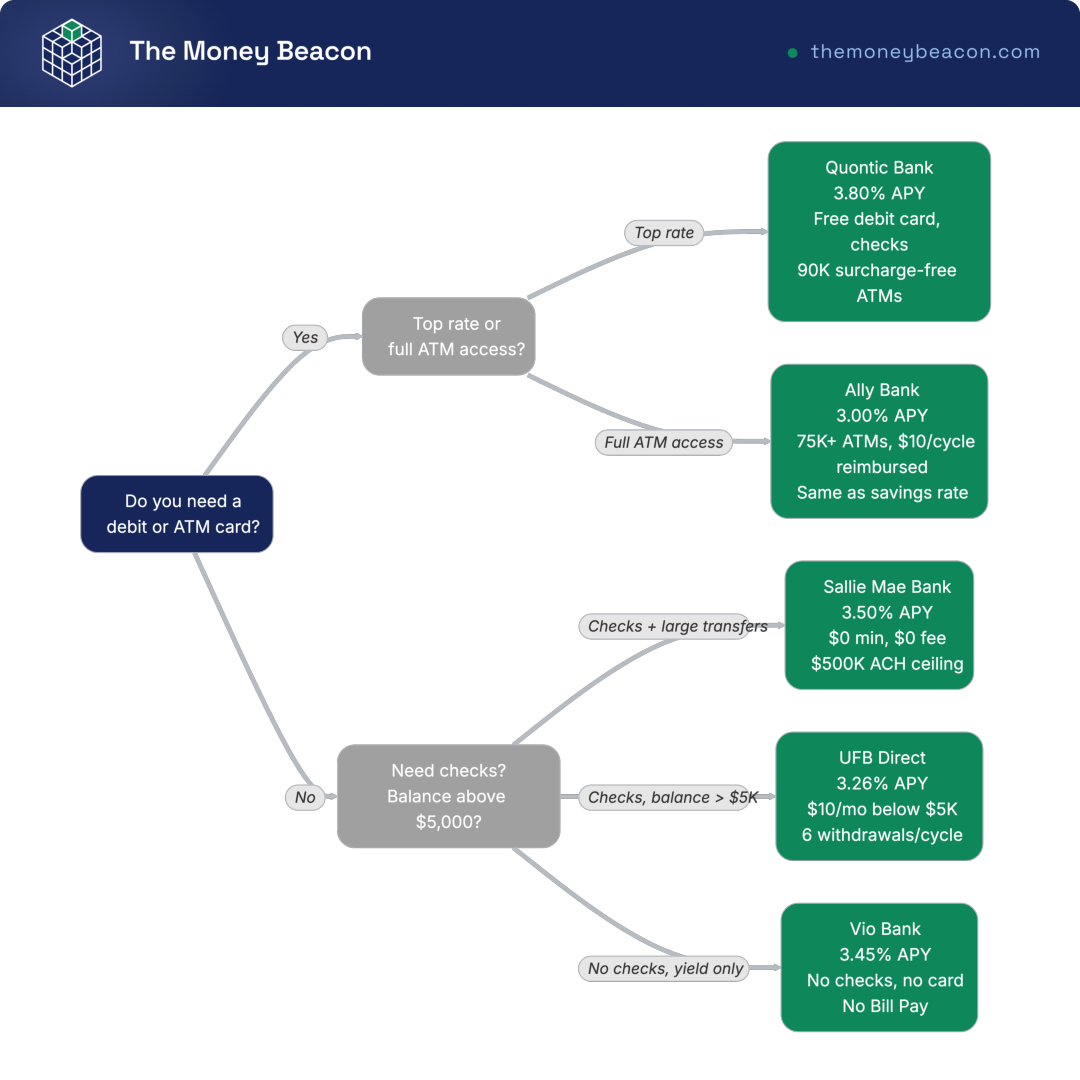
And if you’ll never write a check or use a card, your real comparison is against the best savings account you can actually open.
8.8 How to open the one you picked
Six steps, in order.
Apply with your name, address, date of birth and Social Security number. Fund it: Quontic and Vio want $100, the other four want nothing. Request the checks or the card. Switch Vio to electronic statements, and set a calendar reminder for UFB Direct’s $5,000.00 balance condition.
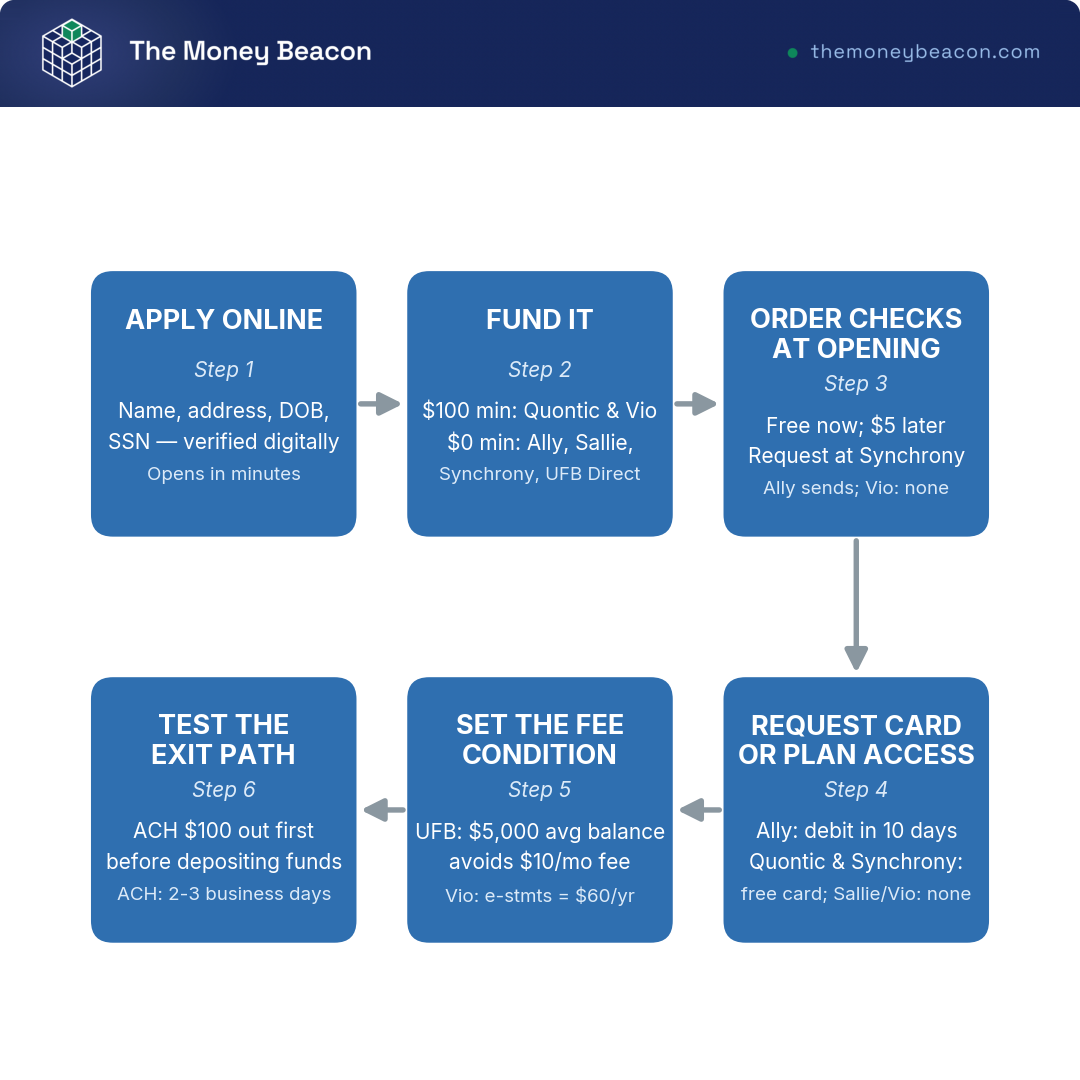
Then step six, in your first week: move $100 back out by ACH and count the business days. Two to three is typical. Whether any of these banks pulls credit or checks ChexSystems, I won’t say, because none of the six publishes its inquiry policy.
Conclusion
A money market account is a savings account with a checkbook attached. And that checkbook is the only real reason to open one. If you’re never going to write the check or use the card, you’re paying for access you won’t use.
What that access costs is the part worth remembering. At Synchrony it’s about 130 basis points a year, roughly $325 on $25,000. At Ally it’s nothing. At Quontic the money market account pays more than the bank’s own savings. Same product name, three different deals.
So here’s what I’d do before applying. Look up the savings rate at the same bank. Put it next to the money market rate. Then work out what the difference is worth on your balance over a year. If the money is just going to sit there untouched, the plain savings account is the simpler answer, and if it isn’t, you now know which of these six banks gives you the access for free.
If you’re still deciding how much of your cash belongs in a spendable account at all, our guide to matching each dollar to a time horizon is the natural next read. And if the large check you’re saving toward is a home purchase, our guide for first-time buyers covers what the down payment and the closing costs actually come to.
FAQ
How much will $10,000 make in a money market account?
Between $200 and $380 over a year, at the rates these six banks publish: $380.00 at Quontic’s 3.80% APY down to $200.00 at Synchrony’s 2.00%, with the other four in between. All of it is before tax, and every one of those rates is variable. Money you won’t need for years usually does better somewhere else, which is what long-term investing is for.
Is a money market account better than a high-yield savings account?
Not automatically, and the answer flips from bank to bank. Synchrony pays 3.30% APY on savings against 2.00% on its money market account, and Sallie Mae pays 3.75% against 3.50%, so savings wins at both. Ally pays 3.00% on either one, and Quontic pays 3.80% on the money market account against 3.20% on savings. Compare the pair at one bank, not the two categories.
Are money market accounts FDIC insured, and up to how much?
Yes, as long as the account is a deposit at an FDIC-insured bank. Coverage is $250,000 per depositor, per insured bank, for each ownership category, so a joint account is covered to $250,000 per co-owner. It attaches to the insured institution, not the brand on the website: Vio Bank is a division of MidFirst Bank and UFB Direct is a brand of Axos Bank, so those deposits share one limit with the parent. Check the legal entity in FDIC BankFind.
Can I write checks and use a debit card with a money market account?
Only if that specific account offers them, and each bank answers differently. Quontic gives you a free debit card and check writing. Ally gives you both, though not free online bill pay. Synchrony issues checks on request plus an optional ATM card. Sallie Mae issues checks and no card. Vio’s own disclosure says the Cornerstone account has no card, no wallet checks and no Bill Pay. UFB Direct advertises check writing, and its own pages don’t settle the card question.
How many withdrawals can I make from a money market account each month?
There’s no federal limit anymore. The Federal Reserve removed Regulation D’s six-per-month cap in 2020, but banks kept their own rules and they vary. UFB Direct still allows six per month or statement cycle and charges $10.00 for every withdrawal past that. Ally allows 10 per cycle and doesn’t count ATM withdrawals. Quontic caps value rather than count, at $2,000 daily and $10,000 monthly. The limit is contractual now, so read the deposit agreement, not the marketing page.
Is a money market account the same thing as a money market fund?
No, and that one word decides whether your money is insured. A money market account is a bank deposit, FDIC insured to the standard limit, paying a variable APY. A money market fund is a mutual fund of short-term debt, sold through a brokerage and governed by SEC rules. It carries no FDIC insurance, its value can fall, and the Securities Investor Protection Corporation (SIPC) covers your broker failing, never investment losses.
Do I pay taxes on money market account interest?
Yes, at your marginal federal rate. Interest is ordinary income, reported on Form 1099-INT, and it gets none of the lower long-term capital-gains treatment. Most states tax it too, unlike interest on US Treasury securities, which is generally exempt from state and local tax. On $25,000 at 3.80%, the $950.00 of gross interest is worth roughly $722.00 after a 24% federal rate. Our guide to lowering your taxable income covers the accounts that shelter interest like this.
How much money do I need to open a money market account and earn the top rate?
Less than most savers expect. Sallie Mae, Synchrony and Ally ask for no opening deposit and no minimum balance, UFB Direct requires no minimum to open, and Quontic and Vio each ask $100. The threshold that costs real money is the fee waiver, not the opening deposit: UFB Direct charges $10.00 a month unless your average daily ledger balance stays at or above $5,000.00. None of the six needs a big balance to pay its top APY.




Comments
Questions and corrections welcome. We read everything.