


You’ve agreed on the price of the car. Then someone walks you over to the finance desk, types for a minute, and comes back with an annual percentage rate (APR). It sounds reasonable. You sign.
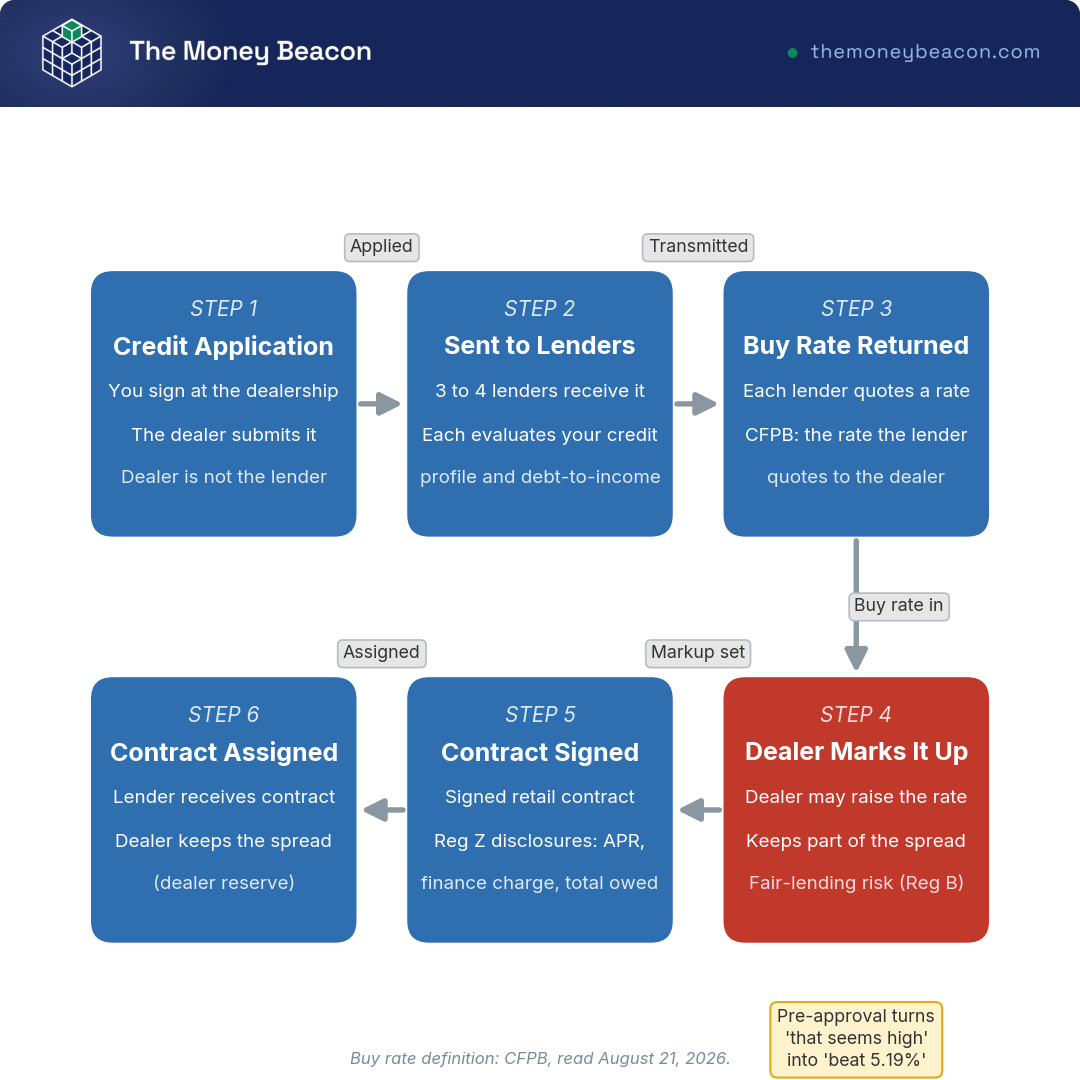
Here’s what that number doesn’t tell you. The dealer isn’t the lender. Your application went out to several lenders, and each one sent back a wholesale price called a buy rate. The dealer is then generally free to quote you a higher contract rate and keep the difference. You never see the buy rate, so you can’t tell whether you got the lender’s price or the dealer’s.
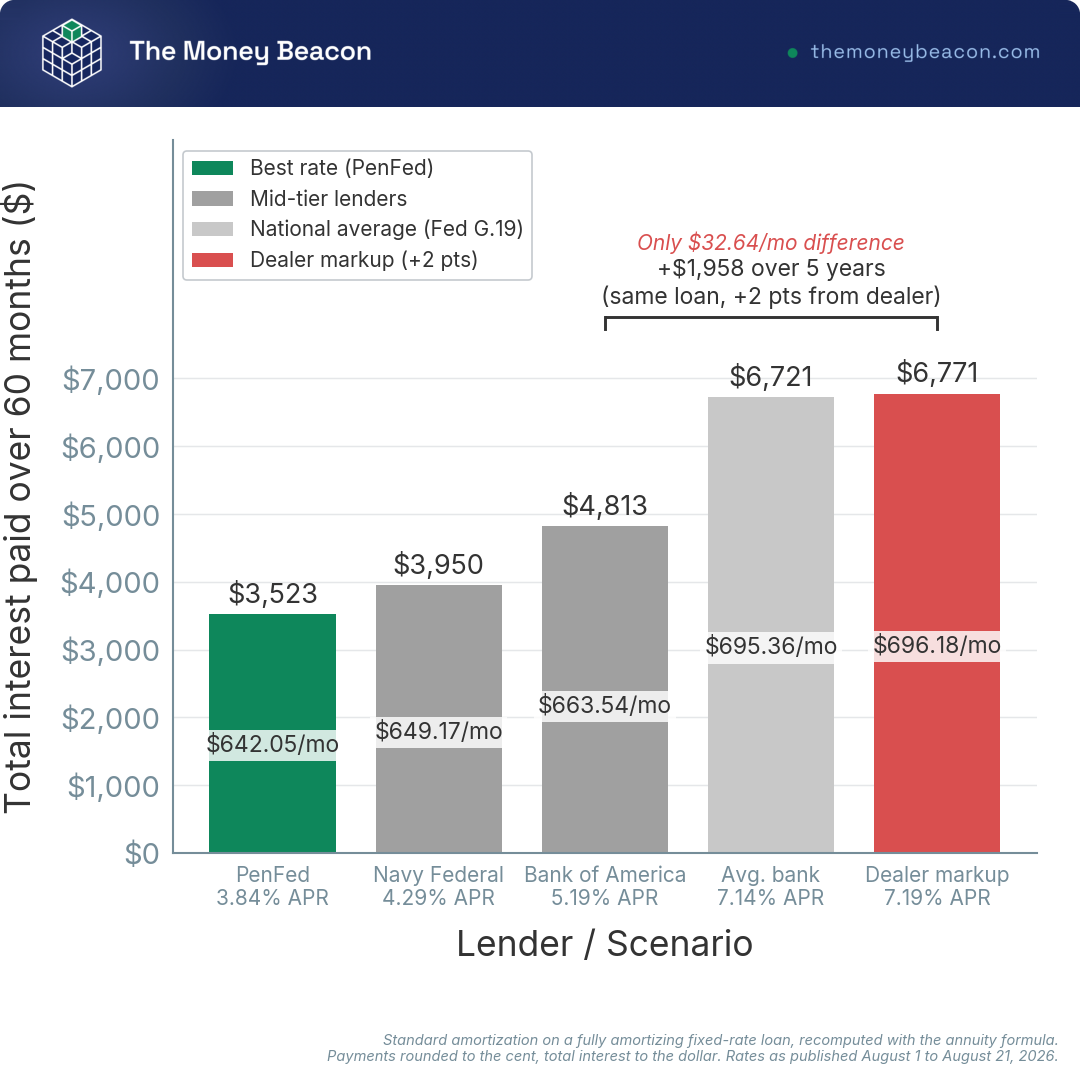
Federal Reserve data puts the average 60-month new car loan at 7.14% in the second quarter of 2026, down from 8.16% in 2024. Rates really are coming down. But watch what a two-point markup does to a good offer. Take 5.19% on a $35,000 loan over five years, add two points, and you’re at 7.19%, right back at the national average.
That costs $1,958 in extra interest. Spread across 60 payments, it’s $32.64 a month. So a finance manager who negotiates on the monthly payment instead of the APR can hide a four-figure cost inside a difference you’d round away.
The fix takes about fifteen minutes. Get an auto loan pre-approval before you shop, walk in holding a real APR at a real term, and ask the finance desk to beat your number, not match it.
Which lender writes that pre-approval decides how strong your number is. So before I rank a single one, I lay out the exact method I use to compare auto loan rates and what actually sets the rate you’re offered.
1. How we compared these six auto lenders, and what a pre-approval is really worth
1.1 The criteria we applied to all six lenders
Every lender gets the same thirteen dimensions: positioning, loan types written, the full APR grid, how the lowest tier is qualified, fees, loan amounts, terms, vehicle restrictions, eligibility, pre-qualification, funding path, deposit insurance, and tax treatment.
Each figure was read off the lender’s own page or an official US source, never off a comparison site. Scope is US consumers, personal use, all 50 states, at rates published between August 1 and August 21, 2026.
Two limits are worth saying out loud. No lender in this comparison publishes a rate card by credit tier, so none of this can tell you what a 680 score gets offered. And when this article calls a number not disclosed, it means the number was checked page by page and proven absent, not skipped.
So the short answer on how to compare auto loans is to read the whole grid at the term you’ll actually sign, not the floor rate in the headline.
1.2 Where the dealer markup enters your loan
The Consumer Financial Protection Bureau (CFPB) defines the wholesale price plainly: “A buy rate is the interest rate that a potential lender quotes to your dealer when you apply for dealer-arranged financing.” The dealer may then present a contract rate above that buy rate and keep the spread, which is called dealer participation, or dealer reserve.
So the number on the finance desk screen isn’t a fact about your credit. It’s a price, and prices are negotiable, but only against another number. Discretionary dealer rate markup also carries fair-lending exposure under the Equal Credit Opportunity Act and Regulation B, since identical credit profiles can walk out with different markups.
None of that makes dealer financing automatically worse. Captive manufacturer programs can undercut every bank in this comparison, and sometimes do. The pre-approval is what lets you tell the difference. The moment you can intervene is before the contract rate is quoted, not after.
1.3 What a normal car loan rate looks like in 2026
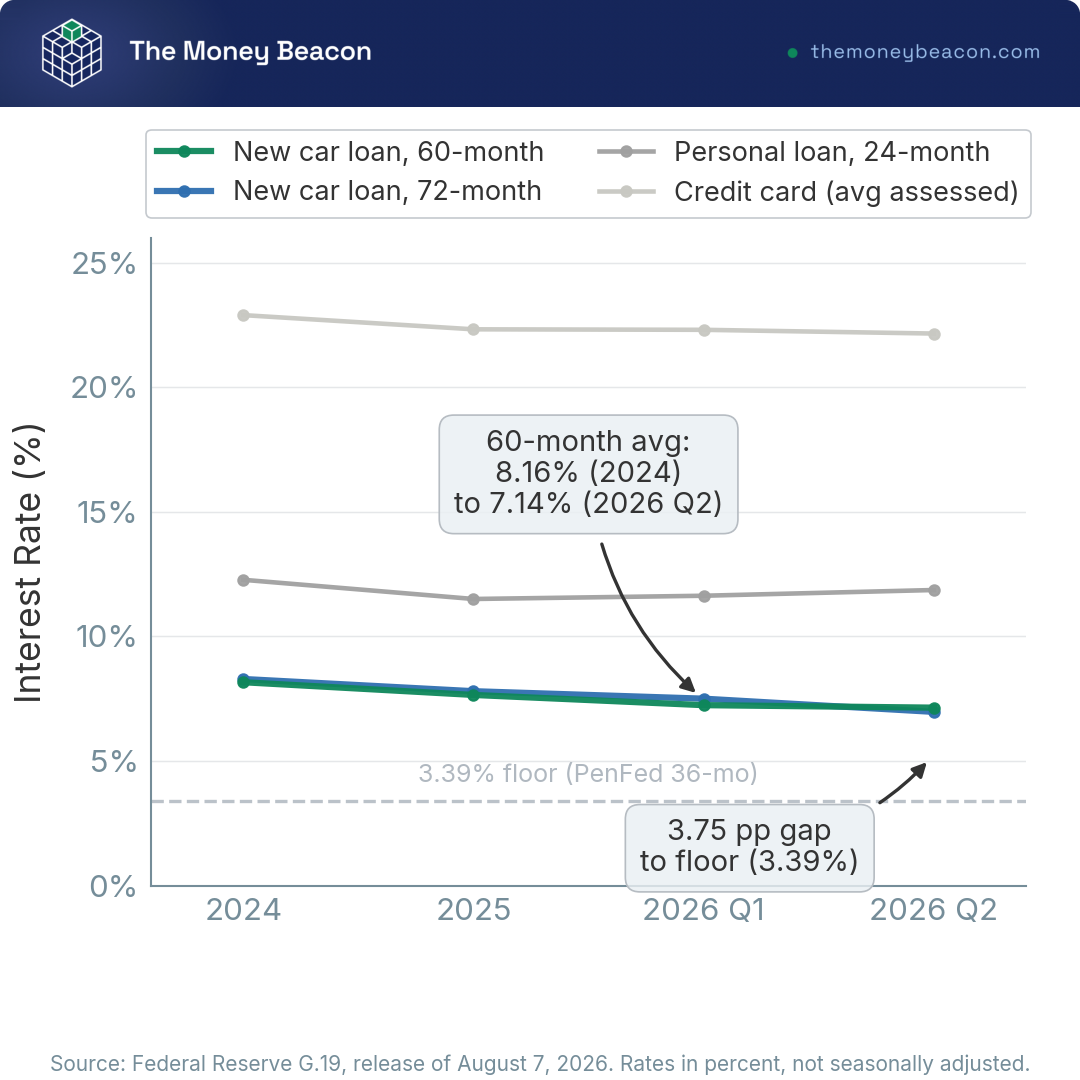
The Federal Reserve’s G.19 consumer credit release, published August 7, 2026, puts the average 60-month new car loan at commercial banks at 7.14% for the second quarter of 2026. That’s down from 7.65% across 2025 and 8.16% in 2024. The 72-month series comes in at 6.97%.
Now put that next to the rest of consumer credit. A 24-month personal loan averaged 11.86%, and card balances that carry interest averaged 22.15%. Your car secures the loan, which is why car borrowing is the cheapest credit most households can get.
Two readings you can use right away. First, seven percent is the average auto loan rate 2026 has produced so far, and average is exactly what a pre-approval exists to beat. Second, a loan written in 2024 near 8% or 9% has a real refinance case, because the market has fallen about a point since it was signed. Pull your current APR off your statement and see which side of the benchmark you’re on.
1.4 The six lenders at a glance
The two credit unions take the top three lines, and they keep them once you strip PenFed’s car-buying-service condition out. PenFed gets two rows because the difference between them is a condition you can choose to meet, not a credit decision made about you. Bank of America reads “Not offered” on refinance, because it stopped offering the product.
Table: Advertised APR by lender, loan type, and term
| Lender | New purchase, lowest advertised | New purchase, 60 months | Used purchase, 60 months | Refinance, lowest advertised | As of |
|---|---|---|---|---|---|
| PenFed (car buying service) | 3.39% (36 mo) | 3.84% | 4.99% | 4.19% | Aug 1, 2026 |
| Navy Federal | 3.89% (12 to 36 mo) | 4.29% | 5.29% | 3.89% | Aug 21, 2026 |
| PenFed (standard) | 4.19% (36 mo) | 4.44% | 5.34% | 4.19% | Aug 1, 2026 |
| Bank of America | 5.19% | 5.19% | 5.39% | Not offered | Aug 20, 2026 |
| Capital One | 5.70% (60 mo) | 5.70% | 6.49% | 9.50% in the published example | Aug 2026 |
| Chase Auto | 5.94% (60 mo) | 5.94% | 5.99% | 6.49% (48 mo) | Aug 20, 2026 |
| LightStream | 7.24% | 7.24% | 7.24% | 7.24% | Aug 21, 2026 |
Data current as of August 2026.
All rates are “as low as” floors assuming excellent credit, read from each lender’s own rate pages. Bank of America publishes one dealer rate rather than a term grid, displayed by state; LightStream prices by purpose and credit, not by new versus used.
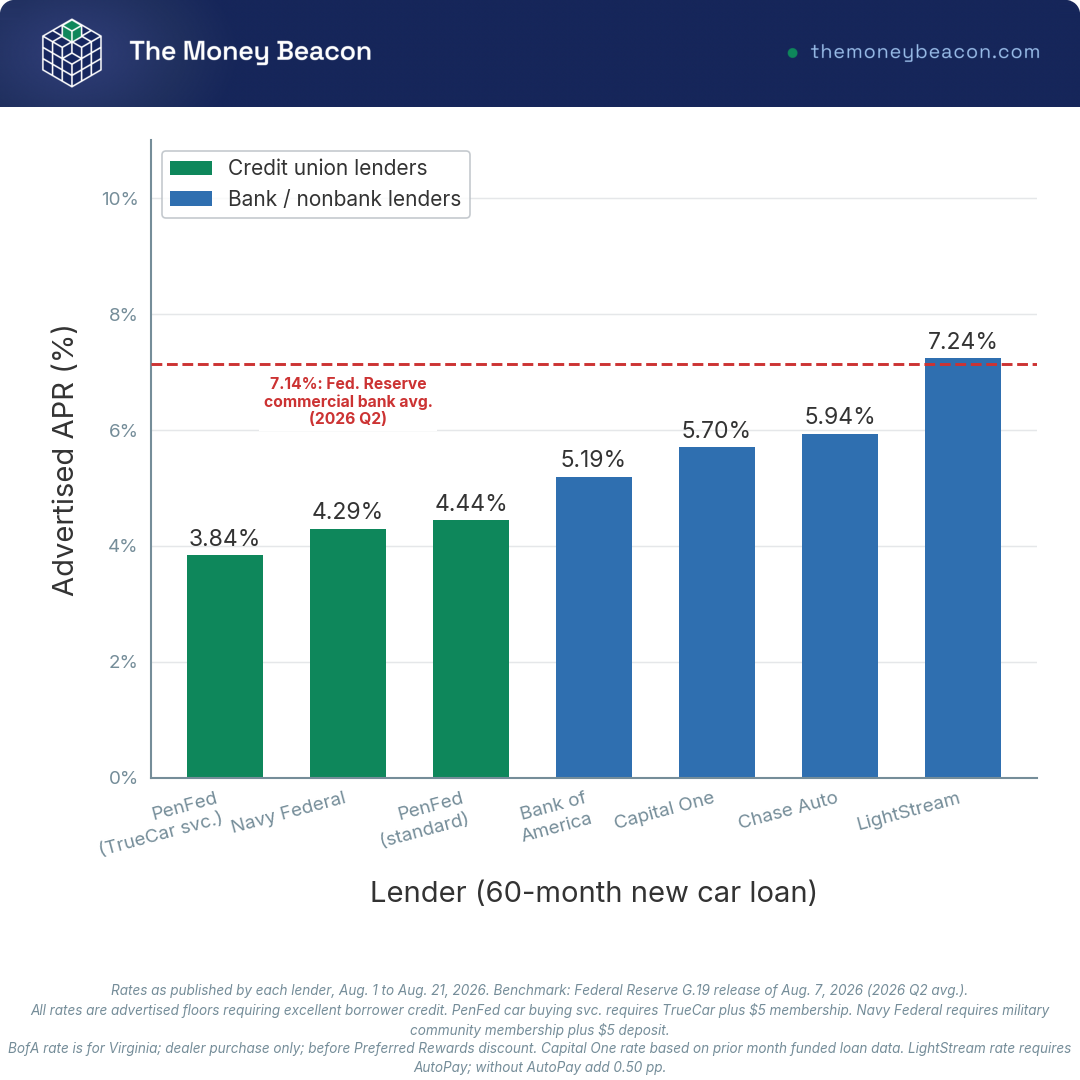
Compare auto loan rates on the 60-month new purchase column and the spread ranges from 3.84% to 7.24%. That’s the whole argument for an afternoon of shopping.
1.5 Every advertised floor rate has a second condition
Now read the same six at 60 months on a new car with the condition attached to each. PenFed’s 3.84% needs its TrueCar-powered car buying service plus the $5 membership. Navy Federal’s 4.29% needs military-community membership. LightStream’s 7.24% needs AutoPay, and is 0.50 points higher without it. Bank of America, Capital One and Chase attach nothing beyond a dealer purchase. The reference line is the 7.14% commercial bank average.
The pattern is the point. The lowest auto loan rates in this comparison almost always carry a second condition. It has nothing to do with your credit file, and everything to do with a membership, a buying service or an enrollment. Only LightStream publishes what share of approved applicants reached its floor, and that number is 33.00%, measured April 1 to June 30, 2026. Every other lender leaves you guessing.
Tom’s take

I’ve shopped most of the big private banks, and the lesson is simple: you have to make them compete. An advertised floor is an opening position, not a price tag. The number only moves once a second institution is holding a written offer on the same deal.
1.6 Which lenders can even write your loan
Price is the second filter. Eligibility is the first, and it eliminates lenders faster.
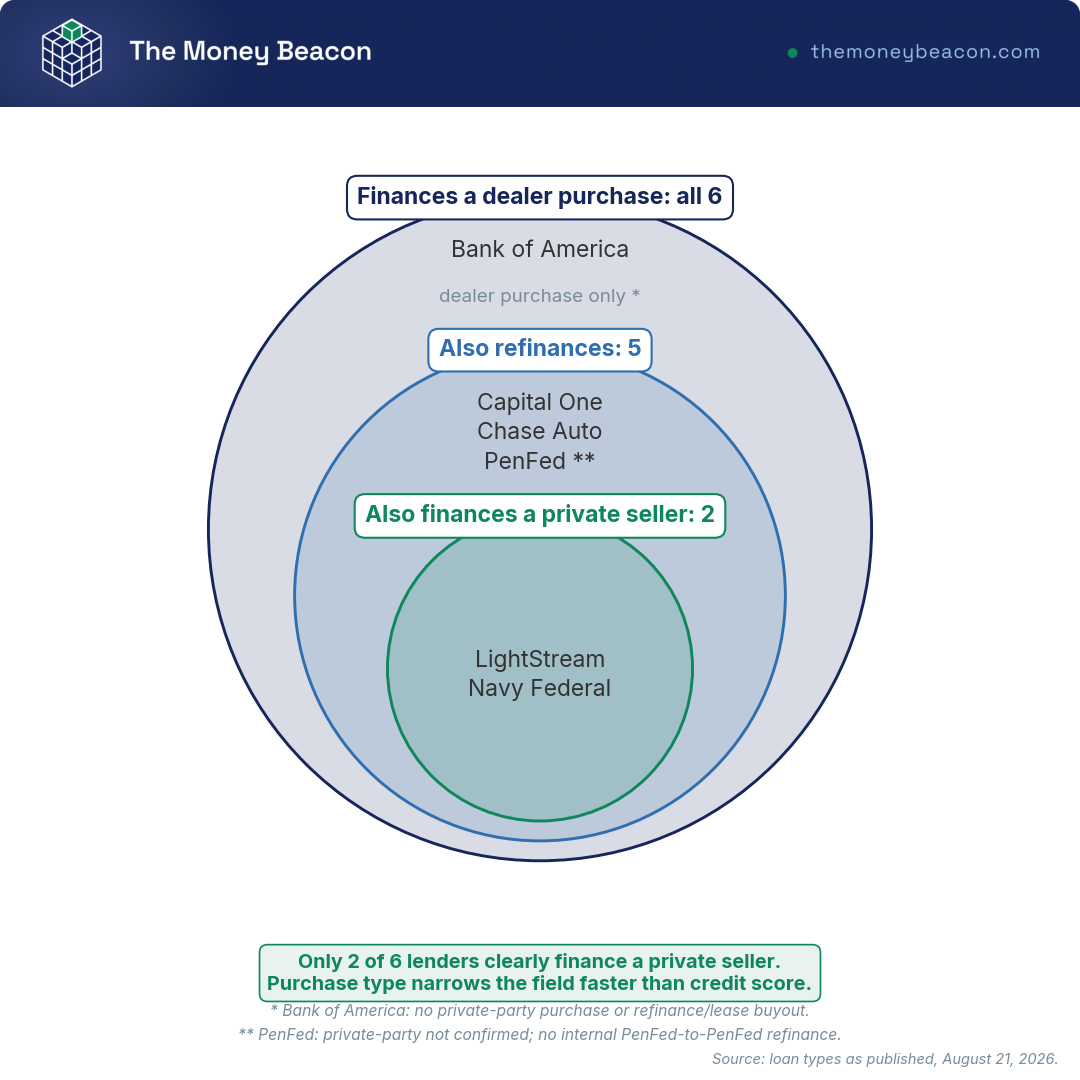
All six write a new or used dealer purchase. Five write a refinance, and Bank of America is the exception because it no longer offers refinance or lease buyout auto loans. Only two clearly finance a private-party purchase, LightStream and Navy Federal. Three write a lease buyout, LightStream, Chase and Navy Federal. PenFed isn’t confirmed on either one.
One live contradiction is worth keeping as an open question. Bank of America’s own auto loan FAQ says it doesn’t finance purchases from private parties. But its secure application flow tells a customer without Online Banking to visit a financial center to apply for a private party loan. Both statements are first party, and the bank hasn’t reconciled them.
So the first question isn’t what a lender charges. It’s whether your car financing options include the transaction you’re actually doing, and you can settle that in five minutes on each lender’s own page.
1.7 The 14-day shopping window, and how long each offer lasts
FICO, the Fair Isaac Corporation model most auto lenders pull, ignores auto-loan inquiries made in the 30 days before it scores you. It also counts multiple auto inquiries inside one span as a single inquiry, 14 days on older versions and 45 days on the newest. VantageScore 4.0 uses its own 14-day window. You can’t pick which model a lender pulls, so group every formal application inside 14 days. One extra inquiry costs less than five points anyway.
The auto loan rate shopping window isn’t the same object as the offer clock, and confusing the two costs people money. Capital One’s pre-qualification expires 30 days from the request. Bank of America and Chase lock an approved rate for 30 days. PenFed gives you 30 days to select an offer and 30 more to supply documents. Navy Federal’s preapproval check runs 90 calendar days.
That sets the order. Join a credit union first, because membership has to exist before you can apply.
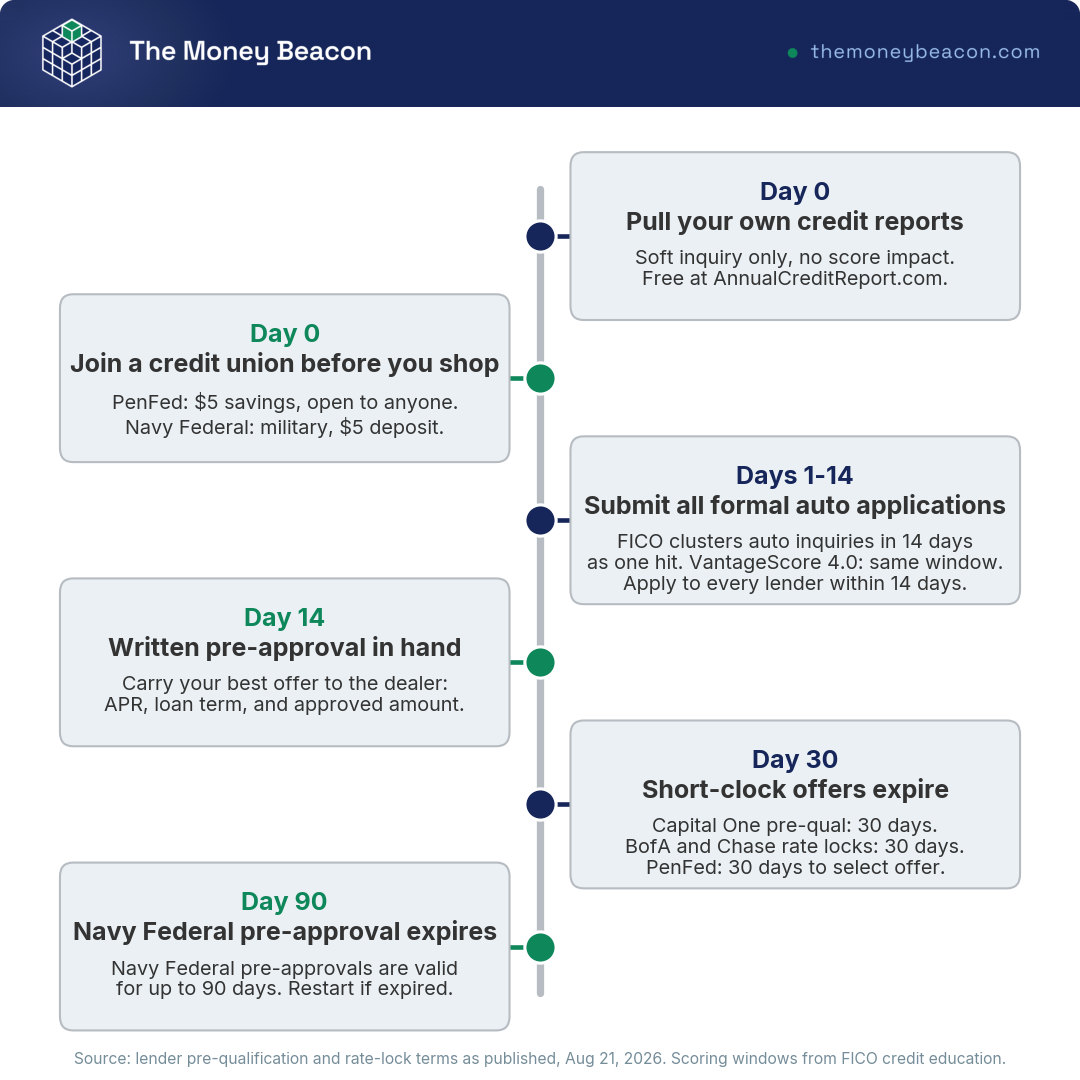
Start with the credit union anyone can join.
2. PenFed Credit Union: the lowest advertised new car rate in this comparison, if you buy through its car buying service
2.1 PenFed at a glance
PenFed Credit Union takes the open-membership route, and it says so in those words. “Not a problem, anyone can join,” and joining “includes opening a $5 PenFed savings account” that gets created during the loan application itself. Deposits are federally insured by the National Credit Union Administration (NCUA) at $250,000 per member, under charter number 227.
The product is built around a TrueCar-powered car buying service, and the lowest advertised new car rate in this comparison is attached to using it. A PenFed auto loan quoted outside that service is a different, higher price. Rates below are effective August 1, 2026.
2.2 What PenFed does well
Start with the number: 3.39% APR on a new car at 36 months, bought through the car buying service, with the $5 membership in place. PenFed membership requirements are about as light as they get, five dollars opened inside the application.
Financing goes to 125% of value, the only ceiling in this comparison that absorbs meaningful negative equity, and the maximum loan is $150,000. Pre-qualification is a soft pull that “will not affect your credit score.” PenFed also publishes an actual servicing fee schedule, which most lenders in this comparison don’t, and it refinances both new and used.
Through TrueCar it adds deductible reimbursement of up to $500 twice a year, reported within 45 days, unavailable in New Hampshire and New York. If your auto insurance deductible is $500, that’s the whole thing reimbursed, twice a year.
2.3 Where PenFed falls short
The floor rate requires the car buying service, so it constrains where you shop and what you can buy.
And the discount shrinks as the term gets longer. It’s worth 0.80 points at 36 months on a new car, 0.60 points at 60 months, and 0.35 points on a 60-month used loan. At 84 months it’s worth nothing, because both new car tiers price identically there. So an 84 month auto loan through the service buys no discount at all.
Minimum loan amounts block long terms on cheap cars, $15,000 for a 61 to 72 month term and $20,000 for 73 to 84 months. PenFed doesn’t permit internal refinances of an existing PenFed auto loan. No maximum vehicle age is published on any PenFed page, which is an unknown rather than a green light. And PenFed doesn’t disclose a minimum credit score.
2.4 PenFed pricing and fees
Four products, five terms, one grid. It shows what the car buying service is worth at each term, and where it stops.
Table: PenFed: purchase APR grid by product and term
| Product | 36 mo | 48 mo | 60 mo | 72 mo | 84 mo |
|---|---|---|---|---|---|
| New, car buying service | 3.39% | 3.79% | 3.84% | 4.54% | 5.74% |
| New auto purchase | 4.19% | 4.39% | 4.44% | 4.79% | 5.74% |
| Used, car buying service | 4.34% | 4.94% | 4.99% | 5.04% | 6.24% |
| Used auto purchase | 4.79% | 5.29% | 5.34% | 5.39% | 6.24% |
Data current as of August 2026.
PenFed advertised APRs as low as, effective August 1, 2026.
At 36 months the service tier reads 3.39% against 4.19% standard. By the 84-month column both new car tiers show the same 5.74%.
On fees, PenFed credit union auto loan rates come with no application fee and no prepayment penalty, since “your loan can be paid off at any time without penalties.” Servicing is priced in the open: $29.00 late charge per payment, $30.00 returned payment, and automobile lien placement at actual cost.
2.5 Who PenFed is for
PenFed is ideal for a civilian with strong credit who’s willing to shop through the credit union car buying service. And it’s ideal for a borrower rolling negative equity into the next loan, because 125% financing is unmatched in this comparison.
It’s not the right choice for someone financing under $15,000 over a long term, or for a buyer who wants their own dealer and the floor rate. It’s also out if you already hold a PenFed auto loan and want to refinance it. If it fits, open the $5 savings account and pre-qualify; the soft pull doesn’t affect your score.
3. Navy Federal Credit Union: the cheapest rate you can reach without a car buying service, if you qualify for membership
3.1 Navy Federal at a glance
Navy Federal Credit Union is the largest credit union in the United States by membership. Deposits are federally insured by the NCUA at $250,000 per member, under charter number 5536.
Its field of membership “is open to the armed forces, the DoD, veterans and their families,” meaning the Department of Defense. It opens with a $5.00 share deposit, and the membership has to exist before you apply. Navy Federal puts it flatly: “Yes, you need to become a member before you can apply for an auto loan.” A Navy Federal auto loan can be a new purchase, a used purchase, a private party purchase, a refinance or a lease buyout. Rates below are effective August 21, 2026.
3.2 What Navy Federal does well
It writes every loan type in this comparison’s scope, including a private party auto loan and a lease buyout. If you’re buying from a neighbor rather than a showroom, that matters more than any rate.
The pricing is reachable without a buying service. 3.89% APR on a new car at 12 to 36 months, and 4.79% used over the same band, with membership and the $5.00 share deposit in place.
Approval comes as a check “good for 90 calendar days from the date of the check,” spendable at a dealer or with a private seller. 100% financing is available. Fees are close to absent. Navy Federal says “we don’t charge any application or origination fees,” there’s no prepayment penalty, and no charge for a returned loan payment.
On credit, Navy Federal answers the question most lenders dodge, stating that no set credit score is required to qualify for an auto loan with it. Its refinance grid is identical to its purchase grid.
3.3 Where Navy Federal falls short
Membership is the wall. Navy Federal membership eligibility extends to the armed forces, the Department of Defense, veterans and their families, and outside that circle there’s no workaround.
Long terms get priced punitively. A new car at 85 to 96 months is priced at 7.39% against 4.29% at 37 to 60 months, a 3.10-point penalty before the extra years of interest. Those tiers also demand $25,000 financed for 61 to 84 months, $30,000 above 84 months, and fewer than 7,500 miles above 84 months.
Used pricing is a full percentage point above new in every term band, so the 3.89% advertised rate at 12 to 36 months tells you nothing about a used purchase. The maximum APR is 18.00%, which shows how high a thin-credit borrower can be priced. The inquiry type at preapproval isn’t stated on the auto loan pages, so read it as not stated rather than assuming a soft pull. Late payments cost $29.00 each.
3.4 Navy Federal pricing and fees
Navy Federal prices by term band rather than by product tier, so the whole grid fits in five rows.
Table: Navy Federal: APR grid by term, new and used
| Term | New auto, APR as low as | Used auto, APR as low as |
|---|---|---|
| 12 to 36 months | 3.89% | 4.79% |
| 37 to 60 months | 4.29% | 5.29% |
| 61 to 72 months | 4.59% | 5.39% |
| 73 to 84 months | 5.99% | 6.98% |
| 85 to 96 months | 7.39% | Not offered |
Data current as of August 2026.
Navy Federal advertised APRs, effective August 21, 2026. Maximum APR 18.00%. Payment example: monthly payment of $591.
The used column stops at 84 months, and the ceiling on any of these Navy Federal auto loan rates is 18.00%.
Fees stay simple. No application or origination fee, no prepayment penalty, no returned-payment charge, and a $29.00 late fee per loan payment.
3.5 Who Navy Federal is for
Navy Federal is ideal for anyone inside the military community. It’s also the best choice for a member buying from a private seller or buying out a lease. The 90-day check spends with any seller, and no other credit union in this comparison confirms both products.
It’s not the right choice for a civilian with no military connection, since membership is the gate. And it’s not right for a borrower who wants a term above 84 months on a modest loan. If you’re eligible, open the membership with the $5.00 share deposit before you shop, because military auto loan rates this low are worth fifteen minutes of paperwork.
4. Bank of America: the lowest advertised big bank rate, with a relationship discount stacked on top
4.1 Bank of America at a glance
Bank of America writes one auto product. It’s a dealer purchase loan on a new or used car, available in all 50 states and the District of Columbia. The lending entity is Bank of America, National Association, Federal Deposit Insurance Corporation (FDIC) certificate 3510. Approval comes with a 30-day rate lock, and an existing customer can stack the BofA Rewards discount on top.
The rate display is state-driven, so what you see depends on where you live. The values in this comparison were read for Virginia on August 20, 2026. The bank “no longer offers Refinance or Lease Buyout auto loans,” so a Bank of America auto loan today means a dealer purchase and nothing else.
4.2 What Bank of America does well
The rate comes first. It’s 5.19% APR on a new dealer purchase and 5.39% used, and both numbers assume excellent credit.
Then the discount that gives this loan its shape. BofA Rewards takes 0.10% to 0.50% off the rate across four published tiers, and it applies on top of the advertised number. That stacking is what makes this a relationship discount auto loan rather than a plain dealer loan.
Fees are light, with no loan documentation fee and no prepayment penalty. A pre-qualification request “may result in a soft credit pull,” and approval then holds your rate for 30 days while you shop.
The eligibility list is published in full, covering age, citizenship, vehicle age, mileage, vehicle value and the minimum financed. You can rule yourself out before you apply, which is rarer than it should be.
4.3 Where Bank of America falls short
Purchase only. No refinance, no lease buyout, and no private-party purchase through the online channel.
That last one carries a live contradiction inside the bank’s own site. The auto loan FAQ says it doesn’t finance a purchase from private parties. But the secure application flow tells a customer without Online Banking to visit a financial center “to apply for your private party loan.” Neither statement has been reconciled, so it’s a question for a banker rather than a yes or a no.
Then the discount’s fine print. The 0.50% Premier tier takes $1,000,000 in qualifying balances, so the realistic band for most customers is 0.10% to 0.25%, not the headline.
The vehicle rules exclude cheap cars. You need a minimum of $7,500 financed, or $8,000 in Minnesota, plus a $6,000 minimum vehicle value. Nothing qualifies at 125,000 miles or more, and the vehicle age limit on this auto loan is 10 calendar years. The online application offers 48, 60 or 72 months only.
Three blanks are worth flagging. The minimum credit score is not disclosed. The maximum loan amount isn’t published either, and neither are the late and returned-payment fee amounts, which makes them unknown rather than absent.
4.4 Bank of America pricing and fees
There are only two lines, and both assume excellent borrower credit.
Table: Bank of America: advertised APR by loan type
| Loan type | Advertised APR | As of |
|---|---|---|
| New car (dealer) | 5.19% APR | August 20, 2026 |
| Used car (dealer) | 5.39% APR | August 20, 2026 |
Data current as of August 2026.
Bank of America advertised rates, shown for Virginia; the rate display is state-driven.
The tiers move those two bank auto loan rates. Member with no minimum balance takes 0.10% off, Preferred Plus at $30,000 takes 0.25%, Preferred Honors at $100,000 takes 0.35%, and Premier at $1,000,000 takes 0.50%. Applied to the new car rate, a Premier customer reaches 4.69% APR.
Before you move money to reach a tier, price the trade. A $30,000 balance buys 0.25 points off one car loan you’ll repay in a few years, while the same $30,000 parked in a high-yield savings account earns interest every year you hold it.
On fees, there’s no loan documentation fee and no prepayment penalty, though title and state fees may apply. The published example finances $54,000 over 60 payments of $1,024.
4.5 Who Bank of America is for
Bank of America is ideal for an existing customer with real balances buying new or used from a dealer, especially when the 30-day rate lock buys you time to shop.
It’s not the right choice if you’re refinancing or buying out a lease. And it’s out for a cheap old car, since the $6,000 vehicle value floor and the 10-year age cap rule that car out before your credit even comes up.
If you already bank there, check your BofA Rewards tier, then pre-qualify. That request is a soft pull, so it won’t affect your score.
5. Capital One Auto Finance: the most predictable soft pull pre-qualification for a dealer purchase
5.1 Capital One at a glance
Capital One Auto Navigator is the product in this comparison. It’s a pre-qualification tool that shows you real cars at real estimated payments before anyone runs a hard inquiry. The lending entity is Capital One, National Association, FDIC certificate 4297.
The natural buyer shops a participating franchise dealer and wants a number before walking in. Capital One also writes refinances, on narrow terms covered below. Its advertised rates are “based upon the previous month’s Capital One funded loan data (as of August 2026),” so they track loans the bank actually funded rather than a marketing floor.
5.2 What Capital One does well
The pre-qualification is the reason to look at Capital One at all. The bank is explicit: “We only perform a soft credit inquiry which will not impact your credit score.” And the estimate attaches to specific vehicles at specific dealers. An auto loan soft credit pull that names the car and the payment beats a floor rate nobody will price for you.
The criteria are published, so a rejection is predictable: at least 18 years old, $1,500 minimum monthly income, a model year within the last 10 years, fewer than 120,000 miles.
On a refinance, both bounds are public, $7,500 minimum and $75,000 maximum. Capital One pays off your old lender directly and helps with the title transfer. There’s no application fee and no prepayment penalty.
5.3 Where Capital One falls short
The dealer network is a hard gate. Capital One doesn’t finance vehicles “purchased from dealers who don’t provide Capital One auto financing, auto brokers or private party sellers.” No lease buyout and no cash-back refinance either. Five makes are excluded outright: Oldsmobile, Daewoo, Saab, Suzuki and Isuzu.
Then there are the blanks. On a purchase, the loan amounts and the term range are both not disclosed. The only published bound is an aggregate ceiling of $100,000 across your Capital One auto debt, which isn’t the same as an auto loan maximum amount on the loan you’re applying for. The minimum credit score is not disclosed, and a late fee applies under your contract with no amount published.
One number shows the distance between a real approval and a headline. Capital One’s own refinance payment example is priced at 9.50% APR.
5.4 Capital One pricing and fees
Both terms below are quoted for “individuals with excellent credit characteristics.”
Table: Capital One Auto Finance: advertised APR grid
| Loan type | 60 months | 72 months |
|---|---|---|
| New auto purchase | 5.70% APR | 5.86% APR |
| Used auto purchase | 6.49% APR | 6.66% APR |
Data current as of August 2026.
Capital One advertised rates, as of August 2026.
Stretching a new purchase from 60 to 72 months costs 0.16 points. The same stretch on the used car loan rates costs 0.17.
The published refinance example is $25,000 at 9.50% APR over 60 months, or $525.05 a month.
Fees are minimal. There’s no application fee and no prepayment penalty, and the late fee is set by your contract at an amount Capital One doesn’t publish.
5.5 Who Capital One is for
Capital One is ideal for a buyer with excellent credit purchasing from a franchise dealer in its network, and who wants a car-specific number before setting foot on the lot. If you’re hunting the best auto loan for excellent credit and you already know the dealer, testing it costs nothing.
It’s not the right choice for a private-party purchase or a lease buyout. It’s also a poor fit if you need the loan minimum and the term range before applying.
6. Chase Auto: purchase, refinance and lease buyout under one roof
6.1 Chase Auto at a glance
Chase Auto lends through a franchise dealer network, with a refinance product and manufacturer tie-ins on top. The lending entity is JPMorgan Chase Bank, National Association, FDIC certificate 628. A Chase Auto loan can be a new purchase, a used purchase, a refinance or a lease buyout.
The borrower it suits is an existing Chase customer buying from a mainstream dealer, or someone refinancing a loan taken elsewhere. The manufacturer angle is real money, since Chase publicizes a $7,500 EV lease incentive on Rivian with a 1 to 6 week delivery window. Rates below were last updated August 20, 2026.
6.2 What Chase Auto does well
Range is the selling point. Chase writes new and used purchases, refinances, and a lease buyout loan for a driver keeping the car at the end of the term.
Pre-qualification is a soft pull with “no impact to your credit score,” and approval holds the rate for 30 days.
Refinance bounds are published up front: the estimated payoff has to be at least $4,000 and under $100,000. And the marketing number comes with its own footnotes. Chase advertises an average refinance saving of $2,400. Then it qualifies that as a life-of-loan interest saving on customers who refinanced between September 2025 and February 2026, excluding optional coverage and tax, title and registration fees.
On fees, “We don’t charge an application fee,” and “there’s no pre-payment penalty.”
6.3 Where Chase Auto falls short
Transparency is the weak spot. On a purchase, the loan amounts and the selectable term range are both not disclosed, and so is the minimum credit score. The auto loan late fee amount isn’t published on Chase’s own pages, and neither is the returned-payment fee, so both stay unknown rather than absent.
The 0.25% relationship discount comes with four conditions: “an average daily combined balance of $150,000 or more across eligible accounts,” an application submitted through chase.com, no stacking with manufacturer subvention or pre-approval offers, and no lease buyouts.
The car is gated too. Chase is explicit about private sellers, stating that it “doesn’t offer financing for private party vehicle purchases.” The dealer has to be in the Chase network. The car can’t have more than 120,000 miles, and it must be 10 years old or newer, or 5 years or newer for certain makes.
One rule catches refinancers out. Your current loan has to be at least 91 days old before Chase will replace it.
6.4 Chase Auto pricing and fees
Chase quotes each product at a fixed example, so read the term and the amount alongside the rate. All three lines are stated “For customers with excellent credit who apply online.”
Table: Chase Auto: advertised APR by loan type
| Loan type | Term and amount assumed | Advertised APR |
|---|---|---|
| New car purchase | 60 months, $45,000 financed | 5.94% |
| Used car purchase | 60 months, $30,000 financed | 5.99% |
| Auto refinance | 48 months, $30,000 financed | 6.49% |
Data current as of August 2026.
Chase advertised rates, as of August 20, 2026.
On the new car line that works out to $868.72 a month on $45,000 financed.
The 0.25% relationship discount comes off those rates. A car loan refinance is bounded at $4,000 and $99,999 of estimated payoff.
No application fee, no prepayment penalty. So the rates above are the only pricing you get before you apply.
6.5 Who Chase Auto is for
Chase Auto is ideal for an existing Chase customer buying from a network dealer, and for a borrower who wants a purchase, a refinance and a lease buyout handled by one bank.
It’s not the right choice for a private-party buyer, or for anyone whose current loan is younger than 91 days. If you’re refinancing, pull your payoff quote first and check it clears $4,000. The soft-pull pre-qualification costs nothing after that.
7. LightStream: an unsecured loan for the car and the seller nobody else will finance
7.1 LightStream at a glance
A LightStream auto loan is the outlier in this comparison. It’s an unsecured loan marketed for buying a car, written by a lending division of Truist Bank, FDIC certificate 9846.
Nobody puts a lien on the car, so LightStream imposes no restriction on what the car is or who sells it. And it prices that freedom into a higher APR. Rates and disclosures below are as of August 21, 2026.
7.2 What LightStream does well
No vehicle restrictions at all: “we do not place any restrictions on the vehicle’s year, make, model, mileage,” and any seller qualifies, dealer or individual. That’s what makes it a genuine buy a car from a private seller loan.
No fees of any kind, no prepayment penalty, no down payment required. Funds go to your own bank account, and same-day funding is possible if you’re approved and finish the steps by 2:30 p.m. Eastern on a banking business day. So you can turn up in a stranger’s driveway with cleared money.
Terms range from 24 to 240 months, the widest in this comparison, with a $100,000 ceiling. Rate Beat comes in 0.10 points below a competing lender’s rate. You can use the money for a new or used purchase, a lease buyout or a refinance.
7.3 Where LightStream falls short
The floor is 7.24% APR with AutoPay enrolled, the highest in this comparison. Without AutoPay, rates are 0.50 percentage points higher, and the ceiling is 25.39%. With no collateral behind the loan, merely good credit is priced a long way above that floor. Only 33.00% of approved applicants who applied for the lowest rate actually got it, measured April 1 to June 30, 2026.
It’s also the only lender in this comparison with no soft-pull option, so every quote costs a hard inquiry auto loan application: “The LightStream loan application process pulls a hard inquiry from TransUnion or Equifax.” You can’t price it without spending an inquiry. It behaves like the unsecured personal loan it actually is.
Rate Beat “excludes secured or collateralized loan offers,” so a competing car loan approval won’t trigger it. No refinancing of an existing LightStream loan, no cash-out refinance. The minimum credit score isn’t disclosed. The published requirement is qualitative: “a good-to-excellent FICO score.”
7.4 LightStream pricing and fees
Amounts go from $5,000 to $100,000. The rate card is short.
Table: LightStream: rate range, ceiling, and payment example
| Metric | Value |
|---|---|
| New car loan APR range, with AutoPay | 7.24% to 15.24% APR |
| Lowest APR advertised | 7.24% APR |
| Maximum APR on a LightStream loan | 25.39% |
| Share of applicants for the lowest rate who got it | 33.00% (April 1 to June 30, 2026) |
| Payment example | $10,000 at 7.24% APR over 3 years equals 36 payments of $309.87 |
Data current as of August 2026.
LightStream advertised rates and disclosures, as of August 21, 2026.
That third-of-applicants line is the revealing part of these auto loan interest rates: the advertised floor is a real price for a minority of approved borrowers.
“LightStream loans do not have any fees.” One state exception: Florida borrowers pay a Documentary Stamp Tax of slightly more than .0035 times the loan amount. That’s just over $35 on a $10,000 loan, added to the amount financed and left out of the quoted APR.
7.5 Who LightStream is for
LightStream is ideal for a borrower with good to excellent credit whose car is the problem: old, high-mileage, exotic or privately sold, the kind no lien-based lender will touch. An auto loan no lien product is also the fastest route to cash in your own account.
It’s not the right choice for a straightforward franchise-dealer purchase, because a 7.24% floor is higher than the 7.14% bank average a secured loan gets measured against. Apply there last, after everything you can shop for free.
8. The full comparison, and the lender that fits your profile
8.1 How many of the six will write your loan type
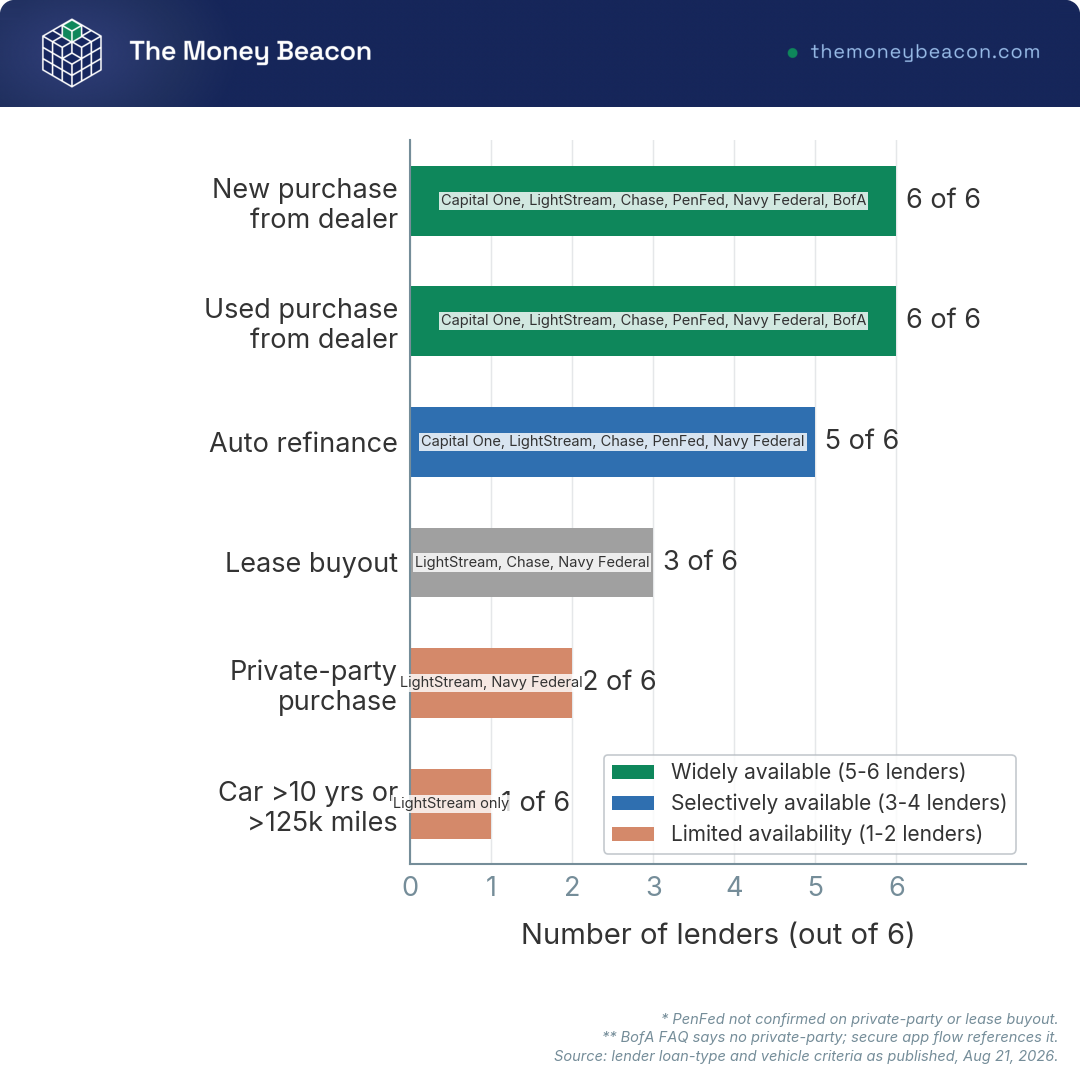
Count the lenders by what you’re actually buying. All six write a dealer purchase, new or used. Five write a refinance, since Bank of America has exited the product. Three write a lease buyout: LightStream, Chase and Navy Federal. Two write a private-party purchase: LightStream and Navy Federal. Only LightStream will take an old or high-mileage car with no conditions, and PenFed isn’t confirmed on either of the narrow products. And Bank of America’s private-party contradiction stays an open question.
Purchase type filters the lenders faster than any credit score does. Applying at a lender that was never going to write your loan spends an inquiry for nothing.
8.2 What each lender lets you borrow, and for how long
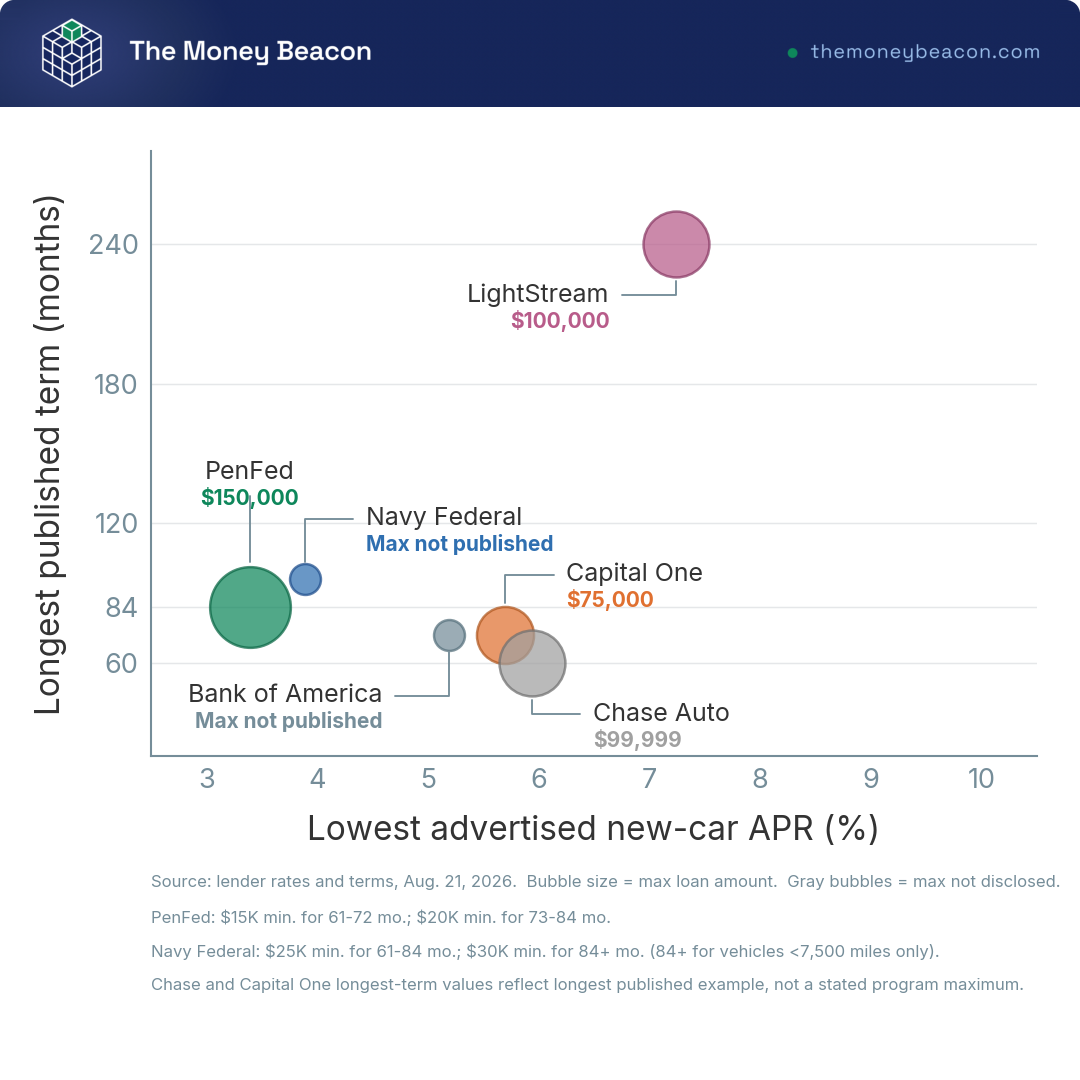
LightStream takes $5,000 to $100,000 over 24 to 240 months. PenFed goes to $150,000 over 36 to 84 months. Navy Federal writes 12 to 96 months with no published maximum. Bank of America starts at $7,500 financed ($8,000 in Minnesota), with 48, 60 or 72 months online. Capital One and Chase publish refinance bounds only. Purchase amounts and terms aren’t disclosed at either.
Both credit unions gate their long terms behind a minimum loan size, PenFed from $15,000 and Navy Federal from $25,000, and Navy Federal also caps mileage at 7,500 above 84 months. So an advertised 96 month term isn’t generally available. The auto loan loan to value limit is published at three lenders only, PenFed at 125% and LightStream and Navy Federal at 100%.
8.3 Fees and discounts side by side
Table: Fees and rate discounts across the six lenders
| Fee or discount | Capital One | LightStream | Bank of America | Chase Auto | PenFed | Navy Federal |
|---|---|---|---|---|---|---|
| Origination fee | None | None | None published | None published | None | None |
| Application fee | None | None | None | None | None | None |
| Loan documentation fee | None published | None | None | None published | None published | None published |
| Prepayment penalty | None | None | None | None | None | None |
| Late fee | Per contract, amount not published | None | Not published | Not published | $29.00 per payment | $29.00 per payment |
| Returned payment fee | Not published | None | Not published | Not published | $30.00 | None |
| State tax exception | None published | Florida doc stamp, .0035 x loan | Title and state fees may apply | None published | Lien placement at cost | None published |
| Rate discount | None published | 0.50% for AutoPay | 0.10% to 0.50% BofA Rewards | 0.25% with $150,000 balances | 0.80% via car buying service (new, 36 mo) | None published |
Data current as of August 2026.
Fees as published by each lender, August 21, 2026.
No auto loan origination fee anywhere, no application fee, no prepayment penalty. The whole price difference between these six is the APR and the conditions attached to reaching it.
Where the table reads “not published,” no dollar amount was found on the lender’s pages after escalation, so it’s an unknown rather than a proven absence. That covers the late and returned-payment fees at Bank of America, Chase and Capital One.
8.4 The rate discount you can actually earn
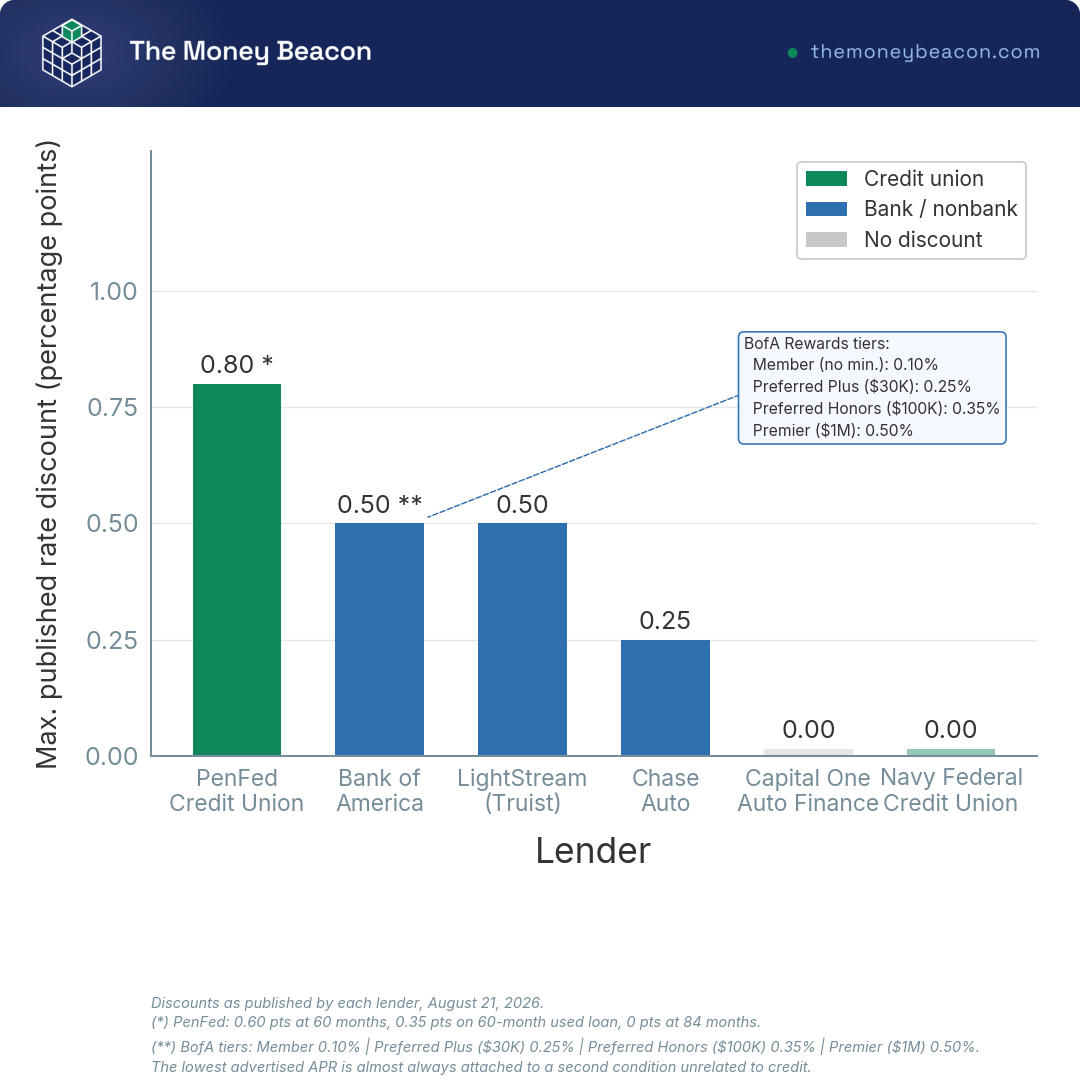
The pattern is uncomfortable for the banks. The two biggest discounts are PenFed’s 0.80 percentage points through its car buying service and LightStream’s 0.50% for AutoPay. Bank of America matches that 0.50% only at the Premier tier, which requires $1,000,000 in balances, and its realistic tiers are 0.10%, 0.25% and 0.35%. Chase takes off 0.25% at $150,000 in balances, and Capital One and Navy Federal publish no discount at all.
So the two biggest discounts cost a $5 credit union membership and an autopay discount auto loan checkbox. The bank versions require balances most readers will never hold.
8.5 The vehicle restrictions that disqualify your car before your credit does
Table: Vehicle restrictions by lender
| Restriction | Capital One | LightStream | Bank of America | Chase Auto | PenFed | Navy Federal |
|---|---|---|---|---|---|---|
| Max vehicle age | Model year within 10 years | None | Under 10 calendar years | 10 years, or 5 for certain makes | Not published | Not published |
| Max mileage | Under 120,000 | None | Under 125,000 | 120,000 | Under 125,000 | Under 7,500 for terms over 84 mo; no general cap published |
| Minimum vehicle value | Established resale value required | None | $6,000 | Not published | None published | None published |
| Excluded makes or types | Oldsmobile, Daewoo, Saab, Suzuki, Isuzu; RVs, boats, motorcycles on refinance | None | Not published | Exotic makes, commercial vehicles, motorcycles | Not published | Not published |
| Seller restriction | Network dealers only | Any seller | Dealers only | Chase network dealers only | Not confirmed for private party | Any seller |
Data current as of August 2026.
Vehicle criteria as published, August 21, 2026.
A 2014 model with 130,000 miles on the clock fails Capital One, Bank of America, Chase and PenFed on the mileage limit auto loan rule alone. It passes LightStream without conditions, and it’s untested at Navy Federal, which publishes no general cap.
LightStream imposes none of that, because there’s no lien to protect.
8.6 What a two-point markup costs on a $35,000 loan
The reference case: $35,000 financed over 60 months at a fixed rate, nothing else added in. PenFed’s car buying service at 3.84% costs $642.05 a month and $3,523 in interest. Navy Federal at 4.29% costs $649.17 and $3,950. Bank of America at 5.19% costs $663.54 and $4,813. And the 7.14% bank average costs $695.36 and $6,721.
Now add two points of dealer markup to that 5.19% approval. You sign at 7.19%, pay $696.18 a month and $6,771 in interest. So the markup costs $1,958 over five years while changing your payment by $32.64.
Regulation Z guarantees the APR gets disclosed, so you can compare at an identical term and check the total interest on a car loan before you sign.
Hank’s take
the behavioral-finance research is blunt about payment framing. Shrink a cost into a monthly number and people stop treating it as a cost. A desk that negotiates in dollars a month is using the one frame where four figures round to nothing.
8.7 Why stretching the term is charged twice
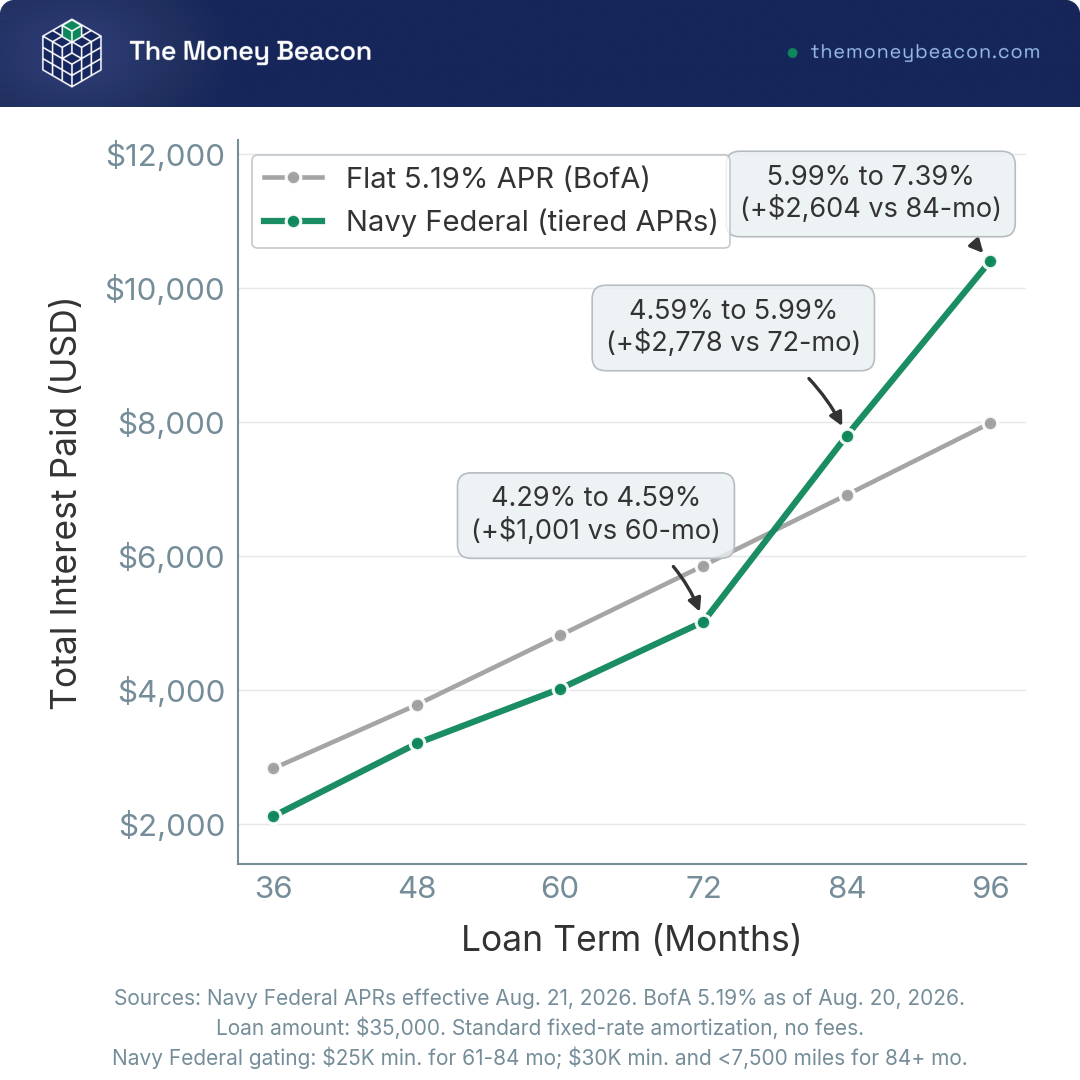
A longer term costs you twice: more months of interest, and a higher rate for the privilege. Navy Federal publishes the clearest example, pricing a new car at 4.29% over 37 to 60 months and 7.39% over 85 to 96. That’s a 3.10-point penalty before a single extra year of interest.
The chart splits the two effects. The flat-rate line measures only the extra months. The term-tiered line adds the rate penalty, and the widening difference between them is the half of the cost nobody quotes you.
A longer term also keeps you underwater longer. And a negative equity car loan can only be refinanced somewhere that lends above the car’s value. Of these six, only PenFed publishes a ceiling high enough to absorb it, at 125%.
8.8 The full comparison recap: eligibility, pre-qualification and funding
Table: Eligibility, pre-qualification, and funding path
| Criterion | Capital One | LightStream | Bank of America | Chase Auto | PenFed | Navy Federal |
|---|---|---|---|---|---|---|
| Minimum credit score | Not disclosed | Not disclosed (“good-to-excellent FICO”) | Not disclosed | Not disclosed | Not disclosed | No set score required |
| Minimum income or DTI | $1,500 per month | Sufficient for existing debt plus the loan; no figure | Not published | Not published | Not published | Not published on the auto pages |
| Age and residency | 18+; US | Individuals, personal use | 18+; US citizen or resident alien | Not published | Membership | Membership |
| Membership required | No | No | No | No | Yes, $5 savings account, open to all | Yes, military community only, $5 share deposit |
| Pre-qualification pull | Soft | Hard | Soft | Soft | Soft | Not stated |
| Offer validity | 30 days | Not applicable | 30-day rate lock | 30-day rate lock | 30 days to select, 30 more for documents | 90 days |
| Funds go to | Dealer | Borrower’s bank account | Dealer | Dealer or prior lienholder | Not published | Borrower, by check |
Data current as of August 2026.
Eligibility and process as published by each lender, August 21, 2026.
Five of the six auto loan credit score requirements read “Not disclosed,” each checked page by page before earning the label. Navy Federal is the exception, and only Capital One publishes an income test.
Two rows decide the order you apply in. LightStream’s pull is the only hard one, and Navy Federal’s is not stated rather than confirmed soft. Navy Federal is also the one that funds you by check, which is what makes a private sale work.
8.9 Verdict by borrower profile
Table: Best lender by borrower profile
| Borrower profile | First choice | Second choice | Why, and what to avoid |
|---|---|---|---|
| Excellent credit, civilian, franchise dealer | PenFed via the car buying service | Bank of America with a Rewards tier | 3.39% new against 5.19% before discounts; the trade is shopping through TrueCar |
| Military community | Navy Federal | PenFed car buying service | 3.89% new, 90-day check, spends anywhere; avoid the 85 to 96 month tier at 7.39% |
| Private party, lease buyout, or an unusual vehicle | Navy Federal, if eligible | LightStream | Only these two write a private-party purchase; only LightStream has no vehicle rules |
| Refinancing a marked-up or 2024-vintage loan | Navy Federal | PenFed | 3.89% against a 2024 loan near 9.50%; Chase needs 91 days of seasoning, Bank of America has exited |
| Fair or thin credit | PenFed or Navy Federal, if eligible | Capital One pre-qualification | Neither publishes a score floor; expect a rate near the ceiling, not the floor |
Data current as of August 2026.
Assignments derive from each lender’s published criteria, not from any third-party ranking.
Five profiles, five picks from the best car loan lenders. Notice how rarely the pick turns on your credit score, and how often it turns on eligibility and the car. LightStream is the exception in the other direction, and it’s not the right choice for anything a lien-based lender would finance happily.
All six advertise floors written for excellent credit, so this comparison doesn’t solve a rebuilding-credit application on its own.
One caveat for servicemembers: the Military Lending Act’s 36% cap excludes purchase-money vehicle loans secured by the vehicle under 32 CFR 232.3(f)(2)(ii), so don’t expect that ceiling to police a car loan.
8.10 Where to pre-qualify first
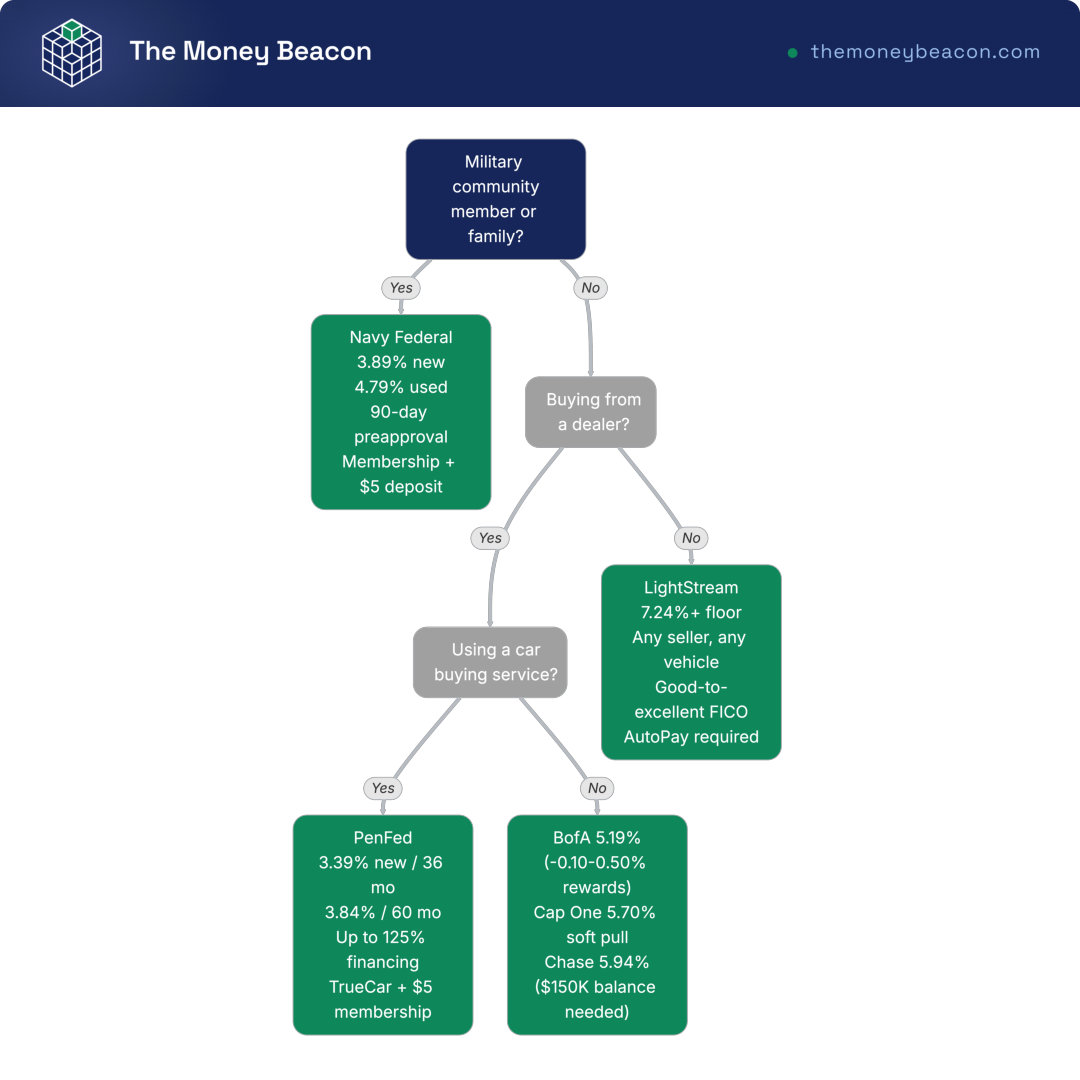
Read the tree as a plan for one afternoon. Eligibility and purchase type come before rate on purpose.
If you’re in the military community, start at Navy Federal. Buying from a private seller and not eligible for Navy Federal? Go to LightStream, the only other lender that clearly writes one. Willing to shop through a car buying service? PenFed membership costs $5. Holding six-figure balances at a bank? Bank of America or Chase, for the relationship discount. And for a plain dealer purchase, Bank of America or Capital One.
Then the sequencing rule that protects your score while you collect an auto loan pre-approval: group every formal application inside 14 days. And leave LightStream until last, because it’s the one that costs you a hard inquiry to price.
Conclusion
You started this article about to sign whatever the finance desk printed. Now you know that number is the buy rate plus whatever margin the dealer chose to add, quoted as a few dollars a month rather than the four figures it actually costs.
Six lenders and five borrower profiles later, the pick still depends on your credit, your eligibility, and the car you’re buying. One thing is true in every case: a pre-approval is what turns the finance desk from a quote into a price you can check. Without one, you’re negotiating against a number nobody will show you. The credit unions in this comparison price far enough below the banks that a $5 membership pays for itself in the first year.
If you already signed, the same math works in reverse: moving a $25,000 balance from 9.50% to 4.44% is worth about $2,816.
So here’s your afternoon: pick your first stop by eligibility and purchase type, pre-qualify with a soft pull, and keep every formal application inside 14 days.
If a car loan is one of several balances you’re carrying, our debt consolidation guide covers the order to pay them down. The same pre-approval discipline applies to a mortgage; see our comparison of current mortgage rates and lenders.
FAQ: credit scores, pre-qualification, and refinancing
What credit score do I need to get the lowest auto loan rate?
Five of the six won’t tell you. Bank of America, Chase, Capital One, LightStream and PenFed all decline to name a minimum. Capital One says only that “your credit score is just one factor used to determine eligibility for auto financing.” Navy Federal is the one lender that answers straight: no set score is required.
So use what they do publish. Every advertised as-low-as rate assumes excellent credit, and LightStream alone quantifies the odds: only 33.00% of approved applicants who applied for its lowest rate actually got it, measured April 1 to June 30, 2026. FICO calls 800 to 850 Exceptional and 740 to 799 Very Good. A score in the high 700s puts a credit union floor rate within reach, and below that, pre-qualifying beats guessing.
Does pre-qualifying with several lenders hurt my credit score?
Pre-qualifying doesn’t hurt it, because it’s a soft inquiry. Capital One, Bank of America, Chase and PenFed each state that pre-qualification has no effect on your score. Navy Federal publishes a 90-day preapproval but doesn’t state its inquiry type. LightStream is the real exception, since it offers no soft-pull option and its application pulls a hard inquiry from TransUnion or Equifax.
Formal applications are different, though the damage is small. FICO puts one extra inquiry at less than five points, and it counts multiple auto inquiries inside a single span as one, 14 days on older versions and 45 days on the newest. VantageScore 4.0 uses its own 14-day window, so group every application inside 14 days.
Are used car loan rates much higher than new car rates?
Less than most buyers expect, and it depends on the lender. Navy Federal advertises 3.89% new and 4.79% used at 12 to 36 months, and Capital One publishes 5.70% new and 6.49% used at 60 months. At the two big banks the difference nearly disappears: Bank of America charges 5.19% new and 5.39% used, and Chase 5.94% against 5.99%.
So the rate isn’t what makes a used car hard to finance. The vehicle rules are. Capital One, Bank of America and Chase all cap vehicle age at 10 years, and mileage caps of 120,000 to 125,000 miles apply at those three plus PenFed. Check your car against those limits before you spend an application.
Can I finance a private-party purchase or a lease buyout?
Yes, but the choice narrows fast. Only two of the six clearly write a private-party purchase, LightStream and Navy Federal, and three write a lease buyout, LightStream, Chase and Navy Federal. Chase states plainly that it “doesn’t offer financing for private party vehicle purchases.” Capital One excludes private sellers and lease buyouts both, and PenFed isn’t confirmed on either.
The two mechanisms differ. Navy Federal issues a preapproval check, good for 90 calendar days, that you hand to the seller, with the title due back within 90 days of the purchase. LightStream deposits the money into your own bank account instead, because its loan is unsecured, so there’s no lien and no title for a lender to hold.
When does refinancing an auto loan actually save money?
Three things have to be true at once. Your current APR is a couple of points above what you’d qualify for today, the car still passes the new lender’s age and mileage tests, and enough term remains for the saving to matter. On a $25,000 balance with 48 months left, moving from 9.50% to 4.44% takes the payment from $628.08 to $569.41, so you keep $58.67 a month and about $2,816 in interest.
It doesn’t work on a loan that’s nearly paid off, since most of the interest is charged early. It doesn’t work when you owe more than the car is worth either, because most lenders stop at 100% of value and only PenFed goes to 125%. And a refinance that just extends the term lowers your payment while raising the total, the same trap our comparison of mortgage refinance lenders flags on a home loan. Chase also wants your current loan to be at least 91 days old, and PenFed won’t refinance one of its own.
Can I deduct my car loan interest on my taxes?
Only on a narrow set of loans. The One Big Beautiful Bill Act created a deduction of up to $10,000 of car loan interest a year, for tax years 2025 through 2028. The vehicle has to be new, personal use, and assembled in the United States, and the loan incurred after December 31, 2024. Used cars, leases and any loan from 2024 or earlier never qualify. The deduction shrinks by $200 for every $1,000 of modified adjusted gross income above $100,000 single or $200,000 joint, and it’s gone at $150,000 and $250,000.
You don’t have to itemize to claim it. But don’t let it change how much you borrow. First-year interest on a $35,000 loan at 5.19% is about $1,670, nowhere near the cap, so the deduction is real but too small to justify a bigger loan. For deductions that move a tax bill further, our guide to reducing your taxable income covers the accounts worth funding first.



Comments
Questions and corrections welcome. We read everything.